


 Little Russian Philokalia: St. Seraphim of Sarov by Seraphim Rose
My rating: 3 of 5 stars
I’m still enough of an evangelical that hagiography strikes me as foreign. I don’t know what to make of it, this idea that holiness can come out from the introspective realm of spiritual instruction to impinge on historical figures and alleged historical events. Which is perhaps why this first volume of the Little Russian Philokalia, the writings of St. Seraphim, seemed progressively stranger as I read through it.
St. Seraphim lived from the middle of the eighteenth century to the early nineteenth, during which time he became one of the best-known mystics of the Russian Orthodox Church. He lived as a monk and ascetic in the Sarov Monastery in eastern Russia (a city known today as being the center of the Russian nuclear industry). This volume collects the saint’s “Spiritual Instructions” and “Acquisition of the Holy Spirit” as well as an account of the rediscovery and return of his relics.
I found the first portion of the book, the “Spiritual Instructions,” the most accessible. They provided, as I had hoped, some challenging and focusing readings for Lent. Similar to The Practice of the Presence of God, The Imitation of Christ, or other classic works of Christian instruction, these are the sorts of words it seems necessary to always have on tap as a Christian reader. The concise, clear, sharp challenges that, if maybe I let them wash against me constantly like a stream against stone, might actually do some good. How to be silent. How to be generous. How to cultivate a true love of God and others. St. Seraphim’s instructions were also useful because they could provide an avenue into the writings of other Orthodox fathers, as he intersperses them with the words of older saints as well as scripture.
In the second portion of the book I was on less familiar ground, taking the first steps into the thick, alien forest of Russian hagiography. This portion, the “Acquisition of the Holy Spirit,” is a conversation purported to have taken place between the saint and one of his disciples, recorded and only found years later in the days leading up to St. Seraphim’s canonization. Here my cynicism begins to raise its head a bit as the author of the spiritual instructions becomes move into the historical narrative. Because historical figures are always notoriously human, and when they’re not, when they’re portrayed as somehow otherworldly beings, I don’t quite know what to make of it. Several hundred years ago is one thing; the 1830s is something else.
Finally, the volume concludes with (again, to my post-evangelical, Western sensibilities) the strangest and yet most compelling portion of the story. Strange in the sense that here we’re fully in the realm of hagiography, with a dash of apocalyptic prophecy thrown in for good measure. Compelling in the glimpse it provides into the sudden and tragic destruction of the religious heritage of Orthodox Russia during the Bolshevik Revolution and its slow and fitful rebirth in the closing decades of the twentieth century. St. Seraphim’s relics are recovered and returned to Sarov, where a church is rebuilt to receive him. Pilgrims flock to the procession. Miracles ensue. What to make of it all?
The paradox is that sanctity, the idea that holiness can truly intrude into the world in very real and tangible circumstances, remains for me one of the most viable arguments for the pursuit of the Christian life. And the first portion of this book illustrates to me the appeal: that a life pursued in humility, love, and devotion is possible. Yet if there are people who truly embody this, as St. Seraphim was reported to, why is it so hard to accept that the results that follow might be the sort of miracles and happenings outlined in the third part? We want our saints at a safe distance, their words coming down to us through the filter of the centuries. It’s harder to deal with them otherwise.

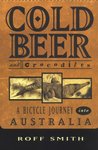 Cold Beer and Crocodiles: A Bicycle Journey into Australia by Roff Smith
My rating: 3 of 5 stars
I first met Roff Smith in Northwestern Australia, as he was in the middle of his bike trip around the continent. Not in person, of course. I read one of his National Geographic articles among some back issues shelved at my folks’ house. But I recently finished Bryson’s In a Sunburned Country, and Bryson was right: this was an incredible place that I needed to learn more about. I recalled Smith’s articles and wondered if they were collected into a book. A bit of searching, an interlibrary loan, and I was off.
Roff’s book documents his 10,000-mile biking odyssey around the perimeter of Australia. Departing from Sydney, he travels north up the coast and proceeds to bike across every Australian state (and one territory), including Tasmania. Smith’s prose is that of a reporter, documenting his travels and the places through which he passes. His account primarily focuses on the people though– from ranchers to campers to Catholic missionaries. He sees the land on a level that makes Bryson’s account seem penned by a funny fat man breezing through the country in a car. But Bryson is the better writer, and Smith (perhaps because he’s pedaling the better part of 100 miles each day) doesn’t spend the time going into the natural history and accounts of past explorers that make Bryson’s work such fascinating read. If you want an eye-level account of the aching emptiness of much of Western Australia though, as well as snapshots into the life of those who make such out-of-the-way places home, Smith’s account is a good place to start.
My only complaint (besides the terrible puns he uses as chapter headings) is that because the account we get of the landscape is tied to this single bicycle expedition, by the time he’s reached Southern Australia he’s tired and sick and pushing for home. I would have liked to have spent more time here. Also, there’s a laconic nature to the descriptions. There are lots of spots on his maps he breezes through, and the only picture we get of them is what he ate, drank, and the room he slept in. After nine months and 10,000 miles, I would liked to have read more.
Still though, I came away from this book with lots of other leads of classical accounts of travel in the Outback to check out, but the main thing I took away?
I need to get a bicycle like that.
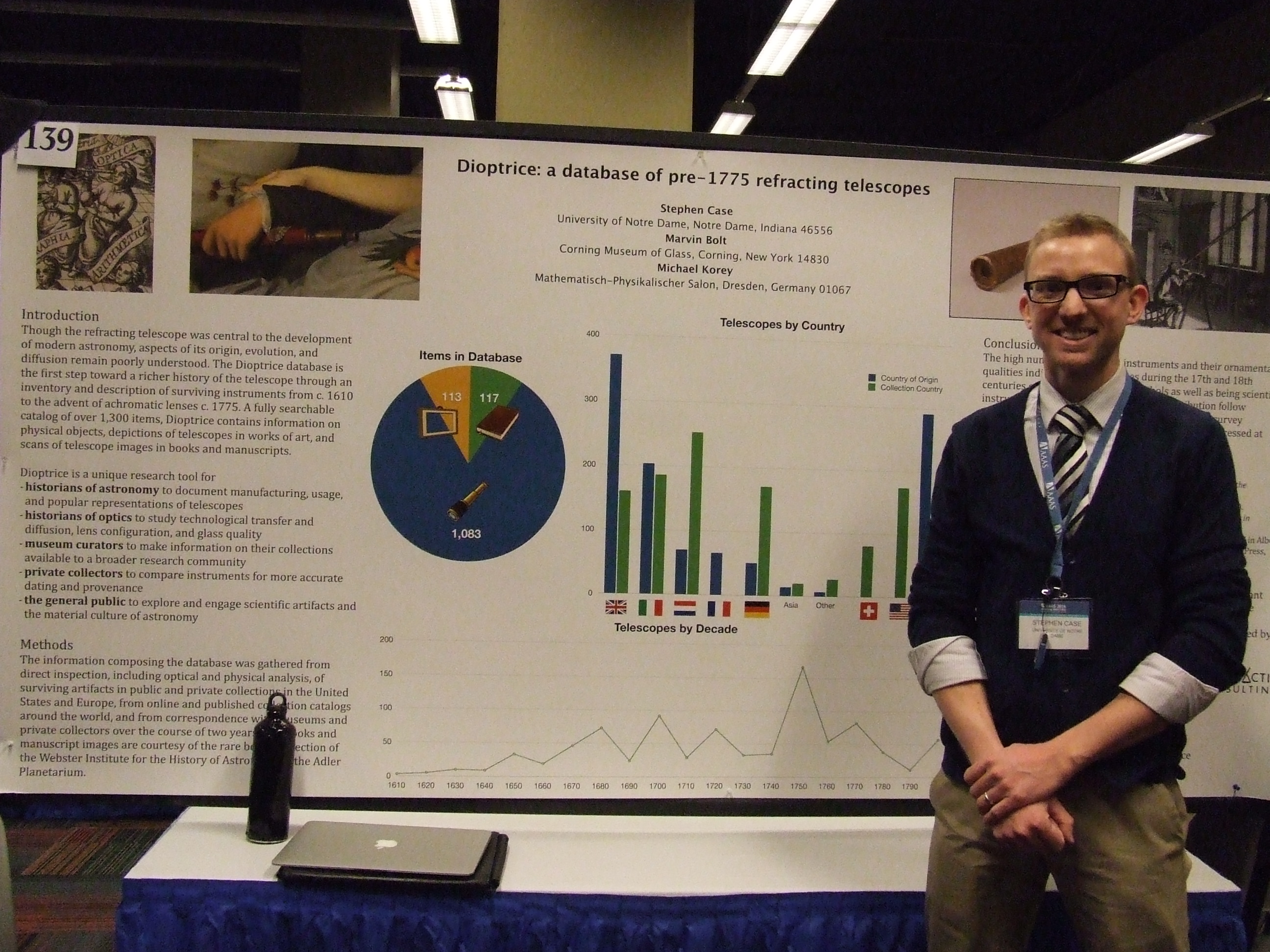
And this is me with my best (and unfortunately completely unintentional) mad scientist face. I presented a poster on the Dioptrice project, a database of pre-1775 refracting telescopes that I’ve been working on as a research assistant for the past few years at the Adler Planetarium as part of my graduate program in the history and philosophy of science at Notre Dame. I didn’t win the student poster presentation, but I did garner some good publicity.
A writer for ScienceNOW, the online publication of the AAAS, picked up the story and wrote up a summary of the Dioptrice project you can view here.
I got a call a few days later from another writer, this time for the science news site motherboard.tv, who wanted to do a piece on the project. His story is here.

Essays from the Edinburgh and Quarterly Reviews by John F.W. Herschel
My rating: 3 of 5 stars
Historians of Victorian science often speak about a common intellectual context that fragmented in the latter half of the nineteenth century. The growth of scientific disciplines, the specialization of fields, and the proliferation of specialized journals made it difficult to stay abreast of all developments in science or maintain a synthetic view of the entire field. What’s more, as science became professionalized, science writing moved to periodicals and publications written specifically for scientists. There arose a divide between science and popular writings or cultural criticism that largely remains to this day.
The Edinburgh and Quarterly Reviews represented what popular, high-brow literature looked like before these changes took place. In their glory days at the beginning of the nineteenth century, the Reviews were a place to discuss politics and culture– including science. This collection of essays and poems by John Herschel illustrates the place that science held in popular culture. Though largely forgotten today, Herschel was arguably the leading popular figure in science in the generation before Einstein. In these essays he discusses everything from Laplace’s celestial mechanics to Whewell’s philosophy of science to Quetelet’s statistics. What’s fascinating is the detailed (though largely non-mathematical) treatment he goes into for a “popular” audience. These essays, important for historians of Victorian society in general and astronomy in particular, are recommended reading (or, more likely, skimming) for anyone who is interested in the sort of treatment science was given in the Victorian period for the general, educated reader.
 The Place of the Lion by Charles Williams
My rating: 3 of 5 stars
Williams is an author in whose work the plot itself (at times obscure and even tedious) is second to the style in which it is written, which is in turn second to the ideas he wants to communicate. It’s the ideas that are rich. This is appropriate for a book about Platonic ideals breaking into the physical world. I read Williams for the first time years ago, after a return from Oxford and the realization that there was an Inkling of whom I had never heard. If you’ve read Lewis’s THAT HIDEOUS STRENGTH, you’ve some idea of what to expect. Philosophical fantasy in 1930s England. Returning to Williams now, after having some proper grounding in philosophical studies, I’m enjoying him much more. He is admittedly more dense and verbose than a Lewis or Tolkien. I still found myself rolling my eyes a bit as the novel reached its conclusion. But throughout there is also that bright strangeness one finds in the other Inklings, Gene Wolfe, sometimes in Borges, more boisterously in Chesterton, and more hilariously in Lafferty– the idea that the world is a terrifyingly good place. That is a world these writers live in, and they believe it to be the true world. I’d like to believe it too– or at least, act and write as though it were.
 Stephen Reid Case