


I’m left-handed. My father was left-handed. I have four kids (two of whom are twins), and none of them are left-handed.
I’m a little disappointed.
Being left-handed, I am also slightly ambidextrous almost by default. I have on occasion kept myself occupied during particularly long presentations or lectures by attempting to take notes in my right hand. This often devolves into mirror-writing, where I write a word backward with my right hand while writing it forward with my left.
Then sometimes I just get distracted by how words look backward. There’s something fascinating about seeing a familiar word reversed.
This is what was happening when the germ for this story, “Read this quickly, for you will only have a moment . . .,” was planted. It was my second sale to Beneath Ceaseless Skies, back in November of 2011, and the first (and so far only) of my stories that has been made into a podcast.
It’s about words and names. It’s also about a woman who can kill with them, a castle drenched in rain and silence, crows, and a love letter.
You can read it (quickly) here.

 The Idea of a Christian College: A Reexamination for Today’s University by Todd C. Ream
My rating: 2 of 5 stars
This book was not what I wanted it to be. That may be my own fault. When I read an interview with the authors, I was immediately interested. As someone who graduated from a Christian university, did graduate work at another Christian university, and will soon resume teaching at my alma mater, I believe an articulation of the idea and ideals of what is distinct about Christian higher education is much needed. From my experience, many students, many faculty, and even many (most?) administrators don’t have a cogent or cohesive understanding of what Christian education means. I made the assumption that this book would be written to academics to fill this need.
What it was instead was a freshman connections textbook. Maybe that’s okay. Many Christian colleges (mine included) have an “Intro to College” course that freshman take their first semester with a goal of introducing them to the philosophy and history of higher education in general and their own institution in particular. This book seems pretty clearly to have been written for such a course. Ream and Glanzer use scripture, history, and the words of scholars both historical and contemporary to argue that Christian education is unique in its (ideally) holistic approach with the goal of forming complete individuals who love God and love learning. This is, they claim, in contradistinction to secular universities in which learning has no true goal or telos beyond career preparation or the propagation of particular academic disciplines. They argue that against the fragmentation and individualistic ethos of the modern university, the Christian university has a distinct and separate mission with the classical understanding that all knowledge must hold together and find its completion in knowledge of God. They also briefly introduce students to the work of Christian scholars like Noll, Polkinghorne, and Hauerwas.
There wasn’t much I disagreed with in this book. Ream and Glanzer are consciously building on the work of Arthur Holmes, who is quoted throughout. I have not yet read Holmes’s 1987 study, but according to the authors that work focused on a Christian college in the traditional liberal arts sense: a place where knowledge is passed along but not where new knowledge is necessarily created. Because of the rise of Christian research universities in recent years, the authors believe it is time for Christian institutions to give more mind to the creation of knowledge and the conduct of research in a Christian context. Here they seem to be following the likes of Marsden and Noll in arguing for an evangelical life of the mind and love of learning. (Note: though the language is inclusive and we’re treated to a summary of the rise of medieval universities in a Catholic setting, the book is definitely written from an evangelical perspective.)
My major complaint with the book was its delivery. I had hoped it would be a good book for a faculty discussion group to provide an avenue into some of the key topics Ream and Glanzer emphasize: in particular, the challenge of holistic education in the face of pressures toward technical or vocational training. I quickly realized academics were not the intended audience. With the “college life” vignettes beginning each chapter and the concluding discussion questions, this is a freshman college text. A good one, maybe. I’d have to try it out with a class to be sure. But a challenging and insightful text for college faculty and administrators? Not so much.

My rating: 3 of 5 stars
Sometimes I think a good author simply comes up with an incredible situation and then writes to see how the characters respond to it, what they do, how they eventually get out of it. In this case the situation is a lifeboat in the middle of the Pacific with a tiger aboard. Pi is the only human survivor of a sunken ship, which was carrying his family and a small menagerie to a new life in Canada. After the accident he finds himself on the ship with the tiger, a hyena, a zebra, and an orangutan– and very soon with only a tiger.
So much you can learn from the back cover. What the back cover (at least the back cover of my edition) doesn’t mention is the twist at the end that casts the entire story into a new, more sinister light. It’s a twist worthy of a Gene Wolfe novel, the hook that makes you flip back through the pages, wondering how much of what you read you really understood, whether you are even now interpreting the signs correctly. Without that twist, it would have been an interesting and compelling novel. It would have been beautiful even. But it would not have been haunting. You would not wake up in the middle of the night thinking about the novel, uneasily considering the stories Pi told.
The novel is broken up into three main sections. The first talks about Pi’s life growing up in India. This portion of the story is told as though the author is interviewing Pi years after his ordeal, though at this point we’re still not sure what that ordeal is. Only that it is a story that will “make us believe in God.” Pi certainly believes in God. His enthusiasm for God leads him to actively pursue and practice three faiths, that of Christianity, Islam, and his native Hinduism, much to his parents’ perplexity. We also learn a lot about zoo-keeping here, as this is where Pi grows up, the son of a zookeeper in Pondicherry. Martel gives us lots to think about regarding our relationship with animals and the subtle, complex, and nuanced universe that is a zoo.
The second and longer portion of the work is Pi’s story about what happened in the lifeboat, how him and the tiger (named Richard Parker) survived their several-month ordeal. We already know the story is going to have a happy ending. (Remember, Martel is telling this as though getting it all from Pi himself, now married and with children and living in Toronto.) Our universe telescope’s down to Pi’s lifeboat, the day-to-day details of surviving at sea and living in close proximity to a Bengal tiger who is always hungry. This is where all the background regarding animals and zoo-keeping comes in handy. The book fits together well in that respect.
It doesn’t fit together as well regarding all the background we got about Pi’s religious faith in the first section of the story. The zoo-keeping stuff blended with survival at sea with the tiger. I kept waiting for Pi’s faith to likewise come into play in some deep existential way during his time on the ocean, but it never happened. Pi was simply there, with God, surviving. No epiphanies or visitations. No deep meaning welling up from his ecumenical perspectives on Vishnu, Jesus, and Muhammed. That’s fine, I just felt the first portion of the book was setting us up for something along those lines.
The third and by far shortest portion of the book was Pi’s interview with two Japanese officials who came to find out what he could tell them regarding the shipping accident. This is where the book twisted, where it showed a hidden depth I had not expected. Up until this point it was an enjoyable, imaginative novel with great description, a clever situation, and splashes of lovely surreality (because the Pacific, after all, is a huge and fairly unknown place to be drifting across). But the details of the story Pi tells are too fantastic, too unbelievable to these polite Japanese officials. Pi says some things about faith, about what we chose to believe.
And then he tells another story.
Perhaps this is the point of the book, the crux of the story that “will make us believe in God.” Because– and I don’t want to give too much away here– there are multiple ways to understand what actually happened to Pi while he was at sea. Pi asks the Japanese officials which story they think is better, which one they choose to believe. Pi knows what happened though, while his hearers have to make a decision. I’m not sure the analogy is perfect here, but in some sense this is us with life. We know what happened. We see (at least pieces of) the complex system of cause and effect we’re snarled within. Crazy, random, maddening, and sickening things happen. But we have to decide what story to believe– a story of chaos and meaninglessness or a story of significance.
This is a story that will make you believe in God, he said. I’m not sure it did. Maybe Martel is just telling us an excellent story about a boy and a tiger (and an ocean and a cannibalistic castaway and a carnivorous island and a tiny zoo in India). But maybe he’s also telling us a story about how life works and how we choose which stories to believe.


This was my second honest-to-goodness-physical-magazine sale, again semi-pro and this time in an overseas market. Andromeda Spaceways Inflight Magazine is (from what I understand) a leading science fiction magazine in Australia. It is certainly a quality rag that, like Shimmer, takes seriously putting together a professional publication with lovely covers and illustrations, thick and perfect-bound.
They’re also great because they published a review of my anthology, of which more anon. (I have a secret desire to become a huge hit in the Australian speculative fiction world so I have an excuse to travel there and sign books and explore. My Australian career hasn’t quite taken off yet.)
“The Story of the Ship that Brought Us Here” was published in issue 51 of Andromeda Spaceways, back in June of 2011. (You can still purchase the issue here.) It was my first story that featured an illustration, which meant that an artist actually had to read it and then depict what my brain was imaging when I wrote words. That is sort of fascinating for me. I think the artist did a pretty good job, even though I imagined the Princess with fewer tendrils.
Science fantasy is a sub genre in which technology is so far developed that it seems like magic and in which authors spend more time playing with the effects (often largely aesthetic) of such technologies than puzzling out how they might actually work or their implications. That’s what I do in “The Story of the Ship,” which is basically a fairy tale set in space. There’s a hero and a Princess and a planetary intelligence and a three-bodied prince and gem-encrusted ribbonships.
You should buy the magazine and read it.

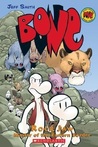 Bone, Vol. 5: Rock Jaw, Master of the Eastern Border by Jeff Smith
My rating: 4 of 5 stars
It’s very hard not to like BONE. When people want to know a good place to start as far as graphic novels go, this is always near the top of my list. Especially if the person who is asking has kids or is a kid. Because besides being heart-warming, adorable, compelling, humorous, and well-drawn, BONE is also pretty wholesome. Imagine Mickey Mouse, Goofy, and Donald (or rather, Uncle Scrooge) stumbling upon an enchanted valley where they get mixed up with dragons, rat-creatures, a princess, prophecy, etc., etc. And to add to that level of surreality, throw in some lovable Bambi-esque woodland creatures. Our heroes fighting alongside, for example, some orphaned turtles, raccoons, talking bugs, and possum kids. Yet the drawing and the story-telling make this Disney-meets-Lord of the Rings schtick work. And work as more than schtick. This isn’t simply a fantasy epic drawn through the medium of a cartoon. It’s cartoon characters– with all the slapstick and mayhem that entails– actually entering into a fantasy epic as characters (and of some depth) in their own right.
I’ve read BONE up through Volume 8, though it was a while ago. Our kids have gotten into them now, so I’ve had the chance to re-read them again up to Volume 5, and I’ll take completion of this volume as a chance to review the entire series so far. The Bone cousins– Fone Bone, Phoney Bone, and Smiley Bone (the loosely Mickey, Uncle Scrooge, and Goofy analogues)– were chased out of Boneville after one of Phoney’s schemes to get rich backfired, and at the beginning of Vol. 1 they find themselves in a strange valley and thrust into the center of a conflict that involves everything from a lost kingdom to cow races to an invasion of an army of rat-creatures. Epic really is a fitting description of what Smith does with these volumes. It takes a few volumes of the story to even get a complete picture of the conflict the Bones have found themselves in.
It’s whimsical without being flippant. Smith’s artwork runs the gamut from suitably cartoonish (the minimalist Bone cousins are in some respects ‘toons boiled down to their essential properties) to subtle (as in some of Fone’s dream sequences or the sweeping panoramas of the valley we’re occasionally treated to). Originally black and white, the volumes have been colored, and having never read the black and white versions I can’t imagine them without it. The colors are vivid and bring an additional depth and drama to the artwork.
Smith’s work is somehow, absurdly, a nod to both cartoons along the lines of Ducktales at its best and your standard sword-and-sorcery epics. And perhaps even more absurdly, it works incredibly well. Every character– including Phoney– is likable. The story continues to build in complexity and raise the stakes but in a well-paced manner without throwing out a huge web of characters or inscrutable backstory. By volume 5 we learn that the girl Fone has fallen for is the lost heir of a kingdom, that a Sauron-like power has return to threaten peace in the valley, and that Phoney’s money-making schemes coupled with the townsfolk’s gullibility spell trouble. And that Smiley has adopted a rat-creature cub. Where it will go from here is anyone’s guess, but one thing is certain: Smith proves that there’s nothing at all flat about two-dimensional characters.

 Stephen Reid Case