Category Archives: Reviews

The Girls of Slender Means

The Girls of Slender MeansThe Girls of Slender Means by Muriel Spark

My rating: 3 of 5 stars

The Girls of Slender Means is straightforward and understated, but it’s a story built around a central riddle. The background to the riddle is a single summer in London at the conclusion of the Second World War in and around the May of Teck Club, a sort of group home for poor, young working-class women. (As Spark explains, everyone in England is poor during this period, even those who aren’t). A cross between a boarding school and an apartment complex, the girls go about their lives in a strange twilight between the bombed-out landscape of London on one hand and the growing certainty of peace on the other. This transitional period in time goes along with the transitional nature of the May of Teck inhabitants: besides the few seasoned spinsters, for the rest of the women it is an in-between place, in between girlhood and adulthood and halfway to a job or a career or a husband. No one will remain there for long. They’re all on their way to other places, eventually– a point emphasized by the fact that the narrative of this single summer is interspersed with snippets of telephone conversations as the grown women mull over the puzzle of those days and their outcome.

There are two threads woven against this background throughout the novel. The first is the mystery, more on which in a moment. The second is poetry. Joanna, one of the boarders at the May of Teck and the only daughter of a country parson, gives lessons in elocution, and the snatches of poetry overheard from the upper levels of the large house provides a constant baseline for the day to day activities taking place therein. Poetry haunts the story, sometimes foreshadowing but always giving an underscore to the wistful atmosphere Spark creates.

The second thread is the riddle of Nicholas, an aimless writer and half-hearted anarchist who wanders into the orbit of the May of Teck over the course of the summer. Within the first few pages of the novel, from the sketchy phone conversations Spark drops us into, we learn that whatever else has happened to Nicholas he at some point since this summer has become a Jesuit priest and was been recently martyred in Haiti. The news of Nicholas’s death spurs Jane, one of the inhabitants of the May of Teck that summer who was then an aspiring writer and is now a successful new columnist, to reflect on the events that led to his conversion. And a conversion of some sort it must have been, for he is not especially devout at the beginning of that summer of 1945 when his primary interest in the May of Teck Club seems to be trying to get Selina, one of the Club’s inhabitants, to sleep with him on the roof.

I’m reminded of Gene Wolfe’s short story “Suzanne Delage” in which the only remarkable thing about the story is that nothing at all remarkable appears to have happened even though something remarkable is implied. This novel has the same feel in that we know Nicholas’s eventual fate, but we see only hints of what may have compelled him toward it. Nicholas enters the novel as one drifting through life, wasting his time and perhaps his talents (though he has a book manuscript he is trying to get Jane’s publisher to publish), fascinated by the poverty and the communal life of the girls in the May of Teck Club (as well as the girls themselves). Besides the meandering philosophical conversations he has with particular members of the Club– with Joanna’s poetry constantly drifting down from above– we get only a single glimpse of a spiritual crisis in the sudden and unexpected catastrophe that concludes the novel. The entire explanation of Nicholas’s spiritual trajectory, which is the admitted impetus of recalling the events of this particular summer, remain obscure and out of the picture.

It is a novel lending itself to many interpretations, and we’re left with Jane to make of it what we may. One possible interpretation is that Nicholas is drawn to the Edenic aspects of the Club– their shared innocence of poverty and youth– and that he is driven to a spiritual crisis when the snake in the garden is ultimately revealed in the pettiness and selfishness of the Club’s final moments, contrasted with an example of faith and pointless sacrifice. His reaction here, and his telling realization that “No place is safe,” are perhaps all the answer we get to his ultimate fate.

The book is as slender and wistful as the girls who figure within it. And as mysterious. In the end, there are no clear answers. Nicholas is dead, and Jane is casting her memories back to that single summer in which their lives intersected. The War is over, and against that background of tragedy and celebration one man makes a quiet and secret decision to change the course of his life. We’re on the outside, trying to make sense of it, which is what makes the book so powerful: this is almost always our own perspective, trying to piece together the clues that might tell us something about the hearts of those around us.

The Heart of the Matter

The Heart of the MatterThe Heart of the Matter by Graham Greene

My rating: 2 of 5 stars

Greene is interested in the paradoxes that arise from pushing Catholic doctrines or dogma to their extreme logical conclusions. The epigram at the start of the book is a quote from the Catholic author Charles Peguy, who wrote of the selflessness we should have that would damn ourselves if it would save another. This is the apparent motivation of Scobie, the novel’s protagonist. He lives and works in World War II British West Africa, finding satisfaction in a go-nowhere police posting in a desolate port town beautiful for approximately five minutes each day. His wife is as drained and worn down as the town itself. Greene expertly shows the painful pity that motivates Scobie– who simply wants peace– in placating her and keeping her despair at bay. The everyday agony of their relationship, the weariness, the stratagems Scobie undertakes to distract and comfort her, is the driving force of the first third of the novel. Greene’s strength here is in the characters: the pained goodness and heavy generosity of Scobie, the faithfulness of his African servant, the machinations of the Syrian merchants of the town– all live (except for the enigmatic Wilson, who seems flat and patchy throughout the novel) against a sharply drawn background of the cloying West Africa Greene knew from personal experience.

In the novel’s second act, Scobie has found the peace he craved by making possible his wife’s passage to South Africa and settling into his own quiet routine. This peace is shattered by war though (a war which, even at its closest approach, remains a forbidding but distant presence over the horizon) as the survivors of a U-boat attack arrive in Scobie’s world. Here his pity (or what he represents to himself as pity) is captured by a young widow. Their quiet affair– whatever else it may have represented– quickly becomes once again a trap and loss of peace for Scobie, compounded by his wife’s sudden return. Greene has now set the scene for the excruciation of the third act, where the narrative action slows and spirals inward to a claustrophobic focus on the conflict warring within Scobie’s own mind.

Whatever Greene’s eventual and ultimate relation to Catholicism, this is unequivocally one of his Catholic novels, in which the conflict depends on the reader buying into– or at least buying into the character’s buying into– the reality of Catholic belief. Scobie believes he is in mortal sin but knows leaving it would mean abandoning someone who depends on him. He’s like the proverbial donkey starving halfway between two piles of hay, crucified on the horns of a dilemma. Whether divided by hunger, pride, or (as he makes himself believe) duty and pity, he can only conclude that both– that everyone– would be better off without him, who seems only able to cause pain despite his every attempt to avoid inflicting it. By this point of the novel, it’s difficult to have patience with Scobie as a character, yet we never lose faith with Greene as an author. Indeed, the telescoping conflict, in which aspects such as Scobie taking communion in a state of sin take on a heightened, almost delirious and certainly cinematic vividness, give the novel its sharpest moments.

The novel reaches the inescapable conclusion you see coming, but it feels all the more powerful for its inescapability. Scobie is trapped in his own mind, hedged by his own dogma, damned– in the paradox Greene relishes representing– by his own generosity. Greene provides no answers. He leaves us with only questions, which is what prevents the novel collapsing into a simple cautionary morality tale. Whatever Scobie’s motives (because it remains difficult to believe pity alone motivates the affair with the much-younger Helen), he is relatable and vivid in as much as anyone has felt trapped between irreconcilable conclusions, alone and cut off in the web of their beliefs. Whether he’s ultimately damned, he’s lost the peace he craved. In the construction of his isolation and misery– which Greene offers in magnificent detail– we get an illustration of how C. S. Lewis described hell: not as a place you go but as a place you gradually construct around yourself.

Awkwardness

AwkwardnessAwkwardness by Adam Kotsko

My rating: 4 of 5 stars

I should write a truly awkward review of this book. It would start, perhaps, with stories about my best friend in high school dating the author’s sister. But it would be largely irrelevant, except perhaps to illustrate the point Kotsko makes at the beginning of this text: we live in an age of awkwardness. It’s become a recognizable and indeed ubiquitous social symptom. Our generation seems to find itself almost daily in social situations in which we don’t know the appropriate roles or cues to follow. We live awkwardly, sometimes painfully so. Paradoxically though, this very fact is celebrated in popular media– or at least, used as the centerpiece for the forms of television comedy the analysis of which make up the backbone of Kotsko’s cultural exploration.

Kotsko begins his short, cogent, and ultimately encouraging examination of awkwardness with a brief philosophical reflection on awkwardness and a historical survey aimed at explaining its origins. Philosophically, Kotsko represents awkwardness in terms of Heidegger’s insight that relationship is fundamental to our existence. Kotsko argues awkwardness should be understood as a breakdown in social norms, analogous in human relationships to the breakdown in norms Heidegger analyzed related to boredom and death. Historically, Kotsko finds the origins of our awkward age in the cultural revolutions of the 1960s. Briefly, the argument is that though these social upheavals did away with many of the constrictive social norms governing relationships (whether between classes, genders, or races), they did nothing to replace them. People learned the importance of cultural sensitivity and the dangers of political incorrectness, but rather than liberation the result was fear of offending by saying the wrong thing. By our generation, people quite simply don’t know how to response appropriately to many social situations. In the 1990s, the cultural recourse was retreat into irony– simply saying thing that weren’t meant– which leads us to Seinfeld.

The thing that makes Kotsko’s cultural examination so compelling is that it is a lens to understand television shows and films we’ve all seen in a broader social context (or, alternatively, using these shows to understand that broader context). This analysis of television comedy is the meat of his work. Kotsko proposes to examined three forms of awkwardness using three popular television or movie examples. The first of these is “everyday awkwardness,” the awkwardness of the workplace, exemplified in The Office. Kotsko here contrasts the American version with the British to argue that everyday awkwardness is not, as often perceived, simply the presence of inherently awkward people. This is the premise of the American version, where Dwight and Michael are “intrinsically” awkward, whereas Pam and Jim are completely normal. The genius of the British version, Kotsko argues, is that it illustrates that awkwardness is something created by the work environment itself. In this analysis, Ricky Gervais’s character in the British version is the creation of this white-collar environment in which roles, responsibility, and motivations are unclear, not an aberration.

The second form of awkwardness Kotsko explores is “cultural awkwardness.” Whereas everyday awkwardness arises from a work environment that cannot provide a stable social order, cultural awkwardness comes from cultural establishments themselves that fail to do so, particularly the idea of marriage and family. The lens he choses here are the films of Judd Apatow. Apatow movies such as The 40-Year-Old Virgin and Knocked Up focus on the awkward transition from an extended adolescence or stunted adulthood into the (perceived) healthy, actualized maturity of a committed relationship. What these films illustrate though is that even this pillar of American values has become an awkward transition– one so difficult, Apatow seems to suggest, it can only be successfully navigated by the equally awkward male bonding or “bromance” functioning as a release valve to compensate for this difficulty.

Finally, Kotsko examines the work of Larry David in Curb Your Enthusiasm as an example of what he refers to as “radical awkwardness,” the awkwardness that arises when social norms break down entirely, primarily through interactions between different social groups or classes with overlapping or contradictory social norms. Larry is a Jewish man from New York interacting with successful Hollywood stars, and much of the awkward comedy from this show, Kotsko relates, comes from Larry trying and failing to integrate into these social structures. This is also where Kotsko makes his most audacious claim about awkwardness: that it can help us understand St. Paul’s instructions to the Romans regarding the law and the relationship between Jews and Gentiles living in community in the early Christian church.

Rather than flee from awkwardness or try to eliminate it by allowing one group to assimilate the social structures of another, Kotsko says we should understand St. Paul’s instructions as an appeal for a community in which awkwardness is embraced because it forces us to accept others as they are with all the messy awkwardness this entails. Instead of shunning or avoided awkwardness, Kotsko concludes, using a particularly powerful illustration from Curb Your Enthusiasm, awkwardness should be embraced. When this happens, he suggests, there can be freedom, acceptance, and joy.

Two points occurred to me that could have been explored further, though their omission does not take away from Kotsko’s central argument. The first is the question of radical awkwardness within families. If awkwardness is the breakdown of social norms, how should we understand the fact that some of the most awkward situations arise between people of shared social and familial backgrounds? Is this simply an example of how radically insufficient these norms have become? Second, it seems that there’s a technological aspect to all this. Is there room in the analysis of awkwardness for technological awkwardness, arising from the growth of devices and communication that have outstripped the ability of social conventions to evolve alongside? The fact that I don’t know how to socially interact with someone who seldom raises his or her eyes from a mobile device, for instance, as well as the socially awkward aspects of internet anonymity (or lack thereof) and trolling, seem especially poignant today and worthy of inclusion in an analysis of awkwardness.

The Open Door

The Open Door: Entering the Sactuary of Icons and PrayerThe Open Door: Entering the Sactuary of Icons and Prayer by Frederica Mathewes-Green

My rating: 3 of 5 stars

Icons are strange. To an outsider, they are certainly among the most foreign aspects of Orthodox spirituality and praxis. The strangeness is only magnified by their centrality: these aren’t simply decorations or “devotional aids.” They get at something central to Orthodoxy: the intersection of the physical with the divine. The Orthodox Church devotes an entire feast to their celebration, and every other feastday, indeed every Sunday, they figure prominently. Understanding icons and why they play such a central role (especially when prayers before them touch at a fundamental divide between Orthodox Christianity and American evangelicalism) is thus key to gaining insights into Orthodoxy itself. In The Open Door: Entering the Sanctuary of Icons and Prayer, Frederica Mathewes-Green offers an accessible, engaging, and conciliatory glimpse into this world.

This is not a scholarly, historical, or theological treatise about icons, though those books have been written and Mathewes-Green offers references to some in a succinct list at the book’s conclusion. Instead, her work is much more a short devotional guide. Indeed, there is no introductory essay explaining or setting the context for icons in Church worship. She begins by inviting us into a church, and the book is the process of her introducing and reflecting on various famous icons (four of which are illustrated in color plates at the book’s center, whereas the rest are unfortunately black and white). The subtitle well illustrates her approach. She’s introducing the physical and spiritual space of Orthodox worship. Indeed, the book begins with a diagram of an Orthodox church, showing where the various icons are usually displayed. We’re given both a tour of the church’s interior architecture as well as the cycle of the church year itself, as some icons are fixed in space whereas others make their appearance at specific times throughout the church calendar.

The book is light reading in one sense. The chapters are short, and the book itself quite thin. But it’s not meant to be read straight through. Instead, it might function best as a devotional primer, with the reader reading and then reflecting on each individual chapter. These are images that have been vital to the life of the church for hundreds of years, in some cases over a thousand years. Each chapter is a response to an icon, accompanied by scripture, hymnology, and prayers. Certain chapters are used as vehicles for explaining church doctrine, as for instance the second chapter on the Virgin of Vladimir in which Mathewes-Green addresses and explains the Orthodox view of prayers before icons as well as to the Theotokos herself. Throughout, the tone is inclusive: she’s not writing for an Orthodox audience alone.

Icons are certainly mystical– as mystical as any truly physical thing is, a wonder of pigment and surface and reality. If you’ve ever been in an Orthodox church (or the home of an Orthodox friend) and been curious about these images and their use– not simply the theology or history behind them but looking for more of a glimpse of what may go on in the mind of the person standing before them– this book is indeed an open door.

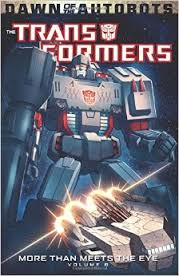
More than Meets the Eye: Volume 6

UnknownTransformers: More Than Meets the Eye Volume 6 by James Roberts

My rating: 4 of 5 stars

An open letter to James Roberts:

Dear Mr. Roberts,

Thank you. I have lots of questions, certainly, and I have plenty of comments, but I need to start with that: thanks. When I read a work I love, that seems the first and most necessary response. I know that writing is a difficult labor– no matter how easy some people make it look and no matter what a reward it must be to see those stories given form by Milne’s artwork. It’s probably still worth something (I hope) to hear a heartfelt thank you from a reader.

But let’s talk about why we should be thanking you for a moment, shall we? Obviously there were a lot of us who grew up loving Transformers, who filled afternoons with sagas enacted by forms of molded plastic on bedroom floors. There were probably less of us, but still a significant number, who bought wholeheartedly into the mythology that Furman created in his brief stint on the original Marvel run, who realized that of course these characters were scions of a god and the universe’s last line of defense against the Chaos-bringer, that of course they were more than simply robots that transformed into cars.

And then we grew up.

We passed the broken survivors of garage sales that hung on in basements and attics to our kids. We went to Botcon maybe once or twice, taped Beast Wars when it was on television, and tried our hand at fan fiction with embarrassing results. We had our hopes dashed by the live action movies. We waited. We knew what we had glimpsed once upon a time, but it appeared as though the deep well of mythology and potentiality in story and mystique– in the epic of a million years’ war– would remain untapped.

But then there was More Than Meets the Eye, and now six volumes of trades into it, here we are. We can talk about the journey that it’s been– what it was like to realize that someone else got it and was going to start telling those stories– but the primary feeling throughout has been: of course. It’s about time. It felt as though these were stories being uncovered as much as they were being created. They were in the bones of the thing itself– spark, cog, and marrow– waiting to be told. We knew they were there. We half-remembered them ourselves. And now, we can nod and gasp and laugh and cry over the pages with recognition.

Except, of course, surprises linger. I read and then I re-read volume 6, trying to imagine the voice of Frank Welker speaking the lines you’ve given Megatron. You are doing a new thing here, because you refuse to let anything be taken as a given. You’re going to give us character and depth, even in what had been the most single-dimensional villain in the entire franchise. In each volume of MTMTE so far we’re provided a new angle, a new insight, and in this one it is the character of the former Decepticon leader himself.

Very well done.

We get new characters as well, showing your continued determination to make this a series about the second-stringers, and pushing against convention when the second-stringers themselves begin to feel established in the limelight by bringing in new faces and introducing them in ways that don’t seem contrived. We get what we expect as well in the sense of science fiction tropes done well and done with Autobots. We also get all of this given form in the continually impressive, subtle, and just so darn wonderful artwork of Milne. Can we talk for just a minute about the care he took in eviscerating everyone’s favorite spaceship?

Okay, so you obviously don’t need any advice besides: keep doing this, but I’m going to give some anyway. Feel free to skip over this to the part at the end when I say thank you one more time and promise to keep reading.

1. Can we all just agree that we’ll do everything we can to keep Milne happy and drawing these comics? I’m not saying that there’s no one else out there who could do it as well but– no, I think I am saying exactly that. Please, guys, don’t ever break up.

2. Do anything you want. Really. I was a bit annoyed at first (okay, I still am) that characters aren’t getting killed off fast enough and that some of them have started coming back. I get it. It’s a comic thing and a franchise thing. But–

3. Kill off at least one cute sidekick. With Swerve and everyone it’s great. With Rewind and Chromedome it’s sweet. With Tailgate and Cyclonus it’s getting old.

4. Spoiler: start dropping some hints about who or what the Lost Light transforms into. I know, I know, I’m a bit slow. It took me until this volume before it hit me: she’s going to transform some day, and it’s going to be awesome.

That’s all. You’re a British subject, right? I think we could probably make a case for you being knighted for service to science fiction literature and sentient robotic lifeforms. It’s probably not how these things work, but you’d have my vote.

Thank you. I promise to keep reading.

Your fan,
-Steve

Science and Eastern Orthodoxy

Science and Eastern Orthodoxy: From the Greek Fathers to the Age of GlobalizationScience and Eastern Orthodoxy: From the Greek Fathers to the Age of Globalization by Efthymios Nicolaidis

My rating: 2 of 5 stars

The complete history of science in the Christian East remains to be told. But it is certainly a narrative the broad strokes of which need to be outlined, if only because Orthodoxy remains a lacuna in most generalized histories of scientific thought. There are a lot of writings about Greek science, about its transmission, appropriation, and development in Arabic and Islamic contexts, and about its reintroduction to Western Europe. Yet about the Eastern Roman Empire, which endured more or less until the fall of Constantinople in 1453, very little has been said, even less in popular surveys for a non-specialized audience. (One popularization treating the topic, though not focusing specifically on science, is Colin Wells’ Sailing from Byzantium.)

The essential difference between science in the Greek East as opposed to the Latin West is that whereas Europe lost linguist links to the corpus of classical Greek texts, these works were never lost to the eastern, Greek portions of the Roman Empire. The interplay between this knowledge and the rapidly Christianized culture of Byzantium has often been portrayed negatively with the assumption that Greek learning was neglected because it was seen as inconsequential or hostile to Christian theology. Greek culture, so the narrative goes, was decadent, and the scientific knowledge soon flourishing in the Arabic world was stagnant or forgotten in the empire of Constantinople.

As with anything else in history, the closer one looks the more complicated the true picture becomes. Even the high-altitude overview provided by Nicolaidis’s Science and Eastern Orthodoxy: From the Greek Fathers to the Age of Globalization has plenty of room for the wide range of reactions and reassessments of science taking place during this period. Indeed, the relationship between the state, Christianity, and science is the true theme of Nicolaidis’s survey. In this he is consciously following the footsteps of Numbers and Lindberg, and in some respects this volume could even be considered a companion to the two volumes that Lindberg and Numbers have co-edited outlining the relationship between science and Christianity in the West. However, whereas those are collections of essays treating the topic from a broad range of chronological and thematic angles, Nicolaidis’s work is a chronological survey.

The extent of this survey is quite impressive. Nicolaidis begins with the hexaemerons– commentaries on the six days of creation– by the early Christian fathers Basil and Gregory. He hits the familiar points of Byzantine history: the impact of the iconoclastic controversy, hesychasm, and the Latin conquest of Constantinople in 1204. This final event, Nicolaidis argues, actually had a positive effect on Orthodox science, illustrating the possibility of radical social and cultural change and ushering in the first Byzantine humanist revival as rulers in the new capital of Nicea built a cosmopolitan group of administrators who valued classical learning. The narrative continues all the way into the modern period, chronicling the Orthodox Church’s largely conservative stance toward modern science (Darwinism usually equated with materialism), primarily because it and the modern ideas accompanying were seen as potential threats to the privileged status Christian enjoyed in the Ottoman empire.

In some respects though, this detailed account simply proves the initial assumption that there wasn’t such a thing as Byzantine or Orthodox science. Instead there was a tradition of commentary and preservation of the classical body of Greek learning, at times appreciated and shared and at times viewed with suspicion, depending on the vicissitudes of church and state policy. Nicolaidis’s account is full of Greek scholars from all periods, explaining who they are and what they taught and how in many cases they were essential for transferring texts and knowledge to the West. But true “scientists” or natural philosophers are distinctly lacking. This doesn’t mean that they are not necessarily there, and this account gives lots of potential leads to pursue in a body of work that is remains largely unexplored. Unlike a popular account of Chinese or Arabic science though, which would be rife with examples of breakthroughs or technological developments, the story of science and Eastern Orthodoxy is largely that of continuity, preservation, and tension (albeit not always a negative tension) with the Church.

As an overview, Science and Eastern Orthodoxy is an invaluable introduction to the topic of Greek learning in Byzantium, the Christian communities of the Ottoman Empire, and its successor Balkan states (with the focus on Greece) and the interaction between natural philosophy and Christian thought in these contexts. There are dozens of useful references and sources if one wants to dig deeper into any of the various topics, time periods, or individuals surveyed. For an English-language introduction to the history of science in the Christian East, this is the place to begin.

Viper’s Tangle

Viper's TangleViper’s Tangle by François Mauriac

My rating: 4 of 5 stars

One of the things that always struck me about C. S. Lewis’s Screwtape Letters is how effectively Lewis wrote in a demon’s voice. The character of Screwtape was believable, because Lewis understood how young Christians thought, the beliefs and desires that motivated them. He understood temptation enough to compellingly examine it from a unique and “alien” point of view that was at the same time disturbingly familiar. As strange a connection as that may be, I couldn’t help but compare the first portions of Mauriac’s Viper’s Tangle to Lewis’s Screwtape Letters.

In Viper’s Tangle we’re given a surprisingly compelling and (for me, at least) an uncomfortably familiar view into the mind of a bitter man nearing death and reflecting on his life. Mauriac’s character, Louis, lives in a state of quiet warfare with his family, whom he sees as hovering around him waiting for his death so they can claim his fortune. He knew love once– or thought he did– early in his marriage, but has for the past forty years lived in symbolic silence with a wife he believes neither understands nor appreciates him. He is embittered and hateful, and we as readers quickly become suspicious of his view of the world around him because it’s so colored by his own perceptions and beliefs. Are things really as bleak and tangled as he represents them? Is he correctly interpreting the present and past actions of his wife and children?

I certainly don’t believe I’m in a similar situation as Mauriac’s protagonist, who begins writing his account as an explanatory letter to his wife to be read upon his death. Yet the power of the account is what I felt years ago reading Lewis’s Screwtape: a certain amount of recognition. If I’m not as hateful and vindictive as Louis, I can see the seeds of such fruit in some of my own attitudes, in my own petty feelings of injury that can easily be nursed into a deep resentment, similar to those Louis uses to justify his attitudes and outlook. As embittered as Louis is, Mauriac effectively outlines how he became this way, and it’s a mirror to some of my own worst days.

This is the second novel we have read in the course I’m auditing on the Catholic imagination in twentieth-century literature. Mauriac’s Louis has nothing but contempt for the lukewarm religiosity of his family members (nominal Catholics) and takes a great deal of pleasure in antagonizing them. He sees them as hypocritical, unable to admit they care only for the same thing that drive him: their wealth. Yet whereas they are unaware of the misery obsession with money brings, he lives and breathes within the center of the web it has cast across his life. He sees clearly how little happiness it brings, and he doesn’t cloak his pursuit of it in any sort of noble or selfless terms, does not justify it with the trappings of middle class Catholicism as do the members of his family.

It’s compelling watching Louis in his own net of vindictiveness and self-destruction. Yet the book is ultimately about Louis’s transformation. This is not a simple Dickensian transformation. Louis does not wake up one morning, like Scrooge, a new man. There is instead one final plot of Louis’s to disinherit his conniving children as he realizes the tangle of vipers is not simply within his own heart but has extended to the actions of those around him. Louis’s final endeavor is concluded by an unexpected death, and then comes– near the end of the novel– the transformation in which his hatred abruptly drains away. Mauriac depicts Louis as paradoxically, finally, realizing the true object of his love in his own loathing for his fortune and his desire to become free of it.

What makes this more than a straightforward conversion tale is the skill Mauriac uses in detailing the weaving of Louis’s tangle of hate and weak, tired avarice. It’s a picture of the furious futility of a selfish life, of hatred that is simply an emptiness. It is believable. Yet there is also, all around Louis, the glimmer of a greater reality breaking in that reminds– like a brilliance glimpse around the edges of cloud– of the wonder of Chesterton’s world. Louis is aware of this, fleetingly, in the world he sees and in a few of the characters who love him unselfishly, uninterested in what they can take from him. This is a story of someone trapped in the wonder of a Chestertonian world and unable to perceive it from the prison of self-loathing until almost too late.

There is a final plot twist near the end of the novel, which enhances the narrative of Louis attempting to reconcile himself– or allow himself to be reconciled– to his children. The question of the unreliable narrator again emerges as we get a glimpse of the ways in which his children perceive his sudden transformation. Indeed, I thought the way Mauriac ended the novel, with letters by Louis’s son and his granddaughter, was especially effective. Each of them present a perception of who Louis ultimately became, and trying to work out which aspects of which were correct or at least understandable adds a final layer of intricacy to the tangle from which Louis attempted to extricate himself at his life’s end.

The First World War

The First World WarThe First World War by John Keegan

My rating: 4 of 5 stars

There are not many books out there about the First World War, and there are even fewer good one-volume popularizations. This might be because the Great War lacks the pathos and the apparent aspects of heroism of its sequel European tragedy. There are no big names that stand out, neither are there many spectacular and critical battles. Nor are there retrospectively clear “good guys” and “bad guys”. The whole thing has the feeling of a mistake, a muddy, avoidable, immense waste of life in which millions of men were sacrificed along fronts that hardly budged, a pointless conflict which saw the dismemberment of three empires: the German, Austro-Hungarian, and Russian.

I’ve mentioned before that the Great War seemed to be prowling in the background of several books I had read recently: The Remains of the Day, Wittgenstein’s biography, and Logicomix. The truth was that I had plenty of general knowledge about the War but very little specific information. It knew it as an event that set the groundwork for the Second World War, but the actual waging of the war, its antecedents and its outcomes, were pretty vague in my mind. If that’s the case for you as well, Keegan’s book is the antidote.

Keegan’s The First World War is a straightforward narrative of the conflict, beginning with a brief cultural and political survey of Europe at the outbreak of war and ending with an explanation of how the outcome and terms imposed on Germany as well as the way national boundaries were re-drawn in its wake from the ruins of empires set the stage for the Second World War, which Keegan understands as a natural progression of the First. Both these topics– the causes and the results of the war– merit books of their own (which have likely been written), but they show the comprehensive ease that Keegan brings to his topic: treating cultural, political, economic, and technological aspects with enough depth as to be meaningful but never moving beyond the scope of a single-volume treatment.

Between these two chronological bookends, the narrative is that of the progress of the Great War itself, as divided and shifting as the scope of the conflict itself. Most chapters deal with progress (or lack thereof) on the Western Front and the details of the trench warfare involved. Keegan puts in a bit of biography, so that the many commanders involved become at least a bit multidimensional, as well as frequent quotes from letters and accounts of troops on the front. This is one of his great accomplishments of the work: humanizing those who fought, on both sides.

The work is slightly Eurocentric because those are the conflicts for which we have the most detailed sources and accounts, and Keegan draws on them to paint each pointless back and forth with specific details. He is careful to show, however, that the conflict was indeed worldwide. There is plenty of discussion of what was happening on the Eastern front as well, including the ultimate collapse of the Russian armies, and around the world. For example, the conflict in the Middle East, the assault on Germany’s African colonial holdings, and the naval battles of the North Sea are all chronicled. One of the interesting points that Keegan makes and that shapes subsequent narratives of the war is the contrast between the education and background of soldiers on the Eastern versus the Western front: the Eastern front soldiers were often illiterate peasants, so besides a very few surviving accounts such as those by Wittgenstein, our knowledge of the conflicts in the East is much more tenuous, acerbated by the fact that the antagonists in those regions– Russia and the Hapsburg Empire– disintegrated by the war’s end. The conflict there did not “set” in the cultural and literary imagination like the war in the West.

There is history of technology in this treatment as well, though not in detail and not in abundance (which is just about right for a general treatment). Specifically, Keegan discusses the construction of the dreadnought class of warship and their role in the conflict, as well as the coming of tanks used alongside infantry. In his discussion of tactics on the battlefield, he highlights the dawning strategy of armies being considered moveable fortresses and the difficulty in the essential coordination of artillary assault with ground attack. Artillary and massed armies– these were the primary format of the conflict.

The entire treatment is accessible, and the narrative momentum does not bog even when the conflict itself does. Keegan captures both the drama and tragedy of the entire war without simplifying or villainizing either side. Indeed, it is the courtesy and camaraderie often showed across lines even in the face of unmitigated slaughter that seems to strike Keegan most about life in the trenches. Empires died in the Great War, and millions of soldiers, for no clear reason. Yet to treat the whole thing as senseless mistake and therefore ignore it would also be a tragedy. Keegan accomplishes the very difficult by telling the story of the Great War without glorifying or dismissing it.

The Man Who Was Thursday

The Man Who Was Thursday: A NightmareThe Man Who Was Thursday: A Nightmare by G.K. Chesterton

My rating: 3 of 5 stars

My edition of G. K. Chesterton’s The Man Who Was Thursday includes an explanatory note at the end of the text, taken from one of Chesterton’s columns published the day before his death, in which he calls attention to the work’s subtitle and the fact that most people ignore it. For me, that subtitle– “A Nightmare”– is one of the biggest riddles of the work. As I reread it recently for a course I’m auditing, “The Catholic Imagination in 20th-Century Fiction,” that question kept coming back to me: in what terms does Chesterton view this story as a nightmare?

It’s certainly dreamlike. The protagonist, Gabriel Syme, is an undercover policeman charged with infiltrating a secret ring of anarchists. He does so by a remarkable chain of events that results in him being elected to the Central Council of Anarchists, a body in which each member is given the codename of a day of the week (hence the title). The monstrous leader of this council and of the worldwide society of anarchists is Sunday, a figure that looms over the entire narrative like a thunderhead.

The course of the novel is one of sudden reversals and switches, a series of unmaskings that are sudden and sweeping and– eventually– somewhat ludicrous. Our hero soon realizes he is not the only person on the council who is not what he appears. The frequent and increasingly elaborate disguises are certainly dreamlike. So are the sudden changes of scenery (moving from London to the French countryside and back almost effortlessly), the weird weather (a breakfast on a balcony followed by a sudden snowstorm), and the bizarre chases.

There is also throughout the book the dreamy quality that makes all of Chesterton’s work so memorable, but it is a sharp and specific dreaminess: his characteristic attention to beauty and the mythological vistas in the everyday. Syme’s prosaic London and its various scenes (buildings along the river, rides in hansom cabs through neighborhoods, glimpses of bushes across a meadow) are glorified– even sanctified– by Chesterton as things of true terror and sublimity. Syme notes, for instance, during a duel in which he realizes he may likely die, that he is not only fighting against anarchy on behalf of all ordinary and wonderful things (a parallel here I think to how Chesterton saw himself as a philosophical champion against the anarchy of nihilism) but that he would be satisfied to lay his whole life beneath a certain almond bush glimpsed across the field, looking upward through its branches.

Though aspects of the novel have a feel of a nightmare (especially the penultimate twist that seems to have Syme and his allies alone against the world), it is the final unmasking, the revelation of the nature of Sunday himself, which takes place during the most dream-like sequence of a novel, that I still don’t see in light of the subtitle. The identity of Sunday, and what it signifies for Chesterton’s view of nature and the universe, is the central theme of the novel. In many ways, I think Syme’s experience with Sunday is an analogy of Chesterton’s conversion experience: he thought he was a man alone, defending the ordinary against the forces of anarchy, but in all his defiance he found himself continually driven back to orthodoxy, always finding the figure that he thought the greatest architect of anarchy grinning out from the cracks of reality. He kept, he has Syme say, feeling he was seeing the backside of nature– all its grimness and cruelty and beauty– but he (in the character of Syme) finally sees its face. And it’s that final realization that I have trouble understanding in the context of the tale as nightmare.

The final twist might be seen coming a long way off, and the ones leading up to it might start to feel a bit ridiculous, but the entire novel still feels fresh and exuberant, if a bit slapdash. Chesterton’s prose is easy and engaging, even when it’s dashing off on a tangent to describe clouds above the city at sunset or how the buildings across the river look like monsters. This is the point, for him. The buildings are monsters. The sunset is a flame. And this may perhaps be the most poignant part of the thing called the Catholic imagination, the thing that rings through all of Chesterton’s work– the idea that the world is almost shockingly, unbelievably good, and the greatest adventure is living among the ordinary things of creation and seeing them so.

A dream, perhaps. But I hope not a nightmare.

Boxers & Saints

Boxers & Saints Boxed SetBoxers & Saints Boxed Set by Gene Luen Yang

My rating: 4 of 5 stars

I read Yang’s American Born Chinese years ago. I don’t remember everything about it, but I do recall that I enjoyed it quite a bit and was especially impressed with the way Yang treated both traditional Chinese mythology and Christianity, managing it in a way that neither belittled nor cheapened either. I hadn’t realized it was still possible to treat Christianity seriously in modern literature (and I definitely include many graphic novels in the category of modern literature) without making it the whipping boy for clashing cultures or post-colonial guilt.

Whereas Christianity and Chinese culture can coexist and and make American Born Chinese successful, no one can accuse Yang of ignoring when this has not been the case. Indeed, Yang takes one of the most famous and tragic confrontations between Western Christianity and Chinese culture as the focus of his latest two-volume work, Boxers & Saints. Here Yang combines history with magical realism, excellent artwork and storytelling, and cultural tact to present a retelling of this conflict from two complimenting viewpoints that is as poignant as it is tragic, as haunting as it is visually effective.

I call Boxers & Saints a two-volume work, but it is not a chronological division. Boxers, the longer of the two, tell the story of a Chinese peasant boy who becomes the leader of the Society of the Righteous and Harmonious Fist, known to Westerners as the Boxers, who rebelled against growing Western influence in China in the first years of the twentieth century. Saints tells the story of a Chinese peasant girl who becomes a Christian during this period and is a first-hand witness to the consequences of the Boxer Rebellion, particularly its targeting of Chinese Christians.

There are no good guys or bad guys in this book. Even the martyrs are simply people trying to do what they think is best. This is a huge strength of the work, something that Yang accomplishes by splitting the work into its two complementary pieces. We see the threat that Western influence represented to Chinese culture and the domineering presence of many Christian missionaries through the eyes of the hero of Boxers. And we see all the blood and death and ultimate personal tragedy that resulted because of it through the eyes of participants on both sides.

The shades of grey get even deeper in Saints, as we are given a glimpse of the mundanities that led many Chinese to embrace Christianity as well as the genuine piety that resulted. Even the saints are ambivalent though, and it’s a stroke of genius that it is Joan of Arc that appears to the heroine of this volume, making the parallels between her attempt to unify France and repel the English invaders and the Boxers’ attempts to do the same for China painfully obvious, even to the Christian protagonist. There are a lot of painful loyalties; there’s a lot of death and tragedy. That’s what makes it so real though: people living through things that really happened, making actual, complicated choices that are often wrong and never black and white.

What makes Yang’s work especially powerful though, like American Born Chinese, is that he never reduces these complicated choices to materialism alone. Magic and spirituality are real here. The heroine from Saints interacts with Joan of Arc throughout the narrative. The hero from Boxers is transformed into a Chinese god who turns out to be the first Emperor of China, returned to save his country through the peasant boy whatever the cost. The Chinese gods are as real– as they were undoubtedly– to the Boxers as the Christian saints (and Jesus, who makes an appearance) were to the Christians. Yang shows us that people don’t put themselves in danger or make sacrifices on behalf of others for physical reasons alone; they do so because of the spiritual realities– the magic– that underlies the world that Yang creates.

The story is told through Yang’s simple, straightforward artwork– pleasingly flat and colorful without ever being two-dimensional or distractingly cartoonish. It is a comic of simple lines and drawings, lacking the depth of shading or detail of something like Joe the Barbarian. In Yang’s work though, this is a strength. The effective simplicity frames the story quite well.

The two volumes are not clearly indicated vol. 1 or vol. 2, but I would suggest reading Boxers first. The stories of the two heroes intersect only twice in their narratives, once in passing at the beginning and again near the climax, but having read Boxers first you can understand the epilogue of Saints better.

Yang does an admirable job navigating what might for anyone else be a minefield of cultural and religious stereotypes to tell a compelling story that underlines the tragedy of religious war by making both sides understandably human. But the paradox, as I mentioned above, is that it does this by treating the spiritual aspects seriously without cheapening or patronizing either East or West. This doesn’t mean it’s all random shades of grey with no white: the true answer, the real heroism comes, Yang seems to be saying, where true compassion is present. There, whether embodied in the crucified Christ or the Chinese goddess of compassion, Yang says, there is hope.