Category Archives: Reviews

The Remains of the Day

The Remains of the DayThe Remains of the Day by Kazuo Ishiguro

My rating: 4 of 5 stars

The back of my copy of Ishiguro’s The Remains of the Day uses phrases like “elegant,” “cruel,” and “quietly devastating” to describe this slender volume. This was another book read on the recommendation of my sister, and neither she nor the cover blurbs lied. I found the work to be a nearly flawless study of the life and reflections of a figure that has been often parodied but seldom understood– the English butler, living out a long and possibly futile career of service to a grand manor house in the first half of the twentieth century.

My readings lately have been orbiting around the First World War. I read Logicomix not long ago and was struck by the role that the War played and realized how little I knew of the history of the conflict. Logicomix led me to Wittgenstein’s biography, in which the War was the backdrop to the dissolution of the philosopher’s native culture and empire. Right now I’m about halfway through Keegan’s excellent one-volume treatment of the First World War, and I was not surprised to again find the War haunting the pages of Ishiguro’s work, its repercussions echoing down the halls of the house to which Ishiguro’s protagonist, Mr Stevens, devotes the prime years of his career.

The Remains of the Day is a novel about reflections, reminding me in many ways of Gene Wolfe’s Peace, one of my all-time favorite novels. As far as actual action and plot, not much happens on the surface: a butler, Mr Stevens, who has spend his career as the head butler of Darlington House in the service of Lord Darlington, finds himself in the evening of his life (this is where the title comes from) reflecting on his years of service as he takes a motoring trip across southwest England to renew an old acquaintance. The larger themes come out only slowly, as Stevens’ interior monologue takes him back and forth between reflections on the countryside and villages he is passing through and his own memories of past years at Darlington House.

You learn several things right away. The first is that Stevens defines himself in terms of “dignity”– a quiet, steady service to a worthy lord. We meet Stevens’ father in his recollections and see how this shaped his upbringing, and we get hints of the sort of international policies that were hammered out in unofficial meetings between great personages coming together at Darlington House. This is where the echoes of the Great War make themselves felt: Lord Darlington and his allies feel the terms of the Treaty of Versailles deals too harshly with the German people and want to preserve international peace by mitigating some of the more draconian strictures.

Stevens explains his view of the world at one point: To us the world was a wheel, revolving with these great houses at the hub, their mighty decisions emanating out to all else, rich and poor, who revolved around them.

As the novel progresses, Stevens is forced to acknowledge the ultimate failure– and indeed the sinister advantages made– of Lord Darlington’s naive idealism. What is more difficult though, is his slow realization of the costs his years of service have had on his own life. It is in this slow, subtle realization that Ishiguro’s writing truly excels. Stevens’ self-reflection, his recollected narratives, are couched entirely in painfully reserved– at times almost Asberger-like in its emotional detachment– preoccupations with proper decorum, dignity, and service. His attempts to reflect on his own feelings, such as those associated with his father’s death and his own unrequited love, are painfully stymied and round-about.

In many passages I found myself reminded of nothing more than Data from Star Trek: the Next Generation trying to understand certain difficult human emotions or expression. Stevens admits that a truly great butler– and for all his humility it is clear that he believes himself to be one by dint of doing good work at a great house– wears a persona he must never remove, and even in his own self-reflections, in the monologue within his mind, we see this persona so carefully constructed that he is unable to escape from it, even at the cost of his relationships with others.

This makes Stevens himself an unreliable narrator, something that again reminds me of Wolfe. It’s not that Stevens tells outright lies, but he either cannot reveal or cannot even perceive emotional nuances that would be obvious to anyone else. Because of this we don’t, for instance, ever learn the true extent of Stevens attachment to the acquaintance he is traveling to see or what their past relationship may have entailed– not because Stevens is covering it up, but because to speak of such things would be irrelevant or unseemly. He doesn’t give us his own emotional state; we’re left to learn of how he is feeling at particular times by the interactions he has with others and the questions they ask him. What we have, always, is the consummate butler.

I don’t know what Ishiguro knew of this world, nor do I know how much a story like this was a model for things like Downton Abbey today. But it seems to me he got a lot right about people who give themselves up entirely to a certain cause or perceived ideal and what happens when one is forced to live up to the fact that loyalty may have been misplaced or– even worse– ultimately futile.

If I have a single complaint about this novel, it’s because I’m partial to fantasies in which the house itself is part of the story. The quote by Stevens above puts me in mind of places like the Professor’s house in The Chronicles of Narnia or Evenmere of The High House. In this novel, Darlington House is never anything more than the background. We don’t see much of its character. We don’t really get any sense at all about what it looks like or its moods or atmosphere. Perhaps this is intentional: for Stevens, it is simply a workplace to be managed with a quiet and ceaseless efficiency. It also means that Darlington House has the strength of non-specificity; imagine any large, stately English manor house: that is Darlington House.

Like every story, The Remains of the Day is a love story at its core, but it is a buried love story. It is a love story of carefully spoken courtesies in which the shape of things unsaid only slowly become apparent. It is a romance of averted glances and missed opportunities, all the more tragic because the hero only slowly has any awareness that they have been missed. The ending, for all its soft cruelty, was satisfying, if not unexpected. This is not a book about storms or sudden, swift changes. It is a book about an evening– of an age as well as a life– about the slow fading of light and the reflections that long English evenings in the countryside entail.

Magical Mushrooms, Mischievous Molds

Magical Mushrooms, Mischievous MoldsMagical Mushrooms, Mischievous Molds by George W. Hudler

My rating: 1 of 5 stars

This was without a doubt the worst book about mushrooms that I’ve ever read. Now, to be fair, I’m relatively certain it’s only the second book about mushrooms I’ve ever read, but it was still much less than satisfying. Writing a compelling science book, and one about a subject as far-ranging and yet obscure as fungus, has to be difficult. But as fascinating as the subject matter may be (and I’m not speaking ironically when I admit I find this particular topic incredibly interesting), unless the author can make that subject come to life, can show the information instead of simply telling it, the exploration will be tedium.

I am in the intended audience for this book: someone without a background in mycology but who is equal parts fascinated and horrified by the kingdom of organisms known as fungi. They’re such a twilight concept: plant-like, yet not plants, little understood or explored by biology at large, causing disease and rot yet also a pharmacopeia of beneficial medicines and psychotropic drugs. They’re as mysterious to most as their most familiar representation: the mushrooms that spring up on summer lawns almost overnight. And like mushrooms, most of what they are remains hidden beneath the soil.

In this book, the author is particularly interested in showing the relationship between the world of fungus and the human world. He wants to highlight species of fungus that have played a role or continue to play an important or potentially important role in human affairs. This includes disease-causing fungi, historically beneficial fungi (like the yeasts that make our bread rise, ferment our beer, and have, arguably, shaped the entire course of human civilization), fungi that cause disease in our crops and trees, and fungi that decay our homes and buildings.

And as you would expect for someone interested in fungi, there are a lot of truly interesting things in here. We get an introduction to the fungal kingdom in general, how they work and how they do the things they do from the point of view of a mycologist. The author then goes through each of his topics in turn with the rigor of an undergraduate survey course (as, incidentally, the book is based upon). I was especially fascinated at the role fungi plays in the fermentation of bread, beer, and wine (I’m currently cultivating in my “fermentation corner” in our kitchen a sourdough starter as well as a jar of kumbucha, a mildly fermented tea) as well as the ability for many to create the chemicals from which we derive many of our antibiotics that still resist laboratory synthesis.

The author is obviously passionate about his topic and eager to pass this along. If nothing else, he succeeds in illustrating the vast scope of influence that fungi have on human life. For all this intention though– and despite the rich content itself, many parts of which could have entailed entire books to themselves– the reading was a drag. In fact, the various chapters often felt like little more than a series of Wikipedia articles: well-written and informative but missing the elusive spark that turns organized knowledge into something more, that translates information into a cohesive and engaging dialogue with the reader.

The entire work is a series of interesting anecdotes. Take the author’s treatment of psychotropic mushrooms. He analyzes the chemical effects that such mushrooms have on the human brain, surveys how they are used in different cultures, and even goes into the history of the investigators in the West who studied the species and brought them to the attention of society at large. This is a fascinating tale, but it’s simply told as you would tell it in a lecture. It’s missing something. It does not reach out and pull the reader into what should be a compelling story that involves Central American tribes, LSD, and academic scandal.

It may not be fair to criticize a book– and one from what I can tell one that is free of errors and obviously written by an expert in the field– that nonetheless does an important job. It brings to light things that are little understood but that have a huge and often ignored effect on human life and flourishing. Still– as interesting as the content was, there’s no escaping the fact that something was lacking: the book was boring.

There are dozens of things to learn in this book to fascinate and horrify, but they’re all passed over from one to the other like you’re on a tour or– as I’ll say again, as it seems the most apt analogy– like you’re reading a series of Wikipedia articles. Perhaps that illustrates one of the challenges in tackling this field: the desire to provide an adequate survey of a huge topic.

One final example. I’ll never forget the one of the most poignant image I have in my memory related to fungi: the time-lapse photography in Discover Channel’s Planet Earth documentary showing mushrooms growing out the bodies of insects on a jungle floor. It was like something out of science fiction. Whether the insects were already dead or still living when infected, they were being consumed from within by something that seemed terrifying and alien and was going to spread spores so it could keep doing this. In this book you might learn a bit about those fungi, but you won’t get any of that wonder and horror: it will simply be another short stop on a tour.

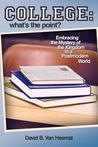
College: What’s the Point?

College: What's the Point? Embracing the Mystery of the Kingdom in a Postmodern WorldCollege: What’s the Point? Embracing the Mystery of the Kingdom in a Postmodern World by David B. Van Heemst

My rating: 2 of 5 stars

At the university where I teach, David Van Heemst looms large. He’s a fixture in the political science department, where his enthusiasm and knowledge have shaped his program and continue to impact the lives of hundreds of students. In the years that I’ve been a part of this academic community, I have never once heard a student say a negative word about one of his classes. Van Heemst clearly has a vision of the Christian college experience, and it’s one that shapes his teaching and his interactions with his students. Not having been a student, I was curious about what this looked like, and the easiest way to find out seemed to be exploring the book he’s written on that subject.

College: what’s the point? is Van Heemst’s manifesto on the role of college as a series of opportunities through which students can become a part of God’s redemptive narrative during their four years at a Christian liberal arts university. The book encapsulates Van Heemst’s enthusiasm, his passion, and his mission in teaching. It’s built upon not only his broad knowledge on a variety of subjects related to higher education, social justice, healthy relationships, and Christian formation but also upon his experiences over the past decades teaching and observing college students.

Audience is important here, and I quickly realized that the book is not a work about choosing a college or whether or why college in general is important; it’s not a book examining the philosophy behind Christian education or attempting to answer the question of whether one should go to college or the relative merits between vocational and liberal arts training. The audience here is those who have already arrived, the students who for whatever reason have decided upon college and have found themselves at a Christian four-year institution. Now that they’re here, regardless of how they arrived, this is what Van Heemst wants them to hear: an impassioned call to making the most of these years, to grasping them as god-given opportunity to engage in god-given work.

For Van Heemst, there is one reason for college, one purpose behind the years spent in such a community, and it’s summed up by the book’s subtitle: “Embracing the mystery of the kingdom in a postmodern world.” Van Heemst begins the work by setting up the confusion and disillusionment that many students arrive to school with (though he may be overplaying this a bit for a place like Olivet, where many of the students seem to arrive quite content with the worldview they’ve inherited). He celebrates what he sees as the genuine desire of students for real meaning in their lives, a meaning he believes that the world at large has not been able to supply them with. That meaning instead can be found in a life of service to God and his kingdom. This is the primary message of the entire book– how to view and experience the formative college years in a Christian, missional context.

Van Heemst first explores three important questions a college student must explore: whether there’s a point to anything (his engagement with nihilism is an important theme of the book), what would happen if one didn’t go to college (or rather, what would happen if one wasted the opportunity college provides to become “a quality person”), and which worldview or narrative will shape one’s life. For this last question, he broadly outlines the appeals and pitfalls of the “ancient” (which he characterizes– a bit problematically– in broad terms as Platonic), modern, and post-modern views of reality. He contrasts these with a Christian view of reality and spends the second part of the book examining the Christian imperatives to work for peace and justice and to wrestle with God’s calling on one’s life to pursue these in a broken world. Finally, Van Heemst examines three primary ways in which a young Christian will be shaped socially and intellectually by his or her college experience: in mind, by friends, and in the search for a mate (more on this last in a moment).

As a political scientist, justice and peace-building play a huge role in this narrative, though Van Heemst implies that there are broader and more abstract ways these can be pursued than direct social engagement– such as through the arts or the natural sciences. Social justice is what he knows and is passionate about though, and one of the great strengths of his work is the testimonies he provides of students who came to college, had their eyes opened regarding the world’s injustices, and then went out into that world to begin the sometimes seemingly futile task of working for change. The whole work, but especially these passages, resonates with passion and hope; the book is a sermon, an appeal, to incoming students to not waste the time and opportunities that they are given but rather to see them all as sanctifying circumstances to grow as a person and as a servant. If you’re looking for a book that synthesizes the ideals of a private Christian liberal arts education– a place to gain tools, passion, and perspective– this is a good place to be begin.

There is, however, one chapter that to me seems highly problematic, and that’s the chapter on healthy sexual relationships. Here Van Heemst outlines the traditional view of Christian sexuality and challenges students to keep sex in the proper context of marriage. In the process, however, he makes explicit the assumption that marriage is the natural end-state of all Christian relationships. It’s the familiar mantra students hear again and again about coming to college to find one’s mate. As he states at the beginning of the chapter, “After all, the question isn’t whether you’ll have sex, the question is when you’ll have sex.” The option of singleness or a life of chastity– which has always been a part of the historical Christian tradition and often prized as a more excellent calling than the life of marriage– is reduced to a single hypothetical bullet point. There was a chance here to bring a new depth and dimension to a discussion that continues to alienate many young people, but it was missed.

Finally, in as much as the passion that bleeds through every page of this work is challenging and laudable– and indeed I found myself personally challenged by the author’s call to deeper social engagement, to seeking ways to bring peace and justice into my own community– the copy-editing for this volume is inexcusable. I’ll admit I’m a bit of a comma Nazi, but even with reigning in some of my normal pickiness the book is littered with sentences of rough, uneven, and sometimes downright unintelligible structure due to inconsistent comma usage. On top of that, there are proliferate typos of an extent that make certain entire passages unclear: god for good, up for us– even entire omitted words abound.

The ideas in this book are solid. Indeed, I would say that any incoming student– who has already committed to attending the sort of Evangelical school that Van Heemst represents here– should read and be challenged by this book. Van Heemst represents the ideal of a Christian education: college as an opportunity to have one’s worldview challenged, to have one’s comfortable bubble pricked and one’s eyes open to the depth of cruelty and injustice in the world, and as a place to be given the tools, the training, and the spiritual and social support over four years to do something about it. Van Heemst gives the call in this book to join and fully engage with such a community with his characteristic passion, depth of knowledge, and experience. These are not simply ideas; this is something he is doing with his own teaching and career. College: what’s the point isn’t simply an appeal to students; it’s the heartbeat of a Christian educator.

Technopoly

Technopoly: The Surrender of Culture to TechnologyTechnopoly: The Surrender of Culture to Technology by Neil Postman

My rating: 4 of 5 stars

Being a social critic must be a lonely job. No one wants to hear what he says, I imagine, besides those already disillusioned with the system. For those though who have a vague sense that something somewhere has gone wrong but lack the words to articular exactly what, the social critic serves an essential function. He helps diagnose the problem. Neil Postman did this in his work Amusing Ourselves to Death, which I read years ago, when he talked about the way that television has shaped public dialogue. One of the main themes in that book is that the medium is never neutral– it shapes the message and the type of dialogue that can be conducted. Whereas print allows a certain level of dialogue and reflection, the medium of television news– depending as it does on sensationalism and catering to the limited attention span of viewers, upon which their marketing model is sustained– cannot. In this book, Technopoly, Postman takes his idea of the impossibility of a neutral medium deeper with his critique of the assumptions that underlie our technological world.

Postman believes that the United States has become the world’s first “Technopoly.” In the first few chapters of the work, which was written in the 1990s, he sets out what this means with an overview of the history of technology that, though problematic in some respects, draws widely on many well-known historians of technology. (Indeed, the primary reason I read this book was because I wanted to get a sense for whether it would work for a history of technology unit in a history of science course I’ll be teaching in the spring, and these chapters indeed fit the bill for a general student reader.) Postman wants to chart the transition from societies in which tools are used by humans (a tool-using society) to a society in which those tools bring about radical social changes (what Postman calls a technocracy) and ultimately to the society we have today, one in which we no longer shape tools for ourselves but in which we shape ourselves for our tools (a Technopoly).

There are a lot of generalizations at play here, as one would expect in a three-chapter survey of the history of technology. Postman shows how the technology of writing transformed society and created an abundance of information that required institutions to manage. Schools and universities, for instance, arose in large part to help sort, organize, evaluate, and manage the new information created by the technology of printing. In the past century, Postman argues, technologies increasing the amount and immediacy of information– the telegraph, telephone, television, and finally computer– have proliferated much faster than the capacity of the institutions that exist to manage that information. The result in today’s Technopoly is a flood of information that exists without content, context, or relevancy; the assumption that information is good and valuable for its own sake; and the belief that society’s ills arise from a lack of information that only more information-generating technology can solve. One of the main threads in Postman’s argument is against these last two flawed (but overwhelmingly accepted) assumptions in today’s society.

Another complaint of Postman’s regarding technology’s role in society is the way humans become subordinate to technology. Postman’s claim is not simply that technology creates problems in today’s world; it’s deeper and more subtle than that. Postman wants to show the unperceived and unquestioned ways technology shapes thought. Against those who believe technological progress is always desired and inevitable, Postman argues technology is not value-neutral. It carries with it a host of assumptions that fundamentally change the way humans interact with each other and their environment and conceive of the natural and social world.

He provides specific examples from the field of medical and computer technology. The primary problem, he says, is the familiar adage that to a man with a hammer everything looks like a nail. Machines depend for their functioning upon the reduction of things to uniformity, automated processes, and problems of efficiency. The usurpation of culture by technology, Postman argues, takes place when this becomes the lens through which all human interactions are viewed. Machines predispose us to see social interactions in these reductionist, efficiency-driven terms. In these cases, Postman says, we are no longer simply using our machines; they are shaping the way that we view the world.

Postman takes this argument further by discussing “invisible” technologies– that is, technologies we use every day but that we don’t normally think of as technologies. His big examples here are the practices of standardized testing, questionnaires, polling, and the tools of social scientists– basically the perceived ability to objectively quantify specific traits. A standardized test is a technology, and again it’s a technology that has shaped the way we perceive the world. It allows us to believe that nebulous traits like empathy, beauty, and intelligence can be reduced to a number, and it causes us to reify things like “intelligence” that don’t really exist. Intelligence, empathy, beauty– they’re not things; they’re complex qualities that exists in different ways in different people in different circumstances.

The results of all this, Postman says, is that our culture places an inordinate faith in applying the methods of natural science– quantification, empirical observation, testing– to places where they never belonged in the first place, the realm of human interaction and society. Postman has a long screed against social scientists, who he believes misuse the tools of scientific practice and have contributed nothing to the actual understanding of the human mind or human interactions. I find this generalization to be a bit dangerous, especially the division he makes between studying the processes of nature (allowable via the scientific method) and human practices (not allowable, because humans are too complex). What would Postman make of the burgeoning field of neuroscience, for instance, which combines aspects of the social sciences with biology and psychology? The divisions here are, I think, more tenuous than Postman allows.

As a critique of a society that unquestioningly embraces technology and all the reductionist assumptions it entails, this book– published over twenty years ago– still seems incredibly relevant. No technology is value-neutral– for good or ill, using it has radical effects on human relationships (and this is where one can’t help but wonder what Postman would make of the internet today and the efflorescence of social media). Deeper than that though, Postman believes technology shapes the way we view the world. Computers, for instance, don’t simply process data for us; they give us an entirely new language. They cause us to re-conceptualize our problems in mechanistic terms, even when this is inappropriate. In some cases we start treating computers like people, and in many cases we start treating people like computers.

His conclusion– the “what can we do about it”– chapter of the book warms the heart of a historian of science. Postman says that the only place the problems of Technolopy can be address are in the schools (which are themselves a form of technology). The key, Postman claims, to helping people see the problematic assumptions of Technopoly is teaching the history of every discipline, especially the history and philosophy of science. It’s only by seeing the way in which what we know– or think we know– has changed over time that we can teach students to see and question the assumptions that today’s culture rests upon. As much as I agree with the call to historicizing knowledge (and Postman is right– this is the only way for knowledge to become more than a consumer product), the grand narrative of human progress that Postman thinks teaching should be structured around smacks of the very technological determinism that he is trying to avoid.

Most of society focuses on what we gain with technology; Postman wants to make us consider what we lose, but more than that he wants to warn against the standards of Technopoly– efficiency, information, standardization, immediacy– becoming the standards of culture. This is a warning that is just as poignant now, if not more so, than it was when the book was first written.

Does Anyone Else Have Something Further to Add?

Does Anyone Else Have Something Further to Add?Does Anyone Else Have Something Further to Add? by R.A. Lafferty

My rating: 3 of 5 stars

Gene Wolfe has said of writing short stories that it is not enough to simply show people your ideas. He uses the analogy of a lion-tamer. A writer can’t just say to people, “Hey, look at this lion” and expect them to be impressed with her skills at showing them a lion. A writer has to do something with the lion, preferably something daring and unexpected. Wolfe says that the writer has to put her head in the idea’s mouth.

For me, that is the most difficult part of writing. Often I simply want to show people my ideas– an interesting imaginary place, for instance, or a character or device or image– but finding that narrative twist and plunge that makes the idea spark and come alive as a leaping, writhing story is something very different.

As important as Wolfe’s advice is though, I don’t feel like his requirement applies to R. A. Lafferty. There are in his stories– and specifically in the stories of this volume– rarely those unexpected twists that make you feel as though the bottom has fallen out of the narrative. In many of the stories that make up this collection, a reader can feel the end coming, can get a sense for the ultimate trajectory of the story, within the first few paragraphs. Part of this is because Lafferty does not craft those literary artifacts called short stories. Instead, he tells fables, and most fables have been told in some form before. But I think there’s also something deeper going on here with Lafferty and Wolfe’s lion-tamer analogy.

To return to Wolfe’s image, Lafferty does not need to stick his head in the idea’s mouth. Lafferty is the lion-tamer, but he’s a lion-tamer saying, “My God, it’s a lion. No, you haven’t ever really looked at a lion before. And you haven’t seen a lion like this. Look at it. This is the lionest lion that ever lived; this is the Ur-lion.” And then the lion– which, you realize, is indeed wilder and more savage and yet more merry than any lion you’ve seen before– rips out the lion-tamer’s throat and eats it with a wet chuckle, and both lion and lion-tamer have a good laugh together because that’s what lions are and that’s what lions do.

The story “Golden Trabant” in this volume is a good example of this approach. Narratively, the story is incredibly simple and has indeed been told many times before: a man discovers the El Dorado of asteroids, a rock not far from Earth formed completely of gold. What happens next? Exactly what you would expect. Pirates lay claim to it and become fabulously rich. Earth’s economy becomes unbalanced by the sudden influx of off-planet gold. The pirates build a kingdom with their new gold, sail the high skies hauling back their treasure in ship-loads, and ultimately turn each other. The asteroid becomes an irradiated waste haunted by a ghost. It’s every lost treasure story you’ve heard before with only the (now-blasé) element of being set in space. Maybe that was a new wrinkle when Lafferty wrote it, but beyond that there’s no unexpected twist that makes the story leap up out of the page like a living thing.

And yet it’s a fantastic story. Like so many of Lafferty’s, it simply works. The whole thing is alive. This is the case with many of the stories here. In some, it’s unclear what exactly is happening or has happened, plot-wise. “About a Secret Crocodile,” “Nor Limestone Islands,” and “Boomer Flats” are examples of this. “Boomer Flats” and “Maybe Jones in the City” in particular I found a bit frustrating, but the richness and jollity of Lafferty’s tone always wins me over eventually, even when they seem spun around nothing. If the bones of the story are a bit hollow, you still get Lafferty telling them. And that’s what you want. I’m convinced that had Lafferty taken it upon himself to re-write a phone book, it would be fun to read.

To be fair, there are stories with twists. There’s one at the end of “In the Garden” and “This Grand Carcass Yet” and “The Ultimate Creature.” “The Weirdest World” is all twist, and it may be one of the funniest Lafferty stories I’ve read yet. But the twist is secondary; the story is not built around it. And you probably saw it coming anyway. Moreover, the twist is usually twisted: this is a volume that highlights Lafferty’s brutal, grotesque humor, which is especially ripe in “This Grand Carcass Yet,” “Pig in a Pokey,” and “The Ultimate Creature.”

An annoying and puzzling (though easily ignored) feature of this volume is the needless division of the stories into those related to “Secret Places” and those about “Mean Men.” The stories in this work alternate back and forth between these two headings. In my edition of the book, this is even reflected by stories under each division having a differentiating font. Lafferty (not surprisingly) offers no explanation for this division, but it’s unlike Lafferty to offer much explanation for anything.

The reason the division doesn’t work though– or at least seems unnecessary and arbitrary– is that all of Lafferty’s stories are in some sense about secret places, and they’re all in some sense about mean men. They’re stories about the hidden, real world lurking just below the skin of this one and about the god or the devil lurking just below our own skins. That’s why their twists aren’t wholly unexpected: we feel them in our bones. We catch hints of them when we we’re not asleep.

If you’re new to Lafferty, this is as good a place to start with him as any. It’s hard to know what angle to approach his writings, but wading out into his short stories and learning how they rise and fall is easier than diving into one of his novels. Because, to be fair, you might not like his bright and bloody world. You might not want to get too close to that lionest of lions and hear its throaty chuckle. With his short stories, it’s easier to run away.

Ludwig Wittgenstein: The Duty of Genius

Ludwig Wittgenstein: The Duty of GeniusLudwig Wittgenstein: The Duty of Genius by Ray Monk

My rating: 4 of 5 stars

Ludwig Wittgenstein is widely regarded to be the most influential philosopher of the twentieth century. I’ve never read his first and most well-known work, the Tractatus Logico-Philosophicus, but I know something of its influence through a course on the Vienna Circle, the inter-war group of European philosophers who left their indelible mark on modern theorizing regarding science and language. Wittgenstein also shows up as a peripheral character in Logicomix, a wonderful graphic novel on the intersection between mathematics and philosophy in the first half of the twentieth century, which I reviewed here. It was my recent re-reading of Logicomix that spurred me to learn more about Wittgenstein himself. Monk’s authoritative biography seemed the place to begin.

I was not disappointed. Monk paints a vivid portrait of Wittgenstein as an individual and as a philosopher. This is the challenge of any biography, I suppose: to balance the cultural and historical background of a person’s age with the personal and emotional foreground of the individual’s own psyche and link this to an understanding of how a person creates or does whatever it is that makes her or him worthy of having a biography written. Monk does this expertly– no small accomplishment, because for Wittgenstein all three of these aspects are so complex.

Wittgenstein was born in 1889 to a large Viennese family. His father was a wealthy industrialist, and the Wittgenstein fortune (in which Ludwig ultimately disowned his portion of the inheritance) provides his initial and immediate background. Two of his older brothers committed suicide, and Wittgenstein himself struggled with emotional turmoil throughout his life. To be wealthy in Vienna before the Great War (as well as after, due to his father’s expert handling of money) carried with it a certain cultural heritage: Wittgenstein was very much a child of the twilight of the Romantic era.

But “the duty of genius,” as Monk very appropriately subtitles his work, is very clear in Wittgenstein’s life from the beginning. He was constantly pushing beyond the comfortable life that he could easily have had with his background. Throughout the book (and thus throughout Wittgenstein’s life) Monk represents him as possessing a painful intellectual honesty. This drove Wittgenstein to study the foundations of mathematics in Cambridge with Bertrand Russell, but it ultimately drove him to try to experience life fully. Pure philosophizing was never enough. When the Great War broke out, Wittgenstein enlisted as a common soldier in the Austro-Hungarian Empire. It was here, in the milieu of true existential crisis– both for him personally, posted alone on night duty in combat operations and for Europe writ large as the empire in which his home was the capital crumbled– that he composed his Tractatus.

Though I haven’t yet read it, Monk plays deftly enough with the second important thread of his narrative– what Wittgenstein was actually doing in philosophy– that even the general reader can get some glimpses of why this was significant. Theorizing was not enough for Wittgenstein. Experience and language were central to the philosophizing endeavor. The true meaning of the world, Wittgenstein wrote, would never be expressed in the world itself. The meaning of the system was somehow beyond the system; this was what philosophy alone could never touch, and Monk shows how the background of Wittgenstein’s religious beliefs played out against this as well. Ironically, it was this realization, that there were things on which we must pass over in silence, things that philosophy could never address, that was interpreted exactly backward by the Vienna Circle.

Immediately after the War, Wittgenstein trained to be a primary school teacher and attempted to live out his philosophy by teaching students in the rural Austrian Alps. This was unsuccessful, and after this he traveled between his home in Vienna, a cabin in Norway, and Cambridge, ultimately returning there to lecture in philosophy, though he was never comfortable in the academic setting. Monk here takes what could be rather tedious narrative and keeps the character of Wittgenstein alive: the wandering, tortured, emotionally isolated and yet intensely emotional philosopher who teaches philosophy eccentrically, damning the philosophical establishment the entire time. After Germany absorbs Austria and the Second World War broke out, he was quite literally a man without a homeland (and here Monk offers insightful comments on Wittgenstein’s Jewish ancestry and how this played out for Wittgenstein personally). Wittgenstein passed the remainder of his life boarding with various friends, admirers, and former students, writing, editing, and rewriting (but never publishing) his later philosophical works.

An easy response to a biography like this is to ask, so after all, what did Wittgenstein do exactly? What happened to him? Why is he worth over 500 pages? And in some ways the answer is simply: he did not do much. He thought and wrote. He lived and tried to love. He wrote angst-filled letters, which provide Monk much of his source material, complemented by interviews with many of the surviving characters in this story. And yet Wittgenstein changed the climate of philosophical thought itself. He trained philosophers to ask questions honestly, to try to understand what they were doing, and then he encouraged them to go get useful employment as doctors or laborers. He tried to do this himself but always came back to writing.

He was sure he would be misunderstood. He often was.

I don’t know enough about Wittgenstein to know whether Monk has misunderstood him. I feel like– as with Hankins’ excellent biography of William Rowan Hamilton– Monk has explained– or rather, has held up for examination– what it is that most of us can only hope for: the fertile combination of a life lived with thoughts thought. Wittgenstein is remembered for his thoughts, for what he wrote about the nature of philosophy, truth, language, and perception. But as Monk has very expertly shown, these thoughts arose from a life lived in a great deal of pain, loneliness, discouragement, frustration, and (perhaps contributing to much of the things just listed) a relentless drive to be intellectually honest. To think and to speak clearly, as Wittgenstein attempted, is often the most difficult task of all. To write the account of someone who tried to live doing just that is also intensely difficult, but Monk has succeeded here with care and with a great deal of pathos.

Strange Doings

Strange DoingsStrange Doings by R.A. Lafferty

My rating: 4 of 5 stars

According to certain interweb sources, R. A. Lafferty is making a comeback. There are several new (and very well done) websites dedicated to him and his work, a new journal just in time to celebrate his 100th birthday, and (finally) a series of his collected works that might make it incrementally easier to read some of his stuff that’s been out of print for years. Though not much easier. That first volume of his collected works, for instance, is published by a specialty press and is already out of print. It’s so difficult to get one’s hands on, in fact, that even my heroes– the interlibrary loan librarians at my university– couldn’t get me a copy. Instead, they found a few early Lafferty collections for me to read.

Lafferty shines brightest in his short stories. His romping, boisterous, almost drunken exuberance comes across better in these than extended across an entire novel. I’ve read plenty of Lafferty novels, but they’re more of an acquired taste. You have to go into them knowing what you’re going to get and prepared to weather the storm. Because Lafferty’s novels are like riding out the storms at the core of a gas giant: there’s a good chance diamonds are going to be falling, but there’s also a good chance you’re going to get turned inside out before it’s done.

His short stories are a bit easier, not because they’re more muted or less powerful but simply because they don’t last as long. What is it about this guy? He’s not simply a science fiction writer, though he has plenty of stories about humans on new worlds. He’s even less a fantasy author, though there are fantastic elements in almost all his stories. What he is, is a story-teller. He’s someone who tells tall, sweating, shambling, horrifying, and beautiful stories– who tells stories like they used to be told when the world was a lot younger– and at the time he was writing it was only in the fantasy and science fiction and horror pulps that stories like this still found a home.

The pieces in this particular volume seem to cluster around a theme. They are stories of breaking out, of some new, larger reality breaking into the world. They’re stories of superhuman genius (“Rainbird,” “The Man with the Speckled Eyes,” “The Transcendent Tigers,” and “Aloys”) and of making contact with transcendent creatures or transcendent places (“All but the Words,” “World Abounding,” “Entire and Perfect Chrysolite”). Lafferty writes stories of phase transitions, of tipping points, of new or unseen (and sometimes horrifying) worlds breaking in on this one (“Continued on Next Rock,” “Once on Aranea,” “Sodom and Gomorrah, Texas,” “Dream”). They aren’t always the most narratively dense or developed; they don’t necessarily have tight plots or stunning plot twists. What they all are, however, are huge, rollicking yarns told in Lafferty’s unmistakable voice.

And this is what makes them work. There is a grotesque jollity about Lafferty. For him, the world is a bloody, beautiful, terrifying place– but never simply grim or grey. He is more than a little drunk on the world. This is a huge, holy brutality similar to but rowdier than Chesterton and far less tidy than the subdued mysteries of Borges. Wolfe has this in flashes, like shots of light through his stories’ elaborate puzzles. But in Lafferty it’s all there on the surface, naked and undistilled.

If you want to hear Lafferty’s language, head over to Daniel Otto Jack Petersen’s blog, where he regularly lays out slabs of Lafferty prose in all their bloody, dripping glory for passers-by to admire. Besides his language, Lafferty has a strength in creating characters, but his characters are like his stories– super-humans, larger than life, more alive than alive. I’m reminded of the sort of things people say about van Gogh, that he saw colors more vibrantly than other people. When I read Lafferty’s stories, I can’t help but wonder: is this how he saw the world? Is this how he saw people? It’s as though someone was living as Chesterton wrote in Manalive, with a certainty that the world was more gruesome and deep and joyful than could be properly grasped. There’s nothing slow or sedate or studied in his character sketches.

The stories that are the most effective in this particular collection are the ones that attempt the least. “Rainbird,” which opens the volume, tells the story of an early American inventor and the way he did– or did not– shape the modern world. It has all the pieces of Laffertian excellence in an easy-to-swallow morsel: the language that takes an obvious delight in lists and the bright mundanity of the workshop in all its sawdusty glory, the hint of the fantastic and the ease of the impossible that makes the entire, simple time-loop drama shine. And then there’s “The Ugly Sea” near the volume’s end. Again, something as simple as a tale of how a man falls in love with a woman and with the sea– and yet nothing could be more significant. This is what Lafferty does. He tells stories, but they are the stories that live down deep in the bones of the earth. He’s a grave-robber, and he does it all with a deep-throated laughter and terrible bright eyes and words that are thick with soil.

Europa Report

EuropaI grew up in the generation after the golden age of manned space exploration. I never watched the Moon missions. I never held my breath as humanity first ventured into space. Was that terrifying to watch on television? Certainly the drama in events like the Apollo 13 mission must have been electrifying. But the explorers of my generation are primarily robots: intrepid Martian rovers and lonely orbiters. Landers on comets a hundred million miles away. We see new vistas, certainly, and dream big dreams, but the human element is often somewhat lacking.

It doesn’t necessarily have to be this way, Europa Report eloquently demonstrates. This low-budget, independent science fiction movie illustrates two things. The first is how close the high drama of true human discovery still waits beyond the horizon. The other is that it doesn’t take a studio powerhouse to bring this to life.

Europa Report is a story set in the near future chronicling the first manned mission to Europa, one of Jupiter’s large moons and today in truth assumed to be the most promising location for finding life in the solar system. The story is told in the form of found footage and interviews, a bricolage of believable glimpses into the life of the six astronauts living aboard their vessel on its twenty-two month voyage to Jupiter. They have been sent because scientists on Earth have (again, very believably) found strong evidence for the possibility of life on Europa. A private venture has funded the mission—humanity’s first voyage into deep space since Apollo—to ascertain whether or not there are microscopic organisms living beneath the moon’s icy surface.

The story is believable enough that at times I had a hard time separating the science from the fiction. It’s an image of a possible very near future, and there’s no wildly unbelievable piece of technology or contact with alien intelligence that pushes this movie firmly into the realm of the unbelievable. This could be us in a handful of years. There’s great effectiveness in this narrative humility. No epic story arch. No shaking camera angles. No impressive and overwhelming CGI explosions. This is a story about simple wonder and exploration—and that it’s never quite that simple.

Soon into the story it becomes apparent that something has gone wrong. One of the astronauts is killed, and the mission loses contact with Earth. The pieces are filled in as the story continues, but the survivors are faced with deciding whether to carry on and complete the mission. How far are they willing to go, they must ask themselves several times throughout the film, in answering the question of whether life exists elsewhere in our solar system?

You’re not going to find killer aliens or stark insanity or creeping terror here. This is not a psychological space-horror or Lovecraftian tale of unfathomable alien intelligences. There are certainly moments of terror, yes, and an effective story that keeps you guessing until the very end. (There’s a particularly effective twist that upends what you think you’re seeing and who you think survives near the end of the movie that’s expertly done.) The backdrops to the action are the ominous, gorgeous approach of Jupiter through the ship’s windows as the characters continue their voyage. It’s awe-inspiring in a slow, subtle way, a reminder of just how huge these objects are, how vast the distances, how audacious the hubris to venture out on that emptiness.

I loved Europa Report because it was simple. It was a terrifying and exciting drama of discovery against the immense and unforgiving background of space. The cramped confines of the ship were held in a steady, tight contrast with the emptiness through which they traveled, and these were both balanced against the bleak vista where one might find life sheltered against the void. The actors (no big names that I recognized) played the role not of heroes or villains but explorers, with all the shades of heroism and failings that this entailed.

The ending left the door wide open, not in the sense of dangling more mysteries to spin out a sequel (there was definitely resolution) but in the way that the sky remains open: there is more to discover. There is much more to know. In this respect, Europa Report felt like a throwback to the golden days of science fiction in the very best way possible.

My grade: A

Snowpiercer

SNOWPIERCER_LE-TRANSPERCENEIGE-Affiche-def

If Snowpiercer feels a bit one dimensional, that’s because it is. It’s linear, with a plot as streamlined and direct as a bullet train. But that’s exactly the point. The action is telescoped down to the length of a single train carrying the only survivors of the human species on an endless loop across a frozen landscape. Snowpiercer takes this claustrophobic setting and uses it to tell the story of revolution, a Great Train Robbery where the prize to be won is control of what’s left of the human species.

The background: in the very near future a failed experiment to reverse global warming has resulted in a deep freeze of the entire planet. The only survivors are the passengers of a luxury train with a perpetual engine that ceaselessly travels a worldwide circuit. The train is a closed, self-sufficient system. Seventeen years into the voyage a strict hierarchy between the cars has developed, with the first class passengers living in luxury and worshiping the benevolence of Wilfred, the designer and conductor of the train that sustains them, while the passengers in the rear cars live in squalor eating with children occasionally abducted by the crew of the front cars for unknown purposes. Conditions are, of course, ripe for revolution.

The effectiveness of the movie arises from its linearity. It’s set on a train. There’s nowhere else to go but back toward the rear or up toward the engine. The protagonist is Curtis, a man who leads a revolt to take control of the engine by pushing forward, car by car. This is a familiar motif if you’ve watched pretty much any western ever (or Back to the Future III), but here the difference is the surreal transformation, the slow blossoming of color, as the revolt surges up the train and moves from cars of industrial grime to bourgeoisie opulence. A heavy stamp of the movie’s origin in graphic novel format remains, especially in the elegantly brutal fight scenes when the rebellion reaches its first major obstacle (brutal because bullets are supposedly extinct on the train, so spears, bludgeons, and axes are the order of the day).

When I first heard the premise of this movie with its not-so-subtle commentary on social hierarchies, I assumed the movie would feature a somewhat more metaphysical (or at least futuristic) train that literally circled the entire world. I imagined the revolution was going to end with the realization that there was no front or rear to the train, that the characters would continue passing through a long series of cars only to eventually arrive back where they started from. There might even have been an analogy somewhere in that about the lowest classes themselves being the engine that drove society. Spoiler alert: that’s not what happens.

This is an actual finite train, with a front and a rear, but the revelations Curtis experiences when he reaches the engine are far from unexpected. In fact, the astute viewer has probably figured them out pretty soon into the movie, with the first clues that perhaps this rebellion is not as spontaneous as its participants would like to believe. For most of the movie it feels as though the questions Curtis wants answered are what’s driving the plot, but when those answers are finally given, you realize they’re not really what you wanted anyway.

In retrospect, the engine that actually drives the plot is justified outrage. Any subtly that could have been explored on the side of the train’s crew—embodied in Ed Harris’s portrayal of Wilfred and Tilda Swinton’s wonderful depiction of the minister (probably the best character portrayal in the movie, priceless in her initial speech to the inhabitants of the rear cars)—has to be overplayed with brutality to convince the viewer just how justified this revolution is. The plot skirts around legitimate discussion of how disciplined and carefully managed life on a self-sustained train would actually have to be to instead focus on how heavily-handed this discipline is carried out so sympathies stay firmly with the protagonists. There’s a lot of grey here that could have been explored. As it stands, the moral basically turns out to be something like: don’t be a dickish train manager.

The most powerful reveal, in my opinion, was the stuff that happened seventeen years before the story begins, as Curtis makes his confessions to his last surviving companion at the entrance to the engine car. There are themes of true self-sacrifice here amidst painful brutalities that offer some of the film’s most devastatingly effective lines. Yet all of that is in the past, and we get it here only to better understand why Curtis hates Wilfred so much—in a word, to keep fueling our justified outrage, which at this time might be dulled by seeing what life on the train actually involves.

For an excellent example of a movie that sets itself up perfectly for the sort of action it wants to depict—focused and linear along the length of a train—Snowpiercer is a success. The action is gritty and believable and beautifully orchestrated. The plot is fast with plenty of twists and bumps. As far as social commentary, an analysis of class relations, or apotheosis as god killing, it doesn’t do quite as well. The sermons are too predicable, the moral too pat.

My grade: C

Some spoiler thoughts regarding the end of the movie: Are we really to believe the train didn’t have any way of measuring external temperatures? And if it did, what do we make of Wilfred’s motives for keeping everyone trapped on the train?

And the final scene: I get the feeling, especially with the way the plot played with snow and Inuit heritage, that we’re supposed to find the shot of the polar bear hopeful and optimistic: life persists. But seriously? We have two kids standing in the wreckage of a train, face to face with one of Earth’s most effective predators. How are we not supposed to read this as hopeless?

Welcome to the Table

Welcome to the Table: Post-Christian Culture Saves a Seat for Ancient LiturgyWelcome to the Table: Post-Christian Culture Saves a Seat for Ancient Liturgy by Tony Kriz

My rating: 2 of 5 stars

Tony Kriz is known in evangelical circles as the guy who set up a confessional booth on a secular college campus and asked forgiveness of those who entered for the church’s failures throughout history– an example of turning expectations of guilt and forgiveness on their ear. Those familiar with the book Blue Like Jazz, in which this episode is recounted, know him as Tony the Beat Poet. He’s on my radar this semester a speaker coming to my institution and whom I’m hoping to bring into dialogue with some of my honors students. To that end, I thought I should familiarize myself with his work. This book seemed to fit the bill for the sort of discussions we try to cultivate in our class, especially this semester as we deal with writings from throughout church history.

Welcome to the Table, as I quickly discovered, is Kriz’s DMin thesis written at George Fox Evangelical Seminary, a Quaker school in Portland, Oregon. A friend who has recently started an EdD program explained the difference in philosophy between the thesis written for a professional degree like a DMin or an EdD and the dissertation written for a research degree like a PhD. The former is usually a project geared for implementation in a specific place or situation. It does not have the goal of adding to a universal body of knowledge in the way a PhD dissertation does. This is the case with Kriz’s work: as he explains in the first chapters, the post-Christian culture mentioned in his book’s subtitle is specifically the culture of Portland, Oregon. Kriz’s research is a detailed evaluation of the religious views provided by survey respondents in a specific Portland zip code. From this data, he offers what he feels is the best method of church engagement with and ministry to this culture, which is characterized by negative or neutral impressions of the practices of mainstream American Christianity- in a word, a post-Christian culture.

In an environment characterized by this lack of engagement with Christianity, but where issues of spirituality, faith, and religion are still freely expressed and explored, Kriz believes it is liturgical traditions that have the most advantage for ministry and outreach. Though this analysis is specific to Portland, Kriz’s argument is that the benefits of liturgical practice still find “a place at the table” in a culture passing out of the influence of prevailing evangelical mores. As Kriz argues, liturgical worship– specifically liturgical worship in structures of the Anglican communion– answers a post-Christian culture’s enduring need for symbolism, locality, community, ritual, and structure as well as for the gospel of Christ.

This might be a hard sell for some evangelicals, so Kriz spends an entire section of the book describing Old Testament and New Testament precedents for ritualistic worship before examining the universal witness of the liturgy in the church’s history. The work here is clearly secondary and synthetic, giving a bird’s eye view of selected texts and practices from throughout church history. He ends this section with a brief look at the origins of Anglican liturgical practice and its appeal as a “middle way” between Protestantism and Catholicism. Finally, he examines the identity of the Anglican communion today, emphasizing its global, missional aspects– specifically its growth in the global south and the fact that the African Anglican church has an active missionary presence in America. Here again, there’s a lovely freshness in turning evangelical, Anglo-centric assumptions on their ear.

Kriz is enamored of the Anglican liturgy, though his work shows a wide range of reading that includes theologians and writers from across the spectrum of Christian traditions. With this wide-ranging background, I was left with little clarity though of why Kriz felt Anglicanism in particular was the silver bullet for ministry in post-Christian Portlandia. He gives a series of short chapters in which he outlines some of the perceived weaknesses of other traditions in this culture, including a two-page dismissal of Catholic and Orthodox liturgical expression. One of his complaints here is that while there is a negative impression of the Roman Catholic Church among some of the population surveyed, the Anglican communion is still largely off the radar and thus (assumedly) able to more effectively minister. But this raises a question I was left with reading the book and hoped Kriz would address: what exactly is the Anglican communion and how does it differ from the Episcopalian Church, which Kriz acknowledges is its better-known brother but does not go into any detail upon?

In general, I’m for anything that challenges evangelical Christians to pay closer attention to liturgical practices and the forms of worship that prevailed unquestioned through most of church history (and continue around the world today in the majority of Christian churches and cultures). Anything that gets us out of our self-centered, marketed, consumeristic mentalities of worship is a good thing. So most of Kriz’s claims are largely consonant with my own feelings. Yet I remained unconvinced by the work as a whole.

Maybe part of this is simply because I’m disappointed he didn’t go further. If one is interested in getting to the bones of Christian liturgical worship, why not go all the way, back to some of the traditions in which the liturgical forms remain based directly on the very texts Kriz uses from the first Christian centuries to support the historicity of liturgical worship? Kriz’s work opens the door to a deeper discussion– a discussion that is essential in American Christianity today– regarding what exactly it is that we’re doing in worship anyway. What does it mean to worship? Kriz comes tantalizingly close to some of these issues, but ultimately his own approach seems itself a form of the consumerism that characterizes church shopping and attempts at relevance in church marketing. A cynical reading of Welcome to the Table could be that the whole thing is a long commercial for another flavor of Christianity, the one that Kriz personally finds most attractive. (Though even his case for why this particular flavor of Christianity is most “effective” in this particular environment is incomplete: Kriz never goes into detail on any Anglican communities in Portland that are evidencing this effectiveness.)

Tony the Beat Poet writing a book about liturgical worship is a great thing, even one as closely tied to a specific locality as this– but a transformative understanding of the character of the community of faith and how it is informed and shaped by its worship is lingering here just out of view. On some levels, this is simply another call for relevancy and effectiveness, underscored by the final section in which Kriz offers some creative ways to “mix up” the liturgy during service and make it more engaging and interactive for the participants/consumers. There is room at the table for liturgy, but simply as another item on the menu or as the paradigm in which we understand the entire meal itself?