Category Archives: Reviews

Logicomix

Logicomix: An Epic Search for TruthLogicomix: An Epic Search for Truth by Apostolos Doxiadis

My rating: 5 of 5 stars

Imagine a history book that examines the philosophical foundations of mathematics, specifically the quest that culminated in the years leading up to the First World War to establish all mathematical reasoning on a firm logical basis. That book would have a lot of ground to cover. It would have to disentangle some complex mathematics to present to the non-specialist in a meaningful way, as well as shed light on the manic, driven, fascinating characters behind this story, people like Bertrand Russell, Kurt Gödel, David Hilbert, and Ludwig Wittgenstein. Finally, it would need to give at least some light to the background historic scaffolding upon which this drama played out: the turn of the century, the First World War, the rise of Nazism, and interwar Vienna. At tall order for any book, let alone a comic book.

So now imagine that book as a graphic novel—moreover, as a graphic novel that succeeds at all these tasks. That’s what you’ve got with Logicomix, a complex, stirring, well-executed, multi-layer work that brings to life one of the most compelling chapters of mathematical and philosophical history. In a general sense, the graphic novel (which is hefty, weighing in at over 300 pages not counting the reference material at the end) could be considered a stylized biography of Bertrand Russell (1872-1970), 3rd Earl Russell, the British logician and grandson of the Prime Minister, who began his career with an attempt to bring logical rigor to all mathematical reasoning.

Beyond Russell’s stylized biography (stylized because the historical interactions in the graphic novel are artfully fudged for better dramatic effect), the narrative of Logicomix plays out on three levels. Level one is the primary chronological narrative, but level two is the fact that this primary narrative is presented as a lecture delivered by the aging Russell in America near the end of his career. Hecklers in the audience want to know whether Russell, who was famous for his conscientious objections during the First World War, will join them in protesting America’s entry into the Second. Russell promises them their answer in the lecture, and these interactions, as Russell summarizes his career and offers insights on the role of logic in human affairs, bookend the first level narrative and interrupt it occasionally as audience members get rowdy or impatient.

This first narrative—the series of chronological flashbacks forming Russell’s lecture—is the main medium of the story telling in Logicomix. We see Russell as a young, troubled child in an authoritarian home finding the basis of truth and certainty in mathematics. As a student in Cambridge, Russell becomes obsessed with the logical foundations of mathematics, catalyzed by the 1900 challenge of David Hilbert and using the new logical formalism of Gottlob Frege to establish mathematics on completely rigorous, firm foundations. This is the work he spends the first decades of his career on, collaborating with Alfred North Whitehead to produce their Principia Mathematica, which—as Russell recounts wryly—took over 200 pages to prove that 1 plus 1 equals 2.

If this sounds like the stuff of esoteric mathematics, it is. But the success of Logicomix is making the story—which depends on the mathematics—both accessible and engaging. It provides enough of the technical details for the reader to get a conceptual notion of set theory, upon which Russell’s work rested, and the damning implications of Russell’s paradox, which undermined these very foundations. The narrative continues, always through Russell’s eyes though his own work leaves the center stage, to explore Gödel’s incompleteness theorem, Wittgenstein’s Tractatus Logico-Philosophicus, and the rise and fall of the Vienna Circle on the eve of the Second World War.

It’s not quite history (as the authors admit they’ve altered the timeline a bit to make Russell have meetings with characters that he likely never met), but it is a sweeping and effective story of people and their ideas. It’s not quite philosophy or mathematics either, but there’s enough of both to make Logicomix intellectually rich and rewarding—from the logical puzzles themselves (boiled down to their conceptual themes) to exploration of philosophical approaches to mathematics, contrasting Gödel’s Platonic to Poincare’s inductive to Wittgenstein’s linguistic approach to the true meaning of mathematics and its relation to the physical world or the human mind. It’s a story with meat on its bones, executed in bright, clean, understated art that brings the characters and the locales to life without overshadowing the concepts it explores.

As with history of thought done well, the book is as much about the people as the ideas with which they wrestled. One of the primary themes in is the question of the sort of mind or personality it takes to devote a life to wrestling with the basics of logic. We see this most with Russell and the background of madness he worked and fought against, as well as in the periphery characters of Cantor, Frege, Gödel, and Hilbert. The close relationship between madness and logic—as well as questions of the place of logic in life—are explored by Russell himself in the course of his lecture and by the authors and artists of the book as they make their appearance (and interact with the reader) throughout in the third “meta” level of the narrative.

It is this third level of narrative—and the balance it takes to run an additional narrative overtop of Russell’s lecture and his chronological flashbacks—that pushes Logicomix in some of its most interesting directions. This meta narrative represents the self-referential nature of the book itself (nicely complimenting the theme of paradox in logic arising through self-reference, as in the case of Russell’s set theory paradox and Gödel’s incompleteness theorem): the authors and artists are characters in their own book, working in modern Athens to write about Russell and the logical foundations of mathematics. We are invited into their studio to witness the discussions between them as they work. In this way, we simultaneously receive additional background to what happens before and after the events of the novel, the rational behind their specific approaches, and what we as readers are supposed to take from the story. As a bonus, we learn a lot about ancient Greek tragedy as well, which, tied elegantly to the discussion of logic and madness at the book’s conclusion, brings the work to its poignant conclusion.

Self-reference does not work well in logic and mathematical proof, but it does quite nicely in literature (The Neverending Story, Gene Wolfe’s Peace, and The Princess Bride immediately spring to mind). There are other parallels to draw between the axiomatic formalism of mathematics and the rules and consistency that govern storytelling, but that is a post for another time. Suffice it to say, Logicomix is incredibly rewarding and opens to door to a host of further readings in history, mathematics, philosophy, and logic, aided and abetted by the helpful reference section at the end. Not many books I read merit the creation of an entire new shelf of “to read” books on Goodreads, but this one did.

Mason & Dixon

Mason and DixonMason and Dixon by Thomas Pynchon

My rating: 2 of 5 stars

The past is a different country, but in Pynchon’s work it might as well be a different planet– or at least a different reality. It is without a doubt someplace foreign, somewhere on the boundary of narrative and myth. Pynchon’s Mason & Dixon is, superficially, a historical fiction recounting the work of the British astronomers Charles Mason (1728–1786) and Jeremiah Dixon (1733–1779), who observed the 1761 transit of Venus across the Sun from the Cape of Good Hope but are better known today for measuring the colonial boundary known today as the Mason-Dixon line.

Mason & Dixon had been recommended to me because of its treatment of the history of astronomy. And there is indeed some great historical astronomy in here. I tagged a passage for my introductory astronomy class to read to illustrate that much of what we know as astronomy in the eighteenth century had nothing to do with probing the nature of celestial objects but was instead a means of measuring position and distances on the Earth’s surface. The primary characters are historical personages, and the narration frequently alludes to Mason’s journals. I wish, however, Pynchon would have explained in either a prefix or an afterward exactly what his sources were that formed the kernel of truth behind what was in many respects a shifting landscape of surreality.

On the skeleton of a historical framework, Pynchon rears a sprawling, phantasmagoric edifice that belies any sort of easy classification. Early on in the narrative the main characters meet a talking dog. Things get stranger from there, and their travels include encounters with a sentient, robotic duck, erotic Jesuit assassins, a Jewish Golem as large as a mountain, ghosts, giant vegetables, and signs of a pre-historic advanced civilization among ancient burial mounds. Most of the action takes place in the wilds of colonial America, where Pynchon uses his stream-of-consciousness approach to paint a wilderness of our own national legends and myths. It is a realm where what we think of as “real” history blends with history-that-could-have-been, or should have been, or was once imagined.

Pynchon’s writing style doesn’t make it any easier for the casual reader. The first thing to master is the eighteenth-century spellings and capitalizations, carried throughout the work. To be fair, once you’ve gotten used to this, it is no longer quite so noticeable and indeed deepens the feeling that you’re actually experiencing life as it was lived and thought over two hundred years ago. The following passage gives a good feeling for Pynchon’s stylistic approach. All of the ellipses are true to the text:

“What Machine is it,” young Cherrycoke later bade himself goodnight, “that bears us along so relentlessly? We go rattling thro’ another Day,– another Year,– as thro’ an empty Town without a Name, in the Midnight . . . we have but Memories of some Pause at the Pleasure-Spas of our younger Days, the Maidens, the Cards, the Claret,– we seek to extend our stay, but now a silent Functionary in dark Livery indicates it is time to re-board the Coach,and resume the Journey. Long before the Destination, moreover, shall this Machine come abruptly to a Stop . . . gather’d dense with Fear, shall we open the Door to confer with the Driver,. . . no Horses, . . . only the Machine, fading as we stand, and a Prairie of desperate Immensity. . . .”

What is harder to come to grips with is Pynchon’s casual treatment of chronology. Dialogue between characters describing a past event will move without warning into a firsthand narrative of said event with no transition. Pynchon’s approach of presenting the entire narrative as a story being told as a recollection by one of Mason and Dixon’s traveling companions in post-independence Philadelphia and switching back and forth between the narrative and description of what’s happening in this Philadelphia drawing room– frequent at first but falling away by the novel’s end– is also disconcerting. All of these scene and temporal shifts come on top of the reality-surreality disjunction that runs through the entire work, contributing to a sense vertigo that makes the whole thing– the primary extent of which chronicles the wanderings of the surveyors in America– feel like an extended fever dream.

It was beautiful in many places, and the weirdness and wonder of the story itself hung nicely with the practice of astronomy during this period, often portrayed in other sources as dull and unromantic. Pynchon plays with connections between carving lines of latitude across a wilderness and early modern (and lingering) beliefs in lines of energy and occult forces across landscapes. (Dixon, we learn, spent his student years not only learning how to mark surveying lines but also using them to fly across the English countryside on a broomstick by night.) But the sheer volume of the tale and its dizzying arabesques of flashback and fantasy and story within story grew (for me) wearing. Maybe Pynchon was making us feel the grind of Mason and Dixon across the unexplored countryside, driving a carefully calibrated visto across America’s “dreamtime,” but all of their eastward and westward peregrinations started to blend together in my own mind. What was I supposed to find in Mason’s melancholy and Dixon’s tales under those strange stars?

The strongest aspect of the story was the relationship between the two astronomer-surveyors, which is played to an excellent effect in the novel’s beginning, during their time at the Cape of Good Hope in South Africa, loses momentum in the bulk of the novel, and only reappears after they have returned to England at the novel’s conclusion. In between, for much of the work, I was as lost as Pynchon makes it feel Mason and Dixon were themselves, with only their lenses and latitudes to guide them. It’s a journey with no real destination– into the wilderness and back, and Pynchon shows you that not even the astronomers themselves were satisfied with it, leaving the reader with ghosts and narrative echoes: an imagined image of them continuing westward and Mason at long last returning (maybe?) from England to America to die.

“Meanwhile, there all of you are, accosting Strangers in Taverns, spilling forth your Sorrows, Gratis. One day, if it be his Will, God will seize and shake you like wayward daughters, and you will thenceforward give nothing away for free.”

Seeing Trees

Seeing Trees: Discover the Extraordinary Secrets of Everyday TreesSeeing Trees: Discover the Extraordinary Secrets of Everyday Trees by Nancy Ross Hugo

My rating: 5 of 5 stars

Thinking is more interesting than knowing, but not so interesting as looking.
-Goethe

What does it mean to see something, to learn to really look? I have colleagues who do this with stones, who can look at something that would be utterly overlooked by most people– a loose tumulus of rocks beside a road, say, or the exposed side of a hill– and name the minerals, put together the pieces of geological history on display, and tell the stories of the stones. Other people can do this with clouds, perhaps, or stars, with texts on a page or paintings or the way people speak or interact. Is this part of what education is, simply extending one’s knowledge so that new aspects of the world become interpretable? This is likely where the humility of education comes in: the realization that however much one knows or sees, it is only an incredibly small sliver of the overall picture, and sight can go so much deeper in so many different directions.

But there’s an art to simply looking and seeing as well, something that complements and yet remains distinct from simply having knowledge. Something that moves observation closer to aesthetics and philosophy than pure objectivity. The prose of Nancy Hugo and the photography of Robert Llewellyn combine in this book to do this with trees.

They succeed extraordinarily. This is quite simply a stunning book. It opens up a new world, but it does this for a world that we’ve lived alongside, without seeing, for our entire lives. Hugo and Llewellyn examine the properties of ten species of trees common to America: oak, maple, tulip popular, white pine, and others. Most people– myself included– know and love trees in a general way. But the images and text in this work reveal that even the most common trees are almost utterly unknown. On some level I’m sure I knew that any plant producing seeds must have flowers (or cones, on evergreens), but who has seen the flowers of a maple or an oak? But there they are, hidden in the upper branches or the unfolding leaves of spring, captured in this book and shown for the delicate and alien things they are, looking as though they belonged on the waving fronds of some undersea creatures rather than the limbs of trees along my street.

To read this book is to see trees for the first time. I am stunned and stirred awake. To see these forms that seem so staid and unmoving, the background to our daily lives and the shade to our fortunate streets, as dynamic, changing, sexual organisms. People who think Groot in the new Guardians of the Galaxy movie is cool have no idea how alive and alien these common trees really are, from the antenna-like flowers of the red maple to the dangling tendrils of the oak male catkins.

You think there are aspects of the world you have a pretty good handle on, things that you can identify and then safely ignore for most of your life. It’s terrifying and refreshing to realize how much life and newness there is in the world around you. And then you’re struck– how much else am I missing? Not simply in the living, green world around me or taking place under my nose in the garden, but what about in the faces of my family, or the unread texts on pages, or a thousand other everyday occurrences?

The greater part of the phenomena of Nature . . . are concealed from us all our lives. There is just as much beauty visible to us in the landscape as we are prepared to appreciate, and not a grain more. . . . A man sees only what concerns him.
-Thoreau

The High House

The High House (The High House #1)The High House by James Stoddard

My rating: 2 of 5 stars

This book is a survivor, one of those volumes that has come through multiple bookshelf purges over the years. It was purchased in an age of Brooks and Jordan and Star Wars novels, but it was solid enough that it remains when most of my pulp paperback science fiction and fantasy are gone. I was reminded of it recently by the graphic novel Joe the Barbarian, so I fished it off the shelf and decided to return to Evenmere, the epigrammatic house of the title, for the first time since childhood.

Evenmere is the central idea and the setting for The High House, which is more of a fable than a fantasy novel. The story is of Carter Anderson, a boy who grew up in the country English manor and only now returns to it as a man. The master keys of the house have been stolen by Anarchists, and Carter has to seek the mantle and the sword of his missing father and take his rightful place of Master of the House. This house, however, is more than a rambling mansion. It is a world unto itself, with entire kingdoms and countries within its rooms, corridors, and courtyards. The image of the house itself is enough for Stoddard to hang his tale on, and the concept comes to life with his descriptive language. Evenmere is Gormenghast done brighter (even with the Room of Horrors). It is a more cosmological version of Wolfe’s House Absolute. It is the extension of the house Susan, Lucy, Edmund, and Peter found a wardrobe within. Stoddard takes the idea of finding an entire world in a cabinet and transforms it into a place where a suite of rooms can be a kingdom without ceasing to also be a suite of rooms.

What is it about this kind of rambling, magical house that has such an appeal in fantasy? Stoddard’s house is a Christian house, the house of the created universe. There is an appeal here to a certain type of fantasy writer (and reader): those who believe the universe was indeed created and that we are all living in our Father’s house. It touches on a way of seeing the universe itself. Stoddard has his main character spell it out after a day of wandering empty corridors:

I love these halls, the crannies and endless passages. The secret panels. The promise of adventure. I think there is something wonderful in all the desolate places. It’s like being a child again, walking outside at night, with the wind stirring the trees, and the sudden fear that something would leap out before I reached the house. But beyond the fear there was a question, a mystery of what inhabits a land when no man is there. What do the trees do when they are alone? And the stones? And this is another desolate place. Think of it, year upon year, and perhaps we are the first ones to walk her halls in many lifetimes.

It is the same thought a friend voiced upon viewing a planetarium show on exoplanets: what does it mean that there are these worlds out there with measurable wind speeds and surface temperatures? How is it significant? In a sense, these places are the empty rooms, the barren corridors. For a writer like Stoddard, they are not simply random or wasted space. They are aspects and portions of a created order. Evenmere is a representation of a universe in which every seam and joining of space was crafted. There is meaning or significance to all of it. The characters spend days walking down empty corridors with dusty sconces and threadbare carpet. But even the empty parts were designed. They are part of the plan of the house. As empty or desolate or far away as they may be, as endless, they are still part of a home.

That’s the power of this book, the idea of a house as an entire universe, which reflects the idea of the entire universe as a house. The rest of the work, unfortunately, has not held up as well as it did when this book first captured me. The characters, though likable, are wooden and predictable. Besides their names, it is difficult to tell one from the other. It is a fable, not a character piece. You follow an Everyman on an adventure through the house, an adventure in which there are no deep personal twists or surprises or stakes beyond the survival of the universe itself. The bad guys, including the Wicked Stepmother, are unequivocally bad. The good guys have to wrestle with their own weaknesses but never in a way that transforms how they think. Everyone is on a set trajectory from the novel’s very beginning. In fable though, these are not necessarily weaknesses.

More disappointing reading this as an adult was the realization that the central theme, a house that is a universe unto itself, could have gone so much deeper. Stoddard’s Evenmere is beautiful, but about halfway through the novel I started getting tired of wandering its corridors. The world of the house starts to become simply an endless variation of architecture and decorating along with a network of secret passageways, all painstakingly described. But a house is so much more than that. There’s an entire universe in the plumbing alone, or the chimneys and gas pipes, or a hundred other things that could have been brought into play. Stoddard has written a sequel to this work that I have not yet read, and he is apparently working on a third novel as well, so perhaps these are aspects of the house he will explore in the future.

One final quibble: the dreams. A house that contains entire kingdoms within its walls is dreamlike enough, but a major portion of the action in this book takes place in long, meandering dream sequences that didn’t do much to move the plot along. These made the action drag.

The High House may not be a perfect, tightly executed novel, but it is a wonderbook, a quest through a beautifully rendered world hidden in the hallways of a house as old as time. In this respect it is simultaneously as new and mysterious as a house you’ve never visited and as familiar and comforting as your own hearth.

Possession

PossessionPossession by A.S. Byatt

My rating: 4 of 5 stars

I was embarrassed when this book came for me through inter-library loan. The problem is that it’s been made into a movie (which I have not yet seen) and I got the movie-cover version. So I have Gwyneth Paltrow looking moody in one corner while some unshaven guy stares at her, and down in the other corner I have two fuzzy Victorian lovers doing fuzzy Victorian love stuff. Plus, it doesn’t help that Byatt subtitled the work “A Romance.”

So much for subtlety.

This is a romance. It is about people falling in love, both in modern times and in the mid-eighteen hundreds. But for me, it was also (and maybe mainly) about scholars, about the people who spend their careers trying to get inside the minds of individuals from the past through their writings. Anyone who has done historical research will resonate with this on some level.

The book’s two main characters are modern day literary scholars who stumble upon previously unknown correspondence between their relative scholarly subjects, two Victorian poets. What follows quickly becomes an absorbing story of these two scholars trying to put together clues through these letters as well as hints in journals and the published poems of both (and of course ultimately falling in love themselves). One of the strengths of this work is that it shows both the appeal and power as well as the pitfalls of literary analysis: the meanings of the poems throughout the book change as the scholars discover new information and connections between their two poets.

Possession does a great job illustrating what historical or literary scholarship can look like, how people would find it compelling to try to piece together past lives through a person’s published and unpublished writings. The excitement they feel in finding something previously unknown about the poets and the ramifications it will have on their fields of scholarship is spot on. This is action and drama for historians. This is what we find exciting. The burgeoning relationship between the two protagonists is nice as well, but it’s almost secondary. This is a story about the letters, about the chase, about finding out what happened and who people really were. Why did they write these poems? What were their influences? What shaped their thoughts and language? I suppose on some level this is similar to The Da Vinci Code though done with more skill, knowledge, and a great deal more believability and style.

Another aspect that Byatt lays out nicely is the characters themselves and the academic realities that accrue around specific research programs or schools of thought. The secondary characters are almost livelier than the two main characters: the acquisitive, flamboyant collector, the careful, ponderous researcher—even some of the caricatures about British versus American scholarship—these all ring true. I know people like this. I know how letter collections work and what can happen when the ins and outs of copyright and possession (one possible meaning for the title) come into play. Again, spot on.

I should have had more patience with the poetry, journal entries, and letters that Byatt uses to form the mosaic of this tale. For the most part, this is how we get a window into the unknown Victorian romance our heroes are putting together. But I admit I did a lot of skimming through this, trying to—perhaps as the fictional scholars were themselves—get out the nuggets of real information and hurrying to where the plot got going again. And I was truly disappointed when Byatt reverted to actual flashbacks to give us all the exact details of the culmination of the Victorian love affair, so we would know that it did not indeed remain unrequited. To me, that felt like cheating. I wanted to be constrained to what the heroes themselves knew. I didn’t want the benefits of an omniscient narrator here.

Byatt’s Victorian characters are fictional, as far as I know, but they inhabit a real Victorian world and rub shoulders with actual historical characters. They lived in a real world. This allowed Byatt in the course of the story to offer real insights into the minds of historical actors. One highlight of this work, an illustration of the power of this form of writing for making the period come to life, is in the spiritualism episode. The Victorian couple has been parted for years, but our scholar heroes unearth evidence that they met again at a séance at the home of a Victorian medium much later. Byatt uses this episode to show why spiritualism—table-knockings, séances, attempts to contact the spirits of the dead, etc.—had such a resonance for a period paradoxically known for its scientific outlook. People like the astronomer William Huggins, the chemist William Crookes, and the physicist Oliver Lodge gave these activities serious consideration.

Byatt first shows the account of a skeptic who interrupted the happening of a séance and felt he had confirmed that it was all charlatanism. But then she also reproduces the account of the medium herself, explaining the events in materialistic terms (recall that this age of auras and emanations was the same period seeing the first detailed studies of electricity and magnetism). For her, there was a completely logical and consistent explanation for why only those acclimated or prepared could observe spiritual effects. The observer himself altered the state of the experiment. It’s a relatively minor part of the plot, but it’s powerful in that it removes the reader– at least momentarily– from the privileged position of viewing a “discounted” science in hindsight.

Possession is intellectual, exciting, and rewarding. It gives a glimpse into two rich worlds: that of scholarly pursuit and the Victorian literary age. And it’s about people falling in love in different periods and cultures. This alone—and I’m only realizing this now—provided one of the book’s most poignant messages: the past is indeed a foreign country. Men and women are going to have affairs, but pairs of affairs separated by one hundred and fifty years can be as different as, well, the face of Gwyneth Paltrow and the fuzzy form of a half-glimpsed Victorian poetess.

Joe the Barbarian

Joe the Barbarian Joe the Barbarian by Grant Morrison

My rating: 5 of 5 stars

It’s too not often that a book jumps off the shelf and grabs me, even though I always walk by bookshelves slowly enough to give the books plenty of opportunity. This usually happens when my wife and I find ourselves at our local Barnes and Noble. I used to feel I needed to spend time here in the history, science, or philosophy sections, just in case any students happened upon me. Now I gravitate more or less unashamedly to the graphic novels. I get grown-up books through inter-library loan when they’re not available in the public domain online, and it’s unlikely that B&N would have anything as specific as what I’m looking for anyway. But for an hour or so of casual perusal, something light, look for me in the ever-expanding graphic novel section.

Joe the Barbarian jumped off the shelf because it looked compelling and was a single volume stand-alone. (Who has the time to get invested in a serial? It’s all I can do to keep up with my beloved More than Meets the Eye.) The art is fabulous and the story is the perfect surrealist-fantasy trope, blending the lines between realism and magic in the way especially suited for graphic representation. I read half of it in a single sitting. A month or so later, when it was time to buy comic books for my brother-in-law’s birthday, I picked up two obligatory Batman titles and then perched in the magazine section with this volume once again. After getting about two-thirds of the way through it, I realized he would love it as much as I did. So I bought it, brought it home and read it, made my wife read it, and only then wrapped it.

It really is nearly flawless. Grant Morrison and Sean Murphy create a tale in which the boy-hero’s real-world home flows seamlessly into a fantasy world that mirrors and epically extends his house. The main character is Joe, who upon waking from a nap in his attic bedroom finds that he may be having a diabetic episode caused by lack of sugar or may have been transported into a magical realm. Or both. Aspects of both worlds blend back and forth. Joe has to make his way downstairs to get a soda, or he has to free the realm in which he finds himself from the darkening grip of Lord Death. Either way, the lights are going out, and Joe wanders downward through rooms and corridors and crypts and wastelands. His pet rat, Jack, becomes his companion, guide, and defender, the warrior-rat (very like I always imagined my Battle Beasts) Chakk. In the bathroom, he meets Sewer Pirates. Near the fireplace, he rests at Castle Hearth. The wonder of seeing a home through a child’s eyes, of watching Joe move back and forth between his real house and its fantastic echo, somehow reveals the magic hidden in the walls of any safe and beloved place.

There are darker aspects at play too. In the background, behind the very real crisis of Joe being home alone and possibly in serious medical trouble, there is the larger situation: his father, a soldier, has died, leaving him and his mother with a home they may not be able to save. Joe’s powerlessness in the face of these circumstances is mirrored in his hallucinations. In the magical realm he is known as the Dying Boy, a hero foreordained to defeat Lord Death, though he does not know how. There is a quest. There are friends and foes. There are spectacular vistas. There are broken doorways and falls down staircases and all the perils of childhood.

The graphic novel this reminded me of most was I Kill Giants, though whereas that was a sketch of childhood fear against the threat of cancer, this feels more complete, drawn out, and—in reality—far more colorful. It also reminded me of Gene Wolfe’s Peace, the novel in which the dead narrator wanders through rooms in a mansion that may simply be memories in his own dead skull, or The High House by James Stoddard, in which an English mansion contains limitless worlds.

I finished this book with tears in my eyes. That doesn’t happen often.

The Farthest Shore

The Farthest Shore (The Earthsea Cycle, #3)The Farthest Shore by Ursula K. Le Guin

My rating: 4 of 5 stars

The Earthsea books are old. The Farthest Shore, third in the trilogy, was published in 1972. But they’re old like a healthy tree is old, like a house with character. You can tell their age in their strength, in the slow, steady pace of the language, in the deep rootedness of the characters. Le Guin writes in an age that harkens more to Tolkien and Lewis, maybe even Peake, than to Jordan or the guy who writes the Game of Thrones books. The pacing is slow, the action is sparse, and the world-building is one of scattered lands and horizons as opposed to complex politics or equally complex magical systems. They take a while to get into.

I found this to be true for all three of these novels. They don’t grab you in the first or even the second or the third chapter. You move into them, charmed by the language but perhaps a bit—not quite bored, but certainly not enthralled. But you’ve heard them spoken of before in the same sentence with Lewis and Tolkien, and you want to find out why. Le Guin sets the stage slowly, introduces the characters, paints a world that always smells strongly of the sea and feels of the vague presence of dragon wings beating just over the horizon. And then by about halfway through you’re hooked and the remainder of the book feels like a painting, like a journey, like the things that solid fantasy is supposed to feel like—not an action movie, not a soap opera. But a tale.

Ged, now the Archmage of Roke, is once again at the center of this third tale. (I assumed the last of Earthsea, as these books were presented as a trilogy. Checking Wikipedia, however, I see that apart from a collection of short stories set in Earthsea there are an additional two novels.) I’ve written on the previous two volumes before, where I stated the volume one, A Wizard of Earthsea, could be generalized as being about wisdom, about finding maturity and true friendship. Ged grows up. Volume two, The Tombs of Atuan, is about redemption and mercy. Ged saves a slave from a life of darkness and servitude. This last volume is about despair and faith.

I think I’ve also said this in writing about the first two volumes: these books are great books because they touch the springs of truth, of something deep and real and beautiful. The best fantasy, I think, tells us something about the real world. In this novel, Ged and a young servant set off to find the source of lifelessness and despair leaking into the land of Earthsea. They travel to islands where joy and art are forgotten, where the wizards no longer know the words of magic that give them their power. (Magic, for Le Guin in Earthsea, is knowing the true names of things.) They find a wizard whose lust for life unending has upset the balance between life and death and has dragged along others who follow out of fear of death.

And Le Guin uses this stage of magic and journeying to pose what may be one of the central questions in our own art and theology and philosophy: is life the source of meaning or is it all an illusion, simply words that we give to things because we cannot stand the idea that they may have no meaning at all? Ged’s servant faces this in the course of their journeying, and he lets the despair overwhelm him. The questions he ask are ones that we all face—if we’re truly awake—at some point in our lives:

“ . . . he knew in his heart that reality was empty; without life or warmth or color or sound: without meaning. There were no heights or depths. All this lovely play of form and light and color on the sea and in the eyes of men, was no more than that: a playing of illusions on the shallow void.
They passed, and there remained the shapelessness and the cold. Nothing else.”

Again this despair and this craving for safety and assurance, for life without end and without danger, the character of Ged is a voice of hope and faith. But this is not a pat, safe, Sunday-school answer. This is a realization that life cannot exist outside of the reality of death, that the two are opposite sides of the same coin, and that we cannot understand either apart from the context of the other. Ged’s answer to his servant’s fear is poignant and true:

“There is no safety, and there is no end. The word must be heard in silence; there must be darkness to see the stars. The dance is always danced above the hollow place, above the terrible abyss.”

But the word is spoken, and the dance is danced nonetheless. I’m reminded of Narnia again, of the incredulous question of whether you hoped to find a safe, tame reality in a Lion’s mane. Phillip Pullman wrote his Dark Materials trilogy as in some respects a secular answer to the Narnia books. But to me the Earthsea novels read as a classical Christian answer to contemporary Christian fantasy that would represent God as the ultimate safety net, as the overwhelming force for good that will erase or correct all badness and emptiness without danger and without cost.

These are good, old books. They read like old stories. You’re not going to find sharp, sparking dialogue. You’re not going to find a riveting plot in the first three pages. But you’re going to go places and you’re going to see things that shape you. You’re going to meet people you want to be like. You’re going to—if you stay the course—see at last the wings of dragons over the Isles of the West.

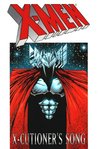
X-Cutioner’s Song

X-Men: X-Cutioners Song TPBX-Men: X-Cutioners Song TPB by Fabian Nicieza

My rating: 1 of 5 stars

I’m not a fan of crossovers. At the core, what is a giant comics crossover other than simply an attempt to get you to buy more comic books? If done right, I suppose, a crossover might also be a chance to bring different characters together and spin a story that spans a couple universes or intertwines a few storylines, but honestly—I don’t think I’ve ever seen a crossover done well. (The Great Fables Crossover was certainly a disappointment, and I’m viewing Dark Cybertron as an unwelcome interruption in my favorite regularly-scheduled comic book.)

There’s so much that can go wrong. Crossovers often have the feeling of being written by a committee and then being put together on the page by a subcommittee, or an entire handful of subcommittees. And this is often I imagine exactly how it’s done. Because each comic title has its own writers and artists, usually with their own vision for the feel of the series and where the stories are going, the pacing and how they’re developed, and oftentimes slamming them together ends up just feeling like a train wreck. Now imagine trying to do that with something as huge and unwieldy as the various X-People Marvel lines, in their early-90s heyday. That’s pretty much exactly what you get with X-Cutioner’s Song.

There’s one reason I bought this volume: nostalgia. I picked it up at a Marvel-themed gift-shop at Universal Studios as a teenager because as a kid I had been on the ground-floor of the launch of Marvel’s second X-Men title. I think I still have issue #1 of that “mutant milestone” floating around somewhere. As a young reader though, I was the primary target of this, the first major crossover involving the title, which was engineered solely to get a kids like me to shell out money for not just the normal X-Men comics but also the Uncanny X-Men, X-Factor, and X-Force. (They were doing the same thing with Spider-Man titles at the same time, calling it Maximum Carnage, and I remember a few of my friends scrambling to piece together the story through Amazing Spider-Man, Web of Spider-Men, and whatever other Spider-titles were running then.) Of course I couldn’t do this, and so there were always holes in the narrative. I wondered what had happened to my characters during their appearances in the other issues. And I had lost many of the issues I had managed to collect anyway, so I bought the volume.

I re-read it again this summer for the same reason: nostalgia. That’s really the only reason there is to pick up this particular collection. The train wreck analogy actually works quite well here. In fact, I think I may have stumbled onto the solution for the X-Men’s faltering transition to the big screen: get Michael Bay to make this into a movie. Everything is ready for him: the thin veneer of plot involving Cyclops and Jean Grey getting kidnapped, Xavier being nearly assassinated, no one knowing what’s going on, and a confrontation between Cable and his clone Stryfe. Pieces of information are dangled but never really resolved. (We learn pretty much nothing about the origins of Cable and Stryfe, though they dance around it the entire book.) The lurching narrative is liberally interspersed with wild melees in which X-Factor fights X-Force, X-Men fight X-Force, X-everyone fights various villains, and Cable and Stryfe fight each other. Apocalypse and Mr. Sinister make random, fairly inexplicable appearances and disappearances. Women (and men!) wear spandex. Cable, Wolverine, and Bishop hang out on a space station. Listing all these things actually makes it sound like more fun than it was.

I think part of the problem with the various X-Men titles is that there’s just so much backstory that at some point it gets nearly impossible to keep track of it all. I looked up the entries for Cable and Cyclops on Wikipedia after reading this, for example, to see if I could answer the questions that this volume did not. It was dizzying. There’s something very compelling to such a Byzantine history, but it also makes it largely inaccessible. It also makes something like X-Cutioner’s Song incredibly unsatisfying as a stand-alone piece. (Though at the end of the day, this is what comic book companies want, right? Because otherwise you might not buy the next issue.) This volume was especially maddening as it didn’t even tie up the crossover pieces that it developed. The story “began,” for instance, with the X-Force on the run because X-everyone-else though that the X-Force leader, Cable, had assassinated Xavier. X-Force, which consists of the younger, next generation of mutants, go head to head with some of their former mentors and trainers. This wrinkle was actually kind of compelling. There was also some good tension as the X-Force de facto leader, Cannonball, accompanied the X-Men to carry out missions while the rest of his team languished in captivity.

But you know what? The volume ended with absolutely no resolution on this score at all. Some of the heroes end up on the Moon to witness the final Cable/Stryfe confrontation, and then that’s it. We don’t even get a hint or an afterword or something explaining what happens to the kids in X-Force (or why Cable had abandoned them in the first place or what happens to them after he disappears). There’s a distinct impression that the compilers simply did not care enough to tell us. Another indication of this lack of care: a table of contents to help keep all the different issues in this volume straight and then the omission of page numbers from any page in the volume.

If there’s a bright spot in this volume (besides the nostalgia for trading comic books on the playground and creating our own X-characters during recess), it’s the art in the X-Factor issues. I don’t know who was drawing those issues and I don’t care enough to wade through all the names to find out, but it’s a marked departure from the generic (though not bad) comic book art throughout the rest of the book. I remember that as a kid though it drove me nuts. It was almost too noir, definitely not as realistic as the artwork in the other X-titles (using the term realistic, of course, very loosely). Looking back though, it seems the freshest and most original part of the book.

I wonder what happened to those characters after this chapter was complete. Because on the one hand that’s the appeal of long-running comic titles like these: you know the stories keep going on and on and on. On the other hand though, that’s the problem: the stories go on, but the characters never change, not really. Wolverine will always be the exact same person. Apocalypse will always come back. We’ll go through the same variations of the same stories over and over again, but—since (in some respects) I’m no longer twelve—I find I don’t have the patience to play.

A Crooked Line

A Crooked Line: From Cultural History to the History of SocietyA Crooked Line: From Cultural History to the History of Society by Geoff Eley

My rating: 3 of 5 stars

What does it mean to be a professional historian today? What does the landscape of the profession look like? What are the big ideas or transformations over the past half-century or so that have shaped how historians work and think? In A Crooked Line, Geoff Eley, a European historian at the University of Michigan, provides a personal answer to these questions from the perspective of a historian who has lived and worked through the shaping of the profession during this period. A Crooked Line is not quite a memoir, not quite a historiography, and not quite a manifesto for political and social engagement among historians. It is a little bit of all of these things, blending and transcending them to become something quite unique: a historian’s reflective survey of what the field looked like from the vantage point of a young historian just beginning a career in the sixties to what the field looks like today.

As a historian of science—and one who came to the field from outside history—I sometimes feel cut off or at least rather uninformed about the broader debates and transformations that have shaped the historical profession as a whole. I felt a bit out of my depth—or at least out of my fit—at a recent workshop at Bielefeld University rubbing shoulders with historians pursuing a very theory-laden sociological approach to history while I presented a talk on John Herschel’s stellar spectroscopy (or lack thereof). I had only a dim inkling of the importance of the Bielefeld School in the history of history. (On the other hand, the history students I interacted with there only asked whether Herschel’s hesitation toward spectroscopy was evidence of his resistance to a Kuhnian paradigm shift.) Clearly, we did not share a great deal of historiographical ground. I asked my roommate, a Latin American historian, for a good book that would give me a broad overview of historical theory and provide some touch-points for connecting that theory with practice. He recommended Eley’s book.

I’m sure A Crooked Line didn’t go all the way toward addressing my ignorance, but it certainly helped. Eley tells the story from his own perspective as a historian coming of age at the eve of history’s first large shift from building traditional narratives to using the tools of sociology to address large-scale questions of the development of society and class relations. This is the portion of the book he titles “Optimism,” chronicling his own excitement as a historian realizing the possibilities of the social sciences to help answer big questions in history, primarily from a Marxist, materialist perspective. Here, the work that he cites as indicative and exemplary of this approach is Edward Thompson’s The Making of the English Working Class (1963). British Marxist historians led the way with utilizing the empirical tools of social science to provide an explanatory framework for the evolution and the conflicts in society at large. For a historian, this held the promise of understanding, engaging, and perhaps even shaping social change.

In the second portion of the book, Eley focuses on the particular challenges of German historiography and the ways in which it illustrated the limits of a materialist approach. In particular—and here the section of the book is called “Disappointment”—the historiographical puzzle of Nazi Germany, the failure to explain the atrocities of World War II using the materialist, structuralist tool bag of social history, tempered early optimism regarding this approach. Tim Mason’s studies of Nazism in the 1970s, according to Eley, illustrated the difficulty of building up a complete history of the Third Reich from the foundation of class relations.

In “Reflectiveness,” the third portion of the work, Eley discusses the “linguistic” or “cultural turn” in history that took place in the 1980s as the field of history became influenced (or infiltrated, depending on your point of view) by anthropology, literary and art studies, oral histories, and the prioritizing of the unique, local, or small-scale, resulting in a historical approach much more open to cultural studies. This was tied to the realization that categories such as gender, race, and colonialism could be used in new and important ways for understanding history. Eley touches on the culture wars that resulted, as traditional historians cleaved to more social historical approaches and resisted what they saw as a “dissent into discourse.” Here the keystone text is Carolyn Steedman’s Landscape for a Good Woman (1987). Eley takes a bright view of the efflorescence of such cultural approaches, asking why such tools and methods should not be used to compliment the historian’s work. Cultural studies, he convincingly argues, bring new questions and methods to the table and moreover make heard historic voices that have been silenced in the past.

Throughout the book, in his survey of the two great turns in history of the course of the second half of the twentieth century—first the turn toward the social sciences and then toward cultural studies—Eley wants to map these changes to outside influences, particularly political. One of his primary claims is that history should be politically engaged. Perhaps though because of my own hazy grasp on the political history of the 1960s-80s it wasn’t always clear to me how this was the case, either proscriptively or descriptively. History as an explanatory tool for society, a critical self-remembrance, and as a counterpoint to flawed and potentially destructive global narratives, yes, but Eley seems to claim that the influence was often the other way—the political situation influenced the sorts of questions and methods the historical field itself pursued. I needed these dots connected more clearly for me.

The big omission (for me) in this historiography was the history of science. Where does Eley see the history of science as playing a role (if any) in the turns he’s outlined? Historians of science certainly played a role in the culture wars, and cultural studies of science abound today, as in an earlier generation did social studies of scientists and their research schools. I would love to find a similar survey of the field written from the perspective of a historian of science. The closest thing I know of is Helge Kragh’s An Introduction to the Historiography of Science, which, while helpful, lacks the personal flavor and the evident passion that made Eley’s book such a pleasure.

Peace Like a River

Peace Like a RiverPeace Like a River by Leif Enger

My rating: 2 of 5 stars

My sister has some credibility when it comes to recommending books. The last one she told me I had to read was Gilead, and I was not disappointed. It was iridescent. So when she delivered another novel about family and love and God set in yesterday’s Midwest, I dutifully put it in the basket beside my bed to ignore for a few months—but not forget. And I eventually got around to it.

Leif Enger creates a family, a single father and his three children in a small Minnesota town, and writes their meandering tale beginning with an abortive act of violence through escalation to the eldest son’s irrevocable act of retaliation (or perhaps preventative justice) and exile. All of this takes place in roughly the first third of the book. The rest is the father and the remaining two kids going to find the lost son.

In grittier hands this would be a tale of a family broken, of the ideals of pacifism playing out against darker realities in a strained relationship between father and son, maybe something like We Were the Mulvaneys. But Enger’s not going to go in that direction. There is murder, at several points throughout the book, and injustice, maybe even some suffering; but from the first page you realize this is a Christian novel, set in a Christian world with a Christian protagonist and by gum it’s going to have a good, Christian ending (and not some ambiguous Catholic ending either).

But, like I said, my sister recommended it. So I kept reading. And to be fair, Enger has a knack for creating characters and (when he’s not laying it on too thick) bringing the bleak beauty of the Midwest to life.

There are a lot of things going on in the novel. The most poignant for me was the characterization of the narrator—the middle son—and his relationship with his exiled older brother and his younger sister. This was where the story felt real. I admire anyone who can bring such a depth of characterization to a tale.

As far as the plot goes, there are snatches of courtroom drama, road trip narrative, romance, a touch of mystery, and—a bit incongruous but not unexpected—eschatology. There’s also a pleasant under-layer of Western lore communicated through the stories and poetry of the younger sister. The language is lovely if at times heavy-handed. The plot drifts but never slowed enough to lose me, though there were moments when the narrative structure was strained. The novel’s superficial villain, for instance, becomes a superficial friend, only to disappear and be randomly murdered off-scene.

My biggest difficulty was with the character of Jeremiah Land, the father who is in many respects the hero of the novel. Imagine a cross between Atticus Finch and Old Testament Elijah. Land is the pole-star of the narrative, the hinge on which everything else turns, and the way that Enger handled this character is what makes this work to me sit firmly in the camp of “Christian literature” (i.e. something you might see on the shelf at Family Christian Stores beside a lighthouse painting and a Precious Moments display.)

In one of the novel’s first episodes, the narrator witnesses his father praying several feet off the ground. If that sounds bizarre, it’s mediated a bit by the fact that the narrator is explaining all this through the haze and hagiography of a nine-year-old remembering his father. Miracles follow Land around throughout the novel: he is carried off by a tornado but lands unharmed, he has a good measure of prescience, and he heals people (specifically his enemies) with a touch. He works as a janitor. He’s humble. He’s good. He’s strong. He’s kind.

A child’s recollection of a saintly father is one thing. And a flat character is not necessarily a bad thing. What was more difficult for me in this book was what Land’s character said about Enger’s God—or rather, the independent, self-reliant, American Midwestern ideal of God. Jeremiah Land is a man alone, at times against the world, but his confidence comes from experience: his God is always the big guy upstairs who has his back and tells him what to do.

The irony is that Enger creates a tale in which a man like Land is faced with what would seem to be a huge challenge: a horrific act that has fractured their family and called his own ideals into question. At the very least it seems there would be some self-reflection. Some soul-searching. Some transformation of character. But there doesn’t seem to be any growth or change or introspection or foundational shifts at play throughout the novel. No one ends up seeing the world in a different way. Simply dig a bit deeper in the King James Bible and wrestle a bit harder in prayer, and things will work out. (And even if they work out [spoilers!] with you dead—no worries, we get a glimpse of paradise.) There’s no loss in this novel, no ambiguity. Characters end the novel with the same opinions, the same outlook and perspectives, that they had when the book opened. That includes everyone we get to know: the narrator, his sister, Land, and the exiled son. The peripheral characters, those who enter Land’s orbit, never get developed; they simply become obliging satellites to Land’s sanctity.

The events at the beginning of this novel set it up to be jarring, to give you some things to wrestle with. But nothing really comes of it. Ultimately you get some good stuff in a good book, just sort of jangling around, with a feel-good God.

She has The Remains of the Day next on the list for me. My hopes are a bit higher.