Category Archives: Reviews

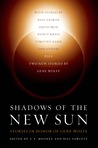
Shadows of the New Sun

Shadows of the New Sun: Stories in Honor of Gene WolfeShadows of the New Sun: Stories in Honor of Gene Wolfe by Bill Fawcett

My rating: 2 of 5 stars

If you love Gene Wolfe, read this book. If you don’t know who Gene Wolfe is, or if you haven’t yet gotten around to reading his stuff, don’t read this book. Read his stuff. Because, consider: for what other contemporary science fiction and fantasy author could you publish an anthology with original contributions by such well-known and respected names all somehow influenced by and tributing him? Even if you don’t believe all your nerdy and literary friends about how great Gene Wolfe is, you should believe Gaiman and Brin and Haldeman and Zahn.

That said, I only gave the anthology two stars. As much as I wanted to like every story in here, I was less than impressed by many of them. It’s probably not fair to compare them to Wolfe’s own stories (the anthology is Shadows of the New Sun, after all), but I couldn’t help it. A story written about Severian by someone other than Wolfe? Someone else trying to play with myth and allegory in a Latro tale? A view of Ushas through non-Wolfean eyes? They felt flat to me. Even Gaiman’s contribution was a bit of a disappointment. I would also have enjoyed hearing more about Wolfe’s life and influence; the introductory paragraphs before each story weren’t enough, especially when each story was followed by author bios two or three times as long.

There were bright spots. I especially enjoyed the contributions by Brin, Allston, Swanwick, and Zahn. Maybe because they were original pieces, and to me that seems the best tribute to Wolfe: be original. Do fine writing, but be original. Not that the others were totally derivative, they just weren’t Wolfe enough to play in Wolfe’s worlds or to play the kind of literary games that Wolfe does so well. Or I’m just picky when it comes to my favorite writer. If anything, this anthology (in particular Swanwick’s story) did inspire me to re-read The Fifth Head of Cerberus, and that may be the best gift of all.

View all my reviews

King City

King CityKing City by Brandon S. Graham

My rating: 3 of 5 stars

If you’ve ever sat at a railroad crossing and wondered where those boxcars got tagged in vibrant colors and an apparently alien language, the answer is on a siding in King City. King City is Gotham meets China Mievelle’s New Crobuzon. It’s Scott Pilgrim’s stomping grounds with more grit, sex, space aliens, and zombies. It’s the Uglyverse for grown-ups.

Joe is a Cat Master, trained to use his super-genius cat in countless different ways as a living weapon. He’s come back home to King City, where it seems everyone is a spy or ninja or graphic artist and the streets are all marked and re-marked with past battles and advertising. There is a Demon King that needs to be stopped, but the story actually revolves around Joe helping his friend become a hero and saving his ex-girlfriend’s lover from an addiction to chalk. The anti-climax of the story works: King City is a place where you know a hundred epic struggles are playing out in the background, but Joe has come home and learned to grow up.

The art is a paradoxical blend of cartoon and grime. It fits the city Graham creates, which in certain panels resemble the bizarre lovechild of a Where’s Waldo page and a Mad Magazine spread. The entire book is black-and-white, but you almost don’t notice. The electric detail of each image makes your mind supply the color without thought or effort. King City is vividly colorful, and you remember it so. It’s also pleasingly surreal in its position on the junction of fantasy, noir, and sci-fi.

It’s not for kids. None of the images are explicit, but there are seedier places in the city (where most of the time is spent) where you can get anything you want for the right price: knives, drugs, sex. A drug-knife you can have sex with. King City can be a rough place.

But keep your cat close, and things will probably be alright.

View all my reviews

Merchants of Doubt

Merchants of Doubt: How a Handful of Scientists Obscured the Truth on Issues from Tobacco Smoke to Global WarmingMerchants of Doubt: How a Handful of Scientists Obscured the Truth on Issues from Tobacco Smoke to Global Warming by Naomi Oreskes

My rating: 4 of 5 stars

I was asked a while ago by a local paper to comment on the issue of global warming. When I had difficulty reducing my views to a quotable byte, I wrote an editorial for the paper. In the editorial, I used the term “manufacture a controversy,” alluding to the fact that while the scientific consensus on global warming is established and has been for decades, there remains the perception for most people that climate change is not well understood and the science is questionable.

This manufactured controversy is what Oreskes and Conway, two historians of science, explore in this book. In several exhaustively-researched chapters, they draw links between “expert” deniers of the dangers of tobacco, second-hand smoke, ozone layer depletion, acid rain, and finally global warming. In each of these cases, Oreskes and Conway argue, there was a clear scientific consensus deliberately attacked by a handful of skeptics. These attacks resulted in perceived controversy for the popular press and ultimately influenced politicians and policy—usually as an argument for not doing anything.

The story the authors tell begins with the tobacco industry, which—as scientific evidence regarding the dangers of smoking and second-hand smoke mounted—enlisted individual scientists and publicity firms to mount a campaign of doubt, making it appear as though the scientific community was divided and more research needed to be done. Oreskes and Conway draw much of their evidence from documents that have been recently made public through the Legacy Tobacco Documents Library (http://legacy.library.ucsf.edu). After this, they argue, many of the scientists and organizations enlisted by the tobacco industry took the same approach to a wide variety of environmental topics, including and culminating with global warming.

Popular perception is biased against the true scientific viewpoint by two factors: a “fair reporting” approach that placed the skeptics’ viewpoint (even when only held by a small minority) on equal footing with the mainline scientific opinion and the fact that skeptics published most of their work in the popular press while the evidence and research on global warming done by the actual scientific community appeared (and continues to appear) in peer-reviewed journals with very small audiences.

So what’s at play here? Do Oreskes and Conway have a conspiracy theory? No. What they have is a group of scientists who came to prominence during the Cold War and then, late in their careers and after their own research days were over, came to see environmentalism as the newest threat to American liberty. The common theme running through tobacco smoke, acid rain, DDT, ozone depletion, and now global warming is that each represents a market failure—a situation in which the true costs are hidden or not quantifiable by the free market. In such situations, government regulation is often necessary. The villains in Oreskes and Conway’s narrative are a small minority of scientists who did not want this to happen and so collaborated with industry, policy-makers, and the media to perpetuate a sense of controversy where the science was clear.

The narrative is compelling. I recommended the chapter on global warming for a discussion group, and though each chapter is densely researched, a friend told me that it read for him like a murder mystery. The historical chapters show two historians of contemporary science at their finest. The concluding chapters, in which Oreskes and Conway offer their take on why controversy is created on these issues, blaming it on “free market fundamentalists” who cannot accept government regulation in any form and are willing to smear any science that disagrees with them through unscientific means, hit hard and—I feel—largely accurately. Finally, Oreskes and Conway offer some insight into why the public often goes along with this: a misunderstanding of how science actually works and a confusion between scientific consensus (attained) and absolute proof or clarity (never attained in science).

Read it. Recommend it to your friends. It is easy to understand why the tobacco industry would want to manufacture doubt about the true costs of their products; it should be fairly easy to see why many today would want to do the same regarding the true cost of fossil fuels. This book connects the dots.

View all my reviews

Teardown

Teardown: Memoir of a Vanishing CityTeardown: Memoir of a Vanishing City by Gordon Young
My rating: 4 of 5 stars

I did not grow up in Flint, so I’m pretty sure I cannot call Young’s memoir a book about my hometown. But many of my relatives lived and still live in Flint, and I grew up just outside it and spent quite a bit of time in and around it. I remember going to Autoworld as a child. My father worked for GM. My mother worked for Hurley. Though I definitely lack cred as a true “Flintoid,” I consider myself among this book’s intended audience. I must have been, because I couldn’t put it down.

Young’s memoir is not perfect. I would have liked to hear less about Gordon Young and more about Flint’s history and the neighborhoods Young rediscovers. Young’s account of his own home-purchasing odyssey in San Francisco– though it helped illustrate the poor choices that led to the housing crisis and paint a sharp contrast between Flint and the West Coast– was tedious, as was the narrative thread of Young going back and forth about whether he should help the city out by buying and refurbishing a house in Flint. To his credit, Young finds another meaningful way to contribute to his hometown.

Yet the book itself might be his most important contribution. Young’s accomplishment in this work is letting us see Flint through both his past memories and his present journalistic eyes and communicating its history and today’s reality. A comprehensive story of Flint would be a considerable contribution to American history, involving histories of labor, industry, race, capitalism, technology, and urban construction and de-construction. That work remains to be written, but Young makes a powerful case for why it should– and his helpful bibliography points to many additional resources. More than this though, Young’s book gives a compelling picture of the city– of both the harsh economic realities on the ground and the spirit of those who remain to face them.

I have a personal interest in this story. My sister and her husband moved back to Flint after he completed his graduate degree, bought a house in the city, and are at the epicenter of many of the changes and challenges Young describes in this book. Flint’s story is one that needs to be told, and Young’s work is an effective and compelling first chapter. He doesn’t offer many (or any) solutions, but he introduces some of the characters, fills in the background, and gets you rooting for the underdog.

Honestly, I don’t know if this book would appeal to those who don’t already have a place for Flint in their hearts. But if you’re from Flint, or especially if you’re from one of those Flint satellites like Burton, Flushing, Fenton, Swartz Creek, Grand Blanc, or Gaines and grew up hearing of Flint’s glory days alongside ominous accounts of how bad it had become– read this book. It’s your story too, whether you realize it or not.

View all my reviews

Peace

PeacePeace by Gene Wolfe
My rating: 5 of 5 stars

This is one of my favorite books. I still don’t completely understand this book. With Gene Wolfe this is not a problem (at least with his earlier works—for me, the jury is still out on some of his latest novels). His books are layered, and they always repay the slow, careful re-read. I’ve gone through this one at least three times now, and each time I pick up something new. Wolfe remains my favorite author, and Peace I think is an excellent introduction to his work, especially if you’re not coming from a science fiction or fantasy background.

On the first level, Peace is the beautifully written memoir of Alden Dennis Weer and a paean to life in a Midwestern town from a childhood among horses and coaches to old age among factories. The language itself makes it worth the read. Wolfe is a craftsman, and his skill with description, dialogue, and the creation of characters is showcased in any of his works but especially shines throughout Peace. I would be interested to know how much of this work is biographical. (Though Wolfe grew up in Texas, he’s stated that there’s more of him in Weer than many critics recognize.) There’s a richness to the memories that Weer relives throughout the novel—places and people and lost pocket-knives—that carries a deep reality, as I suppose is true with any great work of literature. Yet Wolfe is a “genre” author, so he can wrap this in surreality and twist it in strange ways. (One of my favorite passages is a story-within-a-story when Weer’s childhood housekeeper is telling a story she heard as a child from her own housekeeper. Wolfe deftly telescopes the narrative until, like looking down a tunnel of mirrors, you realize that narrator narrating the story-within-the-story is perceiving you, the reader.)

On a second layer, Peace is a book about memory and death. Weer is writing at a time when all the characters in the novel are dead, and his narration moves back and forth seamlessly between memory and across years. He writes his story from various rooms in a house he claims to have had built to encapsulate various locations from his long life, and he seems to be haunting his own memories like a ghost. On this level, the novel is a tale about childhood and old age and all the memory and loss that goes with both and in many ways reminds me of “Forlesen,” one of my favorite Wolfe short stories.

On a third level, Peace is about storytelling. The novel is a patchwork of stories embedded within other stories, something characteristic of much of Wolfe’s fractal-like writings. Some of the stories, such as the one Weer reads as a child about the princess in the tower, clearly relate to episodes from Weer’s own life (in this case his Aunt Olivia’s succession of suitors). Some are much more ambiguous, and some relate to the novel’s overall story in ways I still don’t perceive (such as the epistolary tale from the carnival near the novel’s conclusion). There are ghost stories and there are stories left unfinished. There are threads I have not yet unwoven, one of the things that keeps me coming back to Wolfe’s work and keeps internet listservs humming with speculations.

And finally, Peace is a mystery and a horror novel. Yet it’s subtle horror, buried so deep that upon first blush, much like Wolfe’s short story, “A Solar Labyrinth,” there doesn’t seem to be much there at all. But by the end of the book you’re left with the distinct impression that Weer has killed at least two characters and possibly more. Nothing is said directly, but the clues are there, the lack of direct acknowledgement making it all the more chilling. Other characters simply disappear. (Did Margaret Lorn’s father ever make it in from the storm?) Things happen off-scene that carry significance the narrator only hints at. Is this because he’s recalling things seen from the vantage point of childhood? Or because there are things he simply does not want us to know?

And then there is Weer’s fate itself, again something that is never spelled out (far be it from Wolfe to have such a low estimate of his readers’ astuteness) but that is made fairly clear from the clue of Eleanor Bold’s tree and the vignette of the necromancers at the grave’s edge (as well as the title of the novel itself).

Strange and dark things happen in Peace, but they are of the horror and wonder that is a large but unseen part of anyone’s life. I think this is what makes Peace so effective: like Weer, we all have our secrets and memories of the ephemeral and the ghastly. Peace is a life story, which always eventually becomes a ghost story.

View all my reviews

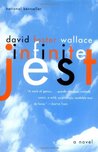
Infinite Jest

Infinite JestInfinite Jest by David Foster Wallace

My rating: 3 of 5 stars

Imagine an immense book about the Royal Tenenbaums, but instead of the father just being generally quirky and giving his family complexes, he also makes a fortune as a genius optical theoretician, opens a tennis academy, produces movies including one so entertaining that anyone who sees it becomes a mindless vegetable, and ultimately kills himself by putting his head in a microwave. And all of this happens before the novel’s narrative even begins.

David Foster Wallace’s Infinite Jest is a little bit like what that book might have been like. Like Wolfe’s Peace, the last book I reviewed on Goodreads, Infinite Jest has multiple levels. As I got into it I was a bit surprised to find I had never seen it classified as science fiction. Many of the elements are there: a near-future in which the USA has sort of haphazardly absorbed Canada and Mexico, waste launched by giant catapults into a toxic landfill where much of northern New England had been, at least one ghost who may be electromagnetically induced, and a cabal of paraplegic Quebecois separatist assassins trying to get their hands on the “Entertainment” mentioned above to use it as the ultimate terrorist weapon against the US. In this respect, aspects of the book read like an incredibly dense, exceedingly verbose cross between Philip K. Dick and Douglas Adams.

Infinite Jest is also about substance dependency (which also brings Dick to mind): what it looks like and feels like, what it does, and how people live with it and after it. Much of the action of the novel takes place at a drug-recovery halfway house, and the portions of the work that I found most compelling were the long descriptions that one of the novel’s main characters, a former addict named Don Gately, provided of the ins and outs of AA meetings. Gately is surrounded by the after-effects of drug addiction and alcoholism, and he moves through it as a quiet, humble, and intensely real character, even rising briefly to the level of heroics. Wallace gives the reader a long look into the mind of (several) recovering addicts as well as an unflinching view of psychotic depression, but what is amazing about the way he does it is that you come away with the sense that not only are all these people true and real characters, but most of them are intensely likable.

The book is also about tennis, at times excruciatingly, precisely, microscopically about tennis. Besides the halfway house down the hill, the tennis academy founded by one of the protagonist’s now-deceased father is the other focus of much of the book’s—I almost want to say action, but you might just as well write description. But of course even here it’s about much else: family relationships, sibling love, adolescence, and again some drugs. And even in the places where the detail reaches a near-frenzied level of description, as for example in Wallace’s extended description of a Risk-type game the tennis players play for fun on a field extending over several tennis courts that continues to a play-by-play description of said nuclear-Armageddon-simulation game, it is often to build up to a situation in which the humor (not in a laugh-out-loud sort of way but in a more Wes Anderson-esque “Isn’t life just so excruciatingly funny that I don’t know whether to cry or laugh?” sort of way) could never have arrived at without the detail, and so much of the time the labored detail is worth it. (Plus, an argument could be made that you can’t create characters as intensely real as Don Gately or Mario Incandenza without hundreds of pages describing their memories and thoughts and random experiences.)

But the detail is also the biggest hurdle in reading this book. Wallace introduces so many characters it’s nearly impossible to keep track of them all. Most frustratingly, some of them never seem to appear again or to appear again briefly only to disappear without a trace. Once you’ve found the author’s rhythm (which took me about 300 pages), you ride that through most of the middle of the book (which is where a lot of the truly wonderful prose takes place), and then you’re amazed and excited when the lives of some of these characters start to intersect. Plus the wheelchair assassins are getting closer, and the dreaded Entertainment could turn up anywhere, and at least one character gets to do something heroic—and (spoilers)

Well, then the book ends. With so much left hanging. With very little neatly tied up. The ending reminded me of my experience after viewing Donnie Darko. I thought the movie was great but had to spend an hour afterward researching on the internet what exactly had happened in said movie and was disappointed because I didn’t think enough clues were there in the movie itself for viewers to make clear sense of it. Infinite Jest is quite a bit denser than Donnie Darko, so I’ll admit there are probably loads of clues I missed. Re-reading the first chapter hinted at some pivotal interfacing between main characters taking place after the primary narrative’s conclusion (a little bit like going back and re-reading the beginning after finishing the end of Peace or Lafferty’s The Devil is Dead only with a few more inches of paper between), but not much that I could tell beyond that.

Was I disappointed? A bit. I wanted a bigger narrative payoff after such an investment of time. The book is after all called Infinite Jest, but ultimately I didn’t feel the author was playing a joke on me. I didn’t feel like my time had been wasted. I’ll admit I started to get aggravated with the end-notes, especially as it seemed some pivotal information was hidden away there that I had to keep interrupting the narrative to go ferret out (and which I often didn’t). If I ever feel audacious enough to tackle this 1000+ page leviathan again, I definitely won’t tear through the final dozen pages nearly beating my head against the wall because who needs more back story about Gately’s addictive death-spiral because I just want to find out if these crazy Canadians find the cartridge and whether Gately and Hal and Mario and Joelle are all going to be okay. Wallace doesn’t tell you whether your characters are going to be okay. But he does say a lot about addiction and reality and life, and the book reads like he was someone who knew.

View all my reviews