Category Archives: Writings

August offers a look at Lyra

When I talk to people about observing here in town, they often bemoan the fact that light pollution makes stargazing all but impossible from within the city limits.

Though it is true that observing from an urban setting doesn’t compare to an experience under truly dark skies, it’s certainly not the case that there’s nothing to see from one’s own backyard or even sidewalk.This month I’ll consider some of the sights in the constellation Lyra, which is almost directly overhead throughout August in early evening.

Lyra is a tiny constellation, but it holds a wealth of lovely double stars that are bright enough to be seen without a pilgrimage to the deep, dark countryside.

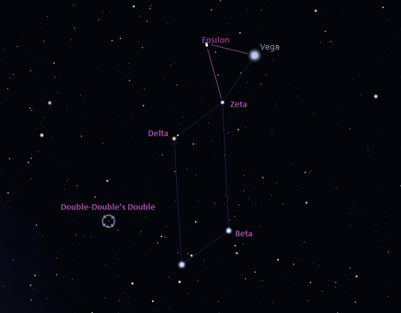
The constellation Lyra is easy to find on clear nights. Vega, its brightest star and the brightest star of summer, is nearly overhead at sunset. Vega marks one apex of the famous Summer Triangle, an asterism of three bright stars high in the summer skies. Lyra itself though is small formed of a triangle of stars attached to a larger parallelogram. Classically, the constellation was seen as a harp or lyre.
Lyra

My observations are made with a six-inch reflecting telescope from my own yard in Kankakee, but a smaller telescope will reveal these sights as well. You’ll want to use eyepieces that give a relatively low magnification. (I used about 40x. Calculate the magnification of your eyepiece by dividing your telescope’s focal length by the focal length of your eyepiece. A shorter eyepiece focal length gives greater magnification.)

Sometimes you want higher magnification, as when you’re viewing the planets or the Moon and want to see details, but for the following views a lower magnification is better.

Start your tour with Vega, especially if you’re new to stargazing. A single star doesn’t look much different through a telescope, but this will give you a chance to align your finding scope (if your telescope has one) and test your instrument’s focus. It will also give you an idea of the seeing conditions for the night. If you can focus Vega down to a brilliant, sharp point, and if you can see one or two of its dimmer companions in your telescope’s field of view, you should be able to spot the rest of the objects in this list.

Hop down from Vega to Zeta Lyrae, the dim star where the triangle meets the parallelogram. This is one of the many double stars in Lyra. Double stars are great targets for light polluted skies. Unlike nebulae or galaxies, they are fairly bright and thus easy to enjoy even from one’s own backyard. Through even a small telescope, Zeta Lyrae is revealed to be a wide, uneven double, and many observers report seeing a beautiful color contrast between the component stars.

Moving up to the third star of the tiny triangle that makes up the top portion of Lyra, we find Epsilon Lyrae, one of the most popular double star systems in the sky and an example of why some observers (like me) get so excited about double stars. At 40x you may simply see what looks like a wide pair of white stars. But if you increase your magnification (I used 130x), you’ll see that each of these stars is actually itself a pair of stars. The entire system is known as the “Double-Double.” You’ll need a steady eye and good seeing to split them, but you’ll know if you’ve succeeded by noticing the orientation of each tight pair: they’re inclined at ninety-degrees to each other.

Moving back to a lower magnification, each of the stars at the apexes of Lyra’s parallelogram is a treat.

Delta Lyrae is a wide double star in a diffuse cluster of stars. One of the components is a lovely orange in contrast to the surrounding blue stars.

Beta Lyrae also is a group of colorful stars. (The Ring Nebula is nearby, halfway between Beta and Gamma Lyrae. From my front yard, the Ring Nebula at 70x looked like a faint smoke ring, barely visible.)

But my favorite sight of all in Lyra is a bit off the beaten path and not terribly well known. It’s sometimes called the “Double-Double’s double,” but I think it’s actually nicer than the more famous Double-Double. It’s a pair of double stars, like the Double-Double, known as Struve 2470 and 2474. They’re dimmer than the pair that make up Epsilon Lyrae, but because the components are farther apart they’re easier to split. They also have more marked colors, the brighter components appearing yellow in contrast to the dimmer bluish companions. Moreover, by some cosmic coincident the pairs are orientated in the same direction so they indeed look like almost perfect twin double stars in a single telescope eyepiece. This view alone would be proof enough for anyone who says the city skies are too bright to hold telescopic wonders.

doubles
Struve 2470 and 2474, the “Double-Double’s Double,” image from bestdoubles.wordpress.com.

This column first appeared in the Kankakee Daily Journal.

New Horizons

108417main_image_feature_267_ajhfullImage courtesy NASA.gov.

Fast, small, cheap, and putting us in touch with the outer reaches of the solar system, the New Horizons spacecraft, which will reach its closest approach to Pluto this month on July 14th, is billed by NASA as the “smart phone” of interplanetary robotic explorers. The fastest spacecraft ever launched from Earth, New Horizons is an example compact, efficient engineering opening the door to new discoveries. This month the probe, launched nearly a decade ago in January of 2006, completes its three billion mile journey, the longest journey ever to a particular object in space.

Besides the technological achievements this plucky probe represents, New Horizons is a step into a new solar system frontier, a glimpse of a region of our own planetary system where we have not yet ventured. The close look at Pluto afforded by this mission is an opportunity for the first time to study the place where the solar system gets weird. Since tiny Pluto was serendipitously discovered in 1930 by Illinois native Clyde Tombaugh, we’ve known that it didn’t quite fit with the rest of the planets. We have small, rocky planets (Mercury, Venus, Earth, and Mars) in the interior of the solar system and large, gaseous planets (Jupiter, Saturn, Uranus, Neptune) on the periphery. Pluto—usually beyond Neptune and much smaller than any other planet—is the odd man out.

Yet it’s only recently that we’ve realized Pluto isn’t alone in its strangeness. Rather, it’s the first known object from a whole new region of the solar system. This region—which is turning out to be filled with small icy objects like Pluto—is known as the Kuiper Belt, and we still don’t know much about it. We do know that Pluto was only the first dwarf planet discovered in this region. Recently Pluto has been joined by the discovery of other dwarf planets beyond Neptune like Eris, Makemake, and Huamea. New Horizons affords the first close look at this strange region of space. Once it passes Pluto, the spacecraft may be redirected to pass another Kuiper Belt object.

Besides the Kuiper Belt, Pluto is itself still an oddity. It will be the first icy planet studied closely, for instance, and may help answer the question of whether certain types of comets are simply objects like Pluto that fall into the inner solar system. Pluto also offers an example of a gravitational oddity: along with its largest moon, Charon, Pluto is technically a double planet. Pluto and Charon orbit a common center of mass between the two objects, making them unique in the solar system by forming a double planet instead of simply a planet and moon.

And then there’s Pluto’s complicated system of newly discovered moons besides Charon. Tiny Nix, Hydra, Styx, and Kerberus have recently been shown to tumble about Pluto in a chaotic system. These miniscule objects have been studied using the Hubble Space Telescope, but New Horizons will provide the first opportunity to study them up close. Indeed, the presence of Pluto’s unexpectedly complex satellite system represents one of the large unknowns of the mission: is the space around Pluto empty or filled with debris that could pose a danger to the speeding spacecraft? The weeks leading up to New Horizon’s encounter with Pluto have been a time of suspense.

New Horizons is a fly-by mission, meaning that it’s not landing on Pluto’s surface (like the Mars rovers) nor is it entering orbit around the dwarf planet (like Cassini around Saturn or Messenger around Mercury). New Horizons will study Pluto from its closest distance of about six thousand miles on July 14th while barreling past the planet at nearly forty thousand mph. It has to be moving fast—it’s had over three billion miles to cover since leaving Earth almost ten years ago.

What sort of things do scientists hope to learn from this mission? For one thing, scientists want to better understand how Pluto “fits in” with the other planets of the solar system. What do its unique properties tell us about the origins and evolution of the solar system? For the first time this month, we’ll get a close look at the strange boundary region of the solar system that we’ve only ever been able to study from afar. As far as the solar system goes, it really is “the final frontier,” and we’ll get our first close views of it this month.

This article first appeared on Friday, July 10th, 2015 in the Kankakee Daily Journal.

Afternoon

slide

My new year’s resolutions this year– which are off to a rather inauspicious start, what with illness and snow days– revolve around my writing. I’ve resolved to try to rise early each morning and spend time writing. And, at the close of the year, I culled several fragments from my mammoth free-write file that had been growing up like brambles for the couple years or so, put them all in a tidy file marked 2014, and resolved to finish them. I’m not sure what that means– delete them or submit them or maybe post some of them here. But finish them.

So here’s one that I’ve found and finished. It was written over a year ago, on an afternoon far removed from the wasteland of snow outside the window right now. I think it does a good job getting at what I sometimes try to touch in my writings as well as the chaos that is writing on summer afternoons that are never empty or silent.

Afternoon

It’s been a long time since I did any free-writing, a long time since I journaled anything that wasn’t an account of papers written or research questions posed. I’ve finished my comprehensive exams. The decompression now beginning is slow, letting the air back in through the pockets and windows of my mind.

It is the feeling of horizons opening up again, just a bit. The feeling of having pushed through a bottleneck.

It’s also the feeling of not knowing where was I with the stories I was trying to tell. I wrote a few ideas down somewhere, but how much time will it take before they begin crowding out again? Some are still knocking around in here waiting to get out, but others are lying just beneath the rocks and stones to stir to wakefulness.

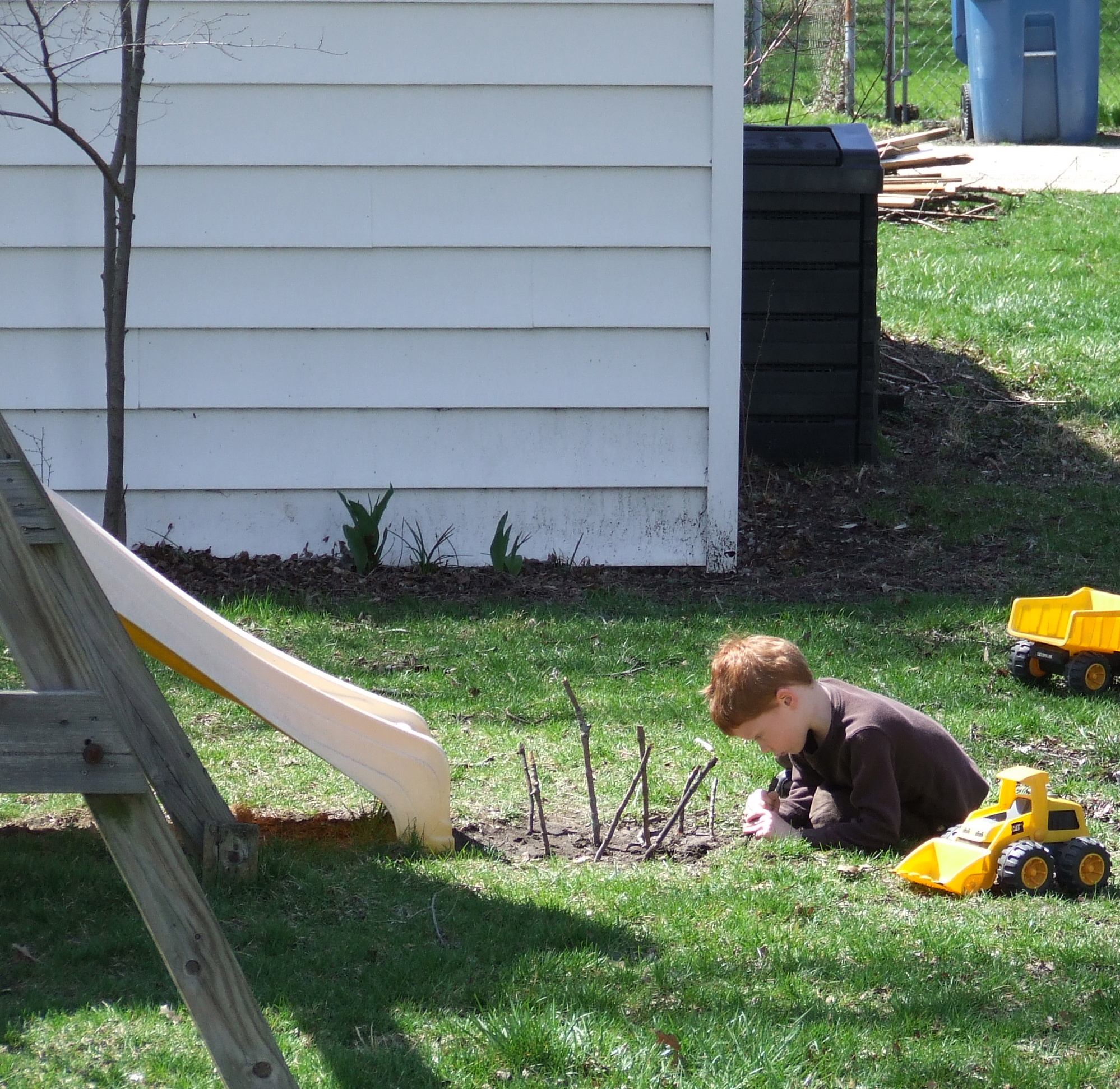
The kids are yelling outside the window. One of the twins, age six, stuck his head in and said this was the first day that felt like summer. They’re in the yard making up superheroes.

“My power, indestructible claws! Strength, two thousand five hundred . . .”

Their sister is yelling something over and over again that sounds like “Hydra.”

“Intelligence, ninety-four.”

Something waiting just beneath the grass and stones to stir.

“Acrobatics, one thousand billion million google . . .”

Their sister echoing, with slight variations. Her voice is harsher, sharper– cutting through the milky afternoon air above the low whine of a mower several lawns away.

Something waiting just beneath the grass and stones to stir. That’s spring, right? That’s the whole point. Lenten is come.

“Did you get hurt, B?”

Footsteps flapping on the pavement, the opening door.

“Can you put this pinecone I found on my shelf for my collection?”

That’s not a pinecone, bud. That’s an old corncob maybe a squirrel was working on.

“My name was Green Laser, because I shot out lasers from my fingers and they were green.”

In and out, in and out. Slamming doors. Flapping of rubber soles on cement. Voices in the backyard.

Questions. Cries. Requests.

The things an afternoon is made of.

Afternoons climbing up on the backs of other afternoons like the minerals left after the drop of water has fallen from the cave ceiling, the stack of years rising upward with a motionless slowness. A growing speleothem of daylights and moments and sharp words and quick smiles and broken glasses.

Something waiting beneath the grass and cement. Something sleeping shallow, something half-listening to the voices above. Something waiting to come back, to spring into wakefulness.

All my life, I realize, will be trying to recapture not the moments themselves but that quality of light and air and shade that hung over the fields and under the trees on the back roads between my hometown and the church campground in thick summer.

Something stirring to life around the corners, curling around the hedges of the fields, curling like fingers of ivy on the sill, like galaxies spiraling down from the edge of the priest’s slowly swung censor.

Something echoed.

Something recalled.