



I’ve been promising a column for a couple months now that offers a basic introduction to telescope optics and usage. I plan to keep that promise, but exciting news keeps breaking out in the astronomical world. Last month it was the alignment of the planets in the early morning skies and the announcement of the possible existence of a new, ninth planet in the solar system. Now it’s even bigger news, as scientists have reported the first confirmed detection of gravity waves, which not only provide a further confirmation of Einstein’s theory of general relatively but more importantly have opened a completely new avenue for learning about the universe.
Up to this point in our history, everything we’ve known about distant objects in space has come from light, whether telescopes set up in backyards or research observatories on mountaintops or even instruments beyond the surface of the Earth like the Hubble Space Telescope. All of these gather types of light (which includes all portions of the electromagnetic spectrum, from the visible light we see up to high-energy gamma rays and down to low-energy radio waves). Light can tell us a lot about the universe, from the velocity of galaxies to the chemical make-up and temperatures of stars. Until now, all discovery related to the distant universe has been through studying light.
But a century ago Einstein predicted that there may be another means of learning about the universe. According to his theory of general relativity, massive moving objects should give off gravity waves, distortions in space that spread outward at the speed of light like ripples on a pond. These waves would be a completely new way of giving us information about objects in space. It would be as though having only before seen distant objects in space, now we would be able to “hear” them as well.
The problem was that gravity waves would be incredibly, almost unimaginably weak and thus very, very hard to detect. As a gravity wave moves through space, it contracts space slightly along one direction while stretching it in a perpendicular direction. This contraction and stretching is tiny, amounting to something like a thousandth of the thickness of a single proton. To detect such miniscule variations in length, scientists have had to build some of the most sensitive detectors ever.
How do you detect the warping of space caused by gravitational waves? There are several detectors around the world, but the two in the U.S. that detected this first confirmed signal (which passed through the planet—and all of us—last September) were the twin detectors of LIGO, the Laser Interferometer Gravity wave Observatory, located in Washington state and Louisiana. LIGO reflects a beam of light down two 2.5-mile tunnels at right angles to each other and by analyzing the beams can detect a tiny difference in the lengths of the tunnels caused by gravitational waves. This past September they both received a signal, and after months of analysis scientists were confident that it was indeed a gravity wave.

Aerial view of the LIGO Hanford Observatory, courtesy LIGO Image Gallery, http://www.ligo.org/multimedia/gallery/lho.php.
This particular signal appears to have come from two black holes billions of light years away in the process of colliding and merging to form one larger black hole. Scientists are able to predict how such an event would “sound” (that is, what sort of gravity waves it would give off), and the signal detected matches this prediction. Scientists are also able to triangulate using the detection at the two different sights to get an idea of where in the sky the signal came from, though it’s far too distant to observe with visible light.
But that’s exactly the point: with this confirmation, we now have a completely new way of observing the universe. We’re in a similar situation to when Galileo first turned a telescope—at the time a completely new scientific instrument—to the heavens. We have a new tool, and we’re not sure what we’ll discover.
Yet our very first observation has already shown us something exciting: double black holes that eventually collide have long been predicted but never before observed. It turns out the very first thing we’ve “heard” with our new ears on the universe is itself something new.
This column first appeared in the Kankakee Daily Journal.
It’s been a good season for placing stories. Besides my latest, “Three Strings,” which appeared in the premier issue of Farstrider Magazine (more on below), I have a handful of short works cropping up in a variety of collections this year.
“The Woodcutter’s Sons,” an arboreal fable, will appear in the first issue of what promises to be the lovely and sylvan Bracken Magazine, I have a short surrealist piece on something that definitely didn’t happen while writing my dissertation coming up in Pulp Literature called “Two Twenty-Two”, and my literary horror story, “Bone Orchard,” is forthcoming in Hypnos Magazine. Finally, I’m quite excited to announce that “When I Was Dead,” a story of the afterlife, will appear in Mysterion, a new anthology of Christian fiction.
It’s a pretty good track record, especially as my fiction writing has slowed down lately. I’ve begun working on a manuscript based on my dissertation for the University of Pittsburgh Press, and whatever room in my life that occasionally was filled by reading and writing fiction has recently been stuffed with the works and writings of various nineteenth-century astronomers.
So far all of these are still forthcoming, but you can find “Three Strings” online now at Farstrider Magazine. It’s fun to be part of the first issue of a publication, especially one that looks as sharp as Farstrider. I mean, just check out that cover:

It’s everything you want good fantasy to be: comforting, warming, and familiar until you glance into the sky and realize, as Chesterton once pointed out, that “you’ve arrived at the wrong star.” It’s that juxtaposition of the expected and the fundamentally strange that makes good speculative fiction resonate, and this cover captures that perfectly.
“Three Strings” is the first story I’ve written so far that’s based around a pun. (Blame my dad. It’s in the blood.) But it made my wife snort out loud when she read it, so that’s a success in my book. If you haven’t already, take a look.
And while you’re there, you can check out the fantastic review they posted on my novel, First Fleet, which is still available on Amazon.

 The Uncontrolling Love of God: An Open and Relational Account of Providence by Thomas Jay Oord
My rating: 3 of 5 stars
The world of Nazarene higher education was rocked not long ago by news of the controversial dismissal of Thomas Jay Oord from his teaching position at Northwest Nazarene University. Though I don’t know Oord personally, I know he was generally regarded as a respected and active theologian inside and outside the denomination and someone who was doing important work. He also had a certain amount of controversy about him, primarily as he was considered a leader in the field of process theology.
Not knowing much about him or about process theology in general, I was anxious to read his most recent work, which is an accessible and non-academic introduction to this school of theology and in particular an explanation of how Oord’s particular flavor of process theology can provide what he sees as a solution to the problem of evil. In the work, it’s clear that Oord has read and engaged extensively with wide fields of contemporary theology across denominational traditions as well as the work of scientists at the forefront of the dialogue between theology and science. If you want to know what Oord in particular and process theology in general are about, this is a good place to start, as Oord’s discussions engage much of the current literature and his extensive footnotes give lots of directions of various places to go to learn more.
The goal of Oord’s work is to apply his brand of process theology to the issue of evil in the world. That bad things happen is undeniable. Oord calls this “genuine evil” and begins the book with several examples, from a random death caused by a rock through a windshield to the story of a woman who was raped after her family was murdered. Any theology, Oord maintains, that attempts to say things about the nature of God needs to give an account of these evils, and Oord outlines several possible responses. Any response, however, that says that God is all-powerful and could have prevented these things but did not, Oord believes, leaves God culpable for the evil and is thus unacceptable. If one has the power to prevent evil and the knowledge that it will happen but allows it to happen anyway, Oord argues, one is in some respect responsible for the evil.
Here is where Oord’s process theology comes into play. In his brand of process theology, God knows all that can possibly be known in principle. However, because Oord believes modern science has shown randomness and uncertainty as fundamental properties of the universe, the future is in principle unknowable. God does not know the future. He is presently omniscient, in that He knows all that happens in the unfolding of time, but He does not know the future because it does not yet exist. He experiences the unfolding of time along with Creation. In a sense, He learns as certain potentialities close and others become actualized.
This takes care of the foreknowledge issue in the problem of evil. God simply does not know for sure what is going to happen. But what about the divine power to prevent evil? Here is where the crux of Oord’s argument lies, as outlined in the title of his book: Oord argues that the primary, essential, and logically prior characteristic of God is uncontrolling love. This means it is always God’s nature to give freedom to his creation—from animate, intelligent beings to inanimate rocks governed by the law-like properties of the universe. Everything that God does flows from this kenotic, self-emptying love that preserves the freedom of all creation. Because God cannot deny his own nature, He cannot violate the freedom of either a person bent on evil or the trajectory of an errant stone. It’s not simply that He choses not to intercede (in which case He would still be culpable in Oord’s eyes). It is instead that the nature of God means He cannot.
If this feels like a risky, limited vision of God, it is. But it’s not one that’s completely without precedent in the Christian tradition. The old analogy of God creating a rock so big He can’t lift it points to the long-held Christian belief that God cannot do things that are logically impossible. Oord believes what someone might think is “lost” in this view of God is more than made up for by replacing a God who seems to allow evil with a deeper knowledge of the essential aspect of God—love.
To some extent, this is a view I can sympathize with and find much attractive about, especially the portions that deal with God’s nature in respect to human freedom. But there are places where I remain unconvinced, primarily related to ideas about God’s foreknowledge or lack thereof, Oord’s definition of “genuine evil,” the perception of God we’re left with, and a few other issues that Oord may clarify in later work or perhaps has already addressed elsewhere.
The first issue is something I’ve never understood, and perhaps someone can explain it to me at more length. I’ve never understood how divine (or any) foreknowledge is incompatible with free will. The explanation usually goes that knowing exactly what someone is going to do would mean they didn’t have free will in making the decision. But consider this: if Doc Brown followed me around for a week (undetected) observing and recording everything I did and then got into his DeLorean and went back in time a week, he would now have foreknowledge of every choice that I made. But would that mean I didn’t have free choice when I made them? I don’t understand how his knowledge would be incompatible with my freedom.
I’m also not convinced by the concept of a God that experiences time along with creation. For one thing, I’m not ready to give up on the concept of time travel, nor am I as married to a forward-only causality as Oord is. (I’ve even published a story about causality working the other direction.) Oord believes science indicates this is the way the world works, but I don’t think science has shut the door on the world working otherwise. Indeed, relativity shows that time is as fluid as space itself, that the geometry of space causes time to flow at different rates in different locations. I’m not sure how this maps onto Oord’s view of a God learning in time along with us. (And, as a friend pointed out, this view of time is inherently Western. Other cultures view time in very different ways.) More generally though, if God’s essential nature is uncontrolling love, I’m not sure we need to give up on his extra-temporal nature to maintain Oord’s central argument.
Too much, in my mind, is given up if we give up the concept of a God who transcends time. For one thing, I like don’t like the idea of a God that can in principle be surprised or a God that functions like a divine super-computer, reduced to simply making (very good) predictions about the future. I like to think at least someone understands and foresees the intricacies of my own personality moment to moment, or the personality of unborn kids. I’m also rather married to the idea of certain events (like the crucifixion, for instance, which the Orthodox like to talk about as happening in some sense “before the foundation of the world”) as being eternal and having backward as well as forward consequences.
I also have concerns with the way Oord defines “genuine evil,” which touches on his ontology of choice. In essence, he’s classified the genuine physical harm that comes about from an errant rock with that coming from the choices made by murders and rapists. I don’t think an accidental death can be a “genuine evil” in the same way as the result of a conscious choice can. I want to maintain a distinction between the two, even though both in my mind can have “genuinely bad” or “genuinely harmful” results. Obviously an explanation of providence needs to encompass both, but Oord seems to be on very different ground philosophically when talking about the rock versus the rapists.
In the case of the human actors, I think I can agree with him: if God’s essential nature is uncontrolling love, then it would result in a logical inconsistency for God to violate His own nature to override the freedom of choice in humans—even to prevent genuine harm. The evil that results from human actions or inactions are the responsibility of humans alone; God is not culpable.
But what about harm that results from the law-like processes of nature, including random actions that result in death and destruction (like a tornado or a stone through someone’s windshield)? Here choice doesn’t seem to be an issue, and Oord recognizes that there’s still a lot to be worked out in this respect. But he claims that because the law-like regularities in the world are themselves a form of grace, God cannot withdraw His presence or override the freedom inherent in physical processes themselves because to do so would also violate His own nature of kenotic love.
This is a bit harder for me to follow, though I again resonate with the idea that the spirit-filled presence of God throughout the physical order means that everything is sustained by God and that law-like regularities (Oord is careful to not call them laws of nature, being sensitive to contemporary philosophy of science) are themselves a form of God’s grace. But in maintaining that the freedom to self-organize is an essential property of nature and that there’s a continuous spectrum of choice from humans down to much simpler forms of life, he has to assume a teleological evolution to the universe in some sense. I don’t know all the implications here, but it seems like Oord is on much shakier ground.
I also wonder if Oord’s prioritizing of self-emptying, uncontrolling love as the essential and logically prior nature of God doesn’t overlay a Western, contemporary view of love on God in the same way that his linear conception of time does. Would this view of love have been one understood throughout history, or even in non-Western contexts today? Note that Oord’s version of process theology does not say that God is evolving; the traits of God remain eternal. But the concept of love seems to be one that has changed throughout history, which makes it potentially problematic to posit as God’s essential nature, at least love qualified in the terms that Oord gives it.
Finally, it seemed like the door was wide open at several points throughout Oord’s account to bring in trinitarian theology, or to at least acknowledge that his work has important implications for our understanding of the Trinity as well as the Incarnation. In his work, however, these implications seemed to take a backseat to Oord’s logical grapplings with qualifying God’s properties.
The idea of a God who suffers along with us, who takes risks, and who is defined and perhaps even bounded by His own self-emptying love is a strong one. I think Oord is on the forefront of important thought on these ideas in evangelical circles. I can follow him a good distance along this road. But especially as relates to issues of the nature of God in time I remain unconvinced, and in questions of God’s presence in the physical world and the implications it has for physical harms (as opposed to those from human or creaturely choice) I need more explanation.

 The Black Corridor by Michael Moorcock
My rating: 3 of 5 stars
The name Michael Moorcock has been on my list of authors to read for so long that I can’t remember why or when he ended up there. I also can’t quite figure out why he’s so well-known or what kind of writer he is, exactly, and reading several entries on him in various fantasy and science fictions encyclopedias hasn’t helped much. Suffice to say he’s British, he was influential in the New Wave, and his writings are extensive and pretty hard to pigeon-hole.
I grabbed The Black Corridor from the science fiction section of my local library, the last of my Christmas break reading that included Benford, Swanwick, and Reynolds. I can’t remember if there were other Moorcock books there and I grabbed this one because it was short and because the cover was obviously by the same artist who did the cover of my edition of Lafferty’s Nine Hundred Grandmothers or because it was the only one they had. Either way, the description intrigued me.
This was an easy read, but it felt dated. The story is about a single human aboard the first colonizing craft traveling to an Earth-like planet around a (relatively) nearby star. Part of it is a psychological exploration of the emptiness of space, of the long, lonely passage (the corridor of the title) to the first habitable worlds. The environment of the ship is sterile, empty technology, a backdrop upon which the single inhabitant is struggling against loneliness and a self-conscious slide into madness. His only defense is a retreat into routine and rationalism.
Yet this isolated existence, we learn through a long series of flashbacks, is only the culmination of a larger slide into madness. The single ship’s inhabitant is actually the only waking member of a crew (the rest are in hibernation) composed of his family and small group of friends who fled a disintegrating Earth. The end-of-times scenario outlined here is a fractious, nationalistic British apocalypse descending into chaos like in Children of Men. In the midst of this, the main character—who built his fortune as a toy manufacturer—sees himself as an isolated island of rationality against this moral and social decay. Together with his companions, they see stealing the only UN ship capable of interplanetary flight and setting off from Earth in the face of and in spite of a nationalistic, atomic holocaust their effort to save not only themselves but the best of humanity.
Two main trends take place over the course of the novel. The first is the narrator’s constant battle against paranoia and loneliness and his gradual descent into possible insanity. Has he woken the other crew members up? Is he having hallucinations because of his sensory isolation or because of the emotionally-stabilizing drugs he feels forced to take? The second is the gradual revelations of what he had to do to secure the crew’s escape from Earth, what he felt justified to do to get them off the planet. There are interesting developments throughout in what is largely a psychological thriller, but some of the most intriguing take place in the final few pages of the book, when we’re forced to ask the question of why he’s the only one awake on the ship in the first place.
In all, there are lots of subtle and troubling themes touched on here but not explored. Parts of the novel make it seem as though we’re dealing with themes of overpopulation or ecological disaster, but these are never front and center. Technology is not a major motivation here, just a sterile backdrop against which the events play out. Mainly The Black Corridor offers a surprisingly troubling treatment of the inevitably isolating results of a self-justifying rationalism.

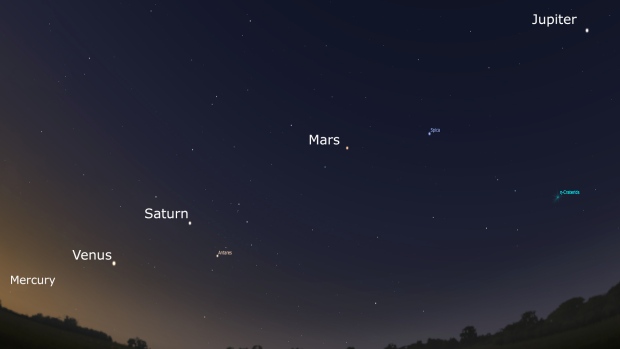
It’s been an exciting month for skywatchers! Last month I talked about some of the easy sights for backyard telescopes in the constellation Orion, which is looming large in our evening skies. The first couple weeks of February though, offer an even more impressive naked-eye sight in our morning sky: the possibility of glimpsing all five visible planets arranged in a straight line across much of the sky. The arrangement is best right now and will continue throughout the first week of February.
Standing outside before dawn, look to the east. Venus is bright above the eastern horizon, and if you have a clear view you may catch elusive Mercury even lower toward the Sun’s glow. Saturn is above Venus to the south, with Mars riding high in the southern sky. Jupiter is the bright object beyond Mars, toward the southwest. Altogether, the planets make a lovely arrangement that spreads across nearly the entire southern skies. The best time to look for them is just before sunrise, around 5:30 to 6:30, at which time the Sun’s glare begins to wash them out.
The mornings of this first week also bring an additional sight to the arrangement: a lovely slender crescent moon which passes by Mars on February 1st, is near Saturn by the morning of the 3rd, and moves down toward Venus on the 5th. An arrangement like this, with all the planets neatly in a row along the ecliptic, is fairly rare, so make an effort to rise early and take a look at this vista of the closest worlds of our solar system.
I mentioned last month I’d spend this column talking about telescope basics, but planetary happenings are enough to push that back a bit. Besides the arrangement of visible planets, astronomers grew quite excited this week with news of new evidence that might indicate the existence of an undiscovered ninth planet in our solar system.
When you look up at the pre-dawn sky this week, you can see all the visible planets in our solar system, which are all the planets that were known throughout most of history. It was only in the late 1700s that we began to realize there were other planets in our own backyard, and this most recent announcement may herald that our family of planets is about to expand again, for the first time in over a century.
All of this obviously makes astronomers pretty excited but also cautious, as there have been lots of false claims for Planet X in the past.
Until William Herschel stumbled upon Uranus in his telescope sights in 1781 and subsequent calculations showed that it wasn’t something like a comet, Saturn was considered the outer boundary of our planetary system. As astronomers observed the new planet though, they eventually realized that something was causing it to speed up and slow down in its orbit. The French astronomer Le Verrier correctly deduced that this was caused by an additional planet in our solar system and predicted its location, and Neptune was thus discovered in 1846.
Since then, astronomers on and off have believed they’ve seen evidence in the motions of the outer planets to hint at other planets lurking out there in the darkness. It was while searching for such a world that Illinois native Clyde Tombaugh found Pluto in 1930. However, it was later realized that Pluto was far too small to be causing any gravitational perturbations and in fact the perturbations themselves didn’t actually exist.
But this is where things get interesting, because it turned out that Pluto was actually simply the first in an entire class of tiny, distant solar system bodies called Kuiper Belt objects. Indeed, it was the discovery of more and more of these objects—some farther away and more distant than Pluto—that eventually caused Pluto to be reclassified as a dwarf planet.
Now, two astronomers from Caltech have published a paper arguing that the orbits of a handful of Kuiper Belt objects show evidence for an even larger body, about the size of Neptune, in the far reaches of the solar system. The reasoning is similar to that which led to the discovery of Neptune: it appears as though a large, massive object is affecting the orbits of these objects. Mathematical modeling indicates these observations could be explained by a ninth planet.
Of course this doesn’t mean that it’s there for sure. That’s how science works: observations provide evidence, and scientists offer a theory or hypothesis to explain it. A good hypothesis is one that can be tested. And that’s exactly what’s happening now: telescopes are being trained toward the outer reaches of the solar system to see if this posited body does indeed exist. If it does, it should be large enough to spot in very large telescopes, despite its enormous distance.
And if it is spotted, the total number of planets in the solar system will go back up to the number we learned in grade school.
This column originally appeared in the Kankakee Daily Journal.
 Stephen Reid Case