

 Demolition Means Progress: Flint, Michigan, and the Fate of the American Metropolis by Andrew R. Highsmith
My rating: 4 of 5 stars
The city is not a problem to be solved; it is a story to be told.
I used to dream about getting a fat grant years down the road and taking a leave of absence to start research toward a complete history of the city of Flint, Michigan. There would be so much to it, from the history of technology and the rise of the auto industry, to labor history and the creation of the middle class. I knew race would play a role in this theoretical history as well, though I hadn’t even begun mapping out the implications. It would have been an immense book, one that tapped into several important streams of the larger American drama. It would be in many ways a tragedy as well– a tale of controlled atrophy and downsizing, of a dying city, industrial decay, and the birth of the Rust Belt. That was my nebulous plan, but it was not to be: the book has already been written, and this past week I finished reading it.
Flint and its story fascinates me. I grew up on its nearly all-white suburban margins but with roots running into its history. I have memories of visiting AutoWorld as a child and of my grandparent’s home on Waldman Avenue. My mom and her parents often spoke with regret about what Flint had once been, of the prosperity of the post-War years and the sparkle of downtown before the sprawl of suburban shopping districts. Though I grew up in the suburbs of Flint Township and later Swartz Creek, my mom (and many of the parents of my friends and peers) had grown up in city. Her family came from Missouri looking for work in the factories, and my grandfather built a career on the Grand Trunk Railroad. My dad spent his career working for General Motors, much of it at Buick City before it was closed and he was relocated to Saginaw. I ventured downtown occasionally as a teenager (and it was always clearly a venture), specifically to the Cultural Center and the Longway Planetarium.
Flint’s story shaped me in obvious ways I’m only now realizing. Many of the photographs on this blog, for instance, were inspired by the rich background of texture and decay I grew up on the fringes of. I knew the city’s history in a cursory way and even saw some of it myself. For all these reasons, I wanted a book that dove into this history. In the absence of such a book (though Gordon Young’s memoir– reviewed here previously– was an excellent journalistic step in this direction) I was prepared (one day in the distant future) to attempt to write it myself.
But the book now exists.
I wrote earlier on this blog about Mark Quanstrom’s study on Nazarene theological history and the way it helped me understand the religious context in which I was raised. What Quanstrom’s book did for my theological heritage, Andrew Highsmith’s new study does for my social and urban context. (Note to self: a work exploring the intersection of these two themes, charting the growth and decline of the Nazarene church– which at one time could count at least half a dozen large congregations in the city– would be of interest.) I knew Flint was economically depressed and racially divided. But I never fully understood the depth, origins, and repercussions of “white flight,” a trajectory in which my family participated.
My sister and her husband live and work in downtown Flint. On multiple occasions I’ve biked with my brother-in-law from his restaurant on Saginaw Street, past the former site of Chevy-in-the-Hole, where it looks like giants literally gouged a cement valley along the river into the center of the city, to his house in Mott Park. He’s told me lately he feels most of his work in the city revolves around racial reconciliation and that if we can’t understand race we won’t understand anything about Flint’s story and where it is today.
I think Highsmith would agree. I first learned of his book just days after it was released from my brother-in-law, who passed it along to me with a sort of resignation: “Here’s another academic who thinks he’s figured Flint out.” I don’t know that Highsmith claims to have unravelled any riddles, but he’s begun plunging the depths of the issue, the tangle of politics– many on a national level– that made Flint what it was and is. It’s very much a story of place, rarely focusing long on any particular individual. Highsmith’s Flint is made up of institutions, organizations, politics, and changing demographics. Yet there are enough specific personal focuses, ranging from Michael Moore to the tragedy of the Beecher assistant principle driven to suicide by the intractable problem of de-segregating his high school, to keep it a poignant and human (though a consistently scholarly) read.
Highsmith offers an urban history of Flint from the early 1900s to the present. (Indeed, the epilogue brings the story up to the point of names, organizations, and developments I recognize from my frequent visits home.) In particular, Highsmith wants to understand and outline the institutional and administrative forms of segregation that kept Flint one of the most racially divided cities in America long after the era of Civil Rights. Under the aegis of strong neighborhood schools, for example, the Flint public school system remained effectively segregated until whites were in a clear minority throughout the city.
Highsmith examines the central issue of race and urban policy from several angles over the century. Much of the division began in housing policies at a national level in the inter- and post-War years, in which real estate redlining kept neighborhoods divided and set the foundation for much subsequent de facto segregation. In the era of urban renewal and the coming of the expressways, proponents of development argued for the clearing of predominately black slums like St. Johns, but administrative segregation largely prevented the relocation of these residents (who initially supported neighborhood clearings) from getting much value from their property and finding new homes in an integrated city.
In addition, a ring of largely white suburbs acted quickly to self-incorporate, preventing Flint’s spatial growth and through tough zoning laws blocking the construction of public housing complexes that would result in racial integration (and potentially lower property values). The background to all of this was of course the ebb and flow of the fortunes of General Motors and its complex relationship with the city. If the city of Flint was equated with Buick as the quintessential company town, what happens when Buick dies?
All of this tells a story. It doesn’t give any answers. At the risk of sounding trite though, that’s the point. Highsmith makes the case that America is the story of a thousand Flints, linking the racial and post-industrial challenges of Flint to the nation as a whole. That may be true, but Flint is also importantly unique, enough that its tragedy has a wholly specific resonance, especially to those who grew up in its shadow. This book should be required reading for anyone in or from the Vehicle City, especially anyone who cares about locality and knowing how the place that shaped you was itself shaped.
As T. S. Eliot said, “We shall not cease from exploration, and the end of all our exploring will be to arrive where we started and know the place for the first time.”

Iowa State Fair
8.13.15

People in Iowa are proud of their fair. That was something common to everyone we talked with today (though this was of course a self-selecting audience—perhaps Iowans ashamed of their fair stayed home). Everyone we spoke with came to the fair each year, and the vendors agreed that of the several fairs they went to every season, this was the best. When asked why, an answer they agreed upon was friendliness. It’s a friendly fair, rooted in the history (as evidenced by the size and solidity of the buildings) and heritage of Iowans.
Yet for me the fair was also a strange patchwork of competing narratives. It was often difficult, especially in places like the agricultural building and the food exhibits, to differentiate between what was agricultural or culinary exhibition and what was commercialization and advertising. They bled into one another and created what often felt like parallel but separate fairs occurring in the same space. When we visited the agricultural building, for instance, the section of produce and floriculture was roped off, preventing a close look at the products of agriculture. Instead, lines of visitors were tightly bunched along the peripheral vendors. There was a divide: the casual visitors milled around the edges or shuffled through the exhibition halls, while a simultaneous, largely unseen process of judging and competition occurred among fair participants. We had a similar experience in the food exhibits, where rows of refrigerator displays alternated baked goods for judging (products of fair participants) and packaged, processed foods (apparently for advertizing to fair visitors).
Which leads me to the question of audience, voiced by someone in our debriefing discussion at the end of the day. Who is the fair for? Is it simply for creating a self-congratulating identity for the Iowans who visit? And does it accurately reflect the true nature of farming in Iowa or an idealized, cultural version of the farm that may no longer actually exist?
Part of what prompts this question is the disconnect I experienced between what I saw yesterday and today. Yesterday I saw miles of corn and soybean, and I heard a farm manager talk about industrialized farming. Today the closest I came to the corn I saw yesterday was probably the corn syrup in the Coke I had for lunch. The diversity concentrated at the fair and displayed in the agricultural building or the horse, cattle, and swine shows seems a cultural margin not reflective of the actual Iowan landscape.
And maybe that explains in part the patchwork disjoint I felt. The commercialized exhibits, the vendors, and the deep-fried fair food—that’s all part of the industrial machine built on corn and soy. The varieties of corn, potatoes, and fruit on display and judged in the agricultural building, the FFA kids with their animals—that’s a cultural remnant celebrated as heritage. But they seem two very different worlds, and it’s unclear to me how they can continue to coexist.


First Impressions
8.12.15
I.
I kept waiting to be surprised. I grew up in the Midwest, so this rolling landscape of corn and soy dotted with towns and suburban spillover from larger cities—this is all very familiar. This looks like home. The economic patchwork is clear: soy and corn on a grid, nearly flat, to the horizon. The fields are quiet this time of year: no tractors or combines combing the rows. (Human figures would be lost on this scale.)
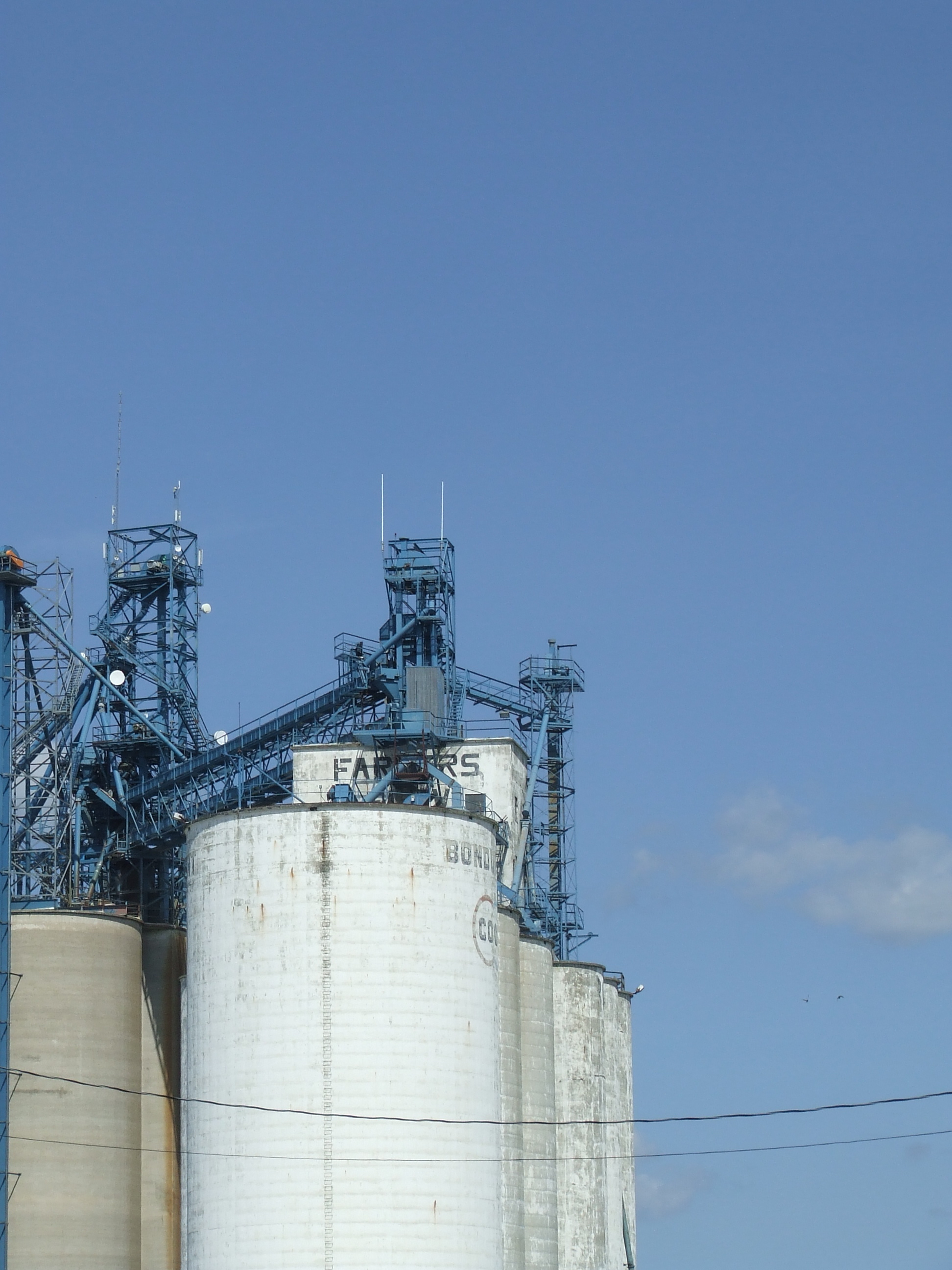
We stop in a town called Bondurant that in a nutshell illustrates the ebb and flow of the local economic tides. The concrete pillars of grain elevators dominate the center of town like monoliths. There’s a small train depot in their shadow that has now become a park. The railroad is gone, replaced by a bike trail running into the heart of Des Moines.
This was a farm town, and though still surrounded by corn and soy, it’s now clearly an appendage to Des Moines, which is a fifteen-minute commute away. This explains the glut of new housing developments. The downtown holds several buildings for rent, a hair salon, dentist office, and a single pub. There’s no commercial center, though there is a brand new library and community center, as well as a new high school and elementary school. It feels like a community being pulled into the suburban orbit of Des Moines.
“The farmer on a small farm,” a local farm manager tells us, “doesn’t make money because he isn’t disciplined or motivated.” Small farms grow or die. The same thing seems to happen to small towns. “Everything in this country comes back to income.” And yet he claims to manage many heritage farms, where absent landlords view their property as something more than simply an investment.
In all of this, I’m trying to understand the cultural ties to the land, be it small town, farm, or suburban. Who invests in the land for its cultural value? And what’s the value of culture when crops are seen as commodity?
II.
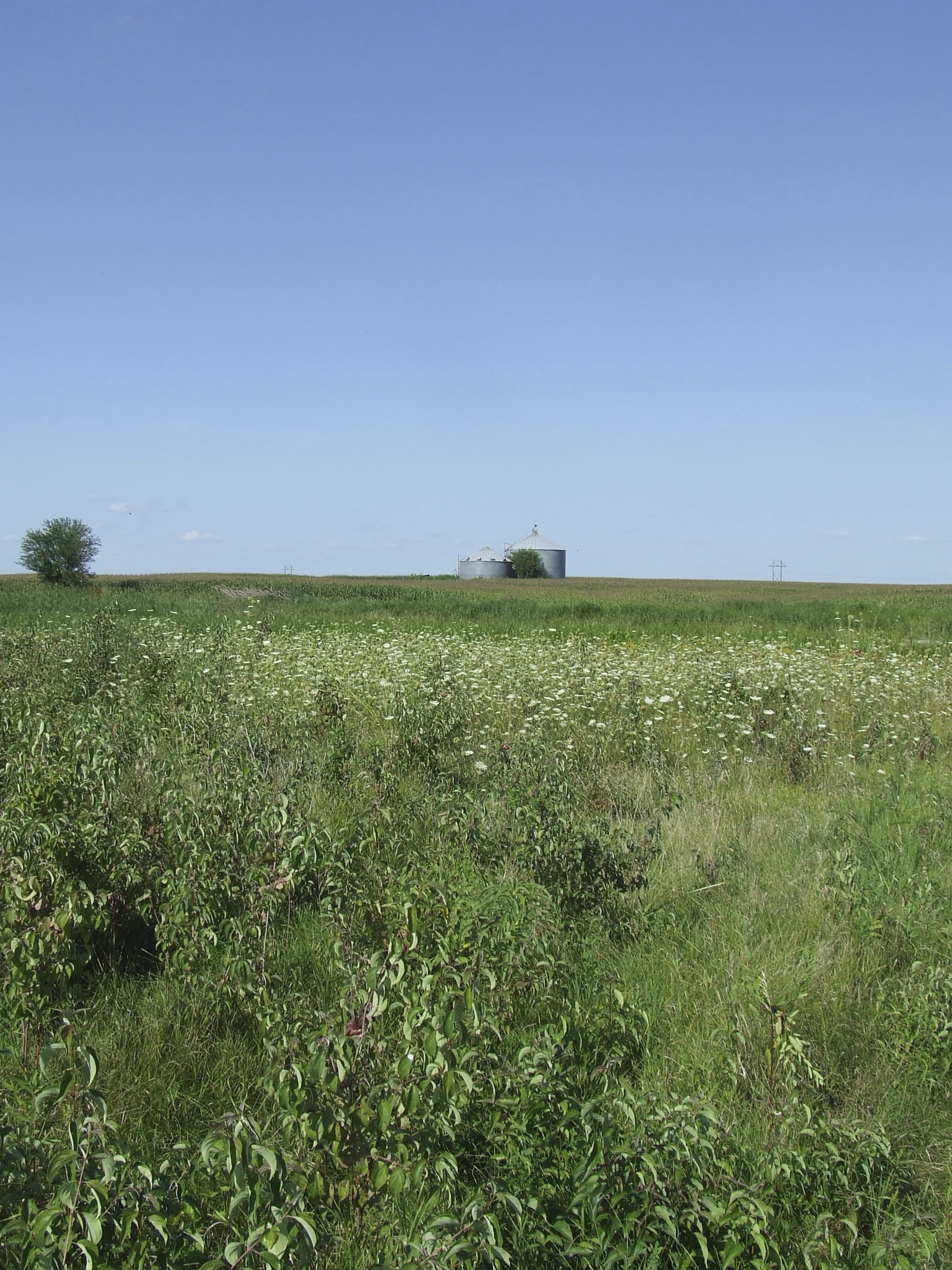
My surprise finally comes when we pull off the road to a “Public Area,” a space carved out of the grid-work of corn and soy and allowed to revert back to prairie. What strikes me is the soundscape: birds and the various chirps, whirring, and buzzes of insects. We had stopped in a cornfield earlier, and compared to this the cultivated land was deadly silent, as the loud life around me now would be considered pests in the fields of corn across the street.
“They say,” my group’s facilitator tells us, “that when the first plows pulled up the prairie grasses, the roots were so deep and strong that it sounded like shotguns going off when they pulled them out.”
I try to imagine that sound, giving way to the absolute silence of growing crops. Monoculture is quiet. Diversity is loud.
The same thing holds true of neighborhoods, I think. We pass housing developments where the homes look like they’ve fallen from the sky into the subdivision that was recently a field. No sidewalks, no families on porches, no baseball in the street. There’s not much diversity in these neighborhoods, either of culture or architecture that I can tell. In these suburbs, where the houses push right up against the cornfields, whatever is growing inside is growing silently, like ears within the husks.

 Stephen Reid Case