



 Lands and Peoples
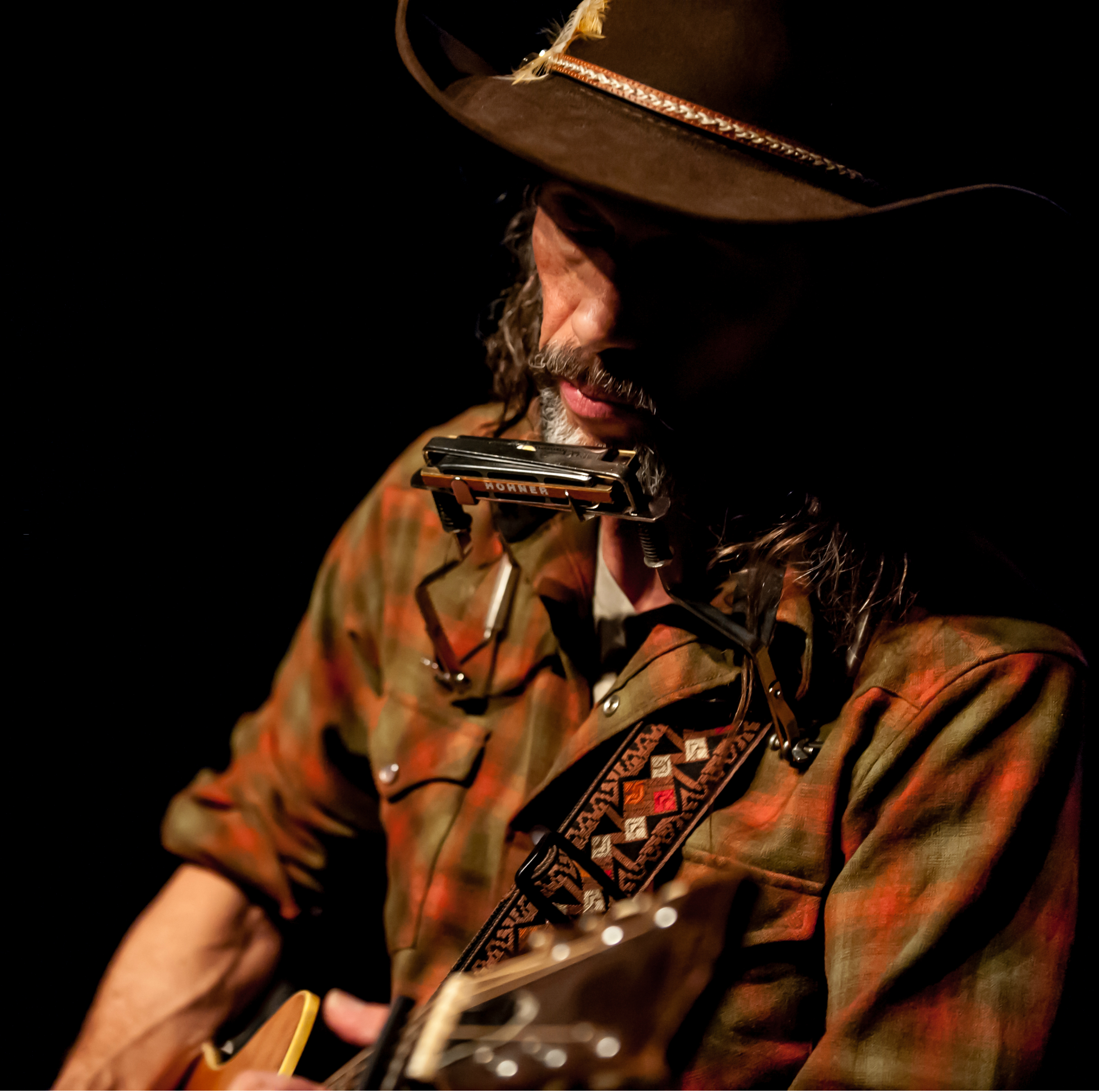
Bill Mallonee & the Big Sky Ramblers
In the Platonic cinema of the forms, there’s an epic movie called something like Americana Melancholia, which chronicles all the interior, wide-sky woe of the great American narrative from Dust Bowl to Rustbelt. It’s about the brokenness that’s been in the American dream from the very beginning. It’s a heart-breaking, gorgeous film, whether or not it exists. But it has a soundtrack that definitely does, and that’s the music of Bill Mallonee.
When I graduated from high school, an older guy I looked up to in my youth group gave me the record/EP combo that pushed Bill Mallonee to the margins of fame: Audible Sigh/Room Despair. It was a breath of dusty, whisky-tinged air into my CCM world of Jars of Clay, Caedmon’s Call, and company. Mallonee sang about something earthier, richer, and somehow deeper– certainly something more real, desperate, and beautiful than the other groups I was listening to at the time. He didn’t provide tidy answers. He didn’t wrap his lyrics in a neat bow of faith. He left them raw and bleeding. Those songs were the soundtrack of my last summer before leaving home, open roads, and the dashboard of a midnight blue ’99 Firebird.
Then he disappeared. Or I lost him. I’m not sure what happened. In college I picked up his next album, Summershine, despite the fact the cover bore an embarrassing pink flower instead of the angsty derailed locomotive of Audible Sigh. (I was, after all, an insecure freshmen.) The magic was still there, though the earthiness was mellowed with glimpses of an almost opalescent brilliance in lyrics like (still among my favorite): “Moonlight be a friend tonight / we’re all wrecked upon these dreams. / Holding on a bit too tight / I’ve got splinters from these moonbeams.” (That line has inspired short stories.)
But something happened. As I said, I’m not sure what. Part of it may have been that Mallonee’s music was simply too heart-felt. I wasn’t the sappy crooning of country, yet it was too genuine– too non-ironic– for the world of CCM or popular alternatives. Perhaps he simply needed more irony. Mallonee’s band was called, after all, “The Vigilantes of Love,” and if this was a bit tongue-in-cheek it was hard to tell. If I had to pick a literary analogue to the situation, I’d fall back on R. A. Lafferty (mentioned often on this blog), the “science fiction” writer from Tulsa whose words and worlds were simply too wide and weird to find a home in the publishing world of the 1980s.
And like the Laffertian renaissance I’ve written about here, there is perhaps a Melloneean renaissance underway as well. Over the past few years Mallonee– living and working now in the American Southwest– has been faithfully writing and producing at the edges of the industry, living on the faith and goodwill of the fans who continue to support his unique voice. I was reacquainted with his work when Noisetrade offered a free download of his EP Victory Garden, putting me in the orbit of his regular email missives with project updates and– painfully– occasional offers to sell guitars and amps to make ends meet.
The desert life is harsh, it seems. But the desert flowers as well. Beginning with last year’s Amber Waves, building to anticipated release of The Winnowing, Mallonee’s recent work culminates with Lands and Peoples, the latest product of this desert efflorescence. And it’s the same Mallonee I remember: a voice of dust and whisky. Mallonee paints pictures in his music of dying towns, dying crops, and wounded dreams with a pained beauty that makes you want to weep and enjoy the weeping. Mallonee’s voice belongs to a lost yesterday. If someone (and I’m sure someone has) collected all the ballads of American cowboys– real cowboys– and wanted a singer to record them to preserve for posterity the voice of the American West– well, Mallonee has that voice.
Yet his sound is his own and doesn’t belong to the West alone. If his voice is from yesterday, the music that envelops it is of today. Lands and Peoples is sonically rich, with a depth and texture showing an organic growth from the albums immediately previous. You hear it from the initial track, “At Least for A Little While,” which hooks immediately with quiet, desperate guitar fingering. It builds into “Hide Me in the Darkness,” a haunting piece that along with “Little While” forms an especially strong beginning into standard Mallonee fare: haunted guitar, haunted voice, haunting lyrics. The clouds Mallonee promises may break “At Least for A Little While” in the first track of course gather again, building over mesas and long roads, steeped in dying light. It’s a familiar ache, but none the less gorgeous. They clear completely though in “Sangre de Cristo,” a piece of lovely blue sky that sits like a bright beacon in the album’s heart. Then they gather again, toward a fitful sunset in “It All Turns to Dust,” with Mallonee leaving us only that whispered promise at the record’s conclusion.
If you’re a fan of rich, textured music with a strong narrative thread and an abiding sense of locality, check out this album. (You can find links and info on all of Mallonee’s work here.) There’s a sound here that deserves being more widely heard.
When I approached Bill about reviewing his latest album, he suggested a Q&A and was good enough to offer detailed responses to my questions. His responses, which I’ve posted below, give deeper insights into what’s going on beneath the surface of these songs as well as a glimpse into the mind and heart of the guy Paste Magazine has called one of America’s greatest living songwriters. (I agree with Paste, incidentally.)
 Q: I don’t know much about the technical details of recording, but I feel a bit like I stepped over the edge of a sonic shelf in Lands and Peoples, which struck me as being deeper musical waters than some of your previous albums. It seemed audibly more three-dimensional. Can you help me understand what I’m hearing?
BM: I think your questions has two parts. First, the “audibly more three-dimensional” part. I have a few good mics, but after that I just use my ears. But, it might have to do with the materials the studio is made from. Muriah and I live in a small community in the high deserts of New Mexico. In every area you go with the materials that are there. In New Mexico, for centuries now of course, houses have been built out of dried clay and mud. We were fortunate, when we moved here four years ago, to be able to rent just such a dwelling. Yeah, it really is a hacienda. So, I think what you might be hearing is the the fact that the studio is housed in an almost two hundred year adobe casita. The walls are two feet thick all around of prepared dried mud. They are non-parallel (always a plus in studio recording) and the the exposed beams in the ceiling create a kind of baffling. It’s an easy room to get sounds in and to mix tracks in. So the fellas who constructed it unknowingly built a great room to record music in. Also, the room is just beautiful. Quaint and full of all that is inspiring about southwest architecture. Step outside and you’ll be looking straight into the snow-capped Sangre de Cristo chain of the Rockie Mountains. (Poor us!) Yes, hats off to the beauty of these wonderful, natural elements. I feel very blessed.
Part two of you question (the deeper musical waters part): I think my love affair with just how guitars can and should interplay with other guitars as part of the song structure is something I’ve been having fun exploring for the last five years. Many of the recent albums (and the EPs I’ve release under the moniker WPA) explore that guitar-to-guitar relationship. It’s about the right parts supporting one another. I think the last few records (The Power & The Glory, Amber Waves, Dolorosa, and last year’s Winnowing) have kind of a subtle, unobtrusive beauty. The trick was to make them sound sparse, but in reality there are many guitar tracks on almost all of these songs, weaving in and out of the musical tapestry. The trick, I think I’m learning, is that no one part necessarily has to carry the weight of the whole.
Q: I also hear continuity with what came before, specifically some of the songs in Audible Sigh (as well as lyrical nods to that album). You haven’t radically transformed your sound, but it’s certainly developed. Yet personally and geographically (and theologically?) you’re hundreds of miles away from where you were then. How does this come out in your music?
BM: I don’t know, really. I think it’s all the natural process of life. Yes, the songs are grimmer, darker now, to be sure. I don’t think that means they’re necessarily drawn from a different well. I do know more about how the country works and how the industry works for some and not others than I did when I first started out. Me? I just wanted to make songs that were authentic and honest. That’s all.
First the back story. Vigilantes of Love. We’d been critics darlings for many years running. We put out great records. Even music critics kept asking after each album: “Why are they not breaking bigger?” You have to remember that we started in a day when bands could break with a few resources marshaled to places like MTV and late night talk shows. In reality, we were broke, confused, increasingly discouraged. My band mates were just incredibly heroic, wonderful people all through this. We enjoyed playing together and hanging out together.
But, the reality is that Audible Sigh, produced by Buddy Miller, and the records in front and back of that release (Roof of The Sky and ‘Cross the Big Pond) were in many ways the beginning of the end. I can’t tell you how many folks saw that band “live” and said things to us like, “Why aren’t you guys playing beside Son Volt, Wilco, the Jayhawks?” All of those bands were big, big names in the early Americana ink that was high profile in the late 90s’ and early 2000’s. We worked hard. I use to joke that we could play on any Fischer-Price PA system any night of the week (and we often did!) and make magic. It was such a beautiful, kickin’ band. And we toured 180-200 shows a year in small college club world to generate a following. Vigilantes of Love became a “best kept secret.”
Could we have broken bigger? I think so, yes. Why we didn’t break, I think again, is simply because we were never very well connected. The folks we trusted, be they managers, or labels, or booking agents, all steered us into dead-ends. I have no “killer instinct.” I just wanted to write, perform, and make records. I think we waited as long as we could until it was time to say: “Ok, this is not gonna happen.”
But one has to grieve when a dream dies. And since I wrote all the songs and had poured so man emotions in it (we’d done something like fifteen albums in ten years) I was devastated. I went through this period where I felt personally let down and cast aside by so many managers and labels. Even our home town was detached. After comparing notes with many other singer-songwriter types, I heard similar stories. But the songs kept coming. Lots of them. I think I released four solo albums in 2001. Ultimately, I decided that I didn’t need an industry’s permission to be who I was.
That’s the backstory.
How does that dark experience play out in the last years and records? Well, Muriah and I moving to the high desert to live a more uncluttered life was one of the responses. One has to excavate from the previous experiences and reflect on the journey. I think there’s a certain haunted quality began to emerge in the songs, even a Southwest quality. I was (mistakenly, I think) lumped in with that whole weird “Christin artist” sub-culture thing for a spell. What I do, at the risk of sounding arrogant, is bigger than that. What I do is not commercial in the way such folks see it. I hope it’s more real than that.
Thematically, I tell folks that you can only write well what you know well. I’m a confessional type writer. (Maybe that comes from my rearing as a Catholic, where everything in one’s life is something of an inventory; something under chronic scrutiny by oneself and the Lord.) I believe the Faith, to be sure. It informs how I see the world and live in it. But, you have to learn how to live with the incongruities in yourself and even in your faith. Some days the world makes sense, other days not so much. So, that’s an undercurrent theme in the new work, to be sure. It comes out as a struggle, a wrestling. Too often darkness seems to be the loudest voice in my life. I do I feel I have been the undeserving recipient of Grace. I am loved. We all are. I see this life as precious, hallowed and a gift. But, those vital truths are also more eroded than ever in the onslaught of what we call modernity.
How does that related to the songs? Well, i have no agendas, no polemic to dispense when I write and sing. Whether I’m giving a new slant on a Dust Bowl ballad tale and investing it with something of my own journey or whether I’m just writing a song that has more of a first person haunted quality (“The Ghost That I run With” comes to mind), I feel my job is to make honest, authentic work. I tell folks: “I love my job. It’s good work, if you can get it!”
Q: I live and breath prose (though sometimes I dream in verse), so it’s hard for me to imagine what the process of writing a song might look like. What does a song sound like for you as it begins to coalesce? Does the sound come first or the words? Do you ever have one without the other?
I think you have to let a song tell you where it wants to go. No over-thinking it. I know that sound mysterious. It is. Songs have a way of “getting outta hand.” And that’s a good thing, I believe. Don’t be afraid of the where they wanna go. I think it’s part of being open to the Spirit, really.
Usually, I have to have a guitar in my hand when I write. I’ll keep a journal of lyrics going on the road when Muriah and I are touring and consult it for ideas later. But mostly a whole song, at least the heart and focus, comes in one sitting. (After that it’s adding hook lines, overlays that keep it living to the ears.) Sometimes a whole song will show up based solely on the cadence or syncopation of a phrase or a couple lines of lyrics. Melodies make the song memorable and that’s what I hope happens naturally.
But, to recap: I do very much think if you force something or over-think it, it’s probably not gonna be memorable.
Q: You sing on the margins, and you also sing about the margins: the margins of failure and defeat, despair, and hope. Maybe the margins of faith as well? Would you say this is part of what inspires your work: transforming the experience of these margins into beauty?
Absolutely. The trick is to make the margins clearer, more visible. We’re all so numbed and mesmerized by daily life. Yet, I think “Something,” or “Some One,” keeps pushing through, asking for our attention. Those can be what writer Frederick Buechner calls those “lump-in-the-throat” moments that take us by surprise. We’re here for such a short time. And yet we’re haunted, captivated, driven by this sense of transcendence, a hunch that Love really does means something; that no life is anything less than precious; that life has this hallowed quality and that each of us are beautiful mysteries; that there is something beyond the grave.
Sure, some think that ground of being is beyond words. And, being small and finite, perhaps it is. But, to me that’s what all great art attempts to do: To give a nomenclature to the Love that I believe is the ground of everything.

 The Lone Ranger and Tonto Fistfight in Heaven by Sherman Alexie
My rating: 4 of 5 stars
Frustrations can lead to rash actions. Regardless of how one feels about the frustrations boiling up in cities like Boston and Ferguson and the resulting actions, my white, middle-class frustrations in response were largely regarding my own lack of comprehension. Here I am, surrounded in a comfortable middle-class environment by a bunch of comfortable, middle-class friends and family. I don’t have a good understanding the frustrations of others. I don’t have a grasp at any significant level of what it must be like to be a minority living and working in America.
Then I looked at the fiction I was reading and realized it was more of the same: it wasn’t helping me reach any sort of understanding of minority perspectives. My books are like my friends: a bunch of white guys I love to death. But not terribly diverse. So I made what may have been a rash decision. It’s certainly a decision that looks kind of pathetic in light of the backdrop of unrest in which it was made. But it’s a step, and one has to start somewhere. I decided for the rest of the year I would start reading works of fiction exclusively by minority voices. Call it an affirmative action program for my own reading list, a way to swing the balance a bit from a life of reading in which Harper Lee and Flannery O’Conner were about the extent of my diversity.
(Note I say “start”– this allows me to finish the couple novels I’ve already begun by old white guys, and it doesn’t hold me to finish a novel if I pick a few duds. I should be able to be colorblind when it comes to not finishing crappy writing. But it does mean I finally get off my metaphorical butt and read some of the things people have been telling me to read for quite a while.)
The first book on my list was Sherman Alexie’s The Lone Ranger and Tonto Fistfight in Heaven, which had been recommended by a friend and which I’ve wanted to read for quite a while. I’ve read several works of nonfiction on the Native American narrative in North America, and I was told Alexie was the person to read if I wanted a view into the life of contemporary Native American society. (Alexie uses the term “Indian.” I’ve been taught that this isn’t a politically correct term to use, but is it more awkward using a term they don’t use for themselves? This is an excellent example of the awkwardness Adam Kotsko discusses in his book Awkwardness where fear of causing offense presents an additional barrier to dialogue across social or ethnic divisions.)
Lone Ranger and Tonto is the collection of short stories that rocketed Alexie, a Spokane Indian who grew up on a reservation in Washington state, to the national spotlight. Alexie’s “reservation realism” is supposed to capture aspects of the essence of life for Native American youth today. The stories are spare, sad, and for the most part revolve around the day-to-day frustrations, disappointment, and lost wonder of Alexie’s generation. The characters drink, fight, play basketball. Portions, Alexie admits, are autobiographical in some sense. Fatherhood is a common theme throughout, both on the side of sons losing their fathers and– in what I thought were two of the most powerful pieces of the collection, “Jesus Christ’s Half-Brother is Alive and Well on the Spokane Indian Reservation” and “Junior Polatkin’s Wild West Show”– becoming fathers with varying degrees of reluctance.
Yet I had to keep reminding myself these weren’t white people. I don’t know if that means I’m colorblind or that I have difficulty extricating my own racial prejudices in visualization when I read. On some level, Lone Ranger and Tonto seemed a collection of windows into the lives of people my peers used to call “white trash”– living with nowhere to go in trailer parks, watching days pass without aim or intent. It was only when Alexie reminded me with descriptions of ribbon shirts or the color of skin or braids or references to pow-wows that I switched the colors in my mind. I’m not sure what this means.
For the most part, Lone Ranger and Tonto is a collection of haunting stories, tinged with despair and yet also beauty. It’s the beauty of a bleak field, of peeling paint, of the winter sky and bare branches. It’s the stories of a community stripped of hope and purpose, a community unrooted and lost even as it has absorbed the Diet Pepsi, diabetes, television, and alcohol of the culture in which has been lost. Yet the parts where it seemed most “Indian,” most indicative of a different view of the world, are the parts where the narrative is least realistic, least straightforward. It’s where the narrative veers toward magical realism or even surrealism, as in the post-apocalyptic dreamscape that pervades the middle of the volume. In that particular story (and more subtly throughout) we get the reminder that in some sense the reservation is already post-apocalyptic: these are the survivors of a culture that was utterly overwhelmed, nearly destroyed, and transformed beyond recognition. They’re all survivors here.
In these narratives, where the Western realism slips, we seem to get a glimpse into the mind of another culture. And here’s where I must tread carefully, because on the one hand a work like this shows us how similar we all really are; yet on the other hand the work– I think– can illustrate how unlike we are as well. Not that race need divide, but that culture informs our perception of the world, and straightforward narrative prose seems a dominantly Western approach. Alexie at times approaches something that I think Lafferty (himself not an Indian) accomplished in his work Okla Hannali: a story told in the way you half-believe a real Indian would tell it, an Indian who knew that stories didn’t have to make logical sense to be true or realistic to be life-like.
The important of stories is the backbone of this collection of stories. Many of the stories, especially those featuring the character of Thomas Builds-the-Fire, are stories about telling stories. There’s something significant here, and something I think is central to the experience of any marginalized people: the stories become a way of survival, essential to culture and identity to an extent we– whose narratives are so dominant that our own stories are ubiquitous and we begin to believe they are the only stories– cannot grasp.


 Visions of Science: Books and Readers at the Dawn of the Victorian Age by James A. Secord
My rating: 3 of 5 stars
Most people believe history is made up of people and their ideas. Maybe also the things they do. But I tend to think of history as being made up much more of books. The majority of people live and die and leave no record, no imprint, on history. You’ll never know what they thought; you’ll never have any contact with them. Great historians can get around this to some extend; I know social historians who can tease a wealth of information about the past from statistics, censuses, documents, and other clues. If you’re lucky you might find a trove of letters or journals related to particular individuals as well. But these are the fringes and margins of intellectual history, and such evidences only go back a couple hundred years at the most.
Books are a different story. Books are like the shelled organisms in the fossil record. By their very nature they leave a mark on intellectual history. They’re ideas given form, preserved, read, and interpreted. And yet they’re not static. A person’s ideas are in some way solidified in a text, but that person’s thoughts change over time, and there’s always also the question of how good a reflection of a person’s true views or ideas a book truly is. But books like the Origin of Species, for instance, or the works of Newton, leave an impact: they’re read, and their ideas spread. They’re the bones we build our intellectual histories upon.
But this isn’t enough. If we simply try to read the classical texts of the past without regard for the context in which they were written or without understanding the ways contemporary readers would have interpreted them then we’re only getting a portion of the picture. It’s this context that the historian of science James Secord brings to a cluster of pivotal texts in his new work, Visions of Science.
The subtitle of the work is “Books and Readers at the Dawn of the Victorian Age.” The first half of the 1800s happens to be a period in which I’m quite comfortable, having written my dissertation on one of the authors whose work Secord examines. But it’s not an arbitrary choice of period, as Secord makes clear. The dawn of the Victorian Age was in many ways the dawn of modern science as we know it. Society was changing, particularly in Great Britain, where there was a growing middle class population, technological innovations were making texts more cheap and accessible, and scientific progress was seen as the panacea for solving social ills. The early 1800s saw the beginning of the devotion to science as a means of progress that we continue (though a bit more jaded, disillusioned, and hopefully wiser) to live within today. This is the world on the cusp of Darwin and the professionalization of science, steeped in the early enthusiasm of the industrial revolution.
Secord examines seven texts from this period: Humphrey Davy’s Consolations in Travel, published near the end of the chemist’s life as a retrospective on the progress of humanity to date; Charles Babbage’s Reflections on the Decline of Science in England, his tract against the perceived stagnation of science in England compared to the Continent, which Secord uses as a segue into the politics and personalities of practicing science during this period; John Herschel’s Preliminary Discourse on the Study of Natural Philosophy, often seen as the first modern text on the philosophy of science; Mary Somerville’s popularization of science, On the Connexion of the Physical Sciences; the geologists Charles Lyell’s Principle of Geology, which set the groundwork for thinking of deep time and Darwin’s revolution; George Combe’s immensely popular work on phrenology, Constitution of Man; and finally Thomas Carlyle’s weird and wonderful critique of the science of his day, Sartor Resartus.
Secord has previously published a book-length treatment of another important book during this period that should be included in this list, the anonymously-written Vestiges of the Natural History of Creation, which created a “Victorian sensation.” In that earlier work Secord does in greater depth for the Vestiges, a text that brought ideas of naturalistic evolution to a widespread audience decades before Darwin, what he does for each of the texts listed above. His treatments in Visions of Science are brief synopses, almost vignettes, about each book, and it would have been nice to have an abbreviated version of his examination of the Vestiges among them as well for completeness; I don’t think any readers would have minded repetition with his previous study.
For each of these works, Secord is interested in showing how these primary sources– many of which students of the history of science in modern Britain would know well– was initially perceived. More than that, he dives into the structure of the physical books themselves: who published them, how they were printed, and what this meant about potential audience and cost. Secord also provides biographical sketches of the authors, but these are complete only in as far as needed to show how the writing of the particular book fit in the context of their lives. Who were these authors, what was their role in the nascent community of modern science, and why did they write? Secord’s exploration gives a clearer picture of the transitional world of early Victorian science and its rise to cultural prominence.
Visions of Science would be ideal for a course focusing on the history of science and culture in this period. Such a course would likely involve the assignment of large portions of the primary texts for reading, with the chapters of Secord’s work as supplementary material so today’s readers could do more than simply filter these works through their own interpretive frameworks. The studies in Secord’s work are a primer for a much more difficult task: seeing the works as they appeared in their own time. In this Visions of Science succeeds in making these foundational texts more three-dimensional, helping them come alive as we approach them as a Victorian reader would and seeing in a new way how foundational they were in shaping society and thought into molds we largely take for granted today.

 The Man Who Made Models: The Collected Short Fiction by R.A. Lafferty
My rating: 4 of 5 stars
It’s kind of fun to be part of a renaissance, even if you were late to the party. It’s kind of fun to be part of something gathering steam, spilling open, being rediscovered. Right now, that’s more or less what’s happening to the writings of R. A. Lafferty.
If you don’t know Lafferty, you haven’t been reading my blog long, as I’ve reviewed at least two of his books here already. You also probably haven’t seen the lovely fanzine, Feast of Laughter, which celebrates the man and his work and in which in the latest issue I have a story and review. You haven’t heard there was this really odd guy in Oklahoma writing at the crest of the New Wave in science fiction who was– bizarrely– Catholic, conservative, and curmudgeonly. You’re one of the lucky ones, because you get to discover his work from the ground up.
The collection The Man Who Made Models is the best place to start. I’ve written about Lafferty’s novels before. They are, I would argue, an acquired taste (but one well worth acquiring). It is in his short stories though that his madness and exuberance come in more manageable bits. But these aren’t dainty snacks; even as short stories they’re bloody, quivering chunks of meat you have to unhinge your jaw to swallow.
Part of what makes a Lafferty renaissance fun to be a part of is that Lafferty’s writings are so immense and scattered. Only one of his books is still in print, and his short story collections are treasures for which used bookstores are to be scoured regularly. Many of his later works were never published on a large scale and only appeared in now-vanished small presses. His short stories are spread across decades and lost in a farrago of out-of-print collections, unpublished manuscripts, and copyright litigation. All of which makes this particular collection so exciting: it’s purported to be the first volume in Lafferty’s complete collected short fiction.
And it really is a great place to begin the strange odyssey that is Lafferty, assuming you can sweet-talk your local librarian in getting her hands on it. There’s a fantastic mix of Lafferties in here, though I don’t believe this volume was designed to be a “best of” collection. (My single complaint about this volume is that the editorial afterword doesn’t explain the selection process for this volume. It is not chronological, as the list of original sources at the volume’s conclusion shows these stories range from the 1960s to the 1980s and appeared in everything from big-name magazines to small-press chapbooks.)
Models a pleasant patchwork, but that makes it sound comfortable and cozy. It’s not. It’s a patchwork of monsters. You’ve got stories in here that are among Lafferty’s best and brightest: “The Six Fingers of Time,” “Frog on the Mountain,” and “Narrow Valley.” These are the ones you want someone to read for the first time when you’re trying to explain who Lafferty is any why people get so excited about him.
But when you want to go beyond that and highlight his exuberant monstrosity, you’ve also got plenty of choices here. You have “The Hole on the Corner,” for instance, which I think is one of the best examples of what makes Lafferty tick: the Chestertonian joy of the gruesome, bizarre, and hilarious. There are some that are genuinely frightening, whether that means chillingly subdued like “Parthen” or riotously macabre like “The Skinny People of Leptophlebo Street.” And you have the ones where Lafferty almost goes too far, leaving you with a simmering crackling in your mind, an effervescence that only hints at the things other writers feel they need to work into their stories such as plots or conclusions: “The Ungodly Mice of Doctor Drakos,” for instance, or the concluding work of the volume, “Rivers of Damascus.”
I’m not a literary analyst who can comment eruditely on the philosophical or theological things lurking below the surface of Lafferty’s prose, like some of the contributors to Feast of Laughter. But I want to comment briefly on two of the stories in this collection, because it’s not worth much to an outsider to simply say Lafferty is impossible to classify and leave it at that. Each one of his stories bears deeper analysis, and each one in some way forces eyes and minds toward a world where a multiplicity of options and universes await, something that is often off-putting for those coming to his stories hoping for tidy conclusions and explanations. Things are a bit larger than that here; it’s like waiting for a cloud-scape to fall into its final configuration.
But there are two stories in this volume I especially love. The first is “Days of Grass, Days of Straw,” which is absolutely strange. On first blush this story seems to be an alternate reality tale, in which a man comes to awareness in a “weird western” motif where Indians have a thriving civilization on the Great Plains. This, it is eventually explained, is a “day of grass,” an extra day in the calendar that doesn’t count, as opposed to the ordinary, mundane “days of straw.” Life in the day of grass doesn’t have much narrative structure: the characters eat and talk and make war with buffalo and dance beneath a floating mountain. Simultaneously, in our own reality the characters discuss the nature of these lost calendar days, and Lafferty lists several of them for us, days we’re led to believe he’s lifted from obscurity from half a dozen ethnic calendars. The story ends abruptly with no real conclusion: we’re left with only potentiality, a flicker of wonder around the edges of our own life, and some pseudo-philosophical discussion of time and potentiality. It’s gorgeous.
And then there’s “Thus We Frustrated Charlemagne,” which features– as much of Lafferty’s short fiction does– characters that form a recurring cast of sorts in many of his stories. A group of scientists has achieved the technological breakthrough of sending avatars back in time to alter the past. (One of the best things about reading Lafferty is the way he handles technology. His explanations, which border on the absurd, somehow have aged much better than some of the best “hard science” explanations for fictitious technology.) Each time they alter the past, the world around them is transformed. It’s a trope that’s been explored often in science fiction since, but here it’s as fresh and new and hilarious as an actual real world popping into existence.
That’s much of the deep magic here: new, real worlds. Lafferty’s science fiction is never about making fantasy worlds to replace this one. Rather, he writes to open our eyes to the weirdness and the wonder in this one. The world, Lafferty’s fiction seems to say, is stranger than you can imagine. This one. The one you’re sitting in. It’s going to eat you alive. All of the fantasy– all of the horror and monstrosity and laughter and joy– is just him shaking your shoulders. Shaking them hard. Wake up.
 Stephen Reid Case