The Heart of the Matter

The Heart of the MatterThe Heart of the Matter by Graham Greene

My rating: 2 of 5 stars

Greene is interested in the paradoxes that arise from pushing Catholic doctrines or dogma to their extreme logical conclusions. The epigram at the start of the book is a quote from the Catholic author Charles Peguy, who wrote of the selflessness we should have that would damn ourselves if it would save another. This is the apparent motivation of Scobie, the novel’s protagonist. He lives and works in World War II British West Africa, finding satisfaction in a go-nowhere police posting in a desolate port town beautiful for approximately five minutes each day. His wife is as drained and worn down as the town itself. Greene expertly shows the painful pity that motivates Scobie– who simply wants peace– in placating her and keeping her despair at bay. The everyday agony of their relationship, the weariness, the stratagems Scobie undertakes to distract and comfort her, is the driving force of the first third of the novel. Greene’s strength here is in the characters: the pained goodness and heavy generosity of Scobie, the faithfulness of his African servant, the machinations of the Syrian merchants of the town– all live (except for the enigmatic Wilson, who seems flat and patchy throughout the novel) against a sharply drawn background of the cloying West Africa Greene knew from personal experience.

In the novel’s second act, Scobie has found the peace he craved by making possible his wife’s passage to South Africa and settling into his own quiet routine. This peace is shattered by war though (a war which, even at its closest approach, remains a forbidding but distant presence over the horizon) as the survivors of a U-boat attack arrive in Scobie’s world. Here his pity (or what he represents to himself as pity) is captured by a young widow. Their quiet affair– whatever else it may have represented– quickly becomes once again a trap and loss of peace for Scobie, compounded by his wife’s sudden return. Greene has now set the scene for the excruciation of the third act, where the narrative action slows and spirals inward to a claustrophobic focus on the conflict warring within Scobie’s own mind.

Whatever Greene’s eventual and ultimate relation to Catholicism, this is unequivocally one of his Catholic novels, in which the conflict depends on the reader buying into– or at least buying into the character’s buying into– the reality of Catholic belief. Scobie believes he is in mortal sin but knows leaving it would mean abandoning someone who depends on him. He’s like the proverbial donkey starving halfway between two piles of hay, crucified on the horns of a dilemma. Whether divided by hunger, pride, or (as he makes himself believe) duty and pity, he can only conclude that both– that everyone– would be better off without him, who seems only able to cause pain despite his every attempt to avoid inflicting it. By this point of the novel, it’s difficult to have patience with Scobie as a character, yet we never lose faith with Greene as an author. Indeed, the telescoping conflict, in which aspects such as Scobie taking communion in a state of sin take on a heightened, almost delirious and certainly cinematic vividness, give the novel its sharpest moments.

The novel reaches the inescapable conclusion you see coming, but it feels all the more powerful for its inescapability. Scobie is trapped in his own mind, hedged by his own dogma, damned– in the paradox Greene relishes representing– by his own generosity. Greene provides no answers. He leaves us with only questions, which is what prevents the novel collapsing into a simple cautionary morality tale. Whatever Scobie’s motives (because it remains difficult to believe pity alone motivates the affair with the much-younger Helen), he is relatable and vivid in as much as anyone has felt trapped between irreconcilable conclusions, alone and cut off in the web of their beliefs. Whether he’s ultimately damned, he’s lost the peace he craved. In the construction of his isolation and misery– which Greene offers in magnificent detail– we get an illustration of how C. S. Lewis described hell: not as a place you go but as a place you gradually construct around yourself.

Awkwardness

AwkwardnessAwkwardness by Adam Kotsko

My rating: 4 of 5 stars

I should write a truly awkward review of this book. It would start, perhaps, with stories about my best friend in high school dating the author’s sister. But it would be largely irrelevant, except perhaps to illustrate the point Kotsko makes at the beginning of this text: we live in an age of awkwardness. It’s become a recognizable and indeed ubiquitous social symptom. Our generation seems to find itself almost daily in social situations in which we don’t know the appropriate roles or cues to follow. We live awkwardly, sometimes painfully so. Paradoxically though, this very fact is celebrated in popular media– or at least, used as the centerpiece for the forms of television comedy the analysis of which make up the backbone of Kotsko’s cultural exploration.

Kotsko begins his short, cogent, and ultimately encouraging examination of awkwardness with a brief philosophical reflection on awkwardness and a historical survey aimed at explaining its origins. Philosophically, Kotsko represents awkwardness in terms of Heidegger’s insight that relationship is fundamental to our existence. Kotsko argues awkwardness should be understood as a breakdown in social norms, analogous in human relationships to the breakdown in norms Heidegger analyzed related to boredom and death. Historically, Kotsko finds the origins of our awkward age in the cultural revolutions of the 1960s. Briefly, the argument is that though these social upheavals did away with many of the constrictive social norms governing relationships (whether between classes, genders, or races), they did nothing to replace them. People learned the importance of cultural sensitivity and the dangers of political incorrectness, but rather than liberation the result was fear of offending by saying the wrong thing. By our generation, people quite simply don’t know how to response appropriately to many social situations. In the 1990s, the cultural recourse was retreat into irony– simply saying thing that weren’t meant– which leads us to Seinfeld.

The thing that makes Kotsko’s cultural examination so compelling is that it is a lens to understand television shows and films we’ve all seen in a broader social context (or, alternatively, using these shows to understand that broader context). This analysis of television comedy is the meat of his work. Kotsko proposes to examined three forms of awkwardness using three popular television or movie examples. The first of these is “everyday awkwardness,” the awkwardness of the workplace, exemplified in The Office. Kotsko here contrasts the American version with the British to argue that everyday awkwardness is not, as often perceived, simply the presence of inherently awkward people. This is the premise of the American version, where Dwight and Michael are “intrinsically” awkward, whereas Pam and Jim are completely normal. The genius of the British version, Kotsko argues, is that it illustrates that awkwardness is something created by the work environment itself. In this analysis, Ricky Gervais’s character in the British version is the creation of this white-collar environment in which roles, responsibility, and motivations are unclear, not an aberration.

The second form of awkwardness Kotsko explores is “cultural awkwardness.” Whereas everyday awkwardness arises from a work environment that cannot provide a stable social order, cultural awkwardness comes from cultural establishments themselves that fail to do so, particularly the idea of marriage and family. The lens he choses here are the films of Judd Apatow. Apatow movies such as The 40-Year-Old Virgin and Knocked Up focus on the awkward transition from an extended adolescence or stunted adulthood into the (perceived) healthy, actualized maturity of a committed relationship. What these films illustrate though is that even this pillar of American values has become an awkward transition– one so difficult, Apatow seems to suggest, it can only be successfully navigated by the equally awkward male bonding or “bromance” functioning as a release valve to compensate for this difficulty.

Finally, Kotsko examines the work of Larry David in Curb Your Enthusiasm as an example of what he refers to as “radical awkwardness,” the awkwardness that arises when social norms break down entirely, primarily through interactions between different social groups or classes with overlapping or contradictory social norms. Larry is a Jewish man from New York interacting with successful Hollywood stars, and much of the awkward comedy from this show, Kotsko relates, comes from Larry trying and failing to integrate into these social structures. This is also where Kotsko makes his most audacious claim about awkwardness: that it can help us understand St. Paul’s instructions to the Romans regarding the law and the relationship between Jews and Gentiles living in community in the early Christian church.

Rather than flee from awkwardness or try to eliminate it by allowing one group to assimilate the social structures of another, Kotsko says we should understand St. Paul’s instructions as an appeal for a community in which awkwardness is embraced because it forces us to accept others as they are with all the messy awkwardness this entails. Instead of shunning or avoided awkwardness, Kotsko concludes, using a particularly powerful illustration from Curb Your Enthusiasm, awkwardness should be embraced. When this happens, he suggests, there can be freedom, acceptance, and joy.

Two points occurred to me that could have been explored further, though their omission does not take away from Kotsko’s central argument. The first is the question of radical awkwardness within families. If awkwardness is the breakdown of social norms, how should we understand the fact that some of the most awkward situations arise between people of shared social and familial backgrounds? Is this simply an example of how radically insufficient these norms have become? Second, it seems that there’s a technological aspect to all this. Is there room in the analysis of awkwardness for technological awkwardness, arising from the growth of devices and communication that have outstripped the ability of social conventions to evolve alongside? The fact that I don’t know how to socially interact with someone who seldom raises his or her eyes from a mobile device, for instance, as well as the socially awkward aspects of internet anonymity (or lack thereof) and trolling, seem especially poignant today and worthy of inclusion in an analysis of awkwardness.

First Fleet #booktrailer

So this is exciting. The folks over at Retrofit Publishing have rolled out the book trailer for my serialized novel, First Fleet. Give it a look! It’s cool enough it makes me want to re-read it.

Part 3, Descent, will be released April 1st and is available for pre-order on Amazon now!

The Open Door

The Open Door: Entering the Sactuary of Icons and PrayerThe Open Door: Entering the Sactuary of Icons and Prayer by Frederica Mathewes-Green

My rating: 3 of 5 stars

Icons are strange. To an outsider, they are certainly among the most foreign aspects of Orthodox spirituality and praxis. The strangeness is only magnified by their centrality: these aren’t simply decorations or “devotional aids.” They get at something central to Orthodoxy: the intersection of the physical with the divine. The Orthodox Church devotes an entire feast to their celebration, and every other feastday, indeed every Sunday, they figure prominently. Understanding icons and why they play such a central role (especially when prayers before them touch at a fundamental divide between Orthodox Christianity and American evangelicalism) is thus key to gaining insights into Orthodoxy itself. In The Open Door: Entering the Sanctuary of Icons and Prayer, Frederica Mathewes-Green offers an accessible, engaging, and conciliatory glimpse into this world.

This is not a scholarly, historical, or theological treatise about icons, though those books have been written and Mathewes-Green offers references to some in a succinct list at the book’s conclusion. Instead, her work is much more a short devotional guide. Indeed, there is no introductory essay explaining or setting the context for icons in Church worship. She begins by inviting us into a church, and the book is the process of her introducing and reflecting on various famous icons (four of which are illustrated in color plates at the book’s center, whereas the rest are unfortunately black and white). The subtitle well illustrates her approach. She’s introducing the physical and spiritual space of Orthodox worship. Indeed, the book begins with a diagram of an Orthodox church, showing where the various icons are usually displayed. We’re given both a tour of the church’s interior architecture as well as the cycle of the church year itself, as some icons are fixed in space whereas others make their appearance at specific times throughout the church calendar.

The book is light reading in one sense. The chapters are short, and the book itself quite thin. But it’s not meant to be read straight through. Instead, it might function best as a devotional primer, with the reader reading and then reflecting on each individual chapter. These are images that have been vital to the life of the church for hundreds of years, in some cases over a thousand years. Each chapter is a response to an icon, accompanied by scripture, hymnology, and prayers. Certain chapters are used as vehicles for explaining church doctrine, as for instance the second chapter on the Virgin of Vladimir in which Mathewes-Green addresses and explains the Orthodox view of prayers before icons as well as to the Theotokos herself. Throughout, the tone is inclusive: she’s not writing for an Orthodox audience alone.

Icons are certainly mystical– as mystical as any truly physical thing is, a wonder of pigment and surface and reality. If you’ve ever been in an Orthodox church (or the home of an Orthodox friend) and been curious about these images and their use– not simply the theology or history behind them but looking for more of a glimpse of what may go on in the mind of the person standing before them– this book is indeed an open door.

First Fleet

FirstFleet1b

I’ve dropped some hints before, but here’s the official blog unveiling: the first two installments of my novel, First Fleet, are now available through Retrofit Publishing!

Go to there! See it! They’re doing some pretty exciting stuff over there, and I’m humbled and delighted to be a part of it.

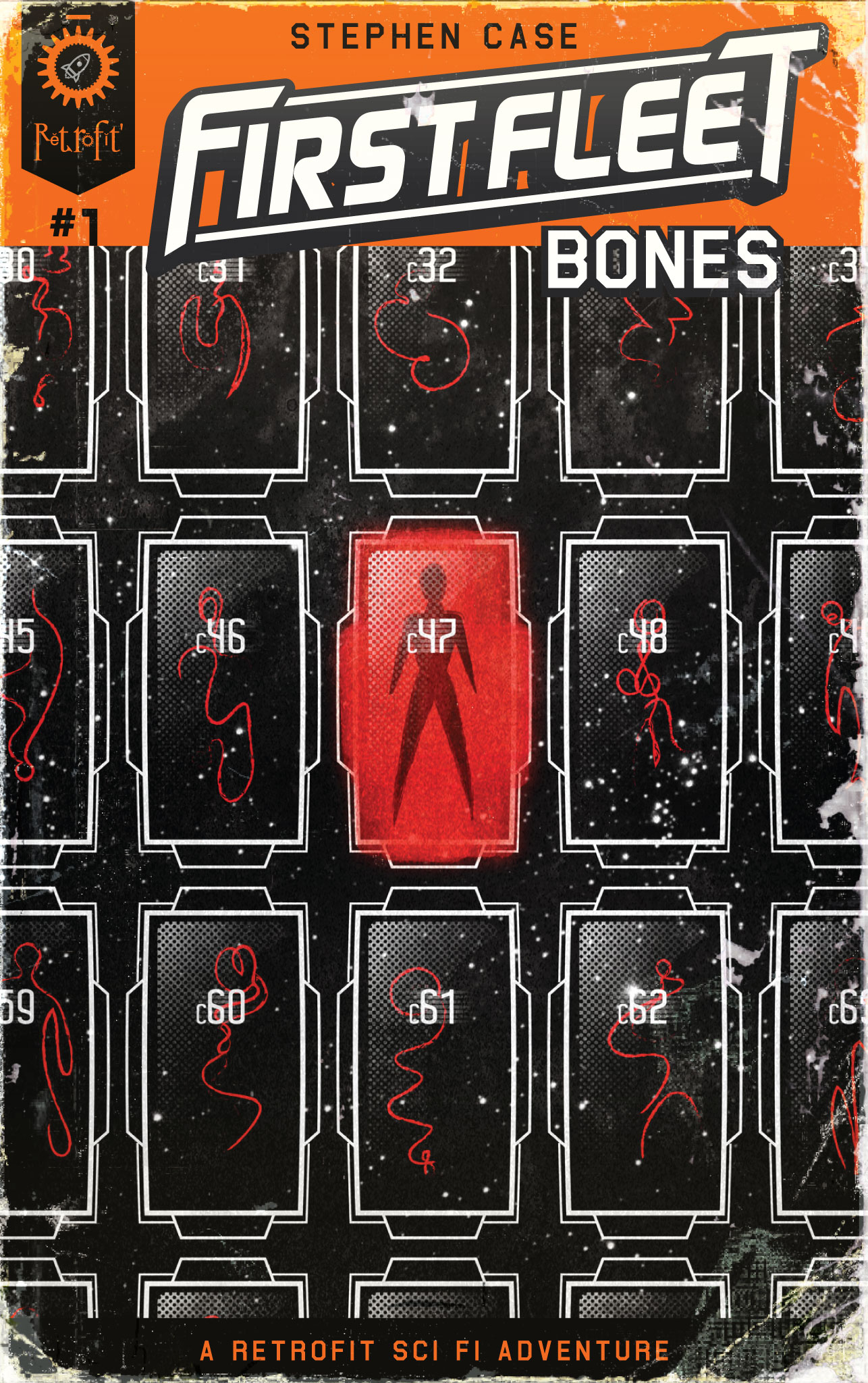
What business have I, you ask, who have never ventured beyond the short story or occasional novella, in writing a novel? I place the blame solely on the shoulders of my editor, who liked one of my published stories enough to contract for a novel based on the premises I started exploring in that first bit. And that first bit, retitled Bones (the awesome cover of which you see above), appears now as the teaser/intro to the novel proper, setting the stage and presenting the initial mystery of the First Fleet. The tone is Lovecraftian horror in space. The plot involves technology used to regenerate soldiers in a war going suddenly very badly.

You can (and should) download Bones. It’s free, and you can get it direct from the Retrofit website or from places like Amazon or Smashwords.

Wake (cover below) is the first installment of the novel proper, which follows the narratives of two women who get entangled in the mystery of the Fleet. I had a lot of fun building these characters and these worlds, as well as the technological systems that support them, and sending them off to solve the Fleet’s mystery. (I talk a bit more about the plot in a recent blog post at Retrofit.)

Besides the process of writing the novel itself, I’ve been blown away by how Retrofit has marketed and promoted this. The editing and formatting has been top-notch, and seeing the covers they designed (capturing perfectly the “old timey” pulp feel of the paperback novels I grew up reading) has been among the coolest parts of the process.

Take a look at the first two installments if you get a chance. If you’re a reviewer and you want a review copy of Wake, please let me know. It’s pulp scifi– with all the pulpy goodness of aliens, catastrophe, military espionage, and space ships you’d expect. If you’ve read my other pieces, you know short-form fiction, veering toward fantasy realism, has been my forte so far. This was an exciting and rewarding (and challenging) departure.

Descent, the second portion of the novel, is done and is due out in April. And I’m working on final edits to the third portion, tentatively titled Memory, as we speak.

Or I will be, as soon as I post this.

And maybe bathe the kids.

FirstFleet_Cvr2b

More than Meets the Eye: Volume 6

UnknownTransformers: More Than Meets the Eye Volume 6 by James Roberts

My rating: 4 of 5 stars

An open letter to James Roberts:

Dear Mr. Roberts,

Thank you. I have lots of questions, certainly, and I have plenty of comments, but I need to start with that: thanks. When I read a work I love, that seems the first and most necessary response. I know that writing is a difficult labor– no matter how easy some people make it look and no matter what a reward it must be to see those stories given form by Milne’s artwork. It’s probably still worth something (I hope) to hear a heartfelt thank you from a reader.

But let’s talk about why we should be thanking you for a moment, shall we? Obviously there were a lot of us who grew up loving Transformers, who filled afternoons with sagas enacted by forms of molded plastic on bedroom floors. There were probably less of us, but still a significant number, who bought wholeheartedly into the mythology that Furman created in his brief stint on the original Marvel run, who realized that of course these characters were scions of a god and the universe’s last line of defense against the Chaos-bringer, that of course they were more than simply robots that transformed into cars.

And then we grew up.

We passed the broken survivors of garage sales that hung on in basements and attics to our kids. We went to Botcon maybe once or twice, taped Beast Wars when it was on television, and tried our hand at fan fiction with embarrassing results. We had our hopes dashed by the live action movies. We waited. We knew what we had glimpsed once upon a time, but it appeared as though the deep well of mythology and potentiality in story and mystique– in the epic of a million years’ war– would remain untapped.

But then there was More Than Meets the Eye, and now six volumes of trades into it, here we are. We can talk about the journey that it’s been– what it was like to realize that someone else got it and was going to start telling those stories– but the primary feeling throughout has been: of course. It’s about time. It felt as though these were stories being uncovered as much as they were being created. They were in the bones of the thing itself– spark, cog, and marrow– waiting to be told. We knew they were there. We half-remembered them ourselves. And now, we can nod and gasp and laugh and cry over the pages with recognition.

Except, of course, surprises linger. I read and then I re-read volume 6, trying to imagine the voice of Frank Welker speaking the lines you’ve given Megatron. You are doing a new thing here, because you refuse to let anything be taken as a given. You’re going to give us character and depth, even in what had been the most single-dimensional villain in the entire franchise. In each volume of MTMTE so far we’re provided a new angle, a new insight, and in this one it is the character of the former Decepticon leader himself.

Very well done.

We get new characters as well, showing your continued determination to make this a series about the second-stringers, and pushing against convention when the second-stringers themselves begin to feel established in the limelight by bringing in new faces and introducing them in ways that don’t seem contrived. We get what we expect as well in the sense of science fiction tropes done well and done with Autobots. We also get all of this given form in the continually impressive, subtle, and just so darn wonderful artwork of Milne. Can we talk for just a minute about the care he took in eviscerating everyone’s favorite spaceship?

Okay, so you obviously don’t need any advice besides: keep doing this, but I’m going to give some anyway. Feel free to skip over this to the part at the end when I say thank you one more time and promise to keep reading.

1. Can we all just agree that we’ll do everything we can to keep Milne happy and drawing these comics? I’m not saying that there’s no one else out there who could do it as well but– no, I think I am saying exactly that. Please, guys, don’t ever break up.

2. Do anything you want. Really. I was a bit annoyed at first (okay, I still am) that characters aren’t getting killed off fast enough and that some of them have started coming back. I get it. It’s a comic thing and a franchise thing. But–

3. Kill off at least one cute sidekick. With Swerve and everyone it’s great. With Rewind and Chromedome it’s sweet. With Tailgate and Cyclonus it’s getting old.

4. Spoiler: start dropping some hints about who or what the Lost Light transforms into. I know, I know, I’m a bit slow. It took me until this volume before it hit me: she’s going to transform some day, and it’s going to be awesome.

That’s all. You’re a British subject, right? I think we could probably make a case for you being knighted for service to science fiction literature and sentient robotic lifeforms. It’s probably not how these things work, but you’d have my vote.

Thank you. I promise to keep reading.

Your fan,
-Steve

The Wizard’s House

e2c22bec9ae2227c45bad94934038040

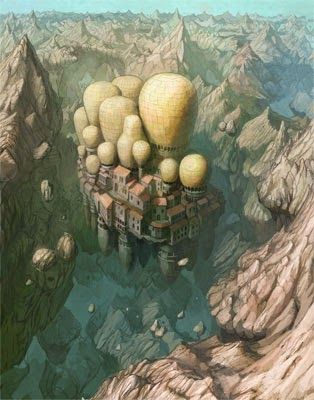
I like the idea of flying castles. I’m a big fan of Hayao Miyazaki’s Howl’s Moving Castle (not technically a flying castle) and Castle in the Sky. I love the idea of something so heavy and earthbound given levity, drifting through the sky like a cloud. (There’s a flying castle at the beginning of Wolfe’s Wizard Knight series as well.)

That idea was the germ for writing “The Wizard’s House.” I wanted to play in a landscape similar to that of Nausicaa of the Valley of the Wind (another Miyazaki film). I wrote this piece about a young man and his search for a wizard’s flying house, and then I wrote the second installment, called “The Unborn God.” It was the second installment that was picked up first and ran in an earlier issue of Beneath Ceaseless Skies, garnering a positive review from Locus. Now the “prequel” has appeared, and you can read it here.

I’m not sure how I’d categorize these stories. BCS publishes “literary adventure fantasy,” and that probably fits pretty well. I might also affix descriptions like “surrealist” or “magical realist” to these. I try to describe the fantastic elements in as concrete, everyday language as possible, as they would appear to the characters. And I’ve had quite a bit of fun with these characters: the timepiece, the wizard, and Sylva.

These were enjoyable stories to write, and I hope you enjoy reading them. My favorite parts are the descriptions of the clouds through which the characters pass on their travels. I love watching the skies from airplane windows; the shifting cartography of clouds and the landscape below. That’s what I’ve tried to capture here.

(Artwork above by Takeshi Oga.)

Science and Eastern Orthodoxy

Science and Eastern Orthodoxy: From the Greek Fathers to the Age of GlobalizationScience and Eastern Orthodoxy: From the Greek Fathers to the Age of Globalization by Efthymios Nicolaidis

My rating: 2 of 5 stars

The complete history of science in the Christian East remains to be told. But it is certainly a narrative the broad strokes of which need to be outlined, if only because Orthodoxy remains a lacuna in most generalized histories of scientific thought. There are a lot of writings about Greek science, about its transmission, appropriation, and development in Arabic and Islamic contexts, and about its reintroduction to Western Europe. Yet about the Eastern Roman Empire, which endured more or less until the fall of Constantinople in 1453, very little has been said, even less in popular surveys for a non-specialized audience. (One popularization treating the topic, though not focusing specifically on science, is Colin Wells’ Sailing from Byzantium.)

The essential difference between science in the Greek East as opposed to the Latin West is that whereas Europe lost linguist links to the corpus of classical Greek texts, these works were never lost to the eastern, Greek portions of the Roman Empire. The interplay between this knowledge and the rapidly Christianized culture of Byzantium has often been portrayed negatively with the assumption that Greek learning was neglected because it was seen as inconsequential or hostile to Christian theology. Greek culture, so the narrative goes, was decadent, and the scientific knowledge soon flourishing in the Arabic world was stagnant or forgotten in the empire of Constantinople.

As with anything else in history, the closer one looks the more complicated the true picture becomes. Even the high-altitude overview provided by Nicolaidis’s Science and Eastern Orthodoxy: From the Greek Fathers to the Age of Globalization has plenty of room for the wide range of reactions and reassessments of science taking place during this period. Indeed, the relationship between the state, Christianity, and science is the true theme of Nicolaidis’s survey. In this he is consciously following the footsteps of Numbers and Lindberg, and in some respects this volume could even be considered a companion to the two volumes that Lindberg and Numbers have co-edited outlining the relationship between science and Christianity in the West. However, whereas those are collections of essays treating the topic from a broad range of chronological and thematic angles, Nicolaidis’s work is a chronological survey.

The extent of this survey is quite impressive. Nicolaidis begins with the hexaemerons– commentaries on the six days of creation– by the early Christian fathers Basil and Gregory. He hits the familiar points of Byzantine history: the impact of the iconoclastic controversy, hesychasm, and the Latin conquest of Constantinople in 1204. This final event, Nicolaidis argues, actually had a positive effect on Orthodox science, illustrating the possibility of radical social and cultural change and ushering in the first Byzantine humanist revival as rulers in the new capital of Nicea built a cosmopolitan group of administrators who valued classical learning. The narrative continues all the way into the modern period, chronicling the Orthodox Church’s largely conservative stance toward modern science (Darwinism usually equated with materialism), primarily because it and the modern ideas accompanying were seen as potential threats to the privileged status Christian enjoyed in the Ottoman empire.

In some respects though, this detailed account simply proves the initial assumption that there wasn’t such a thing as Byzantine or Orthodox science. Instead there was a tradition of commentary and preservation of the classical body of Greek learning, at times appreciated and shared and at times viewed with suspicion, depending on the vicissitudes of church and state policy. Nicolaidis’s account is full of Greek scholars from all periods, explaining who they are and what they taught and how in many cases they were essential for transferring texts and knowledge to the West. But true “scientists” or natural philosophers are distinctly lacking. This doesn’t mean that they are not necessarily there, and this account gives lots of potential leads to pursue in a body of work that is remains largely unexplored. Unlike a popular account of Chinese or Arabic science though, which would be rife with examples of breakthroughs or technological developments, the story of science and Eastern Orthodoxy is largely that of continuity, preservation, and tension (albeit not always a negative tension) with the Church.

As an overview, Science and Eastern Orthodoxy is an invaluable introduction to the topic of Greek learning in Byzantium, the Christian communities of the Ottoman Empire, and its successor Balkan states (with the focus on Greece) and the interaction between natural philosophy and Christian thought in these contexts. There are dozens of useful references and sources if one wants to dig deeper into any of the various topics, time periods, or individuals surveyed. For an English-language introduction to the history of science in the Christian East, this is the place to begin.