Category Archives: Reviews

Christ, Our Way and Our Life

Christ, Our Way and Our Life: A Presentation of the Theology of Archimandrite SophronyChrist, Our Way and Our Life: A Presentation of the Theology of Archimandrite Sophrony by Archimandrite Zacharias
My rating: 4 of 5 stars

We are persuaded that man’s vocation is incomprehensibly wonderful and great. (99)

What do we do with this idea of holiness, the ideal of saintliness? The belief that in this life one can become like God in humility and love and empathy and prayer is one of the things that holds me in hope to Christianity.

Yet different traditions understand the concept of holiness in different ways. In many traditions, holiness and salvation are an either/or, on/off, you have it or you don’t, sort of thing: you’ve either been granted salvation and subsequent holiness by the grace of God and your faith therein, or not. In Orthodoxy, however, the process of theosis– of becoming like God– is not a thrown switch. It is certainly possible, by the grace of God, but it is claimed by few (likely no one, least of all those who approach it) and seen only as the fruit of a long process of ascetic practice and discipline.

That’s not to say holiness is only for monks. But it is to say that Orthodoxy recognizes holiness as a gradual process, an organic and often painful growth, a “ladder of divine ascent.” It doesn’t mean the only people going to heaven are the Mother Teresas of the world, but it does mean there are degrees of holiness and there are those who have advanced much farther along that road than others. And sometimes it’s good to take a long look at the abyss that separates someone like us (me) from someone like that.

For a time I used to regularly read the blog of Father Stephen Freeman, an Orthodox priest living and working in Tennessee. In his excellent posts he would consistently make reference to the works of Archimandrite Sophrony, an Orthodox monk whose life spanned much of the twentieth century. In particular, Father Stephen would quote from a study of Sophrony’s life entitled Christ, Our Way and Our Life, written by another monk, Archimandrite Zacharias, originally as a PhD dissertation and translated into English in 2003.

Sophrony and his mentor, St. Silouan, spent their lives in the pursuit of holiness. They devoted themselves to prayer and contemplation, and they said things like, “Keep your mind in hell, and despair not” and “Stay on the verge of despair, but when you see that you are going to fall over, draw back and have a cup of tea.” They lived in chastity and obedience, poverty and humility, and they attempt to forsake the priorities of this world completely. What’s the point of such endeavors? If salvation is by faith alone, are they missing the point of Christianity? Or are they of the handful of faithful few on whom the salvation of the world rests?

These are deep waters, and I waded out onto them with some trepidation. I’m no mystic, but I tried to wrap my mind around the themes of their theology. Those themes included utter humility and self-loathing to the point of despair to reach the point at which one can truly pray for the entire world. Sophrony believes this is what Christ did and that the ultimate goal of a Christian is to be able to truly pray on behalf of all (something embodied in the liturgy we celebrate each week).

No one besides monks are much into self-loathing or humility today. Yet Sophrony and Silouan maintain that a form of self-loathing is necessary to gain true repentance, that we need to see ourselves as we actually are in comparison to the love and purity of God, and that only by living through the pain of this self-knowledge (which led the publican to beat his chest and cry, “Lord, have mercy”) can we know the extent of redemption and love of God.

Most of us, I think, would prefer repentance and salvation be quick and painless. But for the Orthodox ascetics, it’s painful. It’s a burning. It’s something that’s achieved with rivers of tears. The more we know who we truly are, the more we know the extent of our own sin, the more we understand the love of God.

If they left it there though, it wouldn’t be much in the way of good news. For Sophrony and Silouan, despair over our own condition– and then beyond that, despair over the condition of the human race itself– is necessary to be like Christ. They understand the entire life of Christ as a descent– from the right hand of God to a lowly place on Earth, and then from Earth to Hell itself. Christ sits at the bottom of an inverted pyramid of creation, occupying the most lowly, painful, humble position, and from that position bearing the sins and weight of the world. When we embrace the painful humility of our own brokenness and start to feel the weight and pain of the world itself in our prayers, we are following the path of Christ. Salvation is not upward toward heaven and redemption– or at least not initially; it is downward toward the pain and humiliation of Christ.

“Keep your mind in hell,” are the words reported to have come to St. Siluoan from Christ Himself, meaning we must live in that struggle and that pain, that in taking up the suffering of our own sins and the sins of humanity, we are with Christ. “Keep your mind in hell,” he was told, “and despair not.” Despair not, because Christ did not remain in Hell, and by taking on the sins of the world He was able to redeem the world and conquer death. But, Siluoan and Sophrony would say, we focus too much on this second part alone, but we neglect that Christ only ascended by first descending and that we must follow the same path.

Christ did not descend so that a switch could be flipped and we could live the rest of our lives in redeemed comfort. He came so that we could emulate Him in taking on the burdens of the world and offering them up to God. Generally speaking, man bears witness to his kinship with God when, in every aspect of his life, he thinks, feels, and acts with the consciousness that God has placed all of creation into his care. (63) For them, this is a very real, ontological act centered in prayer, not simply in a role of stewardship of nature or talents (though that’s certainly a part of it).

If this repels, reflect on the saints. Who are the saints, in whatever tradition you find yourself? What makes them saintly? Is it simply that they’ve been saved and sanctified, or is it that they recognize this salvation as a means of taking up the pain and the burdens of others and by doing so sanctifying them to God? And how are they able to do this? By recognizing their own brokenness, by living at the edge of despair and not yielding to it, and by constantly orienting themselves toward humility, patience, and descent.

That seems pretty difficult. And right.

For those who have not been given such a state, copying his way of fulfilling St. Silouan’s word may prove unbearable. A lighter form of this teaching may, however, be realized by anyone, if he gives thanks to God at all times for all He bestows upon him, acknowledging always his own unworthiness. Continual thanksgiving makes up for what is lacking in us. (273)

Transformers: More than Meets the Eye Volume 8

mtmte7Transformers: More Than Meets the Eye, Volume 8 by James Roberts
My rating: 2 of 5 stars

With great excellence comes great expectations. If you’ve followed my book reviews for long, you know that I’m a huge fan of the work of James Roberts and Alex Milne on the ongoing IDW Transformers: More than Meets the Eye series. The release of each trade paperback is a Pretty Big Deal in my world, a world that is usually more or less cut off from What’s Cool Right Now. (I still haven’t seen either Interstellar or The Martian, for example, and I have no idea how many superheroes are currently appearing on network television series.) I’ve had huge expectations for each of these installments, which have consistently been setting the bar higher and higher. Great art, fantastic story-telling, compelling science fiction, and giant transforming robots. What’s not to love?

I say all that to say that the expectations were ratcheted up (no pun intended regarding the cover) pretty high for Volume 8, and it was the first volume that disappointed. I usually read each volume twice before posting a review. With Roberts’ writing this is important, as the narrative flow can at times be very dense. This one though only merited a quick re-skim to see if my initial dissatisfaction was justified. I think it was.

So here’s my list of tongue-in-cheek suggestions as to why this volume for the very first time in the run of TF:MTMTE trades left a bad taste in my mouth. And I say tongue-in-cheek because I realize it’s easy to criticize. So while I stand by these complaints, I still say Roberts is doing great work and can keep doing whatever he wants. I’ll be reading Volume 9, no worries. These are also tongue-in-cheek because they’re also to some extent an acknowledgement of what Roberts is doing continually, which is turning some common expectations on their heads.

But anyway, here they are:

1. Don’t humanize the sociopaths. The Decepticon Justice Division since nearly the very beginning of the series have been the bogeymen, the horror, the real Bad Guys now that the Decepticons themselves are ambiguous. (I’m not sure who the Bad Guys are in the other IDW Transformer title.) They were the worst of the worst of what the Decepticon cause could become. So don’t humanize them now. Don’t pull their teeth. We’ve already had sociopaths getting humanized: Megatron. So please keep Tarn and company easy to hate. Don’t introduce us to the humor and social dynamics of their crew. Don’t confuse our loyalties. And please, please don’t give the DJD a Tailgate. We don’t need another cute sidekick to show us the softer side of our mechanical killing machines.

2. Don’t dial back the body count. This series immediately found its legs by introducing us to the second-stringers of the Transformers universe and not being afraid to kill them. We learned that the secondary characters were themselves heroes, and then we learned that heroes died. The early issues– especially those with Overlord– were gritty and felt real. Things have lightened up significantly in this volume, which is fine, but now we’ve got another wave of second-second-stringers to keep track of. We’ve got a second replacement medic. We’ve got a bunch of new faces. Fine, but remind us why this all matters. I’m with Rodimus on this one: please let Thunderclash die, for goodness’ sake. I guess I’m as twisted as the DJD: I want dead Autobots or the game just stops feeling real.

3. Don’t get sappy. I get it, and I appreciate it: we’re playing with romantic relationships among non-biologically gendered robots. That’s pretty cool, and it was pretty effective when it was Rewind and Chromedome. But I feel like this volume has a lot of drama, a lot of weird tensions, and a lot of goofy crushing. Please, please, please don’t give me an Autobot love triangle (unless Dominus Ambus turns about to be Tarn). And please don’t give me any more pictures of Rewind and Chromedome on a flowered backdrop with the words “my love” written anywhere, ever.

4. Don’t get cute. Besides the two-issue throwaway story arch about the charisma parasites (which I think was a low point for the series so far), this is my major complaint about this volume. It felt too cute. Ten is cute. He draws cute pictures and makes cute toys. Swerve is very meta and cute, creating an entire sitcom planet in which our heroes can cut cute figures and be cute and snarky. I’ve already complained about the DJD’s cute sidekick. Even Megatron’s cuteness in this volume, as he bickers with both Rodimus and Magnus, shows perhaps more than anything else his integration into the Lost Light crew. One or two issues of heavy cuteness I think I could have taken, but the whole volume was full of it. (A major theme of this volume was Autobot dance parties, for Cybertron’s sake.)

Again though, it’s quite likely that Roberts knows exactly what he’s doing. He probably has some of this series’ darkest developments up his sleeve, and he knows we need some time sit back and relax, project our holomatter avatars and just be silly for a while. Or perhaps he’ll explain away the whole thing in another few issues with a wonderfully detailed explanation involving metabombs, time loops, and quantum cuteness paradoxes. Maybe while all this was happening in our universe, another crew of the Lost Light completed their quest only to realize Cyberutopia was long ago consumed by the Chaos-Bringer, Overlord returned, and Pharma had an epic battle over a smelting pool with Ratchet (as opposed to our universe, where Ratchet gets a Drift action figure).

But to tell the truth (Primus help me), I would have rather read a comic about that universe.

Waiting for Godot

Waiting for GodotWaiting for Godot by Samuel Beckett
My rating: 3 of 5 stars

The danger with teaching honors students is that you might learn something from them. In my astronomy class this year I created a new assignment where instead of writing a research paper I had the students write a dialogue between a geocentrist and a heliocentrist. One of my honors students wrote her dialogue using the characters and setting of Samuel Beckett’s Waiting for Godot, assuming I’d understand the literary references. I’m used to student using pop culture or sports references that are lost on me, but I couldn’t have a student using literary references I wasn’t familiar with, so I immediately grabbed the two-act play from the campus library and got to work.

We always find something, eh Didi, to give us the impression we exist?

The back cover of my edition tells me two important things and one utterly opaque thing. I learn that the play was written in French in 1948, so I can assume things about the shattered cultural backdrop against which Beckett was writing. I also learn from a reviewer that the play is “the quintessence of ‘existentialism’”, a interpretation one can agree with pretty quickly once one has gotten into the play. Finally though, there’s the quote by Norman Mailer that “consciously or unconsciously Beckett is restating the moral and sexual basis of Christianity which was lost with Christ.” There’s a lot I don’t understand about this play, but I don’t understand that quote about the play the most of all.

The play itself: two men, Estragon and Vladimir, spend two acts/days in an interminable twilight at a non-specific location (with a tree) waiting for Godot to come. They’re both tired, hungry, depressed, forlorn, and irritable, and they spend the time in often circular conversations trying to stave off depression and reassuring themselves that Godot will indeed come. Godot represents hope for a better situation, but he also represents imprisonment to their current condition: they would move on, away from such a depressing place, except that Godot has promised to meet them there.

In both acts they meet Pozzo and Lucky, a master with his slave. In both acts a young boy comes to bring a message from Godot. The exchanges between the two men and Pozzo and Lucky provide some of the most pathetic and humorous exchanges in the play. Pozzo’s bombastic pronouncements and domineering persona in the first act and his pathetic feebleness in the second say something about the trajectory of a man’s life. Lucky’s bizarre situation and his impassioned monologue– which, as my student pointed out, we want so badly to make sense– also represent something, I’m sure. Exactly what though is much less clear.

Waiting for Godot is obviously a classic because it’s full of symbols that are hauntingly familiar and yet unclear. There’s an abundance of meaning. But the play itself, for all its existential trappings, is surprisingly accessible. It’s easy to read, and the dialogue between the characters is sharp, poignant, and sometimes quite piercing. It’s a rounded bit of absurdity that points at a deeper, more tragic absurdity– that of life itself. But for all that, it goes down as easily and hauntingly as the darkening twilight in which Estragon and Vladimir continue to linger.

At me too someone is looking, of me too someone is saying, He is sleeping, he knows nothing, let him sleep on.

The Fall of the Faculty

The Fall of the Faculty: The Rise of the All-Administrative University and Why It MattersThe Fall of the Faculty: The Rise of the All-Administrative University and Why It Matters by Benjamin Ginsberg
My rating: 3 of 5 stars

There’s something wrong with American higher education today, and Benjamin Ginsberg, a political science professor who has worked at multiple prestigious U.S. universities, is convinced he’s identified the primary component of the problem: college administrators. His work, The Fall of the Faculty: The Rise of the All-Administrative University and Why it Matters, is a polemic against the spread of what he refers to as the “administrative blight” that has proliferated throughout higher education in the past several years. Administrators and faculty are engaged in a war for control of the fate of the university, Ginsberg argues, and he makes it abundantly clear which side he believes actually has the best interests of the university at heart.

It’s a stance that will likely seem reasonable to most faculty. Indeed, Ginsberg’s unwavering sarcasm and biting criticism against the armies of what he calls “deans, deanlings, and deanlets,” their self-aggrandizing campaigns and their academically watered-down programs, makes the book quite entertaining to read. And it would have been more entertaining, if one could escape the suspicion that he’s partially right. His primary argument is that administrators exist primarily to promote their own agendas and expand their own influence, and that this often has very little to do with the primary job of the university, which is teaching and research.

The work will resonate (either positively or negatively) with anyone in higher education, though Ginsberg’s vindictive tone (comparing administrators in various places throughout the work to blight, disease, cancer, and even stronger metaphors) eventually wears a bit thin and is in places unfair. But hang around with any group of faculty for long, and much of what he says will start to sound familiar.

Though I don’t go so far as Ginsberg, my own institution has seen a recent proliferation of administrative levels, and we can all name administrators for whom we don’t have a very clear idea of what it is they actually do. The bureaucratic fuzz-speak on efficiencies, best practices, missions statements, and outcomes that is easy target for ridicule in business settings has become more and more a part of university life in my (very short) experience. Things are changing, outside forces seem to be trying to reshape and restructure what happens on university campuses, and people like Ginsberg are taking note (and getting angry).

For Ginsberg though, any new administrative program is an attempt by administrators– career professionals, in Ginsberg’s evaluation, with little research or teaching experience– to expand their realms of influence and undermine the power and influence of the faculty. It’s a conflict between administrators who wish to run the campus like a business (primarily to their own benefit, Ginsberg claims) and the faculty who are actually responsible for the teaching and research that is the university’s true purpose. Get rid of most administrators, Ginsberg argues, and not many folks on campus would actually notice. But get rid of the professors, and the work of the university grinds to a halt.

Ginsberg, using a mix of anecdotes and hard data, begins his case by outlining the recent growth in total number of administrators in higher education, contrasting it with trends in faculty growth, and explores (and explodes) the rationals often offered for these trends, including financial pressures and outside accreditation requirements. He then provides his (rather snarky) analysis of what administrators actually “do,” explains the ways their cross-purposes with faculty actually end up impeding the university’s true mission of research and teaching, and blows the whistle on attempts to use things like diversity and cultural sensitivity as covers for further expansion of administrative bloat. He takes particular pleasure in highlighting the many recent accounts of inside dealing between trustees and university administrators as well as stories of fraud and spending that have come to light in some of the country’s most prestigious universities.

Ginsberg includes a chapter on the rise and fall of the tenure system in the United States, which he (rightly, I think) believes is central to concerns regarding academic freedom. In Ginsberg’s narrative, faculty tenure came about in the first half of the twentieth century through a partnership with university administration and faculty to help build strong universities and shield them against interference from political forces and powerful board members or trustees. Now, however, tenure is seen as an antiquated relic that keeps universities from functioning effectively and prevents administrators from exercising complete power over potentially troublesome faculty.

Finally, Ginsberg ends with an appeal to the university’s mission and ethos and those charged with maintaining it: the faculty. Faculty, he says, have been complicit in the growth of administration and the erosion of their own influence because they’d rather teach and do research and are happy letting administrators shoulder the burden of day to day bureaucratic concerns. However, historically many administrative posts were held by faculty in temporary or part-time positions, a practice Ginsberg believes was healthier for the university because it prevented the bifurcation in values and methods between administrators and faculty that has taken place today. He provides some ideas of what can be done to stem the growth of the all-administrative university, offering a tentative call to arms (tentative because he admits it may be too late).

Before I respond more fully on Ginsberg’s approach, I have a small quibble with his analysis of administrative growth. He tends to be uniform in seeing this growth as a bad thing, but there’s one aspect I don’t think he takes into account, and that is the growth of research centers. Here I’m speaking from my experience as a graduate student, where places like the “Center for Science, Technology, and Values” or the “Center for International and Peace Studies” were major players in supporting and fostering research and teaching at my institution. Each of these centers had to supply a small cohort of administrators to make their work possible. Here, one could make the case that the growth of administration and even bureaucracy helped bridge the divide between development and alumni relations (as each of these centers bore the name of rich donors or administrators) and actual research and scholarship. Likewise at my current (much smaller) campus, similar centers are where some of the most exciting scholarship is taking place. Albeit both these centers are headed by faculty members, but they likely entail some administrative growth, especially if they continue to expand.

Apart from that, I agree with much of what Ginsberg has to say, but where I depart from him is in his evaluation of motives. For Ginsberg, administrators are always the bad guys, and their motive is simple self-enlargement. Perhaps it’s from my own experiences at smaller, faith-based universities, but I see the very real divide between administration and faculty that Ginsberg has outlined less about bad guys and good guys and more about differences in philosophy. At my own institution, for instance, I genuinely believe most of the faculty and administrators have the best interests of the college at heart. Frustration here arises though because we seem to go about pursuing that interest (and understanding it) in different worlds, using different (and often mutually incomprehensible) languages and practices. Instead of the outline of a war, which Ginsberg has provided, what would have been much more helpful to me is an outline that would have helped me understand the world of administration.

Perhaps Ginsberg believes such worlds are simply incommensurate. He touches on some of the relevant differences in his text as, for instance, when he explains in his introductory chapter:

Controlled by its faculty, the university is capable of producing not only new knowledge but new visions of society. The university can be a subversive institution in the best sense of that word, showing by its teaching and scholarship that new ways of thinking and acting are possible. Controlled by administrators, on the other hand, the university can never be more than what Stanley Aronowitz has aptly termed a knowledge factory, offering more or less sophisticated forms of vocational training to meet the needs of other established institutions in the public and private sectors. (p. 3)

What we begin to see are different (and sometimes mutually incompatible) views of the purpose of education, what I’ve referred to as the impossible tight-rope between constituencies and interests that my own administrative team has to walk (and does so largely successfully). The university, some tell us, has to stay relevant to remain solvent. Plus, we’re beholden to our denominational roots and support. So there’s a strong motivation to not do some of the things that college professors sometimes get in trouble for: being critical, helping our students to think and ask difficult questions even when we’re uncertain where the answers will fall. There’s a conflict of interests– a tension– between these two worlds, which is why there needs to be trust but also checks and balances (like tenure).

Another quote from Ginsberg:

As one prominent higher education accreditation official and former college administrator recently put it, though once seen as a route to “personal growth and development,’” higher education today should be understood more as, “a strategic investment of resources to produce benefits for business and industry by leveraging fiscal and human capital to produce a direct, immediate and positive financial return on those investments.” (p. 10, quote from Ronald L. Baker, “Keystones of Regional Accreditation: Intentions, Outcomes and Sustainability,” in Peter Hernon and Robert Dugan, Outcomes Assessment in Higher Education (Westport, CT: Greenwood, 2004), 1.)

And here we get back to the discussion of what education should be: whether vocational training, liberal arts education, or (more likely) some combination or balance of both. This is a debate that needs to happen, but it’s not going to happen in administrative retreats, planning sessions, or meetings with consultants. It must happen through dialogue and debate that involves (perhaps primarily) the faculty.

Ginsberg touches on this as well:

Even when their underlying motivations may be questionable, professors are obligated, at least in public, to present strong intellectual justifications for their positions. In turf wars among faculty members, victor is most often secured by those who succeed in framing the issue and offering the most compelling philosophical or scientific arguments on behalf of their cause. The best faculty debates have an educational value. (p. 84)

By contrast most administrative “debates” don’t really ever become debates, as they’re usually top-down directives issued from behind closed doors, even when they purport to be setting the plans or identities for the entire campus. Secondly, as Ginsberg notes, administrative decisions tend to simply be adoptions of “best practices” from other universities or even other industries with little intellectual justification provided. I agree with Ginsberg that the power of the faculty should not be curtailed, especially not the power to be agents in setting university course or policy, because the faculty have the expertise and the vested interest in the research and teaching for which the university itself exists.

I don’t think Ginsberg is fair with his evaluation of administrators as people, but I’m a bit naive and I also tend to give people as people the benefit of the doubt. Plus, I’m at a small institution where I can (for the most part) directly see how administrators work to make my job possible. But I think he’s right when he talks about the different worlds we live in. And this is where the crux of the matter lies.

So what is to be done? Ginsberg offers a few concrete suggestions, which I’ve modified into my own list of modest proposals specific to my own university, outlined below. My academic environment is very different from the ones in which Ginsberg has spent his career, but we share many of the same perspectives and values. We’re part of the same profession, and we both have an ideal of the university we’d like to see preserved, sustained, and developed. To that end, I propose that we:

1. Bring back tenure. As mentioned above, the tenure system is not perfect, but it’s an important balance against administrative authority. Even when the administration is largely benign, tenure is essential to academic freedom. The case could be made that this is even more important at a smaller institution, where personalities and politics have the potential to play a more direct role in conflicts between administration and faculty. The power to dismiss senior faculty members who have been vetted and promoted through due process should rest with the faculty as a whole and not the administration alone.

2. Give faculty representation on the board of trustees. As anecdotal evidence at my own institution supports, the trustees (who carry much of the power of the university, at least in theory) exist in a different world from the faculty. They’re made up of ministers and lay leaders in the community, with backgrounds, experiences, and viewpoints that often differ widely from those of the faculty. It’s clear that effective leaders in this environment are those who can navigate between and have credibility with both of these disparate worlds. However, an easy step toward bridging these worlds and increasing faculty agency would be for the faculty to elect a small number of their own members to serve as representatives to this board.

3. Assign administrators some teaching load. This suggestion does not come from Ginsberg’s book but is especially suited to bridging the faculty/administrative divide at my own institution. Many of the faculty feel administrators live and work in a different world than we do as faculty, and many administrators have told me the same thing. This disconnect is heightened by differences in background; even when we want the same things, we don’t speak the same language. As a teaching institution, however, we can all agree that what happens in the classroom is essential. Requiring our administrators to bear some teaching load (or at the minimum requiring that any new administrative position have teaching load built into it) would not only bring faculty and administrators together as colleagues, it would also keep us planted in the same context with the same priorities. Moreover, administrators bearing some teaching load could go a long way to providing limited course release for faculty who wish to pursue research and scholarship but whose current course loads make this impossible.

I think Ginsberg is on to something in his treatment, though his acerbic tone isn’t going to win any administrators over to his side. And that’s not his point: Ginsberg is sure the battle lines are drawn, and he’s articulating a desperate faculty rearguard action. I’d like to think we’re on the same side, just speaking different languages. Unfortunately, I agree with Ginsberg that some of the language and values college administrators have adopted is largely incompatible with what I believe the true values of a liberal arts education actually are, but I haven’t yet given up hope that we can’t bridge those divides and do good work together.

Harry Potter & the Goblet of Fire

Harry Potter and the Goblet of Fire (Harry Potter, #4)Harry Potter and the Goblet of Fire by J.K. Rowling
My rating: 2 of 5 stars

I never really liked the Harry Potter books, and for years I’ve been trying to articulate to myself why. Probably part of it is the determination to be suspicious of anything for which there’s a lot of hype. They didn’t quite take with me when they first came out, even after the girl I was dating made me read the first one. It wasn’t until years later, when I saw the first part of the seventh movie with the same girl (who was by that time my wife) that I decided the story was getting gritty enough to make me curious. I read each book over the Thanksgiving/Christmas holidays one year in graduate school, pausing after each volume to watch the movie adaptation. It was fun.

Now we’re doing the same thing with our twin eight-year-olds. This time, each time they both finish a book we’ve been watching the movie adaptation in the planetarium. We had a few of these “Harry Potter Parties” over the past summer and have made it up through Order of the Phoenix. After we finished the fourth movie, I figured I’d jump back in. I hadn’t read any of them in years, and Goblet of Fire had always been my wife’s favorite.

I still don’t get it. Part of me does, sure: it’s fun. Better than anything else, Rowling captures something (I’m not sure what) that makes you want to go back to Hogwarts with the three main characters each year. The magical boarding school aspect is fun. And as the novels progress, the growing threat of You-Know-Who’s return starts to become compelling. Pulling that out across several novels and following the Orwellian machinations of the Ministry of Magic to deny it eventually starts to build nicely.

But so many other books do this sort of thing so much better.

I had difficulty finishing Goblet of Fire. For one thing, I knew how it was going to end, so there wasn’t really anything driving me to finish it. (I honestly don’t understand how people read these books over and over again.) There’s a mystery, but Harry doesn’t really do anything to solve it. In fact, in this book Harry’s frustratingly passive. He spends most of the narrative complaining about how he doesn’t understand what’s going on, and the story plays out around him. This becomes quite a trend in the later books, aggravated by Harry’s growing adolescent angst. Maybe this is one of the reason the books appealed to kids who read it at a time when they were going through similar things in their lives, at least as far as feeling kind of powerless and at the mercy of circumstances.

Maybe Goblet is a good volume to analyze (though I’m really not going to spend much time doing that) because it’s a microcosm for my primary complaint about the series. As much fun as it is, and as much as Rowling has done just enough world-building to make it work, the whole series is stuff happening to Harry. Possibly that starts to change in the later books (which I don’t recall as sharply as this one I’ve just reread), but as far as book four Harry continues to be a fairly self-centered character who bumbles from one near-disaster to the next, shepherded through by people who are either trying to kill him or trying to protect him.

I guess the character I resonate with the most is Snape, because I kind of share his evaluation of Harry. And, though this isn’t directly relevant to Goblet, Snape’s ultimate fate is still my biggest (and in my opinion most credible) complaint against the series as a whole. A single outstanding question runs through the entire series, which is basically: which side is Snape on? And though we get an answer (not in Goblet), we never really get a resolution. Or rather, we get a resolution so pathetic as to not be worth the multi-book build up.

But I’m trying to give a review of Goblet. As far as the series goes, it illustrates that things are getting serious in the most blatant way possible: by killing a character. But as far as a stand-alone book, a tidy little puzzle gets wrapped up through last-minute revelations and Harry’s participation in the Tri-Wizard Tournament. Sure, the movie leaves out a lot of “plot details,” but it captures the essence: stuff happens to Harry. Serious stuff. But his friends help him out. Also powerful wizards.

But come on, give the kid a break. He’s really dealing with a lot of stuff right now. You know how his parents died, right?

To be absolutely fair though, watching my sons read through them and seeing how excited they got has been fantastic. I don’t have to be a huge fan to enjoy their enthusiasm or to enjoy watching them attempt to walk down the stairs, eat lunch, or do various household tasks with their noses in a pair of a five-hundred-page books. If Rowling is a gateway drug to Tolkien, Lewis, Le Guin, or L’Engle, then a million points to Gryffindor.

Planets & Stars

Planets: Ours and Others: From Earth to ExoplanetsPlanets: Ours and Others: From Earth to Exoplanets by Therese Encrenaz
My rating: 4 of 5 stars

The art of an insightful, timely, and scientifically rigorous overview is a difficult one. This is compounded when the subjects are as broad as planets and stars, respectively. Fortunately for the educated non-specialists, there two slender volumes succeed where many astronomy texts fail: they provide a comprehensive, up-to-date survey of two fields with enough breadth to be useful and accessible to the astronomy educator while retaining enough technical grit for those desiring more depth.

The first volume (Planets), by an atmospheric planetologist at the Paris Observatory, frames the current state of exoplanetary research and the search for life in the context of comparative planetology, starting with Earth and moving through our planetary system.

Beginning with a brief introduction to observing and exploring planets (including exoplanetary detection), Encrenaz moves into a description of theories of planetary formation and then on to the bulk of the book, treating the physical properties of planets. Using Earth as test case and exploring things like geological activity and the water cycle, she provides in-depth comparison of the atmospheres, compositions, and internal structures of the planets of our solar system, touching briefly on some outer-system moons as well.

All of this sets the stage for the final third of the book, a look at exoplanetary systems– their discovery, their properties, and a quick overview of the status of the search for life in the cosmos. The chapters here remind that this is not a book on exoplanets exclusively: rather, it’s a survey of what we know about planets, which any more must include a detailed exposition of the ways other planetary systems are informing this knowledge.

In some respects, this is more helpful than a book on exoplanets alone, allowing an understanding of our own planetary context in light of these new discoveries.

Birth, Evolution and Death of StarsBirth, Evolution and Death of Stars by James Lequeux
My rating: 4 of 5 stars

The second volume is a survey of the physical processes (including a fascinating and detailed analysis of the interstellar medium) governing the life of stars. Lequeux, also of the Paris Observatory, takes a slightly more technical approach. Indeed, it was at times difficult to follow his account of the complex processes taking place within a star at various points in its life cycle.

However, the technical aspects provide a conceptual rigor often glossed over in more popular texts. Topics covered include the birth, physics, evolution, and death of single stars as well as a chapter on the “zoo” of double stars. It concludes with a glimpse of the larger questions of galactic evolution that stellar life and death play into.

Perhaps most importantly, this account discusses the many open questions in stellar evolution, especially star death, and the importance of modeling stellar interiors.

Both books are slender, less than 200 pages each, and filled with diagrams, images, and (especially in Lequeux’s) equations. Both are translations of works originally published in French, and the awkward language at times bears witness to this though never actively detracting from the text.

Neither volume is a textbook (there are no problem sets, for instance), nor are they purely popularizations, maintaining a balance between general survey and in-depth technical treatment. Often I read a survey text and learn nothing new; in contrast, these works are introductions written by active experts in their respective fields, lifting the veil on the physics behind the concepts but keeping a wide and fairly accessible scope, filled with a wealth of new information.

This review first appeared in the September 2015 issue of The Planetarian.

Dwarf Planets and Asteroids: Minor Bodies of the Solar System

Dwarf Planets and Asteroids: Minor Bodies of the Solar SystemDwarf Planets and Asteroids: Minor Bodies of the Solar System by Thomas Wm. Hamilton
My rating: 3 of 5 stars

My first research project as an undergraduate was attempting to determine orbital parameters of some asteroids. I remember being fascinated by these obscure bodies and their mysterious classical names. If I had Dr. Hamilton’s slender volume at that time, some of my questions would have been answered.

The minor bodies of the solar system are an eclectic group with interesting histories, and Hamilton’s volume cracks the door onto this subject. The book (under 70 pages) gives a brief introduction to asteroids (nine pages), but is primarily a catalogue of information– physical characteristics, orbital data, and explanation of name and discovery– for select bodies. There is a lot of interesting information here, but unfortunately none of it is referenced. One example: according to Hamilton, asteroids 300 Geraldina was named by Auguste Charlois, an apparently prodigious asteroid-discoverer who was murdered by a former brother-in-law. There’s obviously a story here, but without references the reader is left with no avenue by which to learn more.

Worse yet is the omission of information related to the objects themselves. Dwarf planets are mentioned (and distinguished by bolding their names), but there is no discussion of their distinction from asteroids. Comets are mentioned without any explanation of how they differ from asteroids and dwarf planets and what this indicates about the physical nature of the solar system. The Yarkovsky Effect is mentioned three separate times without an explanation of what it is.

Finishing the book, I was left with far more questions than I had upon beginning it. Why do some asteroids discovered later have lower numbers than those discovered earlier (i.e., 6312 Robheinlein and 6470 Aldrin, for instance)? Why do some have names consisting of only numbers and letters (2012VP113, for example)? Is Quaoar officially considered a dwarf planet?

A simple response to these might be, “Look it up and find out,” but this leads to my major question regarding this book: in a day when I imagine information about all minor planets is available online somewhere (another reference that would have been helpful in this book), why publish a book with limited information about only a selection of asteroids? It might look on the observatory shelf, but as a catalogue it is inherently incomplete and immediately out of date.

This review first appeared in the September 2015 issue of The Planetarian.

Norstrilia

NorstriliaNorstrilia by Cordwainer Smith
My rating: 3 of 5 stars

There’s something a bit strange about only children. Maybe it’s not polite to point it out, but not having siblings seems to leave one without context and make one a little bit more difficult to relate to. That’s what I felt with Norstrilia, the only completed novel of Paul Linebarger, a diplomat, foreign operative, and expert on psychological warfare who wrote and published science fiction under the moniker of Cordwainer Smith. Norstrilia is a strange only child.

Not only was it strange in content and tone, it was a bit awkward in form. The work was published originally as two separate pieces (serialized?) in magazines. It was only stitched together into a whole narrative later. And this particular work was compiled by a specialty press and included all the textual variations in an appendix at the end. Why do I get suspicious with textual variations? An author is never sure exactly what to say or how to say it, but usually they manage to hide this uncertainty. I suppose I don’t like the reminder of having it made manifest.

That all probably sounds like complaining, but I enjoyed reading Norstrilia quite a bit. I think I was prepared for it because even though it doesn’t have any siblings, it does have some cousins: those strange half-breeds and vagabonds that are the fiction of R. A. Lafferty. Norstrilia wasn’t a Lafferty, but it had several similar features: the strange, rollicking pace; the larger-than-life characters; the comfort with the bizarre; and the lack of emphasis on a tight, cogent plot.

So here’s what it’s about: in the far future there’s a planet called Norstrilia (a contraction of “North Australia”) that grows a viral serum that ensures long life for the rest of the galaxy and makes Norstrilia incredible rich by its export. (Think Arrakis with giant mutant sheep.) The planet is the epitome of the hardy, frontier lifestyle that Smith saw in his own time in Australia, and to preserve this way of life (as well as population control), Norstrilia has kept itself poor on purpose– even though most of its inhabitants are fabulously wealthy. One of the ways they do this is by making imports to the world incredibly expensive. The other is a test at the age of adulthood to determine whether the Norstrilian youth will receive full legal status or be killed (think the gom jabbar, also from Dune).

Against this weird background one Norstrilian grows up handicap, unable to telepathically spiek or hier like his peers. He uses a forbidden computer to play the markets and more or less by accident becomes the wealthiest man in the universe, and he buys the Earth. Traveling to Earth, he’s manipulated by various agencies– including Cordwainer’s famous Instrumentality of Man, the animal-engineered servants of humanity, and a mysterious agency living beneath the surface of the planet. Along the way a lot of things happen, with wild, lazy, larger-than-life brushstrokes that remind of Lafferty.

There’s a lot of bigness and beauty here, shot through with much weirdness. I don’t know if I would have appreciated it as much had I not already read things along these lines– again, had I not been inoculated, so to speak, by Lafferty. I don’t know if this means Lafferty is a gateway drug, but he certain helped. There are rambles here, large figments of imagination floating like icebergs in a froth of Silver Age science fiction, and meanderings enough to annoy someone used to the clipped, brisk pace of contemporary scifi.

But there is kindness as well. When a friend recommended this book, he said he thought kindness was a theme of Smith’s work. I see what he means, though the turn is abrupt and inexplicable halfway through the novel. The main character has a crisis of faith– mitigated by a psychological hall of horrors akin to the trial that started the narrative– from which he emerges with a sense of humility, gratitude, and benevolence. He is filled with pity for the erstwhile enemy that instigated his banishment from Norstrilia (though the denouement with this character is quite weak). From what I’ve read, Smith’s high church Anglicanism shaped his writing here in some respects.

In all, this was a book I enjoyed reading for its comfort with the bizarre and its quirks, but I’m not sure how strongly I’d recommend it to readers at large. I could see it being a bit impenetrable. But if you’ve cut your teeth on someone like Lafferty or even the meandering far futures of Gene Wolfe’s New Sun, you might give Smith a try.

Shimmer #27

Shimmer 27

Shimmer is a gem, and I don’t say that solely because they’ve given a home to two of my disheveled little pieces. Shimmer finds itself home to a lot of beautiful strays. It’s a speculative fiction magazine that has carved a place for itself for bedraggled bits of wonder, lovingly polished and arranged. I’m proud to be a part of it, especially this, its latest incarnation.

In the introduction to issue #27, the editor writes that all the included pieces all fit together if viewed from the right angle. (She says something like that.) They’re like interlocking puzzle pieces, but you have to cock your head just right to see how the combined scene flows. I like that, because it’s just true enough. You’ll come away from these stories knowing how they fit together, and I’ll come away knowing the same thing. But we’ll probably know differently.

To me, besides the gilded edges of wonder common to whatever Shimmer publishes, what held these stories together was a sense of loss. An ache. Something departed.

We start with Alix E. Harrow’s piece, “Dustbaby.”

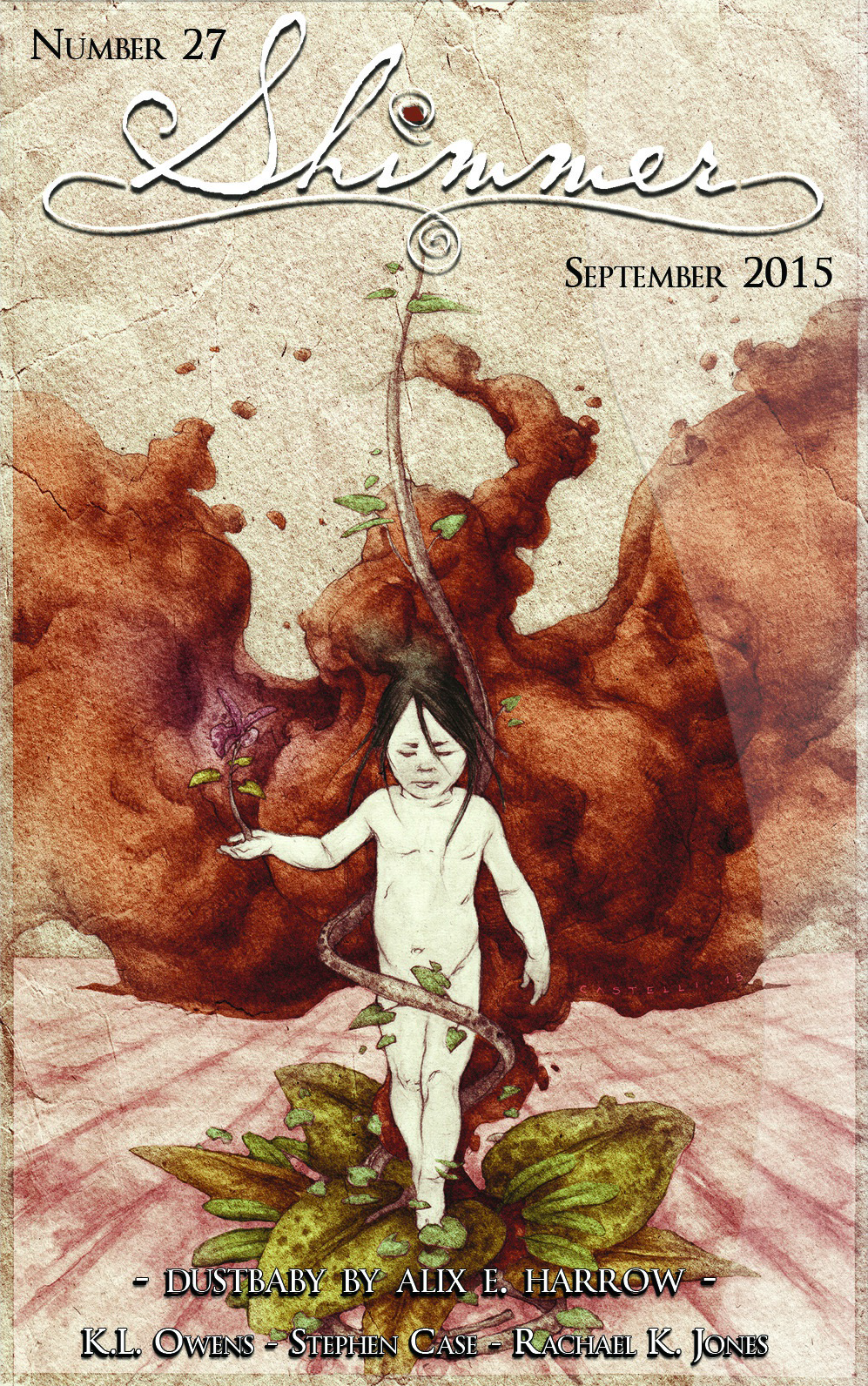
No, we don’t. We start with the cover. Judge this magazine by its cover. The watercolors that Sandro Castelli does for each issue are one big detail that holds Shimmer together and makes it work. They’re lovely and lend a haunting consistency to the magazine’s shelf-appeal.

Now, start with Alix E. Harrow’s piece, “Dustbaby.” I don’t think I’d go so far as to call it an end-of-the-world story, because it’s not among those pieces of ecological devastation or infection or whatever that I’m getting tired of reading. It’s a bit deeper than that, and by that I mean historically richer. We’re back in the Dust Bowl, reimagined. What if the Dust Bowl had been the end, the casting off of a thin crust of tired soil so that something greener and wetter underneath could reemerge? What haunted those hills before our plows passed?

Harrow, herself a historian, does good work here. The images are rich, moving, and disturbing, and we get a reminder that some of the best stories don’t have endings but rather just larger beginnings—part of what’s so much fun about short stories.

(If you like magical apocalypses like “Dustbaby,” you might check out my own “The Crow’s Word,” published in Orson Scott Card’s Intergalactic Medicine Show.)

My favorite piece in this issue (and yes, I might even be including my own) was K. L. Owens’ “A July Story.” Who doesn’t love a haunted house? And who doesn’t love a house with a mind, a mute tongue, and rooms stretching backward and forward in space and time? It might sound too much like the plot of an episode of Doctor Who, if “A July Story” wasn’t so steeped in character and place.

What makes this story work so well, beyond simply a compelling idea, are the characters: Kitten and Lana, and the place: the Pacific Northwest. Kitten’s a child of the English Industrial Revolution, torn out of time, marooned everywhere and nowhere. Lana’s a young girl from today. Their encounter, dialogue, and ultimate trajectories make a haunted house story a lot more than you expect. It’s also an especially strong tale because it takes place on a deeply textured backdrop of a particular time and space, which Owens makes clear in the interview following. Highly recommended.

Then you get to read my story, which is called “Black Planet.” I explained about this a bit in my interview in the issue (which you only get if you purchase the entire issue), so I won’t repeat that here. But I really like this little piece; I think it’s among the best I’ve written, and it’s for my sister.

The final piece in this work is the shortest, “The Law of the Conservation of Hair,” by Rachel K. Jones, which reads like a prose poem (and in fact might be in actuality a prose poem) about love and alien invasion and loss. Read it at least twice. Favorite line: “That we will take turns being the rock or the slingshot, so we may fling each other into adventure.”

So what about the common theme? Things get lost in different ways. Land, lives, siblings, and loves. Why do we sometimes feel richer for the loss—or rather, for the expression of the loss?

Do yourself a favor and grab Shimmer #27.

Demolition Means Progress

Demolition Means Progress: Flint, Michigan, and the Fate of the American Metropolis (Historical Studies of Urban America)Demolition Means Progress: Flint, Michigan, and the Fate of the American Metropolis by Andrew R. Highsmith
My rating: 4 of 5 stars

The city is not a problem to be solved; it is a story to be told.

I used to dream about getting a fat grant years down the road and taking a leave of absence to start research toward a complete history of the city of Flint, Michigan. There would be so much to it, from the history of technology and the rise of the auto industry, to labor history and the creation of the middle class. I knew race would play a role in this theoretical history as well, though I hadn’t even begun mapping out the implications. It would have been an immense book, one that tapped into several important streams of the larger American drama. It would be in many ways a tragedy as well– a tale of controlled atrophy and downsizing, of a dying city, industrial decay, and the birth of the Rust Belt. That was my nebulous plan, but it was not to be: the book has already been written, and this past week I finished reading it.

Flint and its story fascinates me. I grew up on its nearly all-white suburban margins but with roots running into its history. I have memories of visiting AutoWorld as a child and of my grandparent’s home on Waldman Avenue. My mom and her parents often spoke with regret about what Flint had once been, of the prosperity of the post-War years and the sparkle of downtown before the sprawl of suburban shopping districts. Though I grew up in the suburbs of Flint Township and later Swartz Creek, my mom (and many of the parents of my friends and peers) had grown up in city. Her family came from Missouri looking for work in the factories, and my grandfather built a career on the Grand Trunk Railroad. My dad spent his career working for General Motors, much of it at Buick City before it was closed and he was relocated to Saginaw. I ventured downtown occasionally as a teenager (and it was always clearly a venture), specifically to the Cultural Center and the Longway Planetarium.

Flint’s story shaped me in obvious ways I’m only now realizing. Many of the photographs on this blog, for instance, were inspired by the rich background of texture and decay I grew up on the fringes of. I knew the city’s history in a cursory way and even saw some of it myself. For all these reasons, I wanted a book that dove into this history. In the absence of such a book (though Gordon Young’s memoir– reviewed here previously– was an excellent journalistic step in this direction) I was prepared (one day in the distant future) to attempt to write it myself.

But the book now exists.

I wrote earlier on this blog about Mark Quanstrom’s study on Nazarene theological history and the way it helped me understand the religious context in which I was raised. What Quanstrom’s book did for my theological heritage, Andrew Highsmith’s new study does for my social and urban context. (Note to self: a work exploring the intersection of these two themes, charting the growth and decline of the Nazarene church– which at one time could count at least half a dozen large congregations in the city– would be of interest.) I knew Flint was economically depressed and racially divided. But I never fully understood the depth, origins, and repercussions of “white flight,” a trajectory in which my family participated.

My sister and her husband live and work in downtown Flint. On multiple occasions I’ve biked with my brother-in-law from his restaurant on Saginaw Street, past the former site of Chevy-in-the-Hole, where it looks like giants literally gouged a cement valley along the river into the center of the city, to his house in Mott Park. He’s told me lately he feels most of his work in the city revolves around racial reconciliation and that if we can’t understand race we won’t understand anything about Flint’s story and where it is today.

I think Highsmith would agree. I first learned of his book just days after it was released from my brother-in-law, who passed it along to me with a sort of resignation: “Here’s another academic who thinks he’s figured Flint out.” I don’t know that Highsmith claims to have unravelled any riddles, but he’s begun plunging the depths of the issue, the tangle of politics– many on a national level– that made Flint what it was and is. It’s very much a story of place, rarely focusing long on any particular individual. Highsmith’s Flint is made up of institutions, organizations, politics, and changing demographics. Yet there are enough specific personal focuses, ranging from Michael Moore to the tragedy of the Beecher assistant principle driven to suicide by the intractable problem of de-segregating his high school, to keep it a poignant and human (though a consistently scholarly) read.

Highsmith offers an urban history of Flint from the early 1900s to the present. (Indeed, the epilogue brings the story up to the point of names, organizations, and developments I recognize from my frequent visits home.) In particular, Highsmith wants to understand and outline the institutional and administrative forms of segregation that kept Flint one of the most racially divided cities in America long after the era of Civil Rights. Under the aegis of strong neighborhood schools, for example, the Flint public school system remained effectively segregated until whites were in a clear minority throughout the city.

Highsmith examines the central issue of race and urban policy from several angles over the century. Much of the division began in housing policies at a national level in the inter- and post-War years, in which real estate redlining kept neighborhoods divided and set the foundation for much subsequent de facto segregation. In the era of urban renewal and the coming of the expressways, proponents of development argued for the clearing of predominately black slums like St. Johns, but administrative segregation largely prevented the relocation of these residents (who initially supported neighborhood clearings) from getting much value from their property and finding new homes in an integrated city.

In addition, a ring of largely white suburbs acted quickly to self-incorporate, preventing Flint’s spatial growth and through tough zoning laws blocking the construction of public housing complexes that would result in racial integration (and potentially lower property values). The background to all of this was of course the ebb and flow of the fortunes of General Motors and its complex relationship with the city. If the city of Flint was equated with Buick as the quintessential company town, what happens when Buick dies?

All of this tells a story. It doesn’t give any answers. At the risk of sounding trite though, that’s the point. Highsmith makes the case that America is the story of a thousand Flints, linking the racial and post-industrial challenges of Flint to the nation as a whole. That may be true, but Flint is also importantly unique, enough that its tragedy has a wholly specific resonance, especially to those who grew up in its shadow. This book should be required reading for anyone in or from the Vehicle City, especially anyone who cares about locality and knowing how the place that shaped you was itself shaped.

As T. S. Eliot said, “We shall not cease from exploration, and the end of all our exploring will be to arrive where we started and know the place for the first time.”