Category Archives: Reviews

The Martian

The MartianThe Martian by Andy Weir

My rating: 4 of 5 stars

This is a book written by an engineer for engineers. I’m not an engineer. But I can’t lie and say I didn’t enjoy reading this one. I needed a beach book for my week in Michigan, and when this book appeared on the shelf (as books are wont to do on my wife’s side of the bookcase), I grabbed it. I had seen one of my honors students (an engineer) reading it and had read this fantastic quip on XKCD. And then I saw the movie trailer (which looks AWESOME), so that helped me finally jump on the bandwagon. (And I know this is a departure from my resolution to read fiction by minority authors, but– BEACH.)

Be advised, this is a book by an engineer written for engineers. Did I already say that? It is compelling. The idea is simple and devastating: in the near and pretty believable future, manned missions to Mars are a reality and as gritty and physical and dangerous as an actual mission to Mars would be. On one of these missions, an astronaut gets left behind, assumed dead. It turns out he’s not, and he has to figure out how to survive on Mars, NASA has to figure out what happened and what they can do to fix it, and the crew of his ship have to figure out whether they follow NASA’s lead or mutiny and risk their own lives to save him.

Most of the story was told in the form of journal entries made by the marooned astronaut, Mark Watney, during his time on the surface. Here’s where the whole thing at times felt like a long, science fiction McGyver episode. Mark explains in detail how he’ll provide water and oxygen for himself, how he’ll grow food, and how he’ll get around on the surface. These are gripping details for a few chapters, but they can’t keep a reader’s interest– even one who appreciates the thought and detail the author put into keeping this grounded in reality– forever. Mark himself is a sort of Everyman, competent, foul-mouthed, and with a dry sense of humor. His ordinariness at times though, in spite his incredible technical competence, seems hollow. Not once, for instance, do we find Mark describing the view of Mars out his hab suite windows or reflecting on the nature of his dilemma with anything other than a superficial “do or die” mentality. But then again, what are the chances NASA would be sending a philosopher into space?

Luckily, Weir– himself a software engineer– realizes that stories don’t work without people and that it’s going to be difficult to build suspense about whether Mark lives or dies with him reporting in at the end of each day. So the narrative switches up a few times and we get a glimpse into the lives of the people back on Earth working to send supplies to keep Mark alive and ultimately his shipmates as they learn his fate and decide what they need to do to save him (as well as occasionally some God’s-eye-view narrative of the lives of inanimate equipment parts and geological features about to fail, which oddly enough functions quite well to build suspense).

This is where the actual drama comes in, and for me the most exciting parts of the novel were where the crew of the Hermes had to wrestle with what it might cost them to return to Mars to save Mark. And this– the dynamics between crew members on a months-long voyage and the cost of rescue– is what I hope the upcoming movie plays up. This was the pivot-point of the novel, and it was enough pull to get me as a reader over the hump and into the second part of the book, which chronicles Mark again and all the technical challenges of piloting a rover across a good portion of Mars to arrive at the appropriate rondevouz point and make an orbital-return component capable to escape velocity.

Lots of science here. In fact, Mark’s not really the hero of the story so much as science is. Science, Weir is saying, can pretty much solve anything if we’re plucky enough to keep trying and make the sacrifices required. (He also says something about it being the nature of humans to want to help each other, which is quoted pretty much verbatim in the movie trailer.) Besides the scientific triumphalism (which SPOILER dictates how the book will end– there’s never any real question of Mark’s survival), he deftly sidesteps any deeper questions, such as whether there’s an appropriate cost for saving a single human life or whether humans belong on places like Mars at all. No sir, this is a book about engineering. But I have to admit a book that raises philosophical questions without addressing can be fine in its own right. Sometimes it’s okay to simply present the problem in a clear-eyed fashion and leave it to the reader to puzzle through like Mark had to puzzle through the reality of Mars.

It is a fun, compelling, riveting book, but it ultimately felt unfulfilling for me because the pieces that made it tick– the people, and particularly the crew of the Hermes— never got closure. That is, we learn Mark’s fate but we don’t any view of his reunions with the people who saved his life. That would all be a compelling follow-up novel: call it The Earthling. It could show Mark’s life returned as the most famous human on the planet and him interacting with the people who contributed to his rescue as well as his return voyage to Earth with his crew (as well as the implied hook-up with Mindy, the NASA worker who contributed to his recovery and about whom I can only assume there’s an in-joke here regarding “Mork and Mindy” with Weir’s proclivity for 70s television). But the book is still tight and cogent leaving all that up in the air, especially as messy inter-personal stuff like that would take the focus off the science.

Their Eyes Were Watching God

Their Eyes Were Watching GodTheir Eyes Were Watching God by Zora Neale Hurston

My rating: 3 of 5 stars

One (completely inappropriate) way to read this book is as a zombie book. It’s a book about Patient Zero and the beginning of the zombie apocalypse. In fairness to this theory, it has several of the expected elements: the cataclysmic ending and the struggle for survival, the setting in the hot, thick swamps of south Florida, in the midst of the drama the fateful but at the time apparently minor bite, the strange symptoms, the descent into rage, and the possible spread of the infection. In this (absolutely incorrect) interpretation, Janie does not survive the fate of her husband Tea Cake; she carries the infection back with her to the village they left behind and the true horror begins after the book’s conclusion.

But that’s of course absolutely not what this book is about. I don’t think Zora Neale Hurston had zombies in mind when she wrote in the late 1930s. And even though rabies makes a brief and horrific appearance, Hurston isn’t that interested in exploring the terror of this infection (likely the inspiration for lots of zombie and zombie spin-off stories). Instead it’s simply the melancholy end of what for the novel’s main character has been a life of deferred hopes and frustrated imaginings.

Janie is a black girl living in Florida in the early days of the twentieth century. Her grandmother still remembers when the slaves were freed. But the book isn’t about the relationship between races as much as it is the relationship between blacks. The longest discussion on race that takes place in the book is a dialogue Janie has with a black woman who is prejudice against the more “negroid” members of their own people “holding them back” from integration with white society.

Janie’s world is a world on the periphery though, and that periphery is defined by race. Her childhood begins with being raised with white children and only learning to her surprise that she was black, at which point society dictates separation. Her second husband rises to power as the mayor of an all-black community and spends his life trying to create a society that mirrors white society, a separate community in the Florida wastes on the fringes but with all the trappings of a commercial white city: a thriving store and a large house, street lights, industry. To do so though he must constantly clamp down on the traditional black culture that keeps cropping up like a weed, to his frustration and Janie’s growing alienation.

Finally, Janie finds herself and her third husband on the absolute fringes, working cane fields at the edges of the Everglades, the “Muck,” staying over seasons while migrant workers come and go. It’s in this society though, a melting pot of ethnicities and cultures only an anthropologist could sort out (and this is exactly what Hurston was), that Janie finds the joy and freedom she never had before. Ultimately though, the racial lines are drawn most sharply in the final scenes, when Janie stands trial for her third husband’s fate.

The thread that weaves this all together is Janie herself: a woman who is searching for freedom. She wakes to herself beneath a pear tree (the cover of this edition and perhaps the most iconic scene of the book). She’s married off by her grandmother to a gruff old farmer and then runs away with a man who evolves into a small-town dictator. She finally finds the freedom she’s looking for in Tea Cake, with whom she shares years at the dizzy edge of existence before it’s turned upside down by a hurricane and a bite from a rabid dog.

It was an easy book to read, but it felt dated. I felt that Hurston went a bit too easy on me. That is, I was set up for the difficult twists and turns Janie would experience, and she does, but it’s all told in a sedate, matter-of-fact way. Even the eventual fate of Tea Cake, which in a modern book it seems would be full of riveting, harrowing detail, seems softened, like we’re with Janie remembering back on this years later now that the details have been blurred by time.

The language was stunning throughout. This was especially effective juxtaposed with Hurston’s dialogue. Her characters speak in thick Floridian accents (or what I have to imagine are Floridian accents), and she writes this out phonetically so that it actually takes a bit of getting used to to read what her characters are saying. But it means you know how they’re saying it. And her narration throughout is luminous. There are expressions that catch you with their beauty in the same way that Janie wakened to life beneath the pear tree.

A Century of Holiness Theology

A Century of Holiness Theology: The Doctrine of Entire Sanctification in the Church of the Nazarene: 1905 to 2004A Century of Holiness Theology: The Doctrine of Entire Sanctification in the Church of the Nazarene: 1905 to 2004 by Mark R. Quanstrom

My rating: 4 of 5 stars

I grew up in a denomination that defined (and continues to define) itself by a single point of doctrine: entire sanctification. It’s a term you know if you’re a Nazarene, and if you were raised Nazarene (like I was), it’s a term you spent a good deal of your childhood and teenage years trying to puzzle out. For a certain generation, entire sanctification was something that happened after you were saved, a “second act of grace” by which the Holy Spirit filled you completely and you were cleansed of sin and entirely devoted to God. For others (generally in a younger generation) it was a crisis point at which you fully dedicated yourself to God and began a lifelong process (that may have started at the same point at which you were saved) of committing yourself and living a holy life. Whatever it was, it sounded wildly exciting, exuberantly optimistic, and incredibly confusing.

I’m not a Nazarene anymore, and it wasn’t the idea of holiness or sanctity– the idea that one could and should and that certain people even did live a holy life before God– that drove me out. Indeed, I don’t think I was driven out at all, and I still have a great love and even a lot of like for the denomination. I believe there’s a place for people who appreciate, respect, and understand the Nazarene heritage working in and serving the Nazarene world. (Otherwise I wouldn’t be where I am doing what I’m doing.)

But the doctrine of entire sanctification is still confusing. Poll a dozen Nazarenes as to what exactly this means and you’re likely to get a dozen different answers. And what I learned reading Mark Quanstrom’s excellent historical survey of the doctrine is that there’s a reason for this. Quanstrom’s work does what the best historical studies should: it gets at the primary sources to provide an insightful narrative, and in this case a narrative that resonates with me and explains a lot of the reason I was at times confused regarding my own church’s doctrine growing up. The work is not a philosophical polemic (Quanstrom lets the documents speak for themselves), nor is it a systematic theological exposition (though my own background in the church helps, as I already in some sense speak the language). I’m not sure how accessible it would be to someone with no background or relationship to the denomination.

Quanstrom starts by laying the historical groundwork for the church’s formation, which I only patchily remembered from my days reading missionary books and studying up for my Caravan badges. (I’m sure I would have gotten more of this had I been a religion major at a Nazarene college.) The point is that the Church of the Nazarene grew from an assortment of groups with one common belief: sanctification as a second act of grace subsequent to the initial salvation experience. Drawing on his sources (which includes texts as varied as General Assembly reports and addresses, evolving Articles of Faith in the Church Manual, and books that were at one time or another on the list of recommended reading for those studying to be ordained in the Nazarene church) Quanstrom clearly shows that the early Nazarene church– an assembly of several disparate holiness movements– was unified in the early decades of the 1900s about the distinct, instantaneous second crisis event called sanctification that cleansed the Christian from inbred sin.

By the 1960s, however, the denomination had to face a loss of optimism of what this second act would actually accomplish– coming to grips with the depth of the sinfulness of humanity, especially in the lost of confidence that led to the Second World War. First, holiness theologians spent some time refining their definitions of exactly what was cleansed in sanctification and differentiating between actual sin (forgiven when a person was saved), the fallen sinful nature (cured via sanctification), and infirmity (never fixed during this lifetime). Then with an important book by the Nazarene theologian Mildred Bangs Wynkoop in early 1970s and scholars beginning to go back to John Wesley’s original writings, there developed an understanding of holiness (as well as sin) that was more relational and less ontological. This viewed sanctification as more of a process and put more emphasis on the initial act of grace. Opponents of this view felt it watered down the original meaning of holiness, the doctrine for which the denomination came into being in the first place. Quanstrom says in his study that the church is still in the position of having an official position that rests in an uneasy tension between these two rather irreconcilable positions.

This probably won’t be a page-turner for many people out there (though the writing was lucid and easy to follow), but I honestly found it incredibly compelling. It helped me place a lot of the things I had learned and the cognitive dissonance I experienced learning them into a historical context. And by doing this and by bringing external factors to light that were impacting theological developments in the denomination, it gave me a deeper understanding of the community in which I continue to live and work.

A Thousand Acres

A Thousand AcresA Thousand Acres by Jane Smiley

My rating: 4 of 5 stars

I’ll be participating in a workshop later this summer taking place at the Iowa State Fair and the World Food Awards. Part of the regional event is to give an understanding of locality and food production, and we’ll be exploring a bit of Iowa farmland. One of the organizers, in an email outlining our itinerary, suggested reading the novel A Thousand Acres as an introduction to rural Iowa farm life. I bent my “affirmative action” summer reading program slightly, considering that I need to read more novels by women as well.

Jane Smiley’s work is horrifying and profound. The book starts innocuously enough. There are three daughters (compared by some to the three daughters of Shakespeare’s King Lear), one of whom– the eldest– is the book’s narrator. Their father is a third-generation farmer on a tract of land that has grown over the years– through luck, diligence, and good sense– to a round thousand acres. The book begins with him deciding to retire and divide the land between his three daughters and their husbands. From this simple and sudden decision, a chain of events are set up in which the family slowly and painfully implodes.

The book was incredibly compelling to read, as painful as it was. It kept getting darker, which surprised me. I hadn’t read any Smiley, so I naively assumed this would be about a family’s love for each other and for their land and perhaps a struggle to preserve it. It was a good deal grimmer than that, though it was indeed about the land in profound and troubling ways. The story wound downward through madness, adultery, despair, and ultimately suicide and attempted murder. Along the way a past of incest and abuse was revealed that had slept beneath the surface like the drainage tiles that made the family’s thousand acres sound and productive land.

One of the things that made the work so compelling was the skill with which Smiley balanced her characters. There was no clear good guys or bad guys. There were only people with their own conflicting and often well-intentioned motivations. Whenever you thought the lines had been drawn fairly distinctly, a new wrinkle made you realize things were more complicated than you imagined. For the first portion of the book, it was easy to relate to the two older daughters and their struggle against their overbearing and increasingly irrational father. As the work progressed though, you started to see aspects of the sisters as well that highlighted their own pride and selfishness.

Throughout it all though, the land was a constant theme. The role of farmwife and farmer was highlighted and examined, as were the ideals of farming at the beginnings of large-scale industrialization, as the novel was set on the eve of the 1980s. Whatever ills their father had been responsible for, there was no denying he had made the land productive and was therefore admired by his peers. But the narrator links his dominance of the land with his abusive dominance of his family powerfully in the novel’s conclusion, a understanding that eventually results in her exile and separation from others who can’t see it in the same way.

There’s also hints of different ways to view farming and food production in the character of Jess, the outsider who wants to introduce organic farming methods but is ultimately ridiculed and rejected by his father. Jess is a weak alternative, futile, and– at this point in history– marginal to the way the farms are moving. Indeed, despite the dissolution of the family, it is the ultimate fate of their land that is perhaps the novel’s true tragedy. As dark as the novel got though, I couldn’t help feeling it actually had a happy ending in that the main character woke up. She had lived her life in a kind of captivity, and even though her ultimate salvation meant the loss of both land and family, she found it.

Double and Multiple Stars and How to Observe Them

Double and Multiple Stars: And How to Observe ThemDouble and Multiple Stars: And How to Observe Them by James Mullaney

My rating: 4 of 5 stars

“The amateur astronomer has access at all times to the original objects of his study; the masterworks of the heavens belong to him as much as to the great observatories of the world. And there is no priviledge like that of being allowed to stand in the presence of the original.”
-Robert Burnham, Jr. (my emphasis)

One of my goals this summer has been to spend more time with the fleet of telescopes I have access to through my university. I teach about the night sky and I research scientists who spent their lives studying the night sky, but I find I’ve had very few opportunities myself to get to know the sky outside the simulated confines of the planetarium dome.

Double stars are an ideal target for starting out. Unlike nebula, galaxies, and other deep sky targets, double stars are bright and fairly easy to spot. They’re like tiny gems hidden up there in the sky. The sky is a map, and sometimes it’s hard to learn. It’s often difficult to tell whether the star you have in your sights is actually the star on your charts that you think you might be looking at. Yet if your resources tells you it’s supposed to be a tight, nearly equal double with a separation of six arcseconds, and if you see it staring back at you like a pair of distant celestial headlights, then you know you’ve found it. They’re targets that are immediately rewarding, bright enough to spot on moonlit nights or in light polluted skies, and varied enough to be interesting.

Take separation, for instance. My six-inch reflecting telescope hasn’t had any troubles on the evenings I’ve been observing splitting pairs down to a separation of about four arcseconds. Izar in Bootes, with a separation of just under three arcseconds, shows a hint of the bluish companion star elongated from the edge of the brighter orangish primary. Depending on the viewing conditions each night, my scope should theoretically be able to distinguish even closer pairs, but the challenge of realizing this is part of what makes these targets rewarding.

Then there’s color contrast. You view an image from the Hubble Space Telescope, and it seems like space is vibrant with color. Yet actually viewing a nebulae or galaxy with the eye in a telescope eyepiece reveals perhaps a hint of greenish glow at best. With double stars though, the color contrast in star pairs is often quite dramatic. Different people observe different colors, which are artifacts of both intrinsic color differences in the stars and contrast between them.

Finally there’s simply the conceptualization of what you’re actually looking at. Most very close doubles are binary stars, which means systems of two (or more) stars rotating around a common center of mass. These are the objects John Herschel and others were studying in the early 1800s in order to directly calculate stellar masses. (They’re still the only method we have for directly measuring the mass of stars.) These star pairs, I argue in my dissertation, were instrumental in changing the way people thought of the stars: seeing them as vast physical systems. They continue to inform our popular stellar conceptions; recall the iconic scene of the double sunset on Tatooine in Star Wars.

Fortunate for the enthusiast like me there are a host of guides and resources regarding showcase double stars to observe. The Cambridge Double Star Atlas is a great place to start, and banking on the usefulness of that resource I purchased this observing guide by one of the authors of that atlas: Double and Multiple Stars and How to Observe Them. This slim guide is an ideal introduction to the topic, exploring in an overview the practical aspects of observing these objects but also going into some detail on the real scientific contributions an amateur could pursue. Mullaney’s enthusiasm for the topic is contagious, from the introductory physical descriptions of double stars as astrophysical objects (reminescent of the language popularizers were using to describe them in the 19th century) to his own advice on keeping observing journals.

Though the prose is good, I had two big complaints with the work. The first is the quality of printing. It was clear as soon as I cracked the cover that this was a print-on-demand title by Springer, with the pages consisting of scans of a PDF or other electronic image. The text is not crisp or clear, and on many pages there is grey stippling in what should be the white space between letters and lines. It’s not bad enough to make the text illegible, but it is annoying. The second is that Mullaney says the work is really two resources in one: a background or overview on double stars and observing them, along with an observing guide of locations and descriptions for one hundred showcase double stars. Yet– though I haven’t compared it star to star– this list seems to duplicate the list provided in the Cambridge Double Star Atlas. So if you’re looking for a lot of new double stars to admire, you might be disappointed.

“What we need is a big telescope in every village and hamlet and some bloke there with that fire in his eyes who can show something of the glory the world sails in.”
-Graham Loftus (my emphasis)

Invisible Man

Invisible ManInvisible Man by Ralph Ellison

My rating: 3 of 5 stars

This was the first significant accomplishment of my “affirmative action” fiction reading plan for the year. I would have eventually gotten around to reading The Lone Ranger and Tonto Fist-fight in Heaven, but I probably would never have read Ralph Ellison’s Invisible Man had I not made a conscious effort this year to read fiction written by minorities. I poled several literary friends on suggestions via Facebook, and this one was at the top of multiple lists.

It was a difficult read, and part of that was probably the point. Ellison’s prose is vivid, almost too vivid, and at times I was overwhelmed with the shear volume of description. He makes you see everything with a cinematographic vision, focusing in on color, sound, texture, and description until the tableau snaps into focus in your mind as though you’re staring a screen. This is especially effective in his description of crowds in the city or of tumultuous scenes of action or disorder. Ellison can describe a march, a mass meeting, and a riot with an almost painful slow-motion exactitude.

It was this slow-motion exactitude that made the book an grueling read in places. Because the plot itself was rather slow and meandering, the places where it slowed down, heavy-laden with description, were sometimes a painfully vivid slog. The story on one level quite simple: a black man whose name is never given (similar somewhat to Swanwick’s bureaucrat in Stations of the Tide) trying to find his place in the world. Yet the point of the book, and Ellison’s genius in describing it, also contributed to making the book a difficult read. I kept trying to put the narrator into my own framework of a clear and upward narrative or personal progression. For an “effective novel,” my mind seemed to keep telling me– or at least my expectations kept waiting for– we’d see the hero conquer personal and exterior difficulties and arrive at a new position of status and success.

But this was frustrated over and over again throughout the novel. From the narrator’s original fall from grace at the southern black college where the book begins to his ultimate disillusionment with the socialist Brotherhood in which he has gained a position in Harlem in the novel’s second half, he– and my narrative sensibilities– are continually stymied. Throughout, I found myself frustrated more with the narrator himself than the situations in which he found himself: he was constantly second-guessing what people thought or expected of him, constantly trying to make himself the person he felt particular social groups or situations expected of him. And then it hit me that this was exactly Ellison’s point and the reason this novel was so significant: this was the story of so many black men in the decades after the Second World War.

It gets a bit at the concept of awkwardness Adam Kotsko discussed in his monograph by the same name. Ellison’s character is constantly awkward: he doesn’t know what is expected of him, he’s constantly stepping into situations– between different social classes in the south, between union and management in the north, between the people and those who represent them in Harlem, between white women and their sexual perceptions of black men– where there simply aren’t social rules for governing interactions. Or where, he keeps believing until his revelation at the novel’s conclusion, he simply doesn’t know them. But that’s the point: this is a world in which a black man has to completely invent himself or forever be at the mercy of other’s expectations. It’s a world in which he doesn’t have a place.

This is a novel about looking through the eyes of others. And it’s uncomfortable, because it makes me realize how my own assumptions about progress, about what works and what doesn’t both dramatically and socially, simply don’t map onto other situations, other experiences, other social and ethnic and cultural groups. The narrator’s experiences portray life for a black man in both the south and the north, portray its frustration, disjoint, and in some respects its sheer randomness.

The narrator first buys into the mode of progress and education represented by his southern black college and the inspired example of its president; when he realizes the futility of this, he attempts to make it in the industrialized north. Eventually he finds a place as an orator and community organizer, but even here he comes to realize that people are less interested in him than how they can use him. Maybe that’s a realization ultimately true for people everywhere, but in the awkwardness and social chaos the narrator has moved through– a constantly shifting landscape in which the default social relationship has been exploitation– it’s a shattering one. No one truly sees him. He is invisible.

Inheriting Paradise

Inheriting Paradise: Meditations on GardeningInheriting Paradise: Meditations on Gardening by Vigen Guroian

My rating: 2 of 5 stars

The rain over the past several days has meant the plants in my meager garden have grow wild, chaotic, threatening to slip beyond the control of a weeding hand. It doesn’t help that I’m already a bit of a lazy gardener. It’s important for me to have growing things in the ground– my ground– every season, but I don’t spend time each day in the garden. I kind of let things– cucumbers and tomatoes, mainly– run riot.

I have two shallow raised beds in the backyard. This fall I may add a third. One of them is devoted to different varieties of cucumbers with basil plants holding down the corners. There’s a long trellis I made out of old chicken wire running down the middle. The cucumbers are gathering themselves right now in a slow green boil, like they’re gathering momentum to leap up and over it, as they will soon, burying it in a long leafy wave. I’ve always had good luck with cucumbers.

The second bed is more unruly. Half of it is devoted to a weedy onion patch, though the long fingers of the onions still have a comfortable lead on the grass growing up between them, for now. I dropped onion sets into this side of the garden haphazardly and without plan, so the onions have come up in bedraggled rows. The rest of the bed is split between four large tomato plants that have fountained up as bushes, spilling languid green arms in all directions, and a row of potato plants that I’m not sure what to do with. I’ve never grown potatoes before, and as lovely and thick as they look above the ground, I don’t know what that means beneath the soil.

In one corner of this bed I have an uneasy alliance with a bunch of mint. At one time this mint spread across the back of the house and my wife spent a long afternoon pulling it out of the flower bed where it had thrived for perhaps decades. I have a soft spot in my heart for the plant though, because I pull a leaf to chew every time I walk past the garden and I boil it to make mint tea for my kombucha. I have it walled off in its own corner of the raised bed, though my walls don’t go deep enough to actually do anything to hold it back. That’s just me, pulling out the constant runners that keep creeping into the tomatoes.

You’re supposed to be able to tell something about a man from his garden, and if this is true then my garden says I’m enthusiastic, overly optimistic, and naive. I know there are supposed to be growing things on my land, so I plant them, but I’m never quite sure I have the hang of what to do with them once they go crazy, as they do each season. I like to watch the garden come to life, but I lack artistry. Fortunately, there’s not a lot riding on my gardening. I don’t rely on it to provide a major source of my food. If Vigen Guroian is right though, I do need it to provide food for my soul.

The garden is the oldest analogy. As Guroian points out, man was placed in a garden at creation. Whether or not this is “historical” truth, consider what it means as literary truth. Man begins in some kind of order, as some kind of caretaker in relationship with ordered creation. Wildness and wilderness only come later.

For Guroian, an Armenian Orthodox theologian, gardening is more than a hobby or an ecological mission: it is theology, lived in the context of the soil. The annual death and rebirth of his garden is a reflection of the theological– the cosmological, he would argue– truths exemplified in the liturgical life of the Church. Indeed, in this slender volume the chapters are divided by Christian holidays, with Guroian reflecting on the beauty, significance, and meaning of what’s happening in the garden in time with what’s happening in the liturgical year. The garden is a way of participating with creation itself in worship, in bearing fruit joyfully before God. For Guroian, as he shares his own battle with depression, it’s also a means of healing.

The mirror for all this is the prayers and hymns of the Armenian Orthodox liturgy. Guroian pulls from this throughout the year– as well as scripture and occasional quotes from the Fathers or other writers– to draw the reader into an understanding of the cycles at work unseen beneath the turning of the seasons. This might be a central claim of anyone who gardens: for those of us who have lost touch with the land, the circle of the year turns largely unseen. We skim along the skin of it, but we don’t reach deeply and touch what it means.

For an Orthodox Christian gardener like Guroian, the claim might go deeper: most Christians today are like the non-gardeners, out of touch with the deeper turnings in the liturgical life of the Church. We see Easter and Christmas come and go like non-gardeners see certain fruits and vegetables appear and then disappear (though they don’t even really do that anymore) from the markets. But there’s a deep connection between the two, and Guroian believes– in keeping with mystical Orthodox theologians– that the story of the Church, the entire story of redemption and deification, is written in the soil. He would have you know this when you garden as well as when you sing or speak the liturgy.

For all that I agree with Guroian’s message here, I was disappointed with the book. It’s a slender volume that despite the richness of his prose and borrowed texts felt woodenly didactic. The cosmic significance of gardening was spelled out writ large, but what was lacking was the specificity that makes such sweeping analogies and metaphors truly powerful. I learned the significance of gardening, but what of the significance of tomatoes? What of cucumbers or mulch? What of the back bent in labor? They’re all here but passed over, unexplored. I was hoping for something more along the lines of Chet Raymo’s Soul of the Night; whereas Raymo’s theological claims are far vaguer, his treatment of natural (in this case astronomical) phenomena are compelling, concrete, and sublime. For all the truth Guroian is touching here, the execution came off a bit too trite.

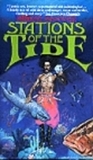
Stations of the Tide

Stations of the TideStations of the Tide by Michael Swanwick

My rating: 4 of 5 stars

If you’ve read or are familiar with Saga, the gorgeous comic series that re-imagines the science fiction epic with a generous helping of fantasy, you won’t be completely at sea with Station of the Tide by Michael Swanwick. Swanwick had been on my to-read list for a while, mainly due to associations with other authors I enjoy, but I had embargoed his work due to my attempt to finish out this year only beginning works of fiction by minority writers. Not long into this commitment though, I found myself in Chicago with time on my hands, nothing to read, and a paperback edition staring up at me from a bookstore shelf with a price of only a few dollars.

I was weak.

It had been on my radar for a while as a fairly recent cult classic among science fiction enthusiasts. The Gene Wolfe list-serv I follow has buzzed about his work occasionally in the past, and I was reminded recently he was someone I needed to check out when one of his essays appeared in the recently-reviewed issue of Feast of Laughter.

I was not disappointed. Stations of the Tide is surreal, gorgeous, and stand-alone. It’s also dream-like, a bit chauvinistic, and at times opaque. Like Saga it’s a tale that artfully blends elements of fantasy with science on a large interplanetary backdrop. There are lots of science fiction elements dropped causally in the background as aspects and support of the plot, but you never get the feeling– as you sometimes do in hard scifi– that the plot is simply an excuse to highlight or features some new piece of speculative technology.

The story is set on Miranda, an alien world fully colonized by humans but upon which (a la Gene Wolfe’s Fifth Head of Cerberus) indigenous inhabitants are rumored to survive. Once every two centuries, the climate of the planet shifts and huge jubilee tides rise to cover the lowlands. The plot takes place primarily in these backwoods Tidewaters, as the protagonist– never named, always simply called the bureaucrat– hunts for a fugitive among towns being abandoned and evacuated in anticipation of the coming, cataclysmic floodwaters.

The power of the book is not in the characters. None of them seem real, except perhaps the bureaucrat’s local partner, Chu, and the story’s villain, Gregorian, a Mirandan accused of stealing forbidden technology but believed on the planet to be a powerful wizard. The rest are caricatures: the administrative superiors the bureaucrat is working for, the woman he falls in love with, and of course– as perhaps intentional and illustrated by his name– the bureaucrat himself. If he’s meant to be a faceless everyman the (presumably male) reader can put himself into the place of relatively easily, this succeeds.

No, the real strength of the novel is the setting and the story-telling itself, which consists of vignette-like chapters in which the bureaucrat moves through this surreal, dream-like (and yet vivid) setting in the wake of Gregorian. And here I think is where the novel illustrates something important about story-telling (important and encouraging to me at least): it’s a powerful example of how to provide a sense of wonder through the “show, don’t tell” maxim used effectively. More than that though, it illustrates an author absolutely comfortable in the world he creates. The history of Miranda is never completely spelled out. It’s simply the world we find ourselves in; it forms a background organically and naturally glimpsed (sometimes frustratingly incompletely) as the story progresses. Same with the technology: no one ever sits us down and tediously explains how surrogates work or the internal functioning of the bureaucrat’s suitcase. The snippets of explanation we do get, mainly between the bureaucrat and his local partner, seem natural because the control of off-planet technology is central to the story and the political tensions on the planet. This is also true of the flora and fauna of the planet itself. Again, these are details mentioned casually in the background: the orchid-crabs, the barnacle flies, the behemoths. Most of them are never actually described in detail, yet you’re given enough to build an image of this world. It’s a strange, alien bayou, with cities being abandoned before the rising waters with a carnival-like Mardi Gras feeling.

Television is an important thematic element throughout. There’s always a television on somewhere in the background, and throughout the novel we’re given glimpses of a serial playing out along the lines of the grotesque pirate adventure that is threaded through Watchmen. It also reminds again of Saga, the ever-present and shifting images on the screen-face of Prince Robot.

Something should also be said about the tantric sex scenes, though I’m not sure what. They’re there and pretty vivid, but what’s vaguely disturbing about their inclusion is that they seem to do little but play into stereotypes that science fiction– even good science fiction like this– is a playground for men and their fantasies, both sexual and technological. The character of Undine, the bureaucrat’s love interest, has the sole purpose of teaching the bureaucrat a couple neat sex tricks and providing an emotional motivation for what is otherwise a straightforward sense of duty (though ultimately these two motivations come to a play briefly in a scene of conflict that for a moment gives the bureaucrat pathos). Yet she doesn’t do this by being any sort of actual character besides a really, really good lover who just happens to take a fancy to the main character.

If Undine represents standard male science fiction sexual fantasies, the bureaucrat’s briefcase represents technological fantasy. The briefcase is a character itself, something like a smartphone might be in several hundred years. It can manufacture anything, integrate into any computer system, and get around on its own. And it’s the perfect servant, always obedient and quick to save the day. Indeed, it becomes one of the most endearing characters because of its faithfulness and resourcefulness. Which makes the final scene with it all the more poignant. I think Swanwick knew what he was doing here, and it’s an ironic commentary on man’s love affair with the technology he creates and controls.

If you’re willing to overlook the awkward deployment of eroticism, Stations tells a powerful, compelling, and enjoyable tale. The plot is meandering, and at times I had trouble figuring out why the characters were going to certain locations or keeping track of characters who disappeared and reappeared throughout the novel. Scenes come and go, only vaguely held together by the pursuit of Gregorian. Some of the reveals at the end seemed forced, and a few were unsurprising. We realize early in the novel that Gregorian is deceptive and the bureaucrat naive. We know to expect a few tricks. But the trick the bureaucrat himself pulls at the novel’s very end took me by surprise, and I’m eager to read it again to tie many pieces together but especially for clues to see if I should have caught the final twist coming.

That’s why it’s a great book. You can’t toss it aside and forget it. It’s going to sit on my shelf, and in another year or two I’ll read it again and figure out how many tangles I can unravel now that I know that whole story. Yet I didn’t leave the first reading disappointed or confused. It’s like a good puzzle. There’s some satisfaction, but I’ll return to it not because I feel l need to in order to fully “get it” but because it’s going to be even better exploring the second time. Maybe it’s less like a puzzle and more like a rambling house. That balance– satisfaction with a single read but awareness that there’s more to return to– is difficult to achieve and I think a mark of a new classic.

The Unsettling of America: Culture and Agriculture

The Unsettling of America: Culture and AgricultureThe Unsettling of America: Culture and Agriculture by Wendell Berry

My rating: 5 of 5 stars

I told my friend that reading a book by Wendell Berry was like your father sitting you down to have a difficult talk. You remember the kind. The kind you dreaded because you knew he was going to be right, you knew he was going to tell you things you didn’t necessarily want to hear, and you knew you were going to have to change. I told my friend this because we’re creating a course for next semester on sustainable agriculture and we’ll be using this as one of our texts. But I told my friend we needed to start with something easier, something to ease the students into considerations of food production, industrial agriculture, and sustainability, because Berry’s going to be difficult.

He’s not difficult to read because he’s a poor writer. He’s a fantastic, lucid, compelling writer. But he’s difficult because what he’s saying is correct and devastating. He says things you don’t want to but need to hear. And you hate it a little bit because you’re embarrassed that you never realized these things for yourself and you’re going to have to do the difficult work of changing.

Berry is the Kentuckian farmer, essayist, and activist who is the patron saint of much of the back-to-the-farm, slow-food, locavore movement. Some might argue he’s the guy who started these movements, though his books are simply about the land and our connection to it and the way this has been lost and abused by industrial agriculture and destructive practices and structures– what Berry calls “agribusiness.” He writes fiction and poetry as well, but from what I’ve read and heard of these works the central theme is the same: fidelity to place.

The Unsettling of America is a collection of some of Berry’s classic and most influential essays. Most were originally published elsewhere, but they all fit together in a structural whole yet independent enough to be read on their own. This makes the work especially useful as a primary text to give readers some introduction to Berry.

Berry’s major claims are that our relationship with the land– primarily through agriculture and animal husbandry– is an essential part of our culture and has been lost through the machinations of agribusiness. In the past, small farmers owned their land and grew a variety of crops with care and attention to the local constraints and conditions of culture and soil. Far from being “quaint” or “rustic,” this represented an integrated, varied system that was robust, culturally-rich, and sustainable. It was, Berry argues, drawing on the writings of Thomas Jefferson and others, an essential part of the structural fiber of our nation: independent land-holders tied to the land and local communities. Berry takes this analogy even farther, offering a holistic view of health as concentric circles radiating from the marriage bed to the family to the land and local community.

Berry has written a jeremiad. He’s mourning the loss of something most of us don’t even realize is gone or– most frustratingly for him– that we’ve been convinced was a good or inevitable thing to lose. He’s arguing small scale, independent farming was more effective for community stability and more efficient at producing a sustainable, varied, intelligent harvest that respected locality, soil, and climate. Essentially, it preserved culture. We’ve lost all that, Berry says, and we’ve been told it was a good thing to lose, that it was backward and dated and couldn’t feed a hungry world.

Berry’s not buying it. He denies the technological determinism most of us accept without thought. Why should a certain way of doing farming– a way dominated by industrial agriculture– be presented as the only effective way when it so obviously has led to the erosion of soil, the dependence on foreign oil and chemicals, and the erosion of local communities. Why is farming such a mess? Why are small family farms being forced out to make way for ever larger, ever less stable, ever more environmentally degrading farms? We’ve broken connections, Berry argues, and he argues this methodically and relentlessly, giving dozens of examples self-evident in retrospect.

Consider something as simple as the relationship between animals and crops on a small farm. Leaving aside the question of horse-powered agriculture, which is also something Berry says has been dismissed completely for no good reason, raising animals on the farm in the context of raising crops simply made sense. They were linked together. Industrial agriculture separates these and immediately creates problems. The huge concentrations of animal waste, which on smaller farms served as important fertilizer, now become pollutants to be disposed of. And for fertilizers, of which good manure would be ideal, farmers now must purchase chemically-prepared substitutes. With Berry’s characteristic, weary sarcasm, he points out the fact that the “efficiency” of industrial farming had separated two solutions and elegantly created multiple problems.

People could protest. Probably many do. They think Berry is old-fashioned or idealistic or that his offered solutions don’t make economic sense. Some of these people simply haven’t read Berry carefully. He patiently gives argument after argument that I’ve never heard truly refuted, let alone directly responded to. But some of these people are right: Berry’s not offering economic solutions, because they don’t work. That sort of thinking is what got us in this mess to begin with, he maintains. You can’t discuss agriculture– our relationship with the land– solely in economic or business terms. It’s a much deeper question, a question of culture, and that’s what’s been lost.

Another way of looking at it is the a question of hidden costs. Agribusiness isn’t interested in the hidden costs to the environment, to the community, and to a culture that values farming as an art and heritage. And neither, unfortunately, are most of us. Berry’s work will remind you why you should be.

More than Meets the Eye, Vol. 7 continued (an interview with James Roberts!)

1James Roberts is without a doubt my favorite writer working in comics right now– not simply because he’s working with the legends of my childhood but because he’s not afraid to use those characters to do new, creative, compelling storytelling in the Transformers universe. I’ve expounded on his work here before, most recently earlier this week, where I explained that I’d posed Roberts and artist Alex Milne some questions on their work on the series and that they’d been gracious enough to respond. Milne’s responses are here, and Roberts’ are below:

Q: What’s it like writing inside a franchise universe? Are there narrative constraints you run up against? You’ve done some incredibly creative things with characters like Ultra Magnus and Megatron, but is there ever a frustration that at the end of the day certain things can’t change?

JR: I can’t speak for other writers working with other licensed characters, but there really are very few restrictions within IDW’s TF universe. Hasbro have the final say as to what goes out, but I’m confident that their vision for the G1 side of things is the same as IDW’s. It helps enormously – certainly in terms of the stories that I want to write – that Michael Kelly (Senior Director of Global Publishing at Hasbro, and the person who, after John [Barber, senior editor at IDW], signs off the scripts) has always been keen to humanise the TFs – to make them characterful. 

It’s true that efforts are being made on both sides to make the comics complement the toys (see ‘Combiner Wars’ for example), but we’re in a good place right now in that the comics are starting to influence the toys. You mention Ultra Magnus. In Season 1 of MTMTE we learned that these days ‘Ultra Magnus’ is a title, inherited – along with a hulking suit of armour – by law enforcers. Currently the armour is worn by Minimus Ambus, someone I created and Alex designed for ‘Remain in Light’, the S1 finale. Now, in the last few months Hasbro have brought out a new version of Magnus and it’s very much the MTMTE version, complete with a Minimus figure. 

And no, I’ve never felt frustrated that certain things can’t change. Quite the opposite: I genuinely believe that the IDW TF universe is one of the most unrestrictive, status-quo-avoiding, open-ended, ever-evolving universes in modern comics. Since John and I started on ‘Phase 2’, as it’s now called, the war has finished (and stayed finished), the Neutrals have returned, Starscream has become ruler of Cybertron, Bumblebee has died etc etc. The clock hasn’t been turned back and we’re not re-setting anything. It’s great. 

Q: For those of us who aren’t following the series each month in the comic book but who get it for the first time in the trades, can you talk a bit about how those are packaged? Is it simply a new one every six issues or so, or is there intention behind how they’re divided?

JR: The latter. John and I structure the ‘seasons’ so that there’s a natural break point every five or six issues. That’s normally not too difficult. At the beginning of MTMTE and Robots in Disguise, he and I said – publicly, too, I think – that we wanted to tell more one- and two-part stories (which you didn’t really get much of, and still don’t get much of, in mainstream comics). Telling shorter tales makes it easier to group the stories into the trades. 

TF_MTMTE_35_cvr1Q: Help someone who’s fairly ignorant of the artistic process understand the relationship between art and narrative. Do the scripts go to Alex fairly finalized, or is it an iterative process? Has the artwork ever transformed the narrative, either in a particular instance or over the course of the series?

JR: I think Alex describes the process well. There are two ways of writing a script, generally speaking: ‘the Marvel method’ and ‘full script’. The former is when the writer breaks down the issue into scenes and describes each one in a few paragraphs; then the artists translates that into layouts and pencils, and the writer adds dialog at the end. With the exception of some Dark Cybertron issues, I’ve always preferred to write ‘full script’, which breaks down each page into panels and describes what’s in the panels, and writes dialog then. The whole package is passed to John, then Alex, and Alex works his magic. As he says, that can involve deviating from the panel descriptions. We trust each other enough that he can interpret moments a different way without prior discussion.

Q: Which character has surprised you most over the course of the series? Are there some you wish you could have spent more time with? (I’m thinking, for instance, of the abrupt departures of Red Alert, Fortress Maximus, and Drift.)

JR: I did think I’d do more with Red Alert in Season 1 but found I was struggling to line things up for him after his attempted suicide; that’s not to say I don’t want to ‘work’ with him again. Fort Max was never going to stick around because he was originally going to die at Overlord’s hands in #15, and then he was going to do something so beyond the pale it would have meant taking him off the board for a long, long time. Dropping him off on Luna 1, so to speak, was more about putting him in a holding position so I think more about how to use him. 

Over the course of the series I’ve found myself more invested than I anticipated in the likes of Whirl, Magnus, Tailgate, Brainstorm and Nautica.

Q: I’m not going to ask the forbidden question of how much you had mapped out at the beginning of the series, but how seriously should we be taking the Necrobot’s list? And when are we going to see Misfire’s misfits again? (Free band name suggestion there.)

JR: Ah, well, the Necrobot list mystery has kind of been cleared up… but for the avoidance of doubt: the famous names on the list we saw at the end of #8 relate to the ‘copy’ characters who were killed on the duplicate Lost Light in issues #32 and #33.

The Scavengers return very, very shortly.

3Q: Apart from making good art, telling good stories, and making fans very, very happy, what relevancy do giant transforming robots have today? Do you see your work as having significance outside the comics alone?

JR: We’re using giant transforming robots to tell all sorts of stories about life, love, death, illness, society, the government, faith, friendship and the rest. The best science fiction – the best fiction – holds a mirror up to the reader. It’s like Swerve says in #41: we valorise fiction because it tells us about ourselves. I’m not putting MTMTE up there with the best, but beyond the giant robots – or rather *through* the giant robots – we’re trying to tell the best stories we can; and the best stories touch a chord because you relate to them, or the characters in them.

Alex is right about TF comics – and licensed comics generally – getting a bit of a cold shoulder on the basis that, somehow, they’re not legitimate comics – which is patently absurd. But it’s changing! Attitudes are changing. People are far more open. We’re benefiting from a new generations of readers and critics who are more open and less dismissive, because good stories are good stories. 

And, you know, MTMTE and RiD and Windblade sell well. In print form they’re rock solid, in digital they do VERY well. I can’t speak for the other titles because I only focus obsessively on MTMTE’s ‘rank’, but on Comixology the most recent issue hit #3 in the UK, #8 in the rest of Europe and #9 in the US. People are still checking it and sticking around.