Category Archives: Reviews

More than Meets the Eye, vol. 7

Transformers: More Than Meets The Eye Volume 7Transformers: More Than Meets The Eye Volume 7 by James Roberts

My rating: 5 of 5 stars

When I reviewed earlier volumes of More than Meets the Eye, I said it was like all your childhood friends getting on a spaceship and going off to have adventures. But it’s actually quite a lot better than that, because the imaginary adventures I had with my childhood friends seldom made much sense or had any sort of narrative cohesion. Another analogy I’ve used for this series is that it’s like the best of Transformers meets the best of Star Trek: The Next Generation. That’s a bit of a better analogy, as it gets at what makes both of these series tick: a great crew exploring some amazing science fiction scenarios. But it’s not a perfect analogy either, as The Next Generation had no extended narrative arch. There was nothing in later seasons or episodes that suddenly made earlier clues fall into place, which is one of the most satisfying (and challenging) aspects of the type of story-telling that television has been doing since Babylon 5 and comics have been doing forever. MTMTE knows this game, revels in it, and plays it to the hilt.

Volume 7 has everything you’ve come to know and love about MTMTE, now with extra time travel. We pick up with a few second-string characters in a stand-alone at the volume’s beginning that effectively reminds us (as if we needed a reminder in the wake of what has come before) to fear and dread– to keep checking under our beds for– the Decepticon Justice Division and dangles some clues about the past of Megatron’s ever-deepening character. Then we launch into a time-travel arch that lets Roberts give us more Cybertronian history without feeling as much of a tangent as some initial forays like this did earlier in the series. It’s clear Roberts want to firmly tie events in this series into Cybertron’s past. The result is character development that takes place in both directions, which is no mean feat if you think about it. (Megatron is a prime example of this. Pun only 65% intended.)

Milne continues to draw the contours of my imagination. His work is at once exceedingly detailed and exceedingly crisp. His backgrounds never seem secondary, which is remarkable when you consider that every vista or wide-angle in this series is a mechanical landscape. There’s no room for organic laziness. Everything has to show signs of exactness and engineering. This is a universe of clean lines and details– even in the midst of chaos and battle. There’s no way around it: Milne’s work is perfect for the series.

And Roberts’ writing continues to impress. He strikes an ideal balance in this volume of appearing to wrap things up (or at least give a satisfying measure of narrative closure) while creating new plot points to follow up later. Indeed, it was only on a second reading (and you know a comic has narrative heft if you need to read it at least twice to catch everything) that I realized how many new nooks and crannies to the story had been presented. Leaving aside the time loop and splinter universe, some of these included things like the identity, fate, and machinations of Terminus, Megatron’s early mentor; the disappearance of Roller; and just who exactly was experimenting on sparks in Cybertron’s past. My single complaint in this installment was Brainstorm’s explanation of his motivations. For all the talk of him being a genius, I wanted more. Apparently he’s the tinkering-with-devices kind of genius, not the nefarious schemes genius.

Since I’ve already waxed eloquent about this series (and now about this volume), I thought I’d go further and pike the collective brain of the team behind it, posing artist Alex Milne and writer James Roberts a few questions on Facebook. To my delight, they were good enough to oblige. Posting them both together was a bit lengthy, so Alex’s responses are below, and Roberts’ will appear on the blog on Saturday.

tf_mtmte_38_cover_lineart_by_markerguru-d87cjdkQ: You have a distinctive style representing Transformers as a lot more than blocky robots. They have expressions, get sick, and even bleed, sort of. They have gruesome deaths. How much of your designs or way of visualizing the Transformers came from previous iterations or from influences outside the franchise?

AM: I guess my style for drawing Transformers is a ever evolving thing. I do absorb a lot of different visual elements from other media and artist I like and try and to incorporate that into my own work. I see what works for me and what doesn’t and I keep playing around and changing how I do things. I’m never quite satisfied with my work. I’m always seeing if I can do better and push myself more. I always look to the past Transformer series and comics and see what I can take from there that will integrate well with what I’m doing. Right now I’ve been trying out more traditional inking techniques to use on the pages. A big inspiration for this is the works of Sean Gordan Murphy who does amazing black and white work. It might make Joana’s [Joana LaFuente, the series’ outstanding colorist] job a lot harder, but I’ve been playing around with using just a brush at times to create interesting inking effects. Hopefully I will continue to be inspired and find new ways of doing things with my art for the book.

Q: Help someone who’s fairly ignorant of the artistic process understand the relationship between art and narrative. Do the scripts come to you fairly finalized, or is it an iterative process? Has the artwork ever transformed the narrative, either in a particular instance or over the course of the series?

AM: I don’t want to speak for James, but I do get very detailed scripts for each issue. Some of them have had more detail than others and I think we’ve gotten to the point where he can describe the basics of what he wants and he knows I will be able to pull it off. There are times when James will write a series of panels where he wants the same image over and an easy way to do that is to copy the one image over again. Well I don’t like doing that and I don’t think I’ve ever done that for MTMTE. I like to think that I can re-draw those panels but have slight changes to them that helps add to the mood of what James is trying to convey with the story. It’s not that I wouldn’t like to save some time, I just come up with an idea in my head and I have to roll with it. Usually I think it works out pretty well.

Q: Did you put together Gundam models as a kid? (I’m thinking of Prowl’s autopsy scene early in the series.)

AM: Yes, yes I did have Gundam model kits as a kid and I still do buy them and put them together. In fact a have a lot of different Anime and giant robot kits and toys that eat up a lot of space in my room, but I would never get rid of them since I think they are so cool looking and fun to build and display. I guess that was a big factor in the autopsy scene. It definitely help come up with how piece of that bot should be laid out on the ground.

Q: Apart from making good art, telling good stories, and making fans very, very happy, what relevancy do giant transforming robots have today? Do you see your work as having significance outside the comics alone?

AM: For myself, it’s hard to see if my work is having a significance outside or even inside comics. I mean, there are a lot of people who can’t get over the stigma of a Transformers comic being anything more then a comic to sell toys. I know from past experience in the comic industry that other comic companies don’t take Transformers comic art as serious and feel its less worthy of looking at over mainstream comics. Recently I have seen that more people are getting into the TF comics and that makes me very happy, but I don’t know if it’s making any significance. I guess it’s just disappointing to me that all the hard work that we put into the comics can just be waved off by some people because they think we’re just selling toys and how can you get a great story from toys? I guess MTMTE is bringing new reader to Transformers so I guess small steps.
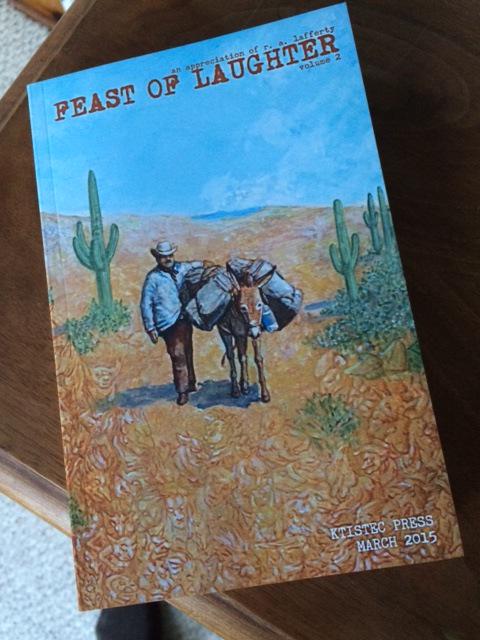

Feast of Laughter vol. 2

feast-frontFeast of Laughter 2 by Kevin Cheek

My rating: 4 of 5 stars

Fanzines are a new thing for me. But when I was approached about one of the reviews I published here about Lafferty’s collection Strange Doings appearing in the Lafferty fanzine Feast of Laughter, I was happy to oblige. And then when the editor asked whether I had any Laffertesque pieces of fiction that might fit its remit as well, I was even happier. Which is how a contributor’s copy of volume 2 of Feast, “An Appreciation of R. A. Lafferty,” appeared in my mailbox.

And what a fanzine! Feast, which I read from cover to cover is indeed just that: a veritable feast for anyone interested in Lafferty or his works. The table is set equisitely: the magazine is well put together, with a gorgeous cover (which I’ve admired but only just realized the creepy details from the story it illustrates depicted), perfect-bound, nearly 300 pages. As lovely as the front cover is, the back is even cooler: an office cameo of everyone’s hero himself. The only way this magazine could physically be better would be if it came with a tiny duplicate of the legendary Lafferty office door itself.

feast-backAnd then there’s the occasion for the meal itself. What other obscure Catholic science fiction writer could generate three hundred pages of prose (and a bit of poetry) simply because people like him so much? One who inspires a great deal of interest and loyalty among erudite fans and even a bit of emulation. A writer whose work is hard to find, difficult yet rewarding to digest, and almost entirely untouched by the popular press. (But you probably know all that already if you’re someone considered a work like this.)

So what are the courses of the feast? First we have essays. Besides Daniel Otto Jack Peterson, I wasn’t familiar with any of the authors. Some of the essays were compelling, especially those that dove into the allegory and Catholic context of Lafferty’s work. A few were as obscure as some of Lafferty’s own difficult work. In particular, I found Persaud’s “Question: Why? Excuse: Because Monsters” montage a bit inscrutable.

The second course consists of articles regarding Lafferty fandom around the world, particularly in Japan and Russia. The Japanese article was especially useful, as it opened a door into a world of Japanese science fiction with a list of recommended works by Japanese readers who love Lafferty. With Lafferty as a common denominator, this could be a powerful window into exploring the speculative literature of another culture, something that’s always daunting to know how to begin.

Then we get an interview with an early and important Lafferty fan, followed by a section of reprinted essays by greats such as Michael Swanwick. I was a bit lost in the contributions by Knight and Sirignano, which attempted to explain the labyrinth that is Lafferty’s Melchizedek saga, but this will likely be an important resource for someone who has read that work and is interested in deciphering its puzzles.Then come the reviews, and I was by this time so immersed in the meal that I had the simultaneously pleasant and disconcerting experience of turning a page and being surprised to see my own name, having forgotten for a moment that the whole reason I had been invited to this feast was because I had prepared a small dish.

The penultimate course is the Lafferty-inspired pieces, which consist primarily of poetry, though I have a story sandwiched pleasantly between a cozily-gruesome little piece by Daniel Peterson and a haunting story by Howard Waldrop and Steven Utley (yes, that Howard Waldrop, the one who wrote “The Ugly Chickens”). My piece is “What I Wrote for Andronicus,” which was originally published in Ideomancer in 2010. The meal ends with dessert: a reprinted interview with Lafferty himself and a reprint of one of his best known stories, “Sodom and Gomorrah, Texas,” which is illustrated by the fantastic artwork on the volume’s cover.

Then the plates are cleared away. The feast is over. But we’ll gather here again soon. Roll on, volume three.

Lands and People (and an interview with Bill Mallonee!)

Lands & Peoples cover (CD & LP) bill mallonee by Kevin HighLands and Peoples
Bill Mallonee & the Big Sky Ramblers

In the Platonic cinema of the forms, there’s an epic movie called something like Americana Melancholia, which chronicles all the interior, wide-sky woe of the great American narrative from Dust Bowl to Rustbelt. It’s about the brokenness that’s been in the American dream from the very beginning. It’s a heart-breaking, gorgeous film, whether or not it exists. But it has a soundtrack that definitely does, and that’s the music of Bill Mallonee.

When I graduated from high school, an older guy I looked up to in my youth group gave me the record/EP combo that pushed Bill Mallonee to the margins of fame: Audible Sigh/Room Despair. It was a breath of dusty, whisky-tinged air into my CCM world of Jars of Clay, Caedmon’s Call, and company. Mallonee sang about something earthier, richer, and somehow deeper– certainly something more real, desperate, and beautiful than the other groups I was listening to at the time. He didn’t provide tidy answers. He didn’t wrap his lyrics in a neat bow of faith. He left them raw and bleeding. Those songs were the soundtrack of my last summer before leaving home, open roads, and the dashboard of a midnight blue ’99 Firebird.

Then he disappeared. Or I lost him. I’m not sure what happened. In college I picked up his next album, Summershine, despite the fact the cover bore an embarrassing pink flower instead of the angsty derailed locomotive of Audible Sigh. (I was, after all, an insecure freshmen.) The magic was still there, though the earthiness was mellowed with glimpses of an almost opalescent brilliance in lyrics like (still among my favorite): “Moonlight be a friend tonight / we’re all wrecked upon these dreams. / Holding on a bit too tight / I’ve got splinters from these moonbeams.” (That line has inspired short stories.)

But something happened. As I said, I’m not sure what. Part of it may have been that Mallonee’s music was simply too heart-felt. I wasn’t the sappy crooning of country, yet it was too genuine– too non-ironic– for the world of CCM or popular alternatives. Perhaps he simply needed more irony. Mallonee’s band was called, after all, “The Vigilantes of Love,” and if this was a bit tongue-in-cheek it was hard to tell. If I had to pick a literary analogue to the situation, I’d fall back on R. A. Lafferty (mentioned often on this blog), the “science fiction” writer from Tulsa whose words and worlds were simply too wide and weird to find a home in the publishing world of the 1980s.

And like the Laffertian renaissance I’ve written about here, there is perhaps a Melloneean renaissance underway as well. Over the past few years Mallonee– living and working now in the American Southwest– has been faithfully writing and producing at the edges of the industry, living on the faith and goodwill of the fans who continue to support his unique voice. I was reacquainted with his work when Noisetrade offered a free download of his EP Victory Garden, putting me in the orbit of his regular email missives with project updates and– painfully– occasional offers to sell guitars and amps to make ends meet.

The desert life is harsh, it seems. But the desert flowers as well. Beginning with last year’s Amber Waves, building to anticipated release of The Winnowing, Mallonee’s recent work culminates with Lands and Peoples, the latest product of this desert efflorescence. And it’s the same Mallonee I remember: a voice of dust and whisky. Mallonee paints pictures in his music of dying towns, dying crops, and wounded dreams with a pained beauty that makes you want to weep and enjoy the weeping. Mallonee’s voice belongs to a lost yesterday. If someone (and I’m sure someone has) collected all the ballads of American cowboys– real cowboys– and wanted a singer to record them to preserve for posterity the voice of the American West– well, Mallonee has that voice.

Yet his sound is his own and doesn’t belong to the West alone. If his voice is from yesterday, the music that envelops it is of today. Lands and Peoples is sonically rich, with a depth and texture showing an organic growth from the albums immediately previous. You hear it from the initial track, “At Least for A Little While,” which hooks immediately with quiet, desperate guitar fingering. It builds into “Hide Me in the Darkness,” a haunting piece that along with “Little While” forms an especially strong beginning into standard Mallonee fare: haunted guitar, haunted voice, haunting lyrics. The clouds Mallonee promises may break “At Least for A Little While” in the first track of course gather again, building over mesas and long roads, steeped in dying light. It’s a familiar ache, but none the less gorgeous. They clear completely though in “Sangre de Cristo,” a piece of lovely blue sky that sits like a bright beacon in the album’s heart. Then they gather again, toward a fitful sunset in “It All Turns to Dust,” with Mallonee leaving us only that whispered promise at the record’s conclusion.

If you’re a fan of rich, textured music with a strong narrative thread and an abiding sense of locality, check out this album. (You can find links and info on all of Mallonee’s work here.) There’s a sound here that deserves being more widely heard.

When I approached Bill about reviewing his latest album, he suggested a Q&A and was good enough to offer detailed responses to my questions. His responses, which I’ve posted below, give deeper insights into what’s going on beneath the surface of these songs as well as a glimpse into the mind and heart of the guy Paste Magazine has called one of America’s greatest living songwriters. (I agree with Paste, incidentally.)

Lands%20&%20Peoples%20%28new%20inside%20covermiddle%20panelcolor%29Q: I don’t know much about the technical details of recording, but I feel a bit like I stepped over the edge of a sonic shelf in Lands and Peoples, which struck me as being deeper musical waters than some of your previous albums. It seemed audibly more three-dimensional. Can you help me understand what I’m hearing?

BM: I think your questions has two parts. First, the “audibly more three-dimensional” part. I have a few good mics, but after that I just use my ears. But, it might have to do with the materials the studio is made from. Muriah and I live in a small community in the high deserts of New Mexico. In every area you go with the materials that are there. In New Mexico, for centuries now of course, houses have been built out of dried clay and mud. We were fortunate, when we moved here four years ago, to be able to rent just such a dwelling. Yeah, it really is a hacienda. So, I think what you might be hearing is the the fact that the studio is housed in an almost two hundred year adobe casita. The walls are two feet thick all around of prepared dried mud. They are non-parallel (always a plus in studio recording) and the the exposed beams in the ceiling create a kind of baffling. It’s an easy room to get sounds in and to mix tracks in. So the fellas who constructed it unknowingly built a great room to record music in. Also, the room is just beautiful. Quaint and full of all that is inspiring about southwest architecture. Step outside and you’ll be looking straight into the snow-capped Sangre de Cristo chain of the Rockie Mountains. (Poor us!)  Yes, hats off to the beauty of these wonderful, natural elements. I feel very blessed.

Part two of you question (the deeper musical waters part): I think my love affair with just how guitars can and should interplay with other guitars as part of the song structure is something I’ve been having fun exploring for the last five years. Many of the recent albums (and the EPs I’ve release under the moniker WPA) explore that guitar-to-guitar relationship. It’s about the right parts supporting one another. I think the last few records (The Power & The Glory, Amber Waves, Dolorosa, and last year’s Winnowing) have kind of a subtle, unobtrusive beauty. The trick was to make them sound sparse, but in reality there are many guitar tracks on almost all of these songs, weaving in and out of the musical tapestry. The trick, I think I’m learning, is that no one part necessarily has to carry the weight of the whole.

Q: I also hear continuity with what came before, specifically some of the songs in Audible Sigh (as well as lyrical nods to that album). You haven’t radically transformed your sound, but it’s certainly developed. Yet personally and geographically (and theologically?) you’re hundreds of miles away from where you were then. How does this come out in your music?

BM: I don’t know, really. I think it’s all the natural process of life. Yes, the songs are grimmer, darker now, to be sure. I don’t think that means they’re necessarily drawn from a different well. I do know more about how the country works and how the industry works for some and not others than I did when I first started out. Me? I just wanted to make songs that were authentic and honest. That’s all.

First the back story. Vigilantes of Love. We’d been critics darlings for many years running. We put out great records. Even music critics kept asking after each album: “Why are they not breaking bigger?” You have to remember that we started in a day when bands could break with a few resources marshaled to places like MTV and late night talk shows. In reality, we were broke, confused, increasingly discouraged. My band mates were just incredibly heroic, wonderful people all through this. We enjoyed playing together and hanging out together.

But, the reality is that Audible Sigh, produced by Buddy Miller, and the records in front and back of that release (Roof of The Sky and ‘Cross the Big Pond) were in many ways the beginning of the end. I can’t tell you how many folks saw that band “live” and said things to us like, “Why aren’t you guys playing beside Son Volt, Wilco, the Jayhawks?” All of those bands were big, big names in the early Americana ink that was high profile in the late 90s’ and early 2000’s. We worked hard. I use to joke that we could play on any Fischer-Price PA system any night of the week (and we often did!) and make magic. It was such a beautiful, kickin’ band. And we toured 180-200 shows a year in small college club world to generate a following. Vigilantes of Love became a “best kept secret.”

Could we have broken bigger? I think so, yes. Why we didn’t break, I think again, is simply because we were never very well connected. The folks we trusted, be they managers, or labels, or booking agents, all steered us into dead-ends. I have no “killer instinct.” I just wanted to write, perform, and make records. I think we waited as long as we could until it was time to say: “Ok, this is not gonna happen.”

But one has to grieve when a dream dies. And since I wrote all the songs and had poured so man emotions in it (we’d done something like fifteen albums in ten years) I was devastated. I went through this period where I felt personally let down and cast aside by so many managers and labels. Even our home town was detached. After comparing notes with many other singer-songwriter types, I heard similar stories. But the songs kept coming. Lots of them. I think I released four solo albums in 2001. Ultimately, I decided that I didn’t need an industry’s permission to be who I was.

That’s the backstory.

How does that dark experience play out in the last years and records? Well, Muriah and I moving to the high desert to live a more uncluttered life was one of the responses. One has to excavate from the previous experiences and reflect on the journey. I think there’s a certain haunted quality began to emerge in the songs, even a Southwest quality. I was (mistakenly, I think) lumped in with that whole weird “Christin artist” sub-culture thing for a spell. What I do, at the risk of sounding arrogant, is bigger than that. What I do is not commercial in the way such folks see it. I hope it’s more real than that.

Thematically, I tell folks that you can only write well what you know well. I’m a confessional type writer. (Maybe that comes from my rearing as a Catholic, where everything in one’s life is something of an inventory; something under chronic scrutiny by oneself and the Lord.) I believe the Faith, to be sure. It informs how I see the world and live in it. But, you have to learn how to live with the incongruities in yourself and even in your faith. Some days the world makes sense, other days not so much. So, that’s an undercurrent theme in the new work, to be sure. It comes out as a struggle, a wrestling. Too often darkness seems to be the loudest voice in my life. I do I feel I have been the undeserving recipient of Grace. I am loved. We all are. I see this life as precious, hallowed and a gift. But, those vital truths are also more eroded than ever in the onslaught of what we call modernity.

How does that related to the songs? Well, i have no agendas, no polemic to dispense when I write and sing. Whether I’m giving a new slant on a Dust Bowl ballad tale and investing it with something of my own journey or whether I’m just writing a song that has more of a first person haunted quality (“The Ghost That I run With” comes to mind), I feel my job is to make honest, authentic work. I tell folks: “I love my job. It’s good work, if you can get it!”

Q: I live and breath prose (though sometimes I dream in verse), so it’s hard for me to imagine what the process of writing a song might look like. What does a song sound like for you as it begins to coalesce? Does the sound come first or the words? Do you ever have one without the other?

I think you have to let a song tell you where it wants to go. No over-thinking it. I know that sound mysterious. It is. Songs have a way of “getting outta hand.” And that’s a good thing, I believe. Don’t be afraid of the where they wanna go. I think it’s part of being open to the Spirit, really.

Usually, I have to have a guitar in my hand when I write. I’ll keep a journal of lyrics going on the road when Muriah and I are touring and consult it for ideas later. But mostly a whole song, at least the heart and focus, comes in one sitting. (After that it’s adding hook lines, overlays that keep it living to the ears.) Sometimes a whole song will show up based solely on the cadence or syncopation of a phrase or a couple lines of lyrics. Melodies make the song memorable and that’s what I hope happens naturally.

But, to recap: I do very much think if you force something or over-think it, it’s probably not gonna be memorable.

Q: You sing on the margins, and you also sing about the margins: the margins of failure and defeat, despair, and hope. Maybe the margins of faith as well? Would you say this is part of what inspires your work: transforming the experience of these margins into beauty?

Absolutely. The trick is to make the margins clearer, more visible. We’re all so numbed and mesmerized by daily life. Yet, I think “Something,” or “Some One,” keeps pushing through, asking for our attention. Those can be what writer Frederick Buechner calls those “lump-in-the-throat” moments that take us by surprise. We’re here for such a short time. And yet we’re haunted, captivated, driven by this sense of transcendence, a hunch that Love really does means something; that no life is anything less than precious; that life has this hallowed quality and that each of us are beautiful mysteries; that there is something beyond the grave.

Sure, some think that ground of being is beyond words. And, being small and finite, perhaps it is. But, to me that’s what all great art attempts to do: To give a nomenclature to the Love that I believe is the ground of everything.

The Lone Ranger and Tonto Fist-Fight in Heaven

The Lone Ranger and Tonto Fistfight in HeavenThe Lone Ranger and Tonto Fistfight in Heaven by Sherman Alexie

My rating: 4 of 5 stars

Frustrations can lead to rash actions. Regardless of how one feels about the frustrations boiling up in cities like Boston and Ferguson and the resulting actions, my white, middle-class frustrations in response were largely regarding my own lack of comprehension. Here I am, surrounded in a comfortable middle-class environment by a bunch of comfortable, middle-class friends and family. I don’t have a good understanding the frustrations of others. I don’t have a grasp at any significant level of what it must be like to be a minority living and working in America.

Then I looked at the fiction I was reading and realized it was more of the same: it wasn’t helping me reach any sort of understanding of minority perspectives. My books are like my friends: a bunch of white guys I love to death. But not terribly diverse. So I made what may have been a rash decision. It’s certainly a decision that looks kind of pathetic in light of the backdrop of unrest in which it was made. But it’s a step, and one has to start somewhere. I decided for the rest of the year I would start reading works of fiction exclusively by minority voices. Call it an affirmative action program for my own reading list, a way to swing the balance a bit from a life of reading in which Harper Lee and Flannery O’Conner were about the extent of my diversity.

(Note I say “start”– this allows me to finish the couple novels I’ve already begun by old white guys, and it doesn’t hold me to finish a novel if I pick a few duds. I should be able to be colorblind when it comes to not finishing crappy writing. But it does mean I finally get off my metaphorical butt and read some of the things people have been telling me to read for quite a while.)

The first book on my list was Sherman Alexie’s The Lone Ranger and Tonto Fistfight in Heaven, which had been recommended by a friend and which I’ve wanted to read for quite a while. I’ve read several works of nonfiction on the Native American narrative in North America, and I was told Alexie was the person to read if I wanted a view into the life of contemporary Native American society. (Alexie uses the term “Indian.” I’ve been taught that this isn’t a politically correct term to use, but is it more awkward using a term they don’t use for themselves? This is an excellent example of the awkwardness Adam Kotsko discusses in his book Awkwardness where fear of causing offense presents an additional barrier to dialogue across social or ethnic divisions.)

Lone Ranger and Tonto is the collection of short stories that rocketed Alexie, a Spokane Indian who grew up on a reservation in Washington state, to the national spotlight. Alexie’s “reservation realism” is supposed to capture aspects of the essence of life for Native American youth today. The stories are spare, sad, and for the most part revolve around the day-to-day frustrations, disappointment, and lost wonder of Alexie’s generation. The characters drink, fight, play basketball. Portions, Alexie admits, are autobiographical in some sense. Fatherhood is a common theme throughout, both on the side of sons losing their fathers and– in what I thought were two of the most powerful pieces of the collection, “Jesus Christ’s Half-Brother is Alive and Well on the Spokane Indian Reservation” and “Junior Polatkin’s Wild West Show”– becoming fathers with varying degrees of reluctance.

Yet I had to keep reminding myself these weren’t white people. I don’t know if that means I’m colorblind or that I have difficulty extricating my own racial prejudices in visualization when I read. On some level, Lone Ranger and Tonto seemed a collection of windows into the lives of people my peers used to call “white trash”– living with nowhere to go in trailer parks, watching days pass without aim or intent. It was only when Alexie reminded me with descriptions of ribbon shirts or the color of skin or braids or references to pow-wows that I switched the colors in my mind. I’m not sure what this means.

For the most part, Lone Ranger and Tonto is a collection of haunting stories, tinged with despair and yet also beauty. It’s the beauty of a bleak field, of peeling paint, of the winter sky and bare branches. It’s the stories of a community stripped of hope and purpose, a community unrooted and lost even as it has absorbed the Diet Pepsi, diabetes, television, and alcohol of the culture in which has been lost. Yet the parts where it seemed most “Indian,” most indicative of a different view of the world, are the parts where the narrative is least realistic, least straightforward. It’s where the narrative veers toward magical realism or even surrealism, as in the post-apocalyptic dreamscape that pervades the middle of the volume. In that particular story (and more subtly throughout) we get the reminder that in some sense the reservation is already post-apocalyptic: these are the survivors of a culture that was utterly overwhelmed, nearly destroyed, and transformed beyond recognition. They’re all survivors here.

In these narratives, where the Western realism slips, we seem to get a glimpse into the mind of another culture. And here’s where I must tread carefully, because on the one hand a work like this shows us how similar we all really are; yet on the other hand the work– I think– can illustrate how unlike we are as well. Not that race need divide, but that culture informs our perception of the world, and straightforward narrative prose seems a dominantly Western approach. Alexie at times approaches something that I think Lafferty (himself not an Indian) accomplished in his work Okla Hannali: a story told in the way you half-believe a real Indian would tell it, an Indian who knew that stories didn’t have to make logical sense to be true or realistic to be life-like.

The important of stories is the backbone of this collection of stories. Many of the stories, especially those featuring the character of Thomas Builds-the-Fire, are stories about telling stories. There’s something significant here, and something I think is central to the experience of any marginalized people: the stories become a way of survival, essential to culture and identity to an extent we– whose narratives are so dominant that our own stories are ubiquitous and we begin to believe they are the only stories– cannot grasp.

Visions of Science

Visions of Science: Books and Readers at the Dawn of the Victorian AgeVisions of Science: Books and Readers at the Dawn of the Victorian Age by James A. Secord

My rating: 3 of 5 stars

Most people believe history is made up of people and their ideas. Maybe also the things they do. But I tend to think of history as being made up much more of books. The majority of people live and die and leave no record, no imprint, on history. You’ll never know what they thought; you’ll never have any contact with them. Great historians can get around this to some extend; I know social historians who can tease a wealth of information about the past from statistics, censuses, documents, and other clues. If you’re lucky you might find a trove of letters or journals related to particular individuals as well. But these are the fringes and margins of intellectual history, and such evidences only go back a couple hundred years at the most.

Books are a different story. Books are like the shelled organisms in the fossil record. By their very nature they leave a mark on intellectual history. They’re ideas given form, preserved, read, and interpreted. And yet they’re not static. A person’s ideas are in some way solidified in a text, but that person’s thoughts change over time, and there’s always also the question of how good a reflection of a person’s true views or ideas a book truly is. But books like the Origin of Species, for instance, or the works of Newton, leave an impact: they’re read, and their ideas spread. They’re the bones we build our intellectual histories upon.

But this isn’t enough. If we simply try to read the classical texts of the past without regard for the context in which they were written or without understanding the ways contemporary readers would have interpreted them then we’re only getting a portion of the picture. It’s this context that the historian of science James Secord brings to a cluster of pivotal texts in his new work, Visions of Science.

The subtitle of the work is “Books and Readers at the Dawn of the Victorian Age.” The first half of the 1800s happens to be a period in which I’m quite comfortable, having written my dissertation on one of the authors whose work Secord examines. But it’s not an arbitrary choice of period, as Secord makes clear. The dawn of the Victorian Age was in many ways the dawn of modern science as we know it. Society was changing, particularly in Great Britain, where there was a growing middle class population, technological innovations were making texts more cheap and accessible, and scientific progress was seen as the panacea for solving social ills. The early 1800s saw the beginning of the devotion to science as a means of progress that we continue (though a bit more jaded, disillusioned, and hopefully wiser) to live within today. This is the world on the cusp of Darwin and the professionalization of science, steeped in the early enthusiasm of the industrial revolution.

Secord examines seven texts from this period: Humphrey Davy’s Consolations in Travel, published near the end of the chemist’s life as a retrospective on the progress of humanity to date; Charles Babbage’s Reflections on the Decline of Science in England, his tract against the perceived stagnation of science in England compared to the Continent, which Secord uses as a segue into the politics and personalities of practicing science during this period; John Herschel’s Preliminary Discourse on the Study of Natural Philosophy, often seen as the first modern text on the philosophy of science; Mary Somerville’s popularization of science, On the Connexion of the Physical Sciences; the geologists Charles Lyell’s Principle of Geology, which set the groundwork for thinking of deep time and Darwin’s revolution; George Combe’s immensely popular work on phrenology, Constitution of Man; and finally Thomas Carlyle’s weird and wonderful critique of the science of his day, Sartor Resartus.

Secord has previously published a book-length treatment of another important book during this period that should be included in this list, the anonymously-written Vestiges of the Natural History of Creation, which created a “Victorian sensation.” In that earlier work Secord does in greater depth for the Vestiges, a text that brought ideas of naturalistic evolution to a widespread audience decades before Darwin, what he does for each of the texts listed above. His treatments in Visions of Science are brief synopses, almost vignettes, about each book, and it would have been nice to have an abbreviated version of his examination of the Vestiges among them as well for completeness; I don’t think any readers would have minded repetition with his previous study.

For each of these works, Secord is interested in showing how these primary sources– many of which students of the history of science in modern Britain would know well– was initially perceived. More than that, he dives into the structure of the physical books themselves: who published them, how they were printed, and what this meant about potential audience and cost. Secord also provides biographical sketches of the authors, but these are complete only in as far as needed to show how the writing of the particular book fit in the context of their lives. Who were these authors, what was their role in the nascent community of modern science, and why did they write? Secord’s exploration gives a clearer picture of the transitional world of early Victorian science and its rise to cultural prominence.

Visions of Science would be ideal for a course focusing on the history of science and culture in this period. Such a course would likely involve the assignment of large portions of the primary texts for reading, with the chapters of Secord’s work as supplementary material so today’s readers could do more than simply filter these works through their own interpretive frameworks. The studies in Secord’s work are a primer for a much more difficult task: seeing the works as they appeared in their own time. In this Visions of Science succeeds in making these foundational texts more three-dimensional, helping them come alive as we approach them as a Victorian reader would and seeing in a new way how foundational they were in shaping society and thought into molds we largely take for granted today.

The Man Who Made Models

The Man Who Made Models: The Collected Short FictionThe Man Who Made Models: The Collected Short Fiction by R.A. Lafferty

My rating: 4 of 5 stars

It’s kind of fun to be part of a renaissance, even if you were late to the party. It’s kind of fun to be part of something gathering steam, spilling open, being rediscovered. Right now, that’s more or less what’s happening to the writings of R. A. Lafferty.

If you don’t know Lafferty, you haven’t been reading my blog long, as I’ve reviewed at least two of his books here already. You also probably haven’t seen the lovely fanzine, Feast of Laughter, which celebrates the man and his work and in which in the latest issue I have a story and review. You haven’t heard there was this really odd guy in Oklahoma writing at the crest of the New Wave in science fiction who was– bizarrely– Catholic, conservative, and curmudgeonly. You’re one of the lucky ones, because you get to discover his work from the ground up.

The collection The Man Who Made Models is the best place to start. I’ve written about Lafferty’s novels before. They are, I would argue, an acquired taste (but one well worth acquiring). It is in his short stories though that his madness and exuberance come in more manageable bits. But these aren’t dainty snacks; even as short stories they’re bloody, quivering chunks of meat you have to unhinge your jaw to swallow.

Part of what makes a Lafferty renaissance fun to be a part of is that Lafferty’s writings are so immense and scattered. Only one of his books is still in print, and his short story collections are treasures for which used bookstores are to be scoured regularly. Many of his later works were never published on a large scale and only appeared in now-vanished small presses. His short stories are spread across decades and lost in a farrago of out-of-print collections, unpublished manuscripts, and copyright litigation. All of which makes this particular collection so exciting: it’s purported to be the first volume in Lafferty’s complete collected short fiction.

And it really is a great place to begin the strange odyssey that is Lafferty, assuming you can sweet-talk your local librarian in getting her hands on it. There’s a fantastic mix of Lafferties in here, though I don’t believe this volume was designed to be a “best of” collection. (My single complaint about this volume is that the editorial afterword doesn’t explain the selection process for this volume. It is not chronological, as the list of original sources at the volume’s conclusion shows these stories range from the 1960s to the 1980s and appeared in everything from big-name magazines to small-press chapbooks.)

Models a pleasant patchwork, but that makes it sound comfortable and cozy. It’s not. It’s a patchwork of monsters. You’ve got stories in here that are among Lafferty’s best and brightest: “The Six Fingers of Time,” “Frog on the Mountain,” and “Narrow Valley.” These are the ones you want someone to read for the first time when you’re trying to explain who Lafferty is any why people get so excited about him.

But when you want to go beyond that and highlight his exuberant monstrosity, you’ve also got plenty of choices here. You have “The Hole on the Corner,” for instance, which I think is one of the best examples of what makes Lafferty tick: the Chestertonian joy of the gruesome, bizarre, and hilarious. There are some that are genuinely frightening, whether that means chillingly subdued like “Parthen” or riotously macabre like “The Skinny People of Leptophlebo Street.” And you have the ones where Lafferty almost goes too far, leaving you with a simmering crackling in your mind, an effervescence that only hints at the things other writers feel they need to work into their stories such as plots or conclusions: “The Ungodly Mice of Doctor Drakos,” for instance, or the concluding work of the volume, “Rivers of Damascus.”

I’m not a literary analyst who can comment eruditely on the philosophical or theological things lurking below the surface of Lafferty’s prose, like some of the contributors to Feast of Laughter. But I want to comment briefly on two of the stories in this collection, because it’s not worth much to an outsider to simply say Lafferty is impossible to classify and leave it at that. Each one of his stories bears deeper analysis, and each one in some way forces eyes and minds toward a world where a multiplicity of options and universes await, something that is often off-putting for those coming to his stories hoping for tidy conclusions and explanations. Things are a bit larger than that here; it’s like waiting for a cloud-scape to fall into its final configuration.

But there are two stories in this volume I especially love. The first is “Days of Grass, Days of Straw,” which is absolutely strange. On first blush this story seems to be an alternate reality tale, in which a man comes to awareness in a “weird western” motif where Indians have a thriving civilization on the Great Plains. This, it is eventually explained, is a “day of grass,” an extra day in the calendar that doesn’t count, as opposed to the ordinary, mundane “days of straw.” Life in the day of grass doesn’t have much narrative structure: the characters eat and talk and make war with buffalo and dance beneath a floating mountain. Simultaneously, in our own reality the characters discuss the nature of these lost calendar days, and Lafferty lists several of them for us, days we’re led to believe he’s lifted from obscurity from half a dozen ethnic calendars. The story ends abruptly with no real conclusion: we’re left with only potentiality, a flicker of wonder around the edges of our own life, and some pseudo-philosophical discussion of time and potentiality. It’s gorgeous.

And then there’s “Thus We Frustrated Charlemagne,” which features– as much of Lafferty’s short fiction does– characters that form a recurring cast of sorts in many of his stories. A group of scientists has achieved the technological breakthrough of sending avatars back in time to alter the past. (One of the best things about reading Lafferty is the way he handles technology. His explanations, which border on the absurd, somehow have aged much better than some of the best “hard science” explanations for fictitious technology.) Each time they alter the past, the world around them is transformed. It’s a trope that’s been explored often in science fiction since, but here it’s as fresh and new and hilarious as an actual real world popping into existence.

That’s much of the deep magic here: new, real worlds. Lafferty’s science fiction is never about making fantasy worlds to replace this one. Rather, he writes to open our eyes to the weirdness and the wonder in this one. The world, Lafferty’s fiction seems to say, is stranger than you can imagine. This one. The one you’re sitting in. It’s going to eat you alive. All of the fantasy– all of the horror and monstrosity and laughter and joy– is just him shaking your shoulders. Shaking them hard. Wake up.

Scholarship Reconsidered

Scholarship Reconsidered: Priorities of the ProfessoriateScholarship Reconsidered: Priorities of the Professoriate by Ernest L. Boyer

My rating: 3 of 5 stars

What exactly do we mean when we say scholarship? On some level, it’s simply whatever scholars do when they’re not teaching or in meetings or preparing for class. It is, in the popular conception, research: spending time in laboratories, pouring through sources, writing out one’s thoughts– communicating creative ideas based on original research, meaningfully reviewed by one’s peers, and communicated with one’s field. It is the production of knowledge.

Yet (at my institution at least) there has long been discussion of other “models” of scholarship: the scholarship of integration, the scholarship of application, and the scholarship of discovery. (My institution being a Christian university, the scholarship of “faith integration” is often tacked onto this list as well.) I never quite understood what these distinctions were about, despite the fact that my own PhD was in an integrated history/philosophy program, and when discussion of the “scholarship of integration” came up in a talk with a colleague about a new university program, I realized it was probably time I familiarize myself with the work in which Ernest Boyer first lays out this model.

Scholarship Reconsidered: Priorities of the Professoriate  was published by the Carnegie Foundation for the Advancement of Teaching as a “special report” in 1990, the result of an extensive survey of American professors. The work itself is quite slender, with a large appendix containing data from the survey. Being twenty-five years old now I suppose qualifies the book as a “classic” in the field of higher education, but the things Boyer has to say still seem very relevant (though in parts depressingly unobtained).

Boyer’s study is local, an attempt to quantify and qualify the history and character of American higher education. This localism in his approach appeals to me, especially his emphasis on the need for small colleges to remain distinct and committed to their own unique missions, resisting the pressure of accrediting bodies or the example of larger research universities to conform to a undifferentiated approach to education. Different colleges and universities exist for different and complementary missions, Boyer implies; this tapestry should remain rich and diverse.

From Boyer’s overview of the history of higher education in America (which, though cursory feels composed of fairly safe generalizations), he claims the purpose and structure of higher education has changed over time. Boyer argues that scholarship at these institutions has always been broader than research alone (“scholarship of discovery” in his parlance). Early Colonial colleges were focused on character formation, land-grant schools of the mid-1800s were focused on application, and research colleges proliferated at the conclusion of World War II in response to the burgeoning of the large-scale scientific enterprise. To focus solely on the scholarship of discovery, he argues, at the expense of teaching, integration, and application or to prioritize pure research alone is to disproportionately skew what has traditionally been a much richer heritage of scholarship.

Many of Boyer’s claims made sense to me, especially having spent most of my career thus far working at a “teaching-based” university that purports to value quality instructional practices and evaluation. In such an environment it seems reasonable that a major portion of what scholars do is to reflect on developing and evaluating their own teaching techniques, ideally with the help of a scholarly community. Its identity as a liberal arts university (and my own scholarly background at the intersection between science and the humanities) makes me resonate even more strongly with Boyer’s “scholarship of integration,” the idea that active research can involve synthesizing and forming connections between various and even seemingly disparate disciplines.

The book is at its heart though a recommendation and call to action. Though it has many good things to say, and backs this up with frequent quotations from professors as well as the data of the survey itself, there isn’t much practical explanation of what these things look like on the ground. How is scholarship of integration evaluated by one’s peers when it crosses disciplinary boundaries, for instance? What is the relationship between scholarship of application and the commercial or economic pressures increasingly shaping the educational landscape? Boyer doesn’t have a lot to say about this, and I’m not sure where to go next. Who has taken up this model and written about how it does or does not work in particular institutional settings?

The Supper of the Lamb

The Supper of the Lamb: A Culinary ReflectionThe Supper of the Lamb: A Culinary Reflection by Robert Farrar Capon

My rating: 5 of 5 stars

Robert Farrar Capon can come across a bit pompous, even pretentious, I admit. There were several times I cringed or rolled my eyes reading this work. He writes with a spirit of absolute confidence, and his tone is not mitigated (or only slightly mitigated) by the fact that he is so absolutely, insufferably, correct throughout.

That intro almost makes it sound as if I didn’t love this book. This is a cookbook that will change your life, and anything that changes your life– especially something that gets you to admit you’re only half awake and missing most of the important things transpiring around you because of your own laziness, ineptitude, and pure inattention– is going to be something that might rub you the wrong way a little bit. This is a book both glorious and terrible, but the older kind of terrible, when it meant something that could chew you up, not necessarily something simply of poor quality.

Capon is a materialist in the grandest Christian tradition. For him, the world is holy. Material things are holy. We are not saved from the world, he writes, we are saved through the world. And the book itself, a melange of prose, recipes, reflections on life, and exhortations to excellence, is a celebration of the reality and the wonder of food and its preparation. It is Michael Pollan meets G. K. Chesterton, and it reads about as wonderfully and heavily as you would expect such a combination. Read it slowly. Try to put aside– as was difficult for me– the feelings of inadequacy next to Capon’s grandiose claims for kitchen life and entertaining.

Read this book. We live in an age dominated by two great heresies: on the one hand are the spiritualists who tell us (and many of whom claim Christianity teaches) that the physical world is insignificant. On the other hand are the consumerists who see in the physical world only material to be used, marketed and exploited. (Often these two hands are one and the same.) Against this stand the Christian materialists, in a long line upon the modern branches of which you will find Tolkien, Chesterton, and Lewis, among others. This is Capon’s lineage.

By the second chapter you know where Capon stands. He calls us to meet an onion– to actually look at it, examine it, spend time with it, and reflect on the wonder that it represents. After this there will be plenty of time for the ins and outs of how meat should be prepared and why knives today aren’t as good as they used to be. But the theme that begins here is central: the world exists to be appreciated, and man exists as the priest of nature, lifting it up and offering it up with thanks and humility to God. (If this sounds a bit like Schmemann, you’re not far from the mark.)

There is much to say, but perhaps it is simplest to trust to Capon’s own distinctive voice, from the concluding chapter, in which he offers his own solution to physical heartburn and then reflects on the deeper burning of the heart that will be familiar to any readers of Lewis:

For all its greatness, the created order cries out for further greatness still. The most splendid dinner, the most exquisite food, the most gratifying company, arouse more appetites than they satisfy. They do not slake man’s thirst for being; they whet it beyond all bounds. Dogs eat to give their bodies rest; man dines and sets his heart in motion. All tastes fade, of course, but not the taste for greatness they inspire; each love escapes us, but not the longing it provokes for a better convivium, a higher session. We embrace the world in all its glorious solidity, yet it struggles in our very arms, declares itself a pilgrim world, and, through the lattices and windows of its nature, discloses cities more desirable still.

You indict me, no doubt, as an incurable romantic. I plead guilty without contest. I see no other explanation of what we are about. Why do we marry, why take friends and lovers, why give ourselves to music, painting, chemistry, or cooking? Out of simple delight in the resident goodness of creation, of course; but out of more than that, too. Half of earth’s gorgeousness lies hidden in the glimpsed city it longs to become. For all its rooted loveliness, the world has no continuing city here; it is an outlandish place, a foreign home, a session in via to a better version of itself– and it is our glory to see it so and thirst until Jerusalem comes home at last. We were given appetites, not to consume the world and forget it, but to taste its goodness and hunger to make it great. (my emphasis)

Read this book.

The Violent Bear it Away

The Violent Bear It AwayThe Violent Bear It Away by Flannery O’Connor

My rating: 3 of 5 stars

Why are Catholics so good at making monsters? Our friend Daniel Otto Jack Petersen might eventually have some good answers for us, but at this point– having concluded my audit of the twentieth-century Catholic novels course taught by my good friend Dave (okay, not quite concluded as I skipped Brideshead Revisited and fell off the boat before our final novel, Walker Percy’s Love in the Ruins)– I can venture something along the lines of G. K. Chesterton’s “all is grist.” For the Catholic novelist, it’s all real and it’s all fair game for creation. There aren’t “bad things” off limits. All is useful for building stories, because all– even the dark and twisted– can be redeemed.

But the real, unlike for perhaps an agnostic or atheistic writer, extends far beyond the sanctity of matter to include the reality of the spiritual. Throw all that in the mix, and you get monsters out the other end. For a writer with the bizarre, piercing humor and science fiction tendencies of Lafferty, these monsters become the fleshy, jovial horrors of “The Hole in the Corner.” For the steady eye of Flannery O’Conner in the stagnant heat of southern woods, the monsters take on a stranger and more human aspect.

Because it seems to me that at the core The Violent Bear it Away is a story about monsters.

There are four monsters (five if you count the agent of the sudden, lurching violence of the penultimate scene). The first is the boy protagonist’s great uncle, who considers himself a prophet called by the Lord and who raises the boy to know the Lord’s work in a splendidly wild and woody isolation. His death at the beginning of the novel initiates the book’s plot. The second monster is the boy’s uncle, who considers himself the rational antithesis to the old prophet’s madness and who, when the boy finds his way to his doorstep upon the prophet’s death, sees the possibility of freeing the boy from the prophet’s mad shadow.

The third monster is the boy himself, who drinks himself to a stupor upon his great uncle’s death, refuses to bury his body, and instead burns down the home in which they lived before wandering into the city to find his uncle. It is this monster’s stubborn battle to resist both the compulsion to carry on the Lord’s work placed upon him by his great uncle and his “rational” uncle’s frenzied effort to reform him that forms the primary tension of the novel. The boy is taciturn, isolated, arrogant, and desperate to live out his denial of his great uncle’s holy legacy.

All these characters are monstrous, twisted, and unpleasant to observe. And yet O’Conner pulls us along with them. We are captivated by their misery, by their mutual hostilities, by their failure to accept any sort of redemption from each other.

And then there is Bishop, the fourth monster, the son of the boy’s uncle. Bishop is a child, an idiot “waste,” who can do nothing but follow along innocently– uncomprehending and unconcerned– as the boy fights against his great uncle’s imperative to baptize Bishop and his uncle’s determination to break him of this compulsion. Bishop is the pathetic eye of the storm and the focus of the only genuine moments of pathos and tenderness in the novel.

This is an Old Testament story, and the god looming on the horizon of the boy’s mind is a god of blood and fire and fury, despite metaphors of the bread of life– that tired, stale bread the boy refuses to eat. As with Graham Greene’s Heart of the Matter, the conflict here is primarily in the mind of the boy, but this makes it in no way less real. It makes it instead more tight and tortured. And it makes it all the more terrifying for where it leads.

This is not a book to read for pleasure, unless of course for the simple pleasure of reading good writing. For the story itself, the only pleasure might come in assuring yourself how far your god is from the dark and stormy god of the warm, stagnant forest and how far you are from the pathways of the boy’s own mind– until, of course, you actually read the Old Testament and are forced to ask yourself how thin the line between madness and holiness might really be.

Ian Morgan Cron

Chasing Francis: A Pilgrim's TaleChasing Francis: A Pilgrim’s Tale by Ian Morgan Cron

My rating: 2 of 5 stars

I came to a realization reading Ian Cron’s work: Mystics are empiricists. They’re trying to meaningfully express experiences. I’ve always been a theorist. I try to fit my own experiences and those of others into pre-conceived patterns and structures. I had always imagined (without much thought) that this was the other way around. I imagined the mystics were the theorists and that my own thoughts were grounded more firmly in empirical evidence. Meeting and reading Cron made me realize that the true mystic always speaks from experience.

I say all this because I do believe Cron is a modern-day Christian mystic. He came and spoke at my university at the beginning of this semester, and I had the privilege of meeting him as he visited and had lunch with one of my classes. He is deeply passionate, well-spoken, and kind. His words and vision are compelling, and he left behind stirred minds as well as hearts, a campus buzzing with what he had expressed, and a stack of his books generously gifted to my class.

So it was I found myself reading Chasing Francis, a book several of my students assured me was “the best book they had ever read.” I’m not sure what I was expecting, but within the first chapter I realized it wasn’t this: Francis through the lens of the fictional disillusioned, burned-out megachurch pastor Chase Falson. Though my opinion on the text differs significantly from that of my students, I believe what Cron is doing here is excellent and immensely important: unpacking aspects of Catholic mysticism and social gospel through the eyes of a mainstream evangelical.

The basic premise of the novel (Cron calls it “wisdom literature”) is that a pastor of a successful megachurch has a crisis of faith and finds himself traveling to Italy to spend some time with his uncle, a Franciscan. In the company of his Uncle Kenny and a few other jovial monks, he lives for a time as a spiritual tourist, shuttling back and forth through the Italian countryside visiting historic sights linked to the life of St. Francis and taking up a correspondence of sorts with the saint through his journal. New characters are introduced as needed to explain to Chase aspects of the Catholic spiritualism Francis exemplified: the love of artistic beauty, community, peace-building, and service, for examples. Chase learns there is a lot more to being Christian than the conservative, consumeristic view of the Church he previously held, and he returns to his church a changed man.

First, the value of this book: if you want to learn about the life of Francis, there are better ways. If you want a tour of Italy and Church history, there are better ways. But if you don’t know much about either and if you’ve been raised in the kind of Christianity Chase’s character represents, this might be your window into a new world. For me, this is why– despite the flat characters and the forced plot-line– it’s still gratifying when my students tell me they enjoyed reading it. Because the perspectives they take away from that are important. For someone, for instance, who sees in the symbols and practices of liturgical worship nothing but empty form or at worse harmful superstition, Chase’s realizations are going to be essential.

These themes aside though, the story itself is a bit tedious. The characters– most particularly Chase himself– are caricatures. They have conversations about spirituality and faith and beauty, but they’re simply observers, even the group of Franciscans. Even the most emotionally powerful portion– the account from a survivor of the Rwandan genocide– is staged and somehow sterile: we’re sitting beside Chase as he listens to a lecture at a peace seminar. The entire book is like this: Chase is staring through windows, meeting people who deliver information and perspective. This sense of disconnect reaches its climax in the chapter on beauty, when Chase happens to meet a concert musician, and then they happen to meet an Anglican priest conductor who gives a lecture on the role of beauty in theology, and then they all go out for dinner.

There’s a deeper problem here though, and one that caused a nagging worry as I continued to read. Chase begins the story as a self-centered individualist who realizes the answers he had are no longer working. For the duration of the story he functions as a self-centered spiritual tourist (Cron uses the term “pilgrim,” but I remain unconvinced. Chase is a tourist. He never abandons the Western tourist mentality.)

Chase’s church had been the “Chase Falson” show; he returns to it with new and transformed ideas, but his goal upon his return appears to be to simply reinvent it into the new, improved Chase Falson show. Nothing about his idea of church has essentially changed. He has absorbed apparently nothing from the Franciscans about humility, menial service, church hierarchy, or putting oneself under the authority of a spiritual superior or mentor. Chase’s McMegachurch is certainly transformed upon his return– and some of the twists here will be familiar to anyone who has experience with church politics– but it’s not a transformation away from the dominant paradigm of one man with a dedicated cadre of followers. As the final scenes make clear, this will still be the Chase Falson show, now simply informed by some ideas of St. Francis.

Jesus, My Father, the CIA, and Me: A Memoir...of SortsJesus, My Father, the CIA, and Me: A Memoir…of Sorts by Ian Morgan Cron

My rating: 3 of 5 stars

Ian Cron is a bridge between multiple worlds. He’s a bridge between mysticism and everyday evangelicalism. He’s a bridge between Catholicism and Protestantism. He was raised in one world and now, from what I can see, identifies strongly with the Via media of the Anglican church. And in that position he can mediate between many of the traditions and denominational languages of contemporary Christianity. I saw this at my own university, where Ian on the one hand led our chapel in an ecumenical eucharistic service and on the other listened and tried to understand students expounding on the Nazarene view of holiness.

Wherever we are among these different worlds, we need people like this.

If Chasing Francis, his first book, felt flat and unreal even as it communicated important ideas, Jesus, My Father, the CIA, and Me is alive. In this memoir Chase Falson, the omni-man protagonist of Chasing Francis, is replaced by Cron himself, and the writing that had only a constrained glimmer in Chasing Francis explodes into three-dimensions in this memoir. Here is someone writing about something real. Here is a true mystic expressing true experiences.

The title of the book, as Cron relates in the first chapters, comes from his realization upon his father’s death that Cron knew very little about his father’s actual career, which apparently included time as a CIA operative. His father– an emotionally abusive alcoholic– remains one of the primary threads woven through the work, and it is clear a primary impetus in the writing was Cron grappling with his memories of his father and the way they shaped his childhood. This makes the book’s conclusion– which seems at first glance disconnected from the rest of the narrative– a powerful commentary on fatherhood in general and the lasting repercussions of both wounding and redemption.

Cron calls the book “a memoir . . . of sorts,” but this hedging seems to me to devalue the work itself. He writes in the beginning that he feels the need to qualify this because not every conversation is written from memory and many are recomposed in his mind as he believes they would have happened. But can any memoir be any more than this? Considering the blending of history and fiction that characterized his prior book, I was left by this qualification with a shadow of doubt about whether Cron had taken more than usual artistic liberties with his representations of his past. Otherwise why insist that it was only a memoir of sorts? This would be disappointing, as the whole thing has a vibrant feel of realism and honesty.

The book bounces around chronologically, beginning with his father’s deathbed and funeral, jumping back to Cron’s childhood and teenage years, and chronicling his own battle with alcoholism and his life as a father today. In between he writes about his first communion and the power and transcendence of that experience, which comes full circle as he recounts his own first officiating as an Anglican priest. The stories along the way range from hilarious to deeply troubling, but there is a constant theme of wonder, humility, and gratitude. The language, which seemed forced in Chasing Francis, flowers here into something much deeper.

Cron writes, speaks, and lives well. I hope he comes back soon.