Tag Archives: fantasy

What the Elfmaid Brought

DSF

Last week my latest story, “What the Elfmaid Brought,” appeared in Daily Science Fiction. DSF is a professional-paying market that publishes a wide gamut of fantasy and science fiction, primarily very short stories and flash fiction. Each weekday their website features a new story that is also sent out via email to their (free) subscription base. “Elfmaid” was a Friday story, which meant it was visible on the main DSF page for the whole weekend as well.

Sometimes writing stories for me is like pulling teeth, but other times a certain phrase or image strikes me and the entire thing sort of tumbles together. This was the case with “Elfmaid.” The kernel was an idea a friend of mine gave me in a conversation. He offered– in a context I can’t recall– the thought that the elfmaid gives the narrator at the beginning of this story. I liked the idea, and I like books and elfmaids and magic libraries, so I put them all together in this piece. It’s the second short surrealist bit I’ve written about interesting characters walking into my office. The first was about me losing my bicycle. This is about loss too but also about new beginnings. Take a look and let me know what you think. It got some nice feedback on Daily Science Fiction’s Facebook page.

In other updates, the work proceeds apace on my science fiction thriller, First Fleet. The first third of the novel (which will be serialized by Retrofit Publishing) has been accepted by the publisher, and I’m about two-thirds of the way through a draft of part two. I’ve seen some concept artwork from the artist designing the covers, and I’m quite excited. It’s been a fun process but a challenge as well as I’ve never attempted an extended narrative of this length. Stay tuned for more on this project . . .

The High House

The High House (The High House #1)The High House by James Stoddard

My rating: 2 of 5 stars

This book is a survivor, one of those volumes that has come through multiple bookshelf purges over the years. It was purchased in an age of Brooks and Jordan and Star Wars novels, but it was solid enough that it remains when most of my pulp paperback science fiction and fantasy are gone. I was reminded of it recently by the graphic novel Joe the Barbarian, so I fished it off the shelf and decided to return to Evenmere, the epigrammatic house of the title, for the first time since childhood.

Evenmere is the central idea and the setting for The High House, which is more of a fable than a fantasy novel. The story is of Carter Anderson, a boy who grew up in the country English manor and only now returns to it as a man. The master keys of the house have been stolen by Anarchists, and Carter has to seek the mantle and the sword of his missing father and take his rightful place of Master of the House. This house, however, is more than a rambling mansion. It is a world unto itself, with entire kingdoms and countries within its rooms, corridors, and courtyards. The image of the house itself is enough for Stoddard to hang his tale on, and the concept comes to life with his descriptive language. Evenmere is Gormenghast done brighter (even with the Room of Horrors). It is a more cosmological version of Wolfe’s House Absolute. It is the extension of the house Susan, Lucy, Edmund, and Peter found a wardrobe within. Stoddard takes the idea of finding an entire world in a cabinet and transforms it into a place where a suite of rooms can be a kingdom without ceasing to also be a suite of rooms.

What is it about this kind of rambling, magical house that has such an appeal in fantasy? Stoddard’s house is a Christian house, the house of the created universe. There is an appeal here to a certain type of fantasy writer (and reader): those who believe the universe was indeed created and that we are all living in our Father’s house. It touches on a way of seeing the universe itself. Stoddard has his main character spell it out after a day of wandering empty corridors:

I love these halls, the crannies and endless passages. The secret panels. The promise of adventure. I think there is something wonderful in all the desolate places. It’s like being a child again, walking outside at night, with the wind stirring the trees, and the sudden fear that something would leap out before I reached the house. But beyond the fear there was a question, a mystery of what inhabits a land when no man is there. What do the trees do when they are alone? And the stones? And this is another desolate place. Think of it, year upon year, and perhaps we are the first ones to walk her halls in many lifetimes.

It is the same thought a friend voiced upon viewing a planetarium show on exoplanets: what does it mean that there are these worlds out there with measurable wind speeds and surface temperatures? How is it significant? In a sense, these places are the empty rooms, the barren corridors. For a writer like Stoddard, they are not simply random or wasted space. They are aspects and portions of a created order. Evenmere is a representation of a universe in which every seam and joining of space was crafted. There is meaning or significance to all of it. The characters spend days walking down empty corridors with dusty sconces and threadbare carpet. But even the empty parts were designed. They are part of the plan of the house. As empty or desolate or far away as they may be, as endless, they are still part of a home.

That’s the power of this book, the idea of a house as an entire universe, which reflects the idea of the entire universe as a house. The rest of the work, unfortunately, has not held up as well as it did when this book first captured me. The characters, though likable, are wooden and predictable. Besides their names, it is difficult to tell one from the other. It is a fable, not a character piece. You follow an Everyman on an adventure through the house, an adventure in which there are no deep personal twists or surprises or stakes beyond the survival of the universe itself. The bad guys, including the Wicked Stepmother, are unequivocally bad. The good guys have to wrestle with their own weaknesses but never in a way that transforms how they think. Everyone is on a set trajectory from the novel’s very beginning. In fable though, these are not necessarily weaknesses.

More disappointing reading this as an adult was the realization that the central theme, a house that is a universe unto itself, could have gone so much deeper. Stoddard’s Evenmere is beautiful, but about halfway through the novel I started getting tired of wandering its corridors. The world of the house starts to become simply an endless variation of architecture and decorating along with a network of secret passageways, all painstakingly described. But a house is so much more than that. There’s an entire universe in the plumbing alone, or the chimneys and gas pipes, or a hundred other things that could have been brought into play. Stoddard has written a sequel to this work that I have not yet read, and he is apparently working on a third novel as well, so perhaps these are aspects of the house he will explore in the future.

One final quibble: the dreams. A house that contains entire kingdoms within its walls is dreamlike enough, but a major portion of the action in this book takes place in long, meandering dream sequences that didn’t do much to move the plot along. These made the action drag.

The High House may not be a perfect, tightly executed novel, but it is a wonderbook, a quest through a beautifully rendered world hidden in the hallways of a house as old as time. In this respect it is simultaneously as new and mysterious as a house you’ve never visited and as familiar and comforting as your own hearth.

Joe the Barbarian

Joe the Barbarian Joe the Barbarian by Grant Morrison

My rating: 5 of 5 stars

It’s too not often that a book jumps off the shelf and grabs me, even though I always walk by bookshelves slowly enough to give the books plenty of opportunity. This usually happens when my wife and I find ourselves at our local Barnes and Noble. I used to feel I needed to spend time here in the history, science, or philosophy sections, just in case any students happened upon me. Now I gravitate more or less unashamedly to the graphic novels. I get grown-up books through inter-library loan when they’re not available in the public domain online, and it’s unlikely that B&N would have anything as specific as what I’m looking for anyway. But for an hour or so of casual perusal, something light, look for me in the ever-expanding graphic novel section.

Joe the Barbarian jumped off the shelf because it looked compelling and was a single volume stand-alone. (Who has the time to get invested in a serial? It’s all I can do to keep up with my beloved More than Meets the Eye.) The art is fabulous and the story is the perfect surrealist-fantasy trope, blending the lines between realism and magic in the way especially suited for graphic representation. I read half of it in a single sitting. A month or so later, when it was time to buy comic books for my brother-in-law’s birthday, I picked up two obligatory Batman titles and then perched in the magazine section with this volume once again. After getting about two-thirds of the way through it, I realized he would love it as much as I did. So I bought it, brought it home and read it, made my wife read it, and only then wrapped it.

It really is nearly flawless. Grant Morrison and Sean Murphy create a tale in which the boy-hero’s real-world home flows seamlessly into a fantasy world that mirrors and epically extends his house. The main character is Joe, who upon waking from a nap in his attic bedroom finds that he may be having a diabetic episode caused by lack of sugar or may have been transported into a magical realm. Or both. Aspects of both worlds blend back and forth. Joe has to make his way downstairs to get a soda, or he has to free the realm in which he finds himself from the darkening grip of Lord Death. Either way, the lights are going out, and Joe wanders downward through rooms and corridors and crypts and wastelands. His pet rat, Jack, becomes his companion, guide, and defender, the warrior-rat (very like I always imagined my Battle Beasts) Chakk. In the bathroom, he meets Sewer Pirates. Near the fireplace, he rests at Castle Hearth. The wonder of seeing a home through a child’s eyes, of watching Joe move back and forth between his real house and its fantastic echo, somehow reveals the magic hidden in the walls of any safe and beloved place.

There are darker aspects at play too. In the background, behind the very real crisis of Joe being home alone and possibly in serious medical trouble, there is the larger situation: his father, a soldier, has died, leaving him and his mother with a home they may not be able to save. Joe’s powerlessness in the face of these circumstances is mirrored in his hallucinations. In the magical realm he is known as the Dying Boy, a hero foreordained to defeat Lord Death, though he does not know how. There is a quest. There are friends and foes. There are spectacular vistas. There are broken doorways and falls down staircases and all the perils of childhood.

The graphic novel this reminded me of most was I Kill Giants, though whereas that was a sketch of childhood fear against the threat of cancer, this feels more complete, drawn out, and—in reality—far more colorful. It also reminded me of Gene Wolfe’s Peace, the novel in which the dead narrator wanders through rooms in a mansion that may simply be memories in his own dead skull, or The High House by James Stoddard, in which an English mansion contains limitless worlds.

I finished this book with tears in my eyes. That doesn’t happen often.

The Farthest Shore

The Farthest Shore (The Earthsea Cycle, #3)The Farthest Shore by Ursula K. Le Guin

My rating: 4 of 5 stars

The Earthsea books are old. The Farthest Shore, third in the trilogy, was published in 1972. But they’re old like a healthy tree is old, like a house with character. You can tell their age in their strength, in the slow, steady pace of the language, in the deep rootedness of the characters. Le Guin writes in an age that harkens more to Tolkien and Lewis, maybe even Peake, than to Jordan or the guy who writes the Game of Thrones books. The pacing is slow, the action is sparse, and the world-building is one of scattered lands and horizons as opposed to complex politics or equally complex magical systems. They take a while to get into.

I found this to be true for all three of these novels. They don’t grab you in the first or even the second or the third chapter. You move into them, charmed by the language but perhaps a bit—not quite bored, but certainly not enthralled. But you’ve heard them spoken of before in the same sentence with Lewis and Tolkien, and you want to find out why. Le Guin sets the stage slowly, introduces the characters, paints a world that always smells strongly of the sea and feels of the vague presence of dragon wings beating just over the horizon. And then by about halfway through you’re hooked and the remainder of the book feels like a painting, like a journey, like the things that solid fantasy is supposed to feel like—not an action movie, not a soap opera. But a tale.

Ged, now the Archmage of Roke, is once again at the center of this third tale. (I assumed the last of Earthsea, as these books were presented as a trilogy. Checking Wikipedia, however, I see that apart from a collection of short stories set in Earthsea there are an additional two novels.) I’ve written on the previous two volumes before, where I stated the volume one, A Wizard of Earthsea, could be generalized as being about wisdom, about finding maturity and true friendship. Ged grows up. Volume two, The Tombs of Atuan, is about redemption and mercy. Ged saves a slave from a life of darkness and servitude. This last volume is about despair and faith.

I think I’ve also said this in writing about the first two volumes: these books are great books because they touch the springs of truth, of something deep and real and beautiful. The best fantasy, I think, tells us something about the real world. In this novel, Ged and a young servant set off to find the source of lifelessness and despair leaking into the land of Earthsea. They travel to islands where joy and art are forgotten, where the wizards no longer know the words of magic that give them their power. (Magic, for Le Guin in Earthsea, is knowing the true names of things.) They find a wizard whose lust for life unending has upset the balance between life and death and has dragged along others who follow out of fear of death.

And Le Guin uses this stage of magic and journeying to pose what may be one of the central questions in our own art and theology and philosophy: is life the source of meaning or is it all an illusion, simply words that we give to things because we cannot stand the idea that they may have no meaning at all? Ged’s servant faces this in the course of their journeying, and he lets the despair overwhelm him. The questions he ask are ones that we all face—if we’re truly awake—at some point in our lives:

“ . . . he knew in his heart that reality was empty; without life or warmth or color or sound: without meaning. There were no heights or depths. All this lovely play of form and light and color on the sea and in the eyes of men, was no more than that: a playing of illusions on the shallow void.
They passed, and there remained the shapelessness and the cold. Nothing else.”

Again this despair and this craving for safety and assurance, for life without end and without danger, the character of Ged is a voice of hope and faith. But this is not a pat, safe, Sunday-school answer. This is a realization that life cannot exist outside of the reality of death, that the two are opposite sides of the same coin, and that we cannot understand either apart from the context of the other. Ged’s answer to his servant’s fear is poignant and true:

“There is no safety, and there is no end. The word must be heard in silence; there must be darkness to see the stars. The dance is always danced above the hollow place, above the terrible abyss.”

But the word is spoken, and the dance is danced nonetheless. I’m reminded of Narnia again, of the incredulous question of whether you hoped to find a safe, tame reality in a Lion’s mane. Phillip Pullman wrote his Dark Materials trilogy as in some respects a secular answer to the Narnia books. But to me the Earthsea novels read as a classical Christian answer to contemporary Christian fantasy that would represent God as the ultimate safety net, as the overwhelming force for good that will erase or correct all badness and emptiness without danger and without cost.

These are good, old books. They read like old stories. You’re not going to find sharp, sparking dialogue. You’re not going to find a riveting plot in the first three pages. But you’re going to go places and you’re going to see things that shape you. You’re going to meet people you want to be like. You’re going to—if you stay the course—see at last the wings of dragons over the Isles of the West.


The Unborn God

KayborGate_AlexRies_coverC2_top
KayborGate_AlexRies_coverC2_bottom

I love to fly. When I get on a plane, I try to get the window seat, and then I spend a good portion of the flight with my nose pressed against the smudged glass studying the clouds. I took a weather course at some point, and I just read a book about the classification of clouds, but I can never remember all the different types or their physical explanations. They fascinate me though, especially the tumbling towers of cumulus that rear up and fall apart like temporary mountains. There’s an entire cartography up there that’s constantly changing and being re-written.

It was vistas like these I wanted to capture in a story I wrote called “The Wizard’s House” about a boy who lives under these skies and finds his way up into them. Then I wrote a sequel to that story called “The Unborn God” that talks about what the boy and the wizard have to do with their floating house. As these things sometimes work out, I sold the second story first, and it appeared in Beneath Ceaseless Skies (my fourth story in that publication) this week.

Give it a look. I had a lot of fun writing it. After you read my piece, check out the other stories in this issue (which is a special double-size issue in honor of it being BCS’s 150th). Richard Parks has a sharp tale of demonic imprisonment and lost opportunities. “The Black Waters of Lethe” by Oliver Buckram is a brief, haunting vision of oblivion. I haven’t had a chance to read Adam Callaway’s piece yet, but his story “Jonah’s Daughter,” which appeared alongside mine in the Sword and Laser anthology, was one of the best and most pleasingly bizarre in that collection.

The prequel to “The Unborn God,” “The Wizard’s House,” is forthcoming in Beneath Ceaseless Skies. It’s been a good summer for sales. I also have a story appearing soon in Daily Science Fiction entitled “What the Elfmaid Brought.” Lest you believe I’m getting too prolific though, here’s a list (in no particular order) of pieces I’m still trying to sell:

“Gold, Vine, and a Name”
“Flame is a Falling”
“The Gunsmith of Byzantium”
“Bone Orchard”
“When Cold Man Went to Hell”
“Drying Grass Moon”
“The Crow’s Word”
“Polycarp on the Sea”

Big news though, and more on which soon: I’ve signed a contract with Retrofit Films to write a novel based on a previously-published short story. The story (retitled and reworked a bit) will be released soon, and then the novel will be published as a series of three novelettes. I won’t say much about it now beyond that it’s a science fiction thriller we’re calling Dead Fleet.

In the meantime, you can read “The Unborn God” here.

Neverwhere

NeverwhereNeverwhere by Neil Gaiman

My rating: 2 of 5 stars

I wanted something soft to read for the flight over the Atlantic and back. I knew I liked Gaiman’s short fiction, and I had heard good things about some of his novels. When I ducked into the library to grab a book for the trip, Neverwhere was the only Gaiman novel I could find. It had an epigram at the beginning by G. K. Chesterton, which was an encouraging sign.

As it turned out though, reading Neverwhere for me was like climbing up a hill. If it wasn’t the only book in my backpack, I would have put it down several times during the first half. It’s not that it wasn’t good. The first chapter was compelling. It’s just that it wasn’t great, and yes– I’ve gotten that picky about the novels I read. After the pleasant surreality of the first chapter, the only thing drawing the story along was how bizarre and weird London Below, the mysterious and magical realm that exists somehow beneath or beside or behind the real London, was. And London Below really wasn’t that whimsical or bizarre. It was London viewed through the lens of Chesterton, assuming that the picturesque and odd names of London Underground stops corresponded to actual, physical truths. Black Friars at Black Friars. Etcetera.

It is fun. And Gaiman is a good writer. But the strange nature of the world itself– which never really seemed to have teeth or take on a deep characterization– wasn’t enough. It reminded me very much of Mirrormask, Gaiman’s Labyrinth-like movie that I finally turned off because one bizarre and lovely scene after another just wasn’t enough to make a compelling story. Apart from that, the main character– a normal guy with a normal job and a normal fiancee, who is pulled into London Below after an act of kindness to another protagonist– spent the first half of the book whining about how weird and scary everything in London Below was and how he just wanted to go home. Not terribly endearing.

So like I said, an uphill climb. Again though, Gaiman is a good writer. The dialogue was only unbearably trite in a few places. There were a couple interesting characters, a few good, solid twists, and a fine resolution. And about halfway through, the story found its feet or I just got swept up in the momentum of it, and the second half of the book was a satisfying read. But not terrific. Not terrifying or wonder-inducing, two of the things I’ve come to expect from Gaiman. Perhaps the surreality that is Gaiman’s distinct voice comes across most effectively in short works. Or perhaps it was just because this was his first novel. And we all know the danger of evaluating an author on his first novel. (Anyone remember Wolfe’s Operation Ares?)

In sum, Neverwhere felt like an exercise, like a solid writer seeing what it was like to write a long work of fiction. There was nothing in here to make one catch one’s breath, to genuinely frighten or awe. There was much to make one smile, a bit to make one groan, and a lot to pass the time in an airport, but it’s not a book to change your life.

Unless, of course, I’m wrong and it does. Because magic sometimes works like that.

M is for Magic

M is for MagicM is for Magic by Neil Gaiman

My rating: 4 of 5 stars

Many of us who believe that true magic lies in stories know and love Gaiman for his work on Sandman. Sandman itself was built of stories. That was a large part of the wonder of it. But it was still an epic, and I had never gotten around to exploring Gaiman’s short stories.

I’ve had the goal of doing so for a long time, especially as Gaiman is known as a huge fan and protégé of my very favorite crafter of short stories, Gene Wolfe. (In fact, the only time I’ve ever met the two of them in person they were interviewing each other at a Chicago Humanities Festival event several years ago.) I haven’t had much time for reading fiction lately though, so this was a low-priority, long-term goal.

But then my wife brought this book home from the library, and I had a lazy Saturday. And M for Magic is definitely a Saturday book. It’s a single-day read. Don’t take it along for a week’s getaway by the lake (or at least, don’t take only it along). These stories are quick, lovely, and melt-in-your mouth. I could say other things as well. I could say they were dreamlike (as you would expect from Gaiman), haunting, gorgeous, and practically flawless. But I might sound a bit gushy, something I try to avoid.

This particular anthology was built out of stories Gaiman chose for young-adult audiences, but they don’t feel like kids’ stories. This is part of Gaiman’s art, which he has used to good effect in works like his movie Coraline or his children’s book Wolves in the Walls: the ability to tap into some of the things that make childhood filled with equal parts wonder and fear.

There are a lot of voices echoing around in the corners of this anthology. The title is a self-admitted tip of the hat to Bradbury, whose voice haunts works like “October in the Chair” and “How to Talk to Girls at Parties” (which holds the only whiff of science fiction in what is an otherwise straight fantasy collection). Lafferty is clearly laughing through the background of “Sunbird,” one of my favorites in the anthology. And there are strains of Beagle’s Fine and Private Place throughout the longest story in the batch, “The Witch’s Headstone.”

Not to say any of this work is derivative. It is not. We all build our stories on the backs of what we’ve read and loved. And there are pieces in here that are completely unique, with a voice of cats and railroad beds and England and magic that is Gaiman himself, un-distilled, as in “Troll Bridge,” “Chivalry,” and “The Price.” With the exception of the first, bumpy story in this work, nothing here disappointed. All of my other “to read” Gaiman anthologies just climbed up a notch on my list.

If you need a breath of fresh air, and you want to open a window in your skull letting in a breeze on which the metallic tang of rain and the heavy scent of graveyard flowers are mingled, read this book.

Trees and Other Wonders

castle version

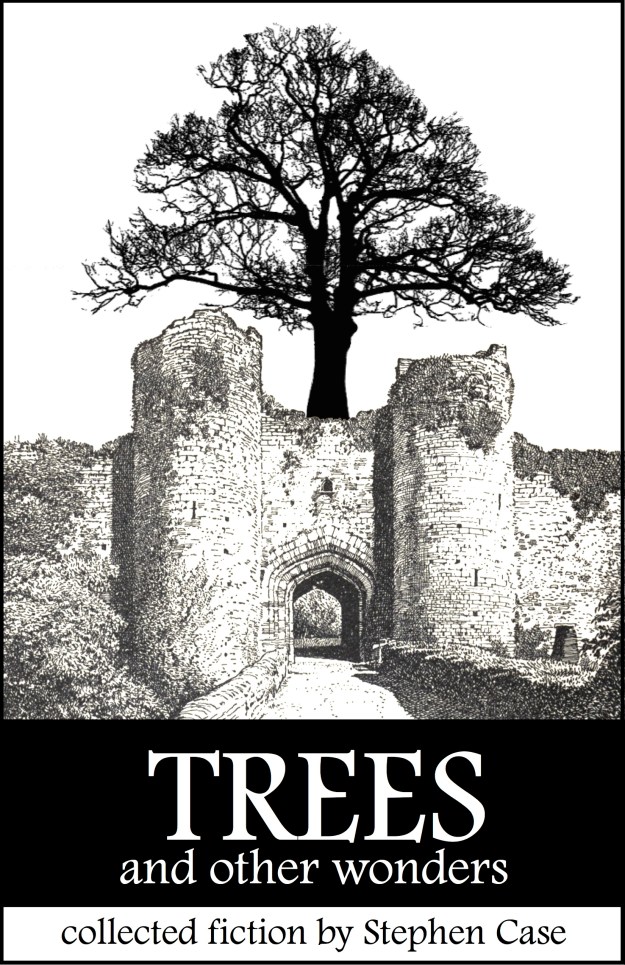
After I had published ten stories in various print and electronic magazines– at least one of which was published on another continent and many of which were quickly out of print– I figured I’d collect them all and try my hand at an anthology. Here they are. Ten of my published pieces from 2008 to 2013, along with two unpublished stories that I felt were worthy of inclusion. This was my experiment with electronic publishing. Currently the work is only available on Kindle, though Kindle as a platform can be downloaded for free on pretty much any operating system. A few people have asked me about getting a print copy. As of right now, I haven’t spent enough time on Createspace to get one worked up, and I haven’t been very pleased with the quality of the print-on-demand books I’ve seen. I did the cover myself and had fun creating an afterword explaining a bit about each piece. I haven’t gotten much feedback, though there are a few nice reviews on Amazon. The one print review I garnered was published in the Australian magazine Andromeda Spaceways Inflight Magazine. I thought it said some pretty nice things, which I’ve quoted below: “There’s a richness of the imagination here, a calmly-measured pace, a solidity. . . . There’s a vivid quality to his writing, and an underlying ability to evoke wonderment at the worlds or tableaux pictured within these pages. There are echoes, too, of a Golden-Age-anything-is-possible kind of sensibility to many of these stories. . . . Case has produced a collection in which almost every story reads like a fable, the moral of which is a secret the reader may hope to discover before the end. There’s an easy acceptance of the fantastical, a hint of the impossible.” I like that. If you’re interested, you can get a copy here.

Sword and Laser Anthology

Sword & Laser AnthologySword & Laser Anthology by Veronica Belmont

My rating: 4 of 5 stars

Please, judge this book by its cover. Because it is such a wicked cool one. And in this case, it’s a good indication of what you can find inside.

Sword and Laser is a “science fiction and fantasy-themed book club, video show, and podcast,” featuring Tom Merritt and Veronica Belmont, the editors of this anthology. The anthology itself consists of twenty stories split between “sword” (fantasy) and “laser” (science fiction). It is, as a good anthology should be, a hodgepodge, rough-and-tumble collection of stories with as many polished faces as jagged edges, sparking with ideas and a lot of raw enthusiasm. Its aim is showcasing new voices in the science fiction and fantasy community.

The enthusiasm is indeed palpable and refreshing. I suppose that’s what happens with a choir of fresh, new voices. Not every story is fantastic, but many are. And the beauty of an anthology is that each reader will likely differ about which stories to put within each category. If you’re a science fiction and fantasy fan, you’ll feel like you’re in a room with a bunch of friends. And they’re telling their best stories.

The ones that stood out to me were by writers who obviously know how the genre works and can have fun with it. In this vein “Partly Petrified” by Auston Habershaw, “The Same International Orange” by Luke R. Pebler, and “Honeybun” by Austin Malone were fine examples. “Honeybun” in particular I thought was a good representation of a lot of this anthology: potential. The bones of some excellent ideas that, perhaps catalyzed by inclusion in this anthology, could spiral out into something deeper and bigger. In this respect, the cover of this work is truer than perhaps anticipated: like the shelved world-bubbles in the image, there are a lot of seeds planted here.

There are glimmers of deeper waters as well. Perhaps because I’m in the midst of stitching together the bones of my own deep space endeavor, my sympathies in this anthology leaned toward the “laser” end of the book. The concepts in “Jonah’s Daughter” by Adam Callaway, “False Lights” by Victoria Hooper, and the very strong finish to the volume, David Emery’s “Only Darkness,” sounded the depths of the weirdness and the wonder that makes great science fiction shimmer.

Then there was my piece, “How Fox Fixed the Sky,” nestled in the final half of the “sword” section. It’s a fablesque epilogue to the story of Chicken Little. What if Chicken had been right and the sky was really falling? What if Fox made a knife from a fallen fragment of sky? What if he climbed through the hole to see what was beyond? I’m probably borrowing tone from Miyazaki, but Fox’s character was put to paper before I ever saw The Fantastic Mr. Fox (though if Miyazaki were to animate this story, Clooney would be a great voice for Fox). It’s surrealist and fun, maybe even a bit haunting, and if you pick up this book I hope you like the bit I contributed.

As far as I know, the anthology isn’t yet available for general purchase. I think it’s gone out to the contributors and the folks who backed Sword and Laser’s next season via Kickstarter. Check back here for updates though, because as soon as I know how you can get your hungry mitts on a copy (besides coming over here and borrowing mine), I’ll let you know.

UPDATE: Sword and Laser Anthology is available for purchase (electronic or traditional format) here. Buy a copy! Support fledgling writers and good science fiction! If you buy a paper copy I’ll promise not to drive its value down by trying to sign it.

The Stone Oaks

Beneath Ceaseless Skies, The Frost Valley

“The Stone Oaks” was my third publication in Beneath Ceaseless Skies (issue #112, in January of 2013). My wife is a huge Robin McKinley fan, and she (my wife) keeps pushing me to write stronger female characters into my stories (and, truth be told, if fiction is supposed to reflect life, and if my fiction is supposed to reflect my life, then– yes– my stories should be filled with very strong female characters).

So this story has one. I like Claire. I also like trees, nuns, and knights. I put them all together (with one additional element) in “The Stone Oaks.” The trees are exaggerated versions of actual trees that filled a park we used to go to in Mississippi. A friend recently asked me what the trees in this story symbolized. I had to think about that, but if forced I’d probably say something like, “They represent any time we’re given a job we don’t understand but try to do obediently and well. And they represent the unexpected fruit such labors may bring.”

I’m “working on” a follow-up to this piece, but I’m also working on a dissertation, so we’ll see.

You can read about Claire and her trees here.