Tag Archives: fiction

The Unborn God

KayborGate_AlexRies_coverC2_top
KayborGate_AlexRies_coverC2_bottom

I love to fly. When I get on a plane, I try to get the window seat, and then I spend a good portion of the flight with my nose pressed against the smudged glass studying the clouds. I took a weather course at some point, and I just read a book about the classification of clouds, but I can never remember all the different types or their physical explanations. They fascinate me though, especially the tumbling towers of cumulus that rear up and fall apart like temporary mountains. There’s an entire cartography up there that’s constantly changing and being re-written.

It was vistas like these I wanted to capture in a story I wrote called “The Wizard’s House” about a boy who lives under these skies and finds his way up into them. Then I wrote a sequel to that story called “The Unborn God” that talks about what the boy and the wizard have to do with their floating house. As these things sometimes work out, I sold the second story first, and it appeared in Beneath Ceaseless Skies (my fourth story in that publication) this week.

Give it a look. I had a lot of fun writing it. After you read my piece, check out the other stories in this issue (which is a special double-size issue in honor of it being BCS’s 150th). Richard Parks has a sharp tale of demonic imprisonment and lost opportunities. “The Black Waters of Lethe” by Oliver Buckram is a brief, haunting vision of oblivion. I haven’t had a chance to read Adam Callaway’s piece yet, but his story “Jonah’s Daughter,” which appeared alongside mine in the Sword and Laser anthology, was one of the best and most pleasingly bizarre in that collection.

The prequel to “The Unborn God,” “The Wizard’s House,” is forthcoming in Beneath Ceaseless Skies. It’s been a good summer for sales. I also have a story appearing soon in Daily Science Fiction entitled “What the Elfmaid Brought.” Lest you believe I’m getting too prolific though, here’s a list (in no particular order) of pieces I’m still trying to sell:

“Gold, Vine, and a Name”
“Flame is a Falling”
“The Gunsmith of Byzantium”
“Bone Orchard”
“When Cold Man Went to Hell”
“Drying Grass Moon”
“The Crow’s Word”
“Polycarp on the Sea”

Big news though, and more on which soon: I’ve signed a contract with Retrofit Films to write a novel based on a previously-published short story. The story (retitled and reworked a bit) will be released soon, and then the novel will be published as a series of three novelettes. I won’t say much about it now beyond that it’s a science fiction thriller we’re calling Dead Fleet.

In the meantime, you can read “The Unborn God” here.

Neverwhere

NeverwhereNeverwhere by Neil Gaiman

My rating: 2 of 5 stars

I wanted something soft to read for the flight over the Atlantic and back. I knew I liked Gaiman’s short fiction, and I had heard good things about some of his novels. When I ducked into the library to grab a book for the trip, Neverwhere was the only Gaiman novel I could find. It had an epigram at the beginning by G. K. Chesterton, which was an encouraging sign.

As it turned out though, reading Neverwhere for me was like climbing up a hill. If it wasn’t the only book in my backpack, I would have put it down several times during the first half. It’s not that it wasn’t good. The first chapter was compelling. It’s just that it wasn’t great, and yes– I’ve gotten that picky about the novels I read. After the pleasant surreality of the first chapter, the only thing drawing the story along was how bizarre and weird London Below, the mysterious and magical realm that exists somehow beneath or beside or behind the real London, was. And London Below really wasn’t that whimsical or bizarre. It was London viewed through the lens of Chesterton, assuming that the picturesque and odd names of London Underground stops corresponded to actual, physical truths. Black Friars at Black Friars. Etcetera.

It is fun. And Gaiman is a good writer. But the strange nature of the world itself– which never really seemed to have teeth or take on a deep characterization– wasn’t enough. It reminded me very much of Mirrormask, Gaiman’s Labyrinth-like movie that I finally turned off because one bizarre and lovely scene after another just wasn’t enough to make a compelling story. Apart from that, the main character– a normal guy with a normal job and a normal fiancee, who is pulled into London Below after an act of kindness to another protagonist– spent the first half of the book whining about how weird and scary everything in London Below was and how he just wanted to go home. Not terribly endearing.

So like I said, an uphill climb. Again though, Gaiman is a good writer. The dialogue was only unbearably trite in a few places. There were a couple interesting characters, a few good, solid twists, and a fine resolution. And about halfway through, the story found its feet or I just got swept up in the momentum of it, and the second half of the book was a satisfying read. But not terrific. Not terrifying or wonder-inducing, two of the things I’ve come to expect from Gaiman. Perhaps the surreality that is Gaiman’s distinct voice comes across most effectively in short works. Or perhaps it was just because this was his first novel. And we all know the danger of evaluating an author on his first novel. (Anyone remember Wolfe’s Operation Ares?)

In sum, Neverwhere felt like an exercise, like a solid writer seeing what it was like to write a long work of fiction. There was nothing in here to make one catch one’s breath, to genuinely frighten or awe. There was much to make one smile, a bit to make one groan, and a lot to pass the time in an airport, but it’s not a book to change your life.

Unless, of course, I’m wrong and it does. Because magic sometimes works like that.

M is for Magic

M is for MagicM is for Magic by Neil Gaiman

My rating: 4 of 5 stars

Many of us who believe that true magic lies in stories know and love Gaiman for his work on Sandman. Sandman itself was built of stories. That was a large part of the wonder of it. But it was still an epic, and I had never gotten around to exploring Gaiman’s short stories.

I’ve had the goal of doing so for a long time, especially as Gaiman is known as a huge fan and protégé of my very favorite crafter of short stories, Gene Wolfe. (In fact, the only time I’ve ever met the two of them in person they were interviewing each other at a Chicago Humanities Festival event several years ago.) I haven’t had much time for reading fiction lately though, so this was a low-priority, long-term goal.

But then my wife brought this book home from the library, and I had a lazy Saturday. And M for Magic is definitely a Saturday book. It’s a single-day read. Don’t take it along for a week’s getaway by the lake (or at least, don’t take only it along). These stories are quick, lovely, and melt-in-your mouth. I could say other things as well. I could say they were dreamlike (as you would expect from Gaiman), haunting, gorgeous, and practically flawless. But I might sound a bit gushy, something I try to avoid.

This particular anthology was built out of stories Gaiman chose for young-adult audiences, but they don’t feel like kids’ stories. This is part of Gaiman’s art, which he has used to good effect in works like his movie Coraline or his children’s book Wolves in the Walls: the ability to tap into some of the things that make childhood filled with equal parts wonder and fear.

There are a lot of voices echoing around in the corners of this anthology. The title is a self-admitted tip of the hat to Bradbury, whose voice haunts works like “October in the Chair” and “How to Talk to Girls at Parties” (which holds the only whiff of science fiction in what is an otherwise straight fantasy collection). Lafferty is clearly laughing through the background of “Sunbird,” one of my favorites in the anthology. And there are strains of Beagle’s Fine and Private Place throughout the longest story in the batch, “The Witch’s Headstone.”

Not to say any of this work is derivative. It is not. We all build our stories on the backs of what we’ve read and loved. And there are pieces in here that are completely unique, with a voice of cats and railroad beds and England and magic that is Gaiman himself, un-distilled, as in “Troll Bridge,” “Chivalry,” and “The Price.” With the exception of the first, bumpy story in this work, nothing here disappointed. All of my other “to read” Gaiman anthologies just climbed up a notch on my list.

If you need a breath of fresh air, and you want to open a window in your skull letting in a breeze on which the metallic tang of rain and the heavy scent of graveyard flowers are mingled, read this book.

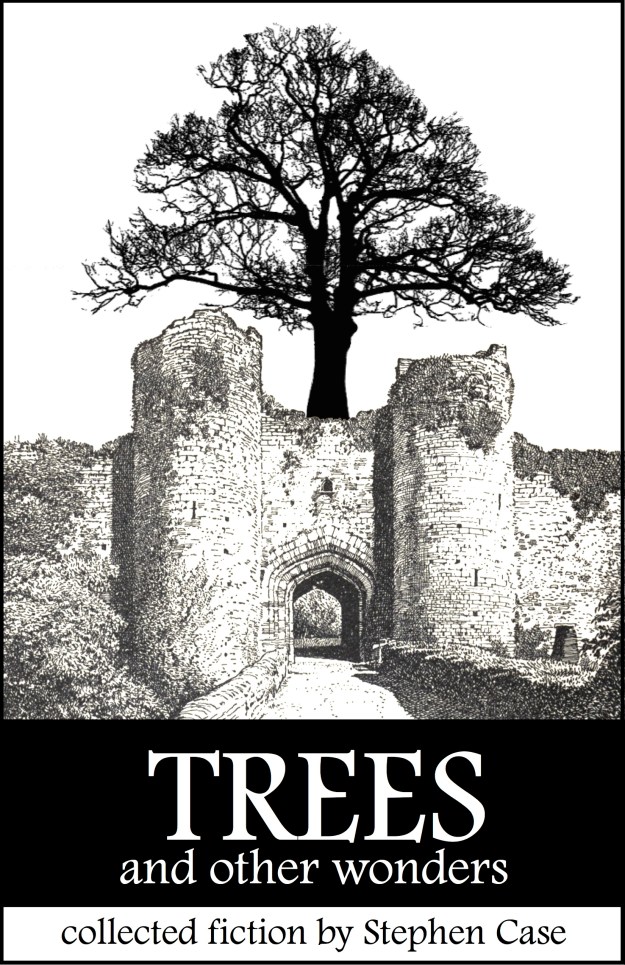
Trees and Other Wonders

castle version

After I had published ten stories in various print and electronic magazines– at least one of which was published on another continent and many of which were quickly out of print– I figured I’d collect them all and try my hand at an anthology. Here they are. Ten of my published pieces from 2008 to 2013, along with two unpublished stories that I felt were worthy of inclusion. This was my experiment with electronic publishing. Currently the work is only available on Kindle, though Kindle as a platform can be downloaded for free on pretty much any operating system. A few people have asked me about getting a print copy. As of right now, I haven’t spent enough time on Createspace to get one worked up, and I haven’t been very pleased with the quality of the print-on-demand books I’ve seen. I did the cover myself and had fun creating an afterword explaining a bit about each piece. I haven’t gotten much feedback, though there are a few nice reviews on Amazon. The one print review I garnered was published in the Australian magazine Andromeda Spaceways Inflight Magazine. I thought it said some pretty nice things, which I’ve quoted below: “There’s a richness of the imagination here, a calmly-measured pace, a solidity. . . . There’s a vivid quality to his writing, and an underlying ability to evoke wonderment at the worlds or tableaux pictured within these pages. There are echoes, too, of a Golden-Age-anything-is-possible kind of sensibility to many of these stories. . . . Case has produced a collection in which almost every story reads like a fable, the moral of which is a secret the reader may hope to discover before the end. There’s an easy acceptance of the fantastical, a hint of the impossible.” I like that. If you’re interested, you can get a copy here.

Driving East

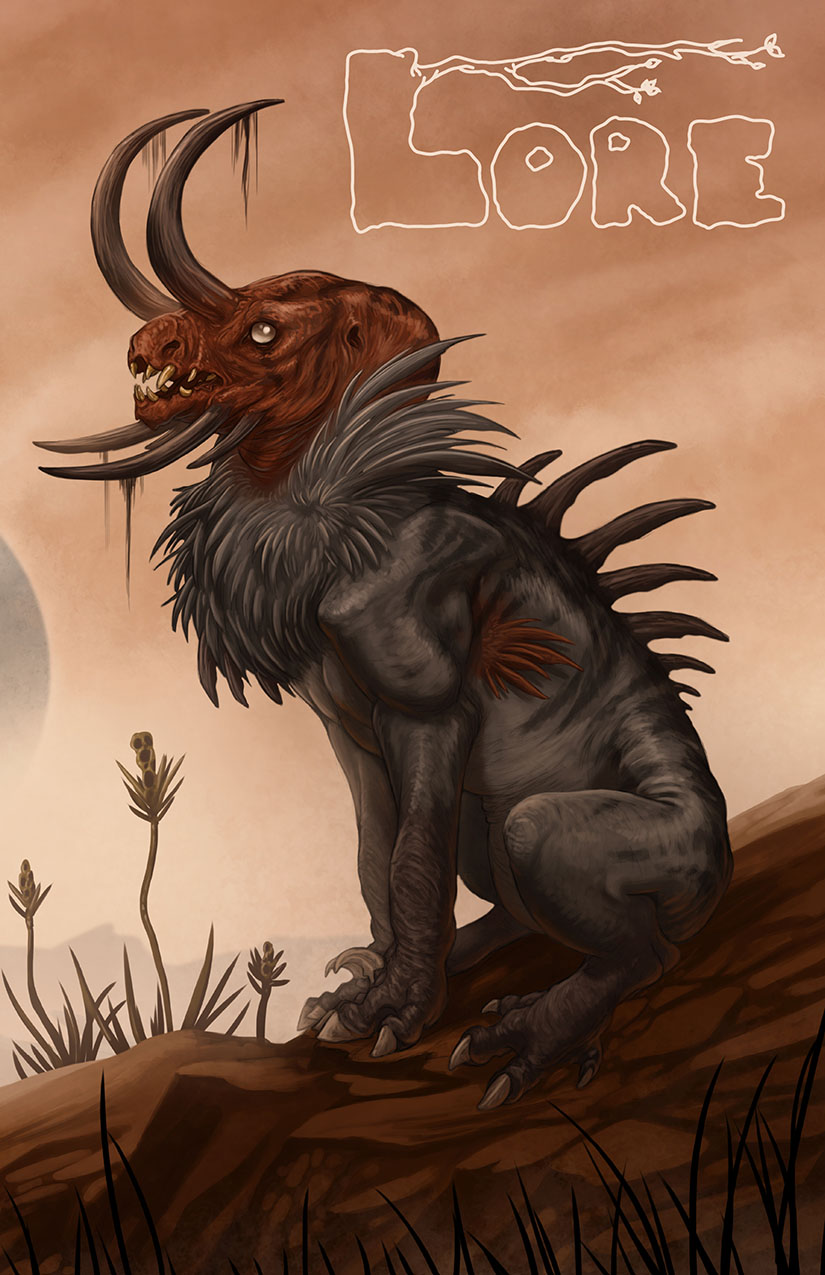
lore3cover

Well this is sort of a creepy guy, huh? He graced the cover of Lore, volume 2, issue 3, which was published back in April of 2013. Lore has an interesting flavor to it. It’s a sturdy, perfect-bound journal paying professional rates and publishing semi-regularly. The stories in it (or at least in this issue, I confess I have not read others) tend to be polished and subdued but also haunting and sometimes grotesque.

In this issue you’ll find a surrealist piece I wrote called “Driving East.” It’s about the commute I made weekly during the first couple years of graduate school. It’s also about (maybe) dying. I’d like to think the ending has something Wolfean to it, that it’s my attempt at his type of endings that are really just beginnings. It’s also the sort of story that makes my friends and family (the ones who read my work) pause and say slowly, “Well, that was interesting. But I didn’t really understand it.”

Neither did I. Sometimes they just need to be written.

To read “Driving East” you need to get your hands on a copy of this issue of Lore, which you can do here. You should do it. You’ll be supporting a smart magazine, and you’ll have that guy up there staring at you for a while.

Sword and Laser Anthology

Sword & Laser AnthologySword & Laser Anthology by Veronica Belmont

My rating: 4 of 5 stars

Please, judge this book by its cover. Because it is such a wicked cool one. And in this case, it’s a good indication of what you can find inside.

Sword and Laser is a “science fiction and fantasy-themed book club, video show, and podcast,” featuring Tom Merritt and Veronica Belmont, the editors of this anthology. The anthology itself consists of twenty stories split between “sword” (fantasy) and “laser” (science fiction). It is, as a good anthology should be, a hodgepodge, rough-and-tumble collection of stories with as many polished faces as jagged edges, sparking with ideas and a lot of raw enthusiasm. Its aim is showcasing new voices in the science fiction and fantasy community.

The enthusiasm is indeed palpable and refreshing. I suppose that’s what happens with a choir of fresh, new voices. Not every story is fantastic, but many are. And the beauty of an anthology is that each reader will likely differ about which stories to put within each category. If you’re a science fiction and fantasy fan, you’ll feel like you’re in a room with a bunch of friends. And they’re telling their best stories.

The ones that stood out to me were by writers who obviously know how the genre works and can have fun with it. In this vein “Partly Petrified” by Auston Habershaw, “The Same International Orange” by Luke R. Pebler, and “Honeybun” by Austin Malone were fine examples. “Honeybun” in particular I thought was a good representation of a lot of this anthology: potential. The bones of some excellent ideas that, perhaps catalyzed by inclusion in this anthology, could spiral out into something deeper and bigger. In this respect, the cover of this work is truer than perhaps anticipated: like the shelved world-bubbles in the image, there are a lot of seeds planted here.

There are glimmers of deeper waters as well. Perhaps because I’m in the midst of stitching together the bones of my own deep space endeavor, my sympathies in this anthology leaned toward the “laser” end of the book. The concepts in “Jonah’s Daughter” by Adam Callaway, “False Lights” by Victoria Hooper, and the very strong finish to the volume, David Emery’s “Only Darkness,” sounded the depths of the weirdness and the wonder that makes great science fiction shimmer.

Then there was my piece, “How Fox Fixed the Sky,” nestled in the final half of the “sword” section. It’s a fablesque epilogue to the story of Chicken Little. What if Chicken had been right and the sky was really falling? What if Fox made a knife from a fallen fragment of sky? What if he climbed through the hole to see what was beyond? I’m probably borrowing tone from Miyazaki, but Fox’s character was put to paper before I ever saw The Fantastic Mr. Fox (though if Miyazaki were to animate this story, Clooney would be a great voice for Fox). It’s surrealist and fun, maybe even a bit haunting, and if you pick up this book I hope you like the bit I contributed.

As far as I know, the anthology isn’t yet available for general purchase. I think it’s gone out to the contributors and the folks who backed Sword and Laser’s next season via Kickstarter. Check back here for updates though, because as soon as I know how you can get your hungry mitts on a copy (besides coming over here and borrowing mine), I’ll let you know.

UPDATE: Sword and Laser Anthology is available for purchase (electronic or traditional format) here. Buy a copy! Support fledgling writers and good science fiction! If you buy a paper copy I’ll promise not to drive its value down by trying to sign it.

The Stone Oaks

Beneath Ceaseless Skies, The Frost Valley

“The Stone Oaks” was my third publication in Beneath Ceaseless Skies (issue #112, in January of 2013). My wife is a huge Robin McKinley fan, and she (my wife) keeps pushing me to write stronger female characters into my stories (and, truth be told, if fiction is supposed to reflect life, and if my fiction is supposed to reflect my life, then– yes– my stories should be filled with very strong female characters).

So this story has one. I like Claire. I also like trees, nuns, and knights. I put them all together (with one additional element) in “The Stone Oaks.” The trees are exaggerated versions of actual trees that filled a park we used to go to in Mississippi. A friend recently asked me what the trees in this story symbolized. I had to think about that, but if forced I’d probably say something like, “They represent any time we’re given a job we don’t understand but try to do obediently and well. And they represent the unexpected fruit such labors may bring.”

I’m “working on” a follow-up to this piece, but I’m also working on a dissertation, so we’ll see.

You can read about Claire and her trees here.


The Land Across

The Land AcrossThe Land Across by Gene Wolfe

My rating: 3 of 5 stars

Gene Wolfe won my undying devotion by being the author of the books that pushed me across the borderland from science fiction and fantasy to literature. (There’s no hard and fast border between the two. It’s a spectrum, but when you start reading Wolfe you realized you’ve definitely wandered– or plunged– into the literary side of this spectrum.) The Fifth Head of Cerberus, Peace, and all of the Sun books are enough to cement his reputation, and they remain among my all-time favorite books. Yet the man is still writing, and I’m still obligingly reading everything that comes from his pen or whatever word-processing software he uses. The Land Across, a standardly (for Wolfe) unclassifiable novel that straddles the boundary between crime mystery, international espionage thriller, and supernatural fantasy, is his latest.

I’ll be honest, some of his most recent stand-alone novels seem like they could be a bit inaccessible to someone not familiar with Wolfe and his tricks. I come to them with a predisposition to love the writing and the writer. Even so, I left An Evil Guest with a confused frown and The Sorcerer’s House with a wry sigh. I closed The Land Across with a perplexed grin. It was nowhere near (to me) as impenetrable as Castleview (for which I lack the Arthurian key). Of all Wolfe’s novels, the one of which it reminded me the most was There Are Doors, but with the soft alienness of a foreign country instead of a parallel dimension. (I also recall Doors as having lots of conversations in cafes, as does Land.)

On the surface, the plot is not straightforward at all. In fact, it’s bewilderingly complex. The main character, Grafton, wants to write a travel book about an unnamed and difficult-to-reach Eastern European country. While traveling there by train he gets picked up by the border patrol and arrested as a possible spy. Under a loose sort of house arrest, he agrees to rent a (probably) haunted house in which there is reputed to be treasure. He gets kidnapped by an underground revolutionary movement and eventually arrested again by the country’s secret police. When his cell-mate escapes, the secret police enlist Grafton to help track the man down. The escapee seems to know some magic, and a secret society of Satanists gets involved. Mysteries are solved. Long conversations are held in cafes. Women (who, married or not, seem to throw themselves at the narrator) are obligingly slept with. Grafton gets awarded a medal by the country’s dictator. Then he goes back to see if he can find the treasure in the haunted house.

If all that seems rather random and scattered, it is. But the genius of Wolfe’s writing is the way he makes it all seem natural. There are aspects of the supernatural and the surreal, but as with most of Wolfe’s writing these aspects are subtle and the bones of the story are the people and the conversations they have. Wolfe is the only writer I know who can create what seems like an action-packed novel but where most of the action is actually taking place in conversations over cafe tables. He is a master of relaying dialogue the way it actually occurs in conversations. People talk like real people in Wolfe’s novels, with all the logical leaps and half-understood or misunderstood transfers of information that this normally entails. The challenge is that Wolfe doesn’t put you in the narrator’s head, so you’re required to make the leaps and conclusions on your own. The narrator might throw you a clue, but for the most part he assumes you can keep up.

I was left, as I so often am after reading Wolfe, with the feeling that there was a lot more going on in the novel than I figured out. Even though, as far as Wolfe novels go, there was a fair degree of closure. There are lingering puzzles: the jarring and dream-like way in which Grafton was first taken off the train at the beginning of the novel, the unnamed lady he meets a few times and then exits the narrative with, and finally the ghostly figure of the Leader himself (as well as Vlad the Impaler) that haunts Grafton throughout the story. But these aren’t large enough or central enough that their mystery detracts from feeling as though I’ve understood the story at all. (Though, with Wolfe, you can’t get away from the feeling that he’s laughing at you because the real story, the secret story taking place in the sewers beneath or the back alleys behind the narrative hinges on solving these lingering mysteries.)

Wolfe’s novels should be read multiple times, ideally immediately after having finished it for the first time. But I am still a bit of a lazy reader, so I was pleased The Land Across did not immediately draw me into a story of tangential pathways and dizzying divergences like Abel’s quest in the Wizard Knight books. Indeed, once Grafton fell in with the secret police, the “case” of solving where his escaped cellmate was and finding the identity of the head of the secret Satanist cult formed a more or less consistent thread on which the novel rested. And this thread was, at least superficially, resolved.

Phantastes

PhantastesPhantastes by George MacDonald

My rating: 4 of 5 stars

Lots of thoughts on this book. It’s not great fantasy. The plot meanders, leaves things unfulfilled and under-explained or simply unfinished. A man wanders into the land of Faerie and then wanders out again. The language at times is eye-rollingly bad. But it’s also easy to see the gems, the bits of wonder and humility, that so effected C. S. Lewis. Consider what MacDonald writes near the end, as an analogy of love for Christ:

“This . . . is a true man. I will serve him, and give him all worship, seeing in him the embodiment of what I would fain become. If I cannot be noble myself, I will yet be servant to his nobleness.”

Or later, about love:

“I knew now, that it is by loving, and not by being loved, that one can come nearest the soul of another . . . All true love will, one day, behold its own image in the eyes of the beloved, and be humbly glad.”

Here the bits that  “baptized” the imagination of Lewis, as well as the universalism that apparently got MacDonald in trouble as a minister. The conclusion of the narrator’s wanderings in Faerie, the moral for him, is given at the end:

“May the world be brighter for me, at least in those portions of it, where my darkness falls not. Thus I, who set out to find my Ideal, came back rejoicing that I had lost my Shadow.”

And the final farewell, reminiscent of Wolfe’s “good fishing” line at the end of the Short Sun books:

“A great good is coming– is coming– is coming to thee, Anodos . . . Yet I know that good is coming to me– that good is always coming; though few have at all times the simplicity and the courage to believe it.”

Godric

GodricGodric by Frederick Buechner

My rating: 4 of 5 stars

The life of a saint is a peculiar thing. As I mentioned in a recent review of the writings of St. Seraphim, hagiography can make me acutely uncomfortable. Time and distance tend to polish the contours of anyone’s life, and a saint viewed through the lens of their own writings is often more comfortable than one in the flesh or even one depicted by contemporary accounts.

Frederick Buechner brings a saint to life in Godric, but it’s a real life, and in more ways than one. Buechner took an account of a historical saint from medieval England and built a life with the pieces history had provided. The skill with which he accomplishes this alone makes the book worthwhile, as England is a land with a rich and deep history entwined with Christianity. Godric would pair well with something like the Ecclesiastical History of the Venerable Bede. Buechner’s Godric is born the year before the Norman invasion and provides a Zinn-like “people’s history” view of the rise and fall of monarchies through the eyes of a merchant, a pilgrim, and finally a monk.

Then there is what the book says about sanctity, and this is where Buechner’s genius really shines. The book is not plot-driven, not riveting in the sense of chapters ending on cliffhangers or some over-arching mystery to solve or eminent peril to resolve. It’s something much more real: it’s a life. It’s about how Godric tried to find God. There are brushes with the supernatural, but they are merely hints and shadings. What Buechner drives home is Godric’s own, very human, search. There is no dramatic conversion. There are instead seemingly aimless wanderings as Godric tries to come to grips with his own fear, his own selfishness, and his seeming inability to do true good to those around him. It is in some respect an account of everyone’s life.

What makes Godric a saint? For Buechner it was two things: the perception that people formed of his sanctity, as he lived out the final half of his life in a hermitage beside the River Wear, and something much harder to define. It wasn’t his miracles. Those could be explained away. It wasn’t his holiness or sinlessness, as Buechner makes abundantly clear. As an anchorite, Godric is crotchety, impatient, and sometimes despairing. Moreover, the single more or less constant theme in his life is a relationship that provides the impetus that sends Godric wandering in the first place and which is ultimately culminated in incest and murder.

The thing about sanctity that Buechner might be telling us (and he is indeed saying much, and saying it very well in this book) is that Godric is a saint because he is desperate. He desperately wants to divorce himself from his own sinfulness. He desperately wants to know the love of God, and he’s crazy and stubborn enough to become one of those people who live out this desperation not enmeshed in the relationships within which most of the rest of us live out the struggle but in isolation, discipline, and constant prayer.

There is something else that makes this book wonderful. This is the voice Buechner creates for Godric; it is what makes the novel truly come to life. There’s not only the tone and the style in which he speaks, nor the harsh clarity that makes you know there was a real, breathing person behind these thoughts. There’s also the rhythm. The entire novel reads like a prose poem, with the flow of each sentence and phrase running with a steady cadence, fitting for the life of a saint who is credited as the first English lyric poet. It is almost intoxicating, carrying the reader along like the River Wear must have whispered constantly to Hermit Godric. Godric is a beautiful book beautifully crafted, and I’d love to find an audiobook version by a talented reader.