Tag Archives: reviews

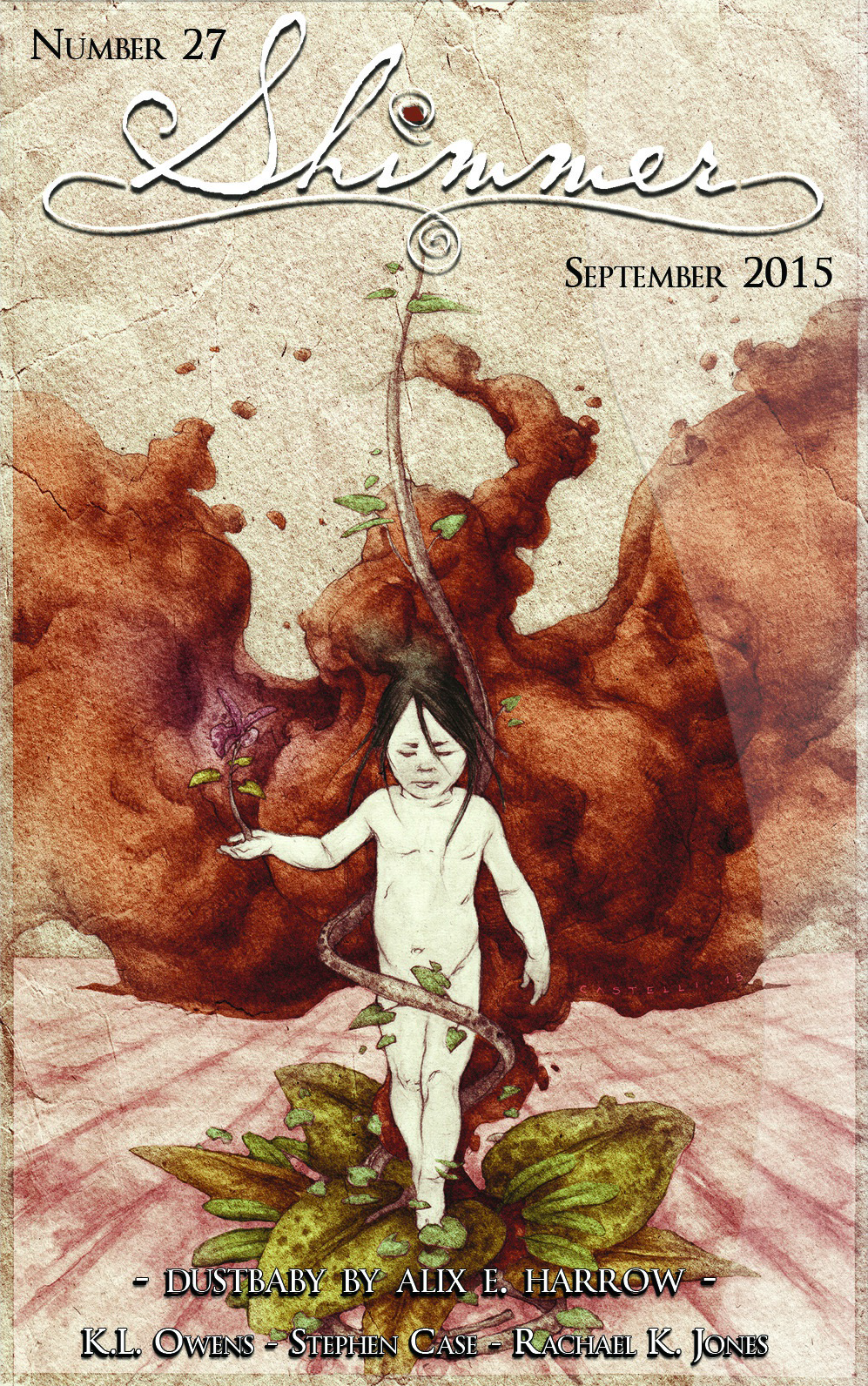
Shimmer #27

Shimmer 27

Shimmer is a gem, and I don’t say that solely because they’ve given a home to two of my disheveled little pieces. Shimmer finds itself home to a lot of beautiful strays. It’s a speculative fiction magazine that has carved a place for itself for bedraggled bits of wonder, lovingly polished and arranged. I’m proud to be a part of it, especially this, its latest incarnation.

In the introduction to issue #27, the editor writes that all the included pieces all fit together if viewed from the right angle. (She says something like that.) They’re like interlocking puzzle pieces, but you have to cock your head just right to see how the combined scene flows. I like that, because it’s just true enough. You’ll come away from these stories knowing how they fit together, and I’ll come away knowing the same thing. But we’ll probably know differently.

To me, besides the gilded edges of wonder common to whatever Shimmer publishes, what held these stories together was a sense of loss. An ache. Something departed.

We start with Alix E. Harrow’s piece, “Dustbaby.”

No, we don’t. We start with the cover. Judge this magazine by its cover. The watercolors that Sandro Castelli does for each issue are one big detail that holds Shimmer together and makes it work. They’re lovely and lend a haunting consistency to the magazine’s shelf-appeal.

Now, start with Alix E. Harrow’s piece, “Dustbaby.” I don’t think I’d go so far as to call it an end-of-the-world story, because it’s not among those pieces of ecological devastation or infection or whatever that I’m getting tired of reading. It’s a bit deeper than that, and by that I mean historically richer. We’re back in the Dust Bowl, reimagined. What if the Dust Bowl had been the end, the casting off of a thin crust of tired soil so that something greener and wetter underneath could reemerge? What haunted those hills before our plows passed?

Harrow, herself a historian, does good work here. The images are rich, moving, and disturbing, and we get a reminder that some of the best stories don’t have endings but rather just larger beginnings—part of what’s so much fun about short stories.

(If you like magical apocalypses like “Dustbaby,” you might check out my own “The Crow’s Word,” published in Orson Scott Card’s Intergalactic Medicine Show.)

My favorite piece in this issue (and yes, I might even be including my own) was K. L. Owens’ “A July Story.” Who doesn’t love a haunted house? And who doesn’t love a house with a mind, a mute tongue, and rooms stretching backward and forward in space and time? It might sound too much like the plot of an episode of Doctor Who, if “A July Story” wasn’t so steeped in character and place.

What makes this story work so well, beyond simply a compelling idea, are the characters: Kitten and Lana, and the place: the Pacific Northwest. Kitten’s a child of the English Industrial Revolution, torn out of time, marooned everywhere and nowhere. Lana’s a young girl from today. Their encounter, dialogue, and ultimate trajectories make a haunted house story a lot more than you expect. It’s also an especially strong tale because it takes place on a deeply textured backdrop of a particular time and space, which Owens makes clear in the interview following. Highly recommended.

Then you get to read my story, which is called “Black Planet.” I explained about this a bit in my interview in the issue (which you only get if you purchase the entire issue), so I won’t repeat that here. But I really like this little piece; I think it’s among the best I’ve written, and it’s for my sister.

The final piece in this work is the shortest, “The Law of the Conservation of Hair,” by Rachel K. Jones, which reads like a prose poem (and in fact might be in actuality a prose poem) about love and alien invasion and loss. Read it at least twice. Favorite line: “That we will take turns being the rock or the slingshot, so we may fling each other into adventure.”

So what about the common theme? Things get lost in different ways. Land, lives, siblings, and loves. Why do we sometimes feel richer for the loss—or rather, for the expression of the loss?

Do yourself a favor and grab Shimmer #27.

Demolition Means Progress

Demolition Means Progress: Flint, Michigan, and the Fate of the American Metropolis (Historical Studies of Urban America)Demolition Means Progress: Flint, Michigan, and the Fate of the American Metropolis by Andrew R. Highsmith
My rating: 4 of 5 stars

The city is not a problem to be solved; it is a story to be told.

I used to dream about getting a fat grant years down the road and taking a leave of absence to start research toward a complete history of the city of Flint, Michigan. There would be so much to it, from the history of technology and the rise of the auto industry, to labor history and the creation of the middle class. I knew race would play a role in this theoretical history as well, though I hadn’t even begun mapping out the implications. It would have been an immense book, one that tapped into several important streams of the larger American drama. It would be in many ways a tragedy as well– a tale of controlled atrophy and downsizing, of a dying city, industrial decay, and the birth of the Rust Belt. That was my nebulous plan, but it was not to be: the book has already been written, and this past week I finished reading it.

Flint and its story fascinates me. I grew up on its nearly all-white suburban margins but with roots running into its history. I have memories of visiting AutoWorld as a child and of my grandparent’s home on Waldman Avenue. My mom and her parents often spoke with regret about what Flint had once been, of the prosperity of the post-War years and the sparkle of downtown before the sprawl of suburban shopping districts. Though I grew up in the suburbs of Flint Township and later Swartz Creek, my mom (and many of the parents of my friends and peers) had grown up in city. Her family came from Missouri looking for work in the factories, and my grandfather built a career on the Grand Trunk Railroad. My dad spent his career working for General Motors, much of it at Buick City before it was closed and he was relocated to Saginaw. I ventured downtown occasionally as a teenager (and it was always clearly a venture), specifically to the Cultural Center and the Longway Planetarium.

Flint’s story shaped me in obvious ways I’m only now realizing. Many of the photographs on this blog, for instance, were inspired by the rich background of texture and decay I grew up on the fringes of. I knew the city’s history in a cursory way and even saw some of it myself. For all these reasons, I wanted a book that dove into this history. In the absence of such a book (though Gordon Young’s memoir– reviewed here previously– was an excellent journalistic step in this direction) I was prepared (one day in the distant future) to attempt to write it myself.

But the book now exists.

I wrote earlier on this blog about Mark Quanstrom’s study on Nazarene theological history and the way it helped me understand the religious context in which I was raised. What Quanstrom’s book did for my theological heritage, Andrew Highsmith’s new study does for my social and urban context. (Note to self: a work exploring the intersection of these two themes, charting the growth and decline of the Nazarene church– which at one time could count at least half a dozen large congregations in the city– would be of interest.) I knew Flint was economically depressed and racially divided. But I never fully understood the depth, origins, and repercussions of “white flight,” a trajectory in which my family participated.

My sister and her husband live and work in downtown Flint. On multiple occasions I’ve biked with my brother-in-law from his restaurant on Saginaw Street, past the former site of Chevy-in-the-Hole, where it looks like giants literally gouged a cement valley along the river into the center of the city, to his house in Mott Park. He’s told me lately he feels most of his work in the city revolves around racial reconciliation and that if we can’t understand race we won’t understand anything about Flint’s story and where it is today.

I think Highsmith would agree. I first learned of his book just days after it was released from my brother-in-law, who passed it along to me with a sort of resignation: “Here’s another academic who thinks he’s figured Flint out.” I don’t know that Highsmith claims to have unravelled any riddles, but he’s begun plunging the depths of the issue, the tangle of politics– many on a national level– that made Flint what it was and is. It’s very much a story of place, rarely focusing long on any particular individual. Highsmith’s Flint is made up of institutions, organizations, politics, and changing demographics. Yet there are enough specific personal focuses, ranging from Michael Moore to the tragedy of the Beecher assistant principle driven to suicide by the intractable problem of de-segregating his high school, to keep it a poignant and human (though a consistently scholarly) read.

Highsmith offers an urban history of Flint from the early 1900s to the present. (Indeed, the epilogue brings the story up to the point of names, organizations, and developments I recognize from my frequent visits home.) In particular, Highsmith wants to understand and outline the institutional and administrative forms of segregation that kept Flint one of the most racially divided cities in America long after the era of Civil Rights. Under the aegis of strong neighborhood schools, for example, the Flint public school system remained effectively segregated until whites were in a clear minority throughout the city.

Highsmith examines the central issue of race and urban policy from several angles over the century. Much of the division began in housing policies at a national level in the inter- and post-War years, in which real estate redlining kept neighborhoods divided and set the foundation for much subsequent de facto segregation. In the era of urban renewal and the coming of the expressways, proponents of development argued for the clearing of predominately black slums like St. Johns, but administrative segregation largely prevented the relocation of these residents (who initially supported neighborhood clearings) from getting much value from their property and finding new homes in an integrated city.

In addition, a ring of largely white suburbs acted quickly to self-incorporate, preventing Flint’s spatial growth and through tough zoning laws blocking the construction of public housing complexes that would result in racial integration (and potentially lower property values). The background to all of this was of course the ebb and flow of the fortunes of General Motors and its complex relationship with the city. If the city of Flint was equated with Buick as the quintessential company town, what happens when Buick dies?

All of this tells a story. It doesn’t give any answers. At the risk of sounding trite though, that’s the point. Highsmith makes the case that America is the story of a thousand Flints, linking the racial and post-industrial challenges of Flint to the nation as a whole. That may be true, but Flint is also importantly unique, enough that its tragedy has a wholly specific resonance, especially to those who grew up in its shadow. This book should be required reading for anyone in or from the Vehicle City, especially anyone who cares about locality and knowing how the place that shaped you was itself shaped.

As T. S. Eliot said, “We shall not cease from exploration, and the end of all our exploring will be to arrive where we started and know the place for the first time.”

Their Eyes Were Watching God

Their Eyes Were Watching GodTheir Eyes Were Watching God by Zora Neale Hurston

My rating: 3 of 5 stars

One (completely inappropriate) way to read this book is as a zombie book. It’s a book about Patient Zero and the beginning of the zombie apocalypse. In fairness to this theory, it has several of the expected elements: the cataclysmic ending and the struggle for survival, the setting in the hot, thick swamps of south Florida, in the midst of the drama the fateful but at the time apparently minor bite, the strange symptoms, the descent into rage, and the possible spread of the infection. In this (absolutely incorrect) interpretation, Janie does not survive the fate of her husband Tea Cake; she carries the infection back with her to the village they left behind and the true horror begins after the book’s conclusion.

But that’s of course absolutely not what this book is about. I don’t think Zora Neale Hurston had zombies in mind when she wrote in the late 1930s. And even though rabies makes a brief and horrific appearance, Hurston isn’t that interested in exploring the terror of this infection (likely the inspiration for lots of zombie and zombie spin-off stories). Instead it’s simply the melancholy end of what for the novel’s main character has been a life of deferred hopes and frustrated imaginings.

Janie is a black girl living in Florida in the early days of the twentieth century. Her grandmother still remembers when the slaves were freed. But the book isn’t about the relationship between races as much as it is the relationship between blacks. The longest discussion on race that takes place in the book is a dialogue Janie has with a black woman who is prejudice against the more “negroid” members of their own people “holding them back” from integration with white society.

Janie’s world is a world on the periphery though, and that periphery is defined by race. Her childhood begins with being raised with white children and only learning to her surprise that she was black, at which point society dictates separation. Her second husband rises to power as the mayor of an all-black community and spends his life trying to create a society that mirrors white society, a separate community in the Florida wastes on the fringes but with all the trappings of a commercial white city: a thriving store and a large house, street lights, industry. To do so though he must constantly clamp down on the traditional black culture that keeps cropping up like a weed, to his frustration and Janie’s growing alienation.

Finally, Janie finds herself and her third husband on the absolute fringes, working cane fields at the edges of the Everglades, the “Muck,” staying over seasons while migrant workers come and go. It’s in this society though, a melting pot of ethnicities and cultures only an anthropologist could sort out (and this is exactly what Hurston was), that Janie finds the joy and freedom she never had before. Ultimately though, the racial lines are drawn most sharply in the final scenes, when Janie stands trial for her third husband’s fate.

The thread that weaves this all together is Janie herself: a woman who is searching for freedom. She wakes to herself beneath a pear tree (the cover of this edition and perhaps the most iconic scene of the book). She’s married off by her grandmother to a gruff old farmer and then runs away with a man who evolves into a small-town dictator. She finally finds the freedom she’s looking for in Tea Cake, with whom she shares years at the dizzy edge of existence before it’s turned upside down by a hurricane and a bite from a rabid dog.

It was an easy book to read, but it felt dated. I felt that Hurston went a bit too easy on me. That is, I was set up for the difficult twists and turns Janie would experience, and she does, but it’s all told in a sedate, matter-of-fact way. Even the eventual fate of Tea Cake, which in a modern book it seems would be full of riveting, harrowing detail, seems softened, like we’re with Janie remembering back on this years later now that the details have been blurred by time.

The language was stunning throughout. This was especially effective juxtaposed with Hurston’s dialogue. Her characters speak in thick Floridian accents (or what I have to imagine are Floridian accents), and she writes this out phonetically so that it actually takes a bit of getting used to to read what her characters are saying. But it means you know how they’re saying it. And her narration throughout is luminous. There are expressions that catch you with their beauty in the same way that Janie wakened to life beneath the pear tree.

A Thousand Acres

A Thousand AcresA Thousand Acres by Jane Smiley

My rating: 4 of 5 stars

I’ll be participating in a workshop later this summer taking place at the Iowa State Fair and the World Food Awards. Part of the regional event is to give an understanding of locality and food production, and we’ll be exploring a bit of Iowa farmland. One of the organizers, in an email outlining our itinerary, suggested reading the novel A Thousand Acres as an introduction to rural Iowa farm life. I bent my “affirmative action” summer reading program slightly, considering that I need to read more novels by women as well.

Jane Smiley’s work is horrifying and profound. The book starts innocuously enough. There are three daughters (compared by some to the three daughters of Shakespeare’s King Lear), one of whom– the eldest– is the book’s narrator. Their father is a third-generation farmer on a tract of land that has grown over the years– through luck, diligence, and good sense– to a round thousand acres. The book begins with him deciding to retire and divide the land between his three daughters and their husbands. From this simple and sudden decision, a chain of events are set up in which the family slowly and painfully implodes.

The book was incredibly compelling to read, as painful as it was. It kept getting darker, which surprised me. I hadn’t read any Smiley, so I naively assumed this would be about a family’s love for each other and for their land and perhaps a struggle to preserve it. It was a good deal grimmer than that, though it was indeed about the land in profound and troubling ways. The story wound downward through madness, adultery, despair, and ultimately suicide and attempted murder. Along the way a past of incest and abuse was revealed that had slept beneath the surface like the drainage tiles that made the family’s thousand acres sound and productive land.

One of the things that made the work so compelling was the skill with which Smiley balanced her characters. There was no clear good guys or bad guys. There were only people with their own conflicting and often well-intentioned motivations. Whenever you thought the lines had been drawn fairly distinctly, a new wrinkle made you realize things were more complicated than you imagined. For the first portion of the book, it was easy to relate to the two older daughters and their struggle against their overbearing and increasingly irrational father. As the work progressed though, you started to see aspects of the sisters as well that highlighted their own pride and selfishness.

Throughout it all though, the land was a constant theme. The role of farmwife and farmer was highlighted and examined, as were the ideals of farming at the beginnings of large-scale industrialization, as the novel was set on the eve of the 1980s. Whatever ills their father had been responsible for, there was no denying he had made the land productive and was therefore admired by his peers. But the narrator links his dominance of the land with his abusive dominance of his family powerfully in the novel’s conclusion, a understanding that eventually results in her exile and separation from others who can’t see it in the same way.

There’s also hints of different ways to view farming and food production in the character of Jess, the outsider who wants to introduce organic farming methods but is ultimately ridiculed and rejected by his father. Jess is a weak alternative, futile, and– at this point in history– marginal to the way the farms are moving. Indeed, despite the dissolution of the family, it is the ultimate fate of their land that is perhaps the novel’s true tragedy. As dark as the novel got though, I couldn’t help feeling it actually had a happy ending in that the main character woke up. She had lived her life in a kind of captivity, and even though her ultimate salvation meant the loss of both land and family, she found it.

The Man Who Made Models

The Man Who Made Models: The Collected Short FictionThe Man Who Made Models: The Collected Short Fiction by R.A. Lafferty

My rating: 4 of 5 stars

It’s kind of fun to be part of a renaissance, even if you were late to the party. It’s kind of fun to be part of something gathering steam, spilling open, being rediscovered. Right now, that’s more or less what’s happening to the writings of R. A. Lafferty.

If you don’t know Lafferty, you haven’t been reading my blog long, as I’ve reviewed at least two of his books here already. You also probably haven’t seen the lovely fanzine, Feast of Laughter, which celebrates the man and his work and in which in the latest issue I have a story and review. You haven’t heard there was this really odd guy in Oklahoma writing at the crest of the New Wave in science fiction who was– bizarrely– Catholic, conservative, and curmudgeonly. You’re one of the lucky ones, because you get to discover his work from the ground up.

The collection The Man Who Made Models is the best place to start. I’ve written about Lafferty’s novels before. They are, I would argue, an acquired taste (but one well worth acquiring). It is in his short stories though that his madness and exuberance come in more manageable bits. But these aren’t dainty snacks; even as short stories they’re bloody, quivering chunks of meat you have to unhinge your jaw to swallow.

Part of what makes a Lafferty renaissance fun to be a part of is that Lafferty’s writings are so immense and scattered. Only one of his books is still in print, and his short story collections are treasures for which used bookstores are to be scoured regularly. Many of his later works were never published on a large scale and only appeared in now-vanished small presses. His short stories are spread across decades and lost in a farrago of out-of-print collections, unpublished manuscripts, and copyright litigation. All of which makes this particular collection so exciting: it’s purported to be the first volume in Lafferty’s complete collected short fiction.

And it really is a great place to begin the strange odyssey that is Lafferty, assuming you can sweet-talk your local librarian in getting her hands on it. There’s a fantastic mix of Lafferties in here, though I don’t believe this volume was designed to be a “best of” collection. (My single complaint about this volume is that the editorial afterword doesn’t explain the selection process for this volume. It is not chronological, as the list of original sources at the volume’s conclusion shows these stories range from the 1960s to the 1980s and appeared in everything from big-name magazines to small-press chapbooks.)

Models a pleasant patchwork, but that makes it sound comfortable and cozy. It’s not. It’s a patchwork of monsters. You’ve got stories in here that are among Lafferty’s best and brightest: “The Six Fingers of Time,” “Frog on the Mountain,” and “Narrow Valley.” These are the ones you want someone to read for the first time when you’re trying to explain who Lafferty is any why people get so excited about him.

But when you want to go beyond that and highlight his exuberant monstrosity, you’ve also got plenty of choices here. You have “The Hole on the Corner,” for instance, which I think is one of the best examples of what makes Lafferty tick: the Chestertonian joy of the gruesome, bizarre, and hilarious. There are some that are genuinely frightening, whether that means chillingly subdued like “Parthen” or riotously macabre like “The Skinny People of Leptophlebo Street.” And you have the ones where Lafferty almost goes too far, leaving you with a simmering crackling in your mind, an effervescence that only hints at the things other writers feel they need to work into their stories such as plots or conclusions: “The Ungodly Mice of Doctor Drakos,” for instance, or the concluding work of the volume, “Rivers of Damascus.”

I’m not a literary analyst who can comment eruditely on the philosophical or theological things lurking below the surface of Lafferty’s prose, like some of the contributors to Feast of Laughter. But I want to comment briefly on two of the stories in this collection, because it’s not worth much to an outsider to simply say Lafferty is impossible to classify and leave it at that. Each one of his stories bears deeper analysis, and each one in some way forces eyes and minds toward a world where a multiplicity of options and universes await, something that is often off-putting for those coming to his stories hoping for tidy conclusions and explanations. Things are a bit larger than that here; it’s like waiting for a cloud-scape to fall into its final configuration.

But there are two stories in this volume I especially love. The first is “Days of Grass, Days of Straw,” which is absolutely strange. On first blush this story seems to be an alternate reality tale, in which a man comes to awareness in a “weird western” motif where Indians have a thriving civilization on the Great Plains. This, it is eventually explained, is a “day of grass,” an extra day in the calendar that doesn’t count, as opposed to the ordinary, mundane “days of straw.” Life in the day of grass doesn’t have much narrative structure: the characters eat and talk and make war with buffalo and dance beneath a floating mountain. Simultaneously, in our own reality the characters discuss the nature of these lost calendar days, and Lafferty lists several of them for us, days we’re led to believe he’s lifted from obscurity from half a dozen ethnic calendars. The story ends abruptly with no real conclusion: we’re left with only potentiality, a flicker of wonder around the edges of our own life, and some pseudo-philosophical discussion of time and potentiality. It’s gorgeous.

And then there’s “Thus We Frustrated Charlemagne,” which features– as much of Lafferty’s short fiction does– characters that form a recurring cast of sorts in many of his stories. A group of scientists has achieved the technological breakthrough of sending avatars back in time to alter the past. (One of the best things about reading Lafferty is the way he handles technology. His explanations, which border on the absurd, somehow have aged much better than some of the best “hard science” explanations for fictitious technology.) Each time they alter the past, the world around them is transformed. It’s a trope that’s been explored often in science fiction since, but here it’s as fresh and new and hilarious as an actual real world popping into existence.

That’s much of the deep magic here: new, real worlds. Lafferty’s science fiction is never about making fantasy worlds to replace this one. Rather, he writes to open our eyes to the weirdness and the wonder in this one. The world, Lafferty’s fiction seems to say, is stranger than you can imagine. This one. The one you’re sitting in. It’s going to eat you alive. All of the fantasy– all of the horror and monstrosity and laughter and joy– is just him shaking your shoulders. Shaking them hard. Wake up.

The Violent Bear it Away

The Violent Bear It AwayThe Violent Bear It Away by Flannery O’Connor

My rating: 3 of 5 stars

Why are Catholics so good at making monsters? Our friend Daniel Otto Jack Petersen might eventually have some good answers for us, but at this point– having concluded my audit of the twentieth-century Catholic novels course taught by my good friend Dave (okay, not quite concluded as I skipped Brideshead Revisited and fell off the boat before our final novel, Walker Percy’s Love in the Ruins)– I can venture something along the lines of G. K. Chesterton’s “all is grist.” For the Catholic novelist, it’s all real and it’s all fair game for creation. There aren’t “bad things” off limits. All is useful for building stories, because all– even the dark and twisted– can be redeemed.

But the real, unlike for perhaps an agnostic or atheistic writer, extends far beyond the sanctity of matter to include the reality of the spiritual. Throw all that in the mix, and you get monsters out the other end. For a writer with the bizarre, piercing humor and science fiction tendencies of Lafferty, these monsters become the fleshy, jovial horrors of “The Hole in the Corner.” For the steady eye of Flannery O’Conner in the stagnant heat of southern woods, the monsters take on a stranger and more human aspect.

Because it seems to me that at the core The Violent Bear it Away is a story about monsters.

There are four monsters (five if you count the agent of the sudden, lurching violence of the penultimate scene). The first is the boy protagonist’s great uncle, who considers himself a prophet called by the Lord and who raises the boy to know the Lord’s work in a splendidly wild and woody isolation. His death at the beginning of the novel initiates the book’s plot. The second monster is the boy’s uncle, who considers himself the rational antithesis to the old prophet’s madness and who, when the boy finds his way to his doorstep upon the prophet’s death, sees the possibility of freeing the boy from the prophet’s mad shadow.

The third monster is the boy himself, who drinks himself to a stupor upon his great uncle’s death, refuses to bury his body, and instead burns down the home in which they lived before wandering into the city to find his uncle. It is this monster’s stubborn battle to resist both the compulsion to carry on the Lord’s work placed upon him by his great uncle and his “rational” uncle’s frenzied effort to reform him that forms the primary tension of the novel. The boy is taciturn, isolated, arrogant, and desperate to live out his denial of his great uncle’s holy legacy.

All these characters are monstrous, twisted, and unpleasant to observe. And yet O’Conner pulls us along with them. We are captivated by their misery, by their mutual hostilities, by their failure to accept any sort of redemption from each other.

And then there is Bishop, the fourth monster, the son of the boy’s uncle. Bishop is a child, an idiot “waste,” who can do nothing but follow along innocently– uncomprehending and unconcerned– as the boy fights against his great uncle’s imperative to baptize Bishop and his uncle’s determination to break him of this compulsion. Bishop is the pathetic eye of the storm and the focus of the only genuine moments of pathos and tenderness in the novel.

This is an Old Testament story, and the god looming on the horizon of the boy’s mind is a god of blood and fire and fury, despite metaphors of the bread of life– that tired, stale bread the boy refuses to eat. As with Graham Greene’s Heart of the Matter, the conflict here is primarily in the mind of the boy, but this makes it in no way less real. It makes it instead more tight and tortured. And it makes it all the more terrifying for where it leads.

This is not a book to read for pleasure, unless of course for the simple pleasure of reading good writing. For the story itself, the only pleasure might come in assuring yourself how far your god is from the dark and stormy god of the warm, stagnant forest and how far you are from the pathways of the boy’s own mind– until, of course, you actually read the Old Testament and are forced to ask yourself how thin the line between madness and holiness might really be.

Ian Morgan Cron

Chasing Francis: A Pilgrim's TaleChasing Francis: A Pilgrim’s Tale by Ian Morgan Cron

My rating: 2 of 5 stars

I came to a realization reading Ian Cron’s work: Mystics are empiricists. They’re trying to meaningfully express experiences. I’ve always been a theorist. I try to fit my own experiences and those of others into pre-conceived patterns and structures. I had always imagined (without much thought) that this was the other way around. I imagined the mystics were the theorists and that my own thoughts were grounded more firmly in empirical evidence. Meeting and reading Cron made me realize that the true mystic always speaks from experience.

I say all this because I do believe Cron is a modern-day Christian mystic. He came and spoke at my university at the beginning of this semester, and I had the privilege of meeting him as he visited and had lunch with one of my classes. He is deeply passionate, well-spoken, and kind. His words and vision are compelling, and he left behind stirred minds as well as hearts, a campus buzzing with what he had expressed, and a stack of his books generously gifted to my class.

So it was I found myself reading Chasing Francis, a book several of my students assured me was “the best book they had ever read.” I’m not sure what I was expecting, but within the first chapter I realized it wasn’t this: Francis through the lens of the fictional disillusioned, burned-out megachurch pastor Chase Falson. Though my opinion on the text differs significantly from that of my students, I believe what Cron is doing here is excellent and immensely important: unpacking aspects of Catholic mysticism and social gospel through the eyes of a mainstream evangelical.

The basic premise of the novel (Cron calls it “wisdom literature”) is that a pastor of a successful megachurch has a crisis of faith and finds himself traveling to Italy to spend some time with his uncle, a Franciscan. In the company of his Uncle Kenny and a few other jovial monks, he lives for a time as a spiritual tourist, shuttling back and forth through the Italian countryside visiting historic sights linked to the life of St. Francis and taking up a correspondence of sorts with the saint through his journal. New characters are introduced as needed to explain to Chase aspects of the Catholic spiritualism Francis exemplified: the love of artistic beauty, community, peace-building, and service, for examples. Chase learns there is a lot more to being Christian than the conservative, consumeristic view of the Church he previously held, and he returns to his church a changed man.

First, the value of this book: if you want to learn about the life of Francis, there are better ways. If you want a tour of Italy and Church history, there are better ways. But if you don’t know much about either and if you’ve been raised in the kind of Christianity Chase’s character represents, this might be your window into a new world. For me, this is why– despite the flat characters and the forced plot-line– it’s still gratifying when my students tell me they enjoyed reading it. Because the perspectives they take away from that are important. For someone, for instance, who sees in the symbols and practices of liturgical worship nothing but empty form or at worse harmful superstition, Chase’s realizations are going to be essential.

These themes aside though, the story itself is a bit tedious. The characters– most particularly Chase himself– are caricatures. They have conversations about spirituality and faith and beauty, but they’re simply observers, even the group of Franciscans. Even the most emotionally powerful portion– the account from a survivor of the Rwandan genocide– is staged and somehow sterile: we’re sitting beside Chase as he listens to a lecture at a peace seminar. The entire book is like this: Chase is staring through windows, meeting people who deliver information and perspective. This sense of disconnect reaches its climax in the chapter on beauty, when Chase happens to meet a concert musician, and then they happen to meet an Anglican priest conductor who gives a lecture on the role of beauty in theology, and then they all go out for dinner.

There’s a deeper problem here though, and one that caused a nagging worry as I continued to read. Chase begins the story as a self-centered individualist who realizes the answers he had are no longer working. For the duration of the story he functions as a self-centered spiritual tourist (Cron uses the term “pilgrim,” but I remain unconvinced. Chase is a tourist. He never abandons the Western tourist mentality.)

Chase’s church had been the “Chase Falson” show; he returns to it with new and transformed ideas, but his goal upon his return appears to be to simply reinvent it into the new, improved Chase Falson show. Nothing about his idea of church has essentially changed. He has absorbed apparently nothing from the Franciscans about humility, menial service, church hierarchy, or putting oneself under the authority of a spiritual superior or mentor. Chase’s McMegachurch is certainly transformed upon his return– and some of the twists here will be familiar to anyone who has experience with church politics– but it’s not a transformation away from the dominant paradigm of one man with a dedicated cadre of followers. As the final scenes make clear, this will still be the Chase Falson show, now simply informed by some ideas of St. Francis.

Jesus, My Father, the CIA, and Me: A Memoir...of SortsJesus, My Father, the CIA, and Me: A Memoir…of Sorts by Ian Morgan Cron

My rating: 3 of 5 stars

Ian Cron is a bridge between multiple worlds. He’s a bridge between mysticism and everyday evangelicalism. He’s a bridge between Catholicism and Protestantism. He was raised in one world and now, from what I can see, identifies strongly with the Via media of the Anglican church. And in that position he can mediate between many of the traditions and denominational languages of contemporary Christianity. I saw this at my own university, where Ian on the one hand led our chapel in an ecumenical eucharistic service and on the other listened and tried to understand students expounding on the Nazarene view of holiness.

Wherever we are among these different worlds, we need people like this.

If Chasing Francis, his first book, felt flat and unreal even as it communicated important ideas, Jesus, My Father, the CIA, and Me is alive. In this memoir Chase Falson, the omni-man protagonist of Chasing Francis, is replaced by Cron himself, and the writing that had only a constrained glimmer in Chasing Francis explodes into three-dimensions in this memoir. Here is someone writing about something real. Here is a true mystic expressing true experiences.

The title of the book, as Cron relates in the first chapters, comes from his realization upon his father’s death that Cron knew very little about his father’s actual career, which apparently included time as a CIA operative. His father– an emotionally abusive alcoholic– remains one of the primary threads woven through the work, and it is clear a primary impetus in the writing was Cron grappling with his memories of his father and the way they shaped his childhood. This makes the book’s conclusion– which seems at first glance disconnected from the rest of the narrative– a powerful commentary on fatherhood in general and the lasting repercussions of both wounding and redemption.

Cron calls the book “a memoir . . . of sorts,” but this hedging seems to me to devalue the work itself. He writes in the beginning that he feels the need to qualify this because not every conversation is written from memory and many are recomposed in his mind as he believes they would have happened. But can any memoir be any more than this? Considering the blending of history and fiction that characterized his prior book, I was left by this qualification with a shadow of doubt about whether Cron had taken more than usual artistic liberties with his representations of his past. Otherwise why insist that it was only a memoir of sorts? This would be disappointing, as the whole thing has a vibrant feel of realism and honesty.

The book bounces around chronologically, beginning with his father’s deathbed and funeral, jumping back to Cron’s childhood and teenage years, and chronicling his own battle with alcoholism and his life as a father today. In between he writes about his first communion and the power and transcendence of that experience, which comes full circle as he recounts his own first officiating as an Anglican priest. The stories along the way range from hilarious to deeply troubling, but there is a constant theme of wonder, humility, and gratitude. The language, which seemed forced in Chasing Francis, flowers here into something much deeper.

Cron writes, speaks, and lives well. I hope he comes back soon.

The Girls of Slender Means

The Girls of Slender MeansThe Girls of Slender Means by Muriel Spark

My rating: 3 of 5 stars

The Girls of Slender Means is straightforward and understated, but it’s a story built around a central riddle. The background to the riddle is a single summer in London at the conclusion of the Second World War in and around the May of Teck Club, a sort of group home for poor, young working-class women. (As Spark explains, everyone in England is poor during this period, even those who aren’t). A cross between a boarding school and an apartment complex, the girls go about their lives in a strange twilight between the bombed-out landscape of London on one hand and the growing certainty of peace on the other. This transitional period in time goes along with the transitional nature of the May of Teck inhabitants: besides the few seasoned spinsters, for the rest of the women it is an in-between place, in between girlhood and adulthood and halfway to a job or a career or a husband. No one will remain there for long. They’re all on their way to other places, eventually– a point emphasized by the fact that the narrative of this single summer is interspersed with snippets of telephone conversations as the grown women mull over the puzzle of those days and their outcome.

There are two threads woven against this background throughout the novel. The first is the mystery, more on which in a moment. The second is poetry. Joanna, one of the boarders at the May of Teck and the only daughter of a country parson, gives lessons in elocution, and the snatches of poetry overheard from the upper levels of the large house provides a constant baseline for the day to day activities taking place therein. Poetry haunts the story, sometimes foreshadowing but always giving an underscore to the wistful atmosphere Spark creates.

The second thread is the riddle of Nicholas, an aimless writer and half-hearted anarchist who wanders into the orbit of the May of Teck over the course of the summer. Within the first few pages of the novel, from the sketchy phone conversations Spark drops us into, we learn that whatever else has happened to Nicholas he at some point since this summer has become a Jesuit priest and was been recently martyred in Haiti. The news of Nicholas’s death spurs Jane, one of the inhabitants of the May of Teck that summer who was then an aspiring writer and is now a successful new columnist, to reflect on the events that led to his conversion. And a conversion of some sort it must have been, for he is not especially devout at the beginning of that summer of 1945 when his primary interest in the May of Teck Club seems to be trying to get Selina, one of the Club’s inhabitants, to sleep with him on the roof.

I’m reminded of Gene Wolfe’s short story “Suzanne Delage” in which the only remarkable thing about the story is that nothing at all remarkable appears to have happened even though something remarkable is implied. This novel has the same feel in that we know Nicholas’s eventual fate, but we see only hints of what may have compelled him toward it. Nicholas enters the novel as one drifting through life, wasting his time and perhaps his talents (though he has a book manuscript he is trying to get Jane’s publisher to publish), fascinated by the poverty and the communal life of the girls in the May of Teck Club (as well as the girls themselves). Besides the meandering philosophical conversations he has with particular members of the Club– with Joanna’s poetry constantly drifting down from above– we get only a single glimpse of a spiritual crisis in the sudden and unexpected catastrophe that concludes the novel. The entire explanation of Nicholas’s spiritual trajectory, which is the admitted impetus of recalling the events of this particular summer, remain obscure and out of the picture.

It is a novel lending itself to many interpretations, and we’re left with Jane to make of it what we may. One possible interpretation is that Nicholas is drawn to the Edenic aspects of the Club– their shared innocence of poverty and youth– and that he is driven to a spiritual crisis when the snake in the garden is ultimately revealed in the pettiness and selfishness of the Club’s final moments, contrasted with an example of faith and pointless sacrifice. His reaction here, and his telling realization that “No place is safe,” are perhaps all the answer we get to his ultimate fate.

The book is as slender and wistful as the girls who figure within it. And as mysterious. In the end, there are no clear answers. Nicholas is dead, and Jane is casting her memories back to that single summer in which their lives intersected. The War is over, and against that background of tragedy and celebration one man makes a quiet and secret decision to change the course of his life. We’re on the outside, trying to make sense of it, which is what makes the book so powerful: this is almost always our own perspective, trying to piece together the clues that might tell us something about the hearts of those around us.

The Heart of the Matter

The Heart of the MatterThe Heart of the Matter by Graham Greene

My rating: 2 of 5 stars

Greene is interested in the paradoxes that arise from pushing Catholic doctrines or dogma to their extreme logical conclusions. The epigram at the start of the book is a quote from the Catholic author Charles Peguy, who wrote of the selflessness we should have that would damn ourselves if it would save another. This is the apparent motivation of Scobie, the novel’s protagonist. He lives and works in World War II British West Africa, finding satisfaction in a go-nowhere police posting in a desolate port town beautiful for approximately five minutes each day. His wife is as drained and worn down as the town itself. Greene expertly shows the painful pity that motivates Scobie– who simply wants peace– in placating her and keeping her despair at bay. The everyday agony of their relationship, the weariness, the stratagems Scobie undertakes to distract and comfort her, is the driving force of the first third of the novel. Greene’s strength here is in the characters: the pained goodness and heavy generosity of Scobie, the faithfulness of his African servant, the machinations of the Syrian merchants of the town– all live (except for the enigmatic Wilson, who seems flat and patchy throughout the novel) against a sharply drawn background of the cloying West Africa Greene knew from personal experience.

In the novel’s second act, Scobie has found the peace he craved by making possible his wife’s passage to South Africa and settling into his own quiet routine. This peace is shattered by war though (a war which, even at its closest approach, remains a forbidding but distant presence over the horizon) as the survivors of a U-boat attack arrive in Scobie’s world. Here his pity (or what he represents to himself as pity) is captured by a young widow. Their quiet affair– whatever else it may have represented– quickly becomes once again a trap and loss of peace for Scobie, compounded by his wife’s sudden return. Greene has now set the scene for the excruciation of the third act, where the narrative action slows and spirals inward to a claustrophobic focus on the conflict warring within Scobie’s own mind.

Whatever Greene’s eventual and ultimate relation to Catholicism, this is unequivocally one of his Catholic novels, in which the conflict depends on the reader buying into– or at least buying into the character’s buying into– the reality of Catholic belief. Scobie believes he is in mortal sin but knows leaving it would mean abandoning someone who depends on him. He’s like the proverbial donkey starving halfway between two piles of hay, crucified on the horns of a dilemma. Whether divided by hunger, pride, or (as he makes himself believe) duty and pity, he can only conclude that both– that everyone– would be better off without him, who seems only able to cause pain despite his every attempt to avoid inflicting it. By this point of the novel, it’s difficult to have patience with Scobie as a character, yet we never lose faith with Greene as an author. Indeed, the telescoping conflict, in which aspects such as Scobie taking communion in a state of sin take on a heightened, almost delirious and certainly cinematic vividness, give the novel its sharpest moments.

The novel reaches the inescapable conclusion you see coming, but it feels all the more powerful for its inescapability. Scobie is trapped in his own mind, hedged by his own dogma, damned– in the paradox Greene relishes representing– by his own generosity. Greene provides no answers. He leaves us with only questions, which is what prevents the novel collapsing into a simple cautionary morality tale. Whatever Scobie’s motives (because it remains difficult to believe pity alone motivates the affair with the much-younger Helen), he is relatable and vivid in as much as anyone has felt trapped between irreconcilable conclusions, alone and cut off in the web of their beliefs. Whether he’s ultimately damned, he’s lost the peace he craved. In the construction of his isolation and misery– which Greene offers in magnificent detail– we get an illustration of how C. S. Lewis described hell: not as a place you go but as a place you gradually construct around yourself.

More than Meets the Eye: Volume 6

UnknownTransformers: More Than Meets the Eye Volume 6 by James Roberts

My rating: 4 of 5 stars

An open letter to James Roberts:

Dear Mr. Roberts,

Thank you. I have lots of questions, certainly, and I have plenty of comments, but I need to start with that: thanks. When I read a work I love, that seems the first and most necessary response. I know that writing is a difficult labor– no matter how easy some people make it look and no matter what a reward it must be to see those stories given form by Milne’s artwork. It’s probably still worth something (I hope) to hear a heartfelt thank you from a reader.

But let’s talk about why we should be thanking you for a moment, shall we? Obviously there were a lot of us who grew up loving Transformers, who filled afternoons with sagas enacted by forms of molded plastic on bedroom floors. There were probably less of us, but still a significant number, who bought wholeheartedly into the mythology that Furman created in his brief stint on the original Marvel run, who realized that of course these characters were scions of a god and the universe’s last line of defense against the Chaos-bringer, that of course they were more than simply robots that transformed into cars.

And then we grew up.

We passed the broken survivors of garage sales that hung on in basements and attics to our kids. We went to Botcon maybe once or twice, taped Beast Wars when it was on television, and tried our hand at fan fiction with embarrassing results. We had our hopes dashed by the live action movies. We waited. We knew what we had glimpsed once upon a time, but it appeared as though the deep well of mythology and potentiality in story and mystique– in the epic of a million years’ war– would remain untapped.

But then there was More Than Meets the Eye, and now six volumes of trades into it, here we are. We can talk about the journey that it’s been– what it was like to realize that someone else got it and was going to start telling those stories– but the primary feeling throughout has been: of course. It’s about time. It felt as though these were stories being uncovered as much as they were being created. They were in the bones of the thing itself– spark, cog, and marrow– waiting to be told. We knew they were there. We half-remembered them ourselves. And now, we can nod and gasp and laugh and cry over the pages with recognition.

Except, of course, surprises linger. I read and then I re-read volume 6, trying to imagine the voice of Frank Welker speaking the lines you’ve given Megatron. You are doing a new thing here, because you refuse to let anything be taken as a given. You’re going to give us character and depth, even in what had been the most single-dimensional villain in the entire franchise. In each volume of MTMTE so far we’re provided a new angle, a new insight, and in this one it is the character of the former Decepticon leader himself.

Very well done.

We get new characters as well, showing your continued determination to make this a series about the second-stringers, and pushing against convention when the second-stringers themselves begin to feel established in the limelight by bringing in new faces and introducing them in ways that don’t seem contrived. We get what we expect as well in the sense of science fiction tropes done well and done with Autobots. We also get all of this given form in the continually impressive, subtle, and just so darn wonderful artwork of Milne. Can we talk for just a minute about the care he took in eviscerating everyone’s favorite spaceship?

Okay, so you obviously don’t need any advice besides: keep doing this, but I’m going to give some anyway. Feel free to skip over this to the part at the end when I say thank you one more time and promise to keep reading.

1. Can we all just agree that we’ll do everything we can to keep Milne happy and drawing these comics? I’m not saying that there’s no one else out there who could do it as well but– no, I think I am saying exactly that. Please, guys, don’t ever break up.

2. Do anything you want. Really. I was a bit annoyed at first (okay, I still am) that characters aren’t getting killed off fast enough and that some of them have started coming back. I get it. It’s a comic thing and a franchise thing. But–

3. Kill off at least one cute sidekick. With Swerve and everyone it’s great. With Rewind and Chromedome it’s sweet. With Tailgate and Cyclonus it’s getting old.

4. Spoiler: start dropping some hints about who or what the Lost Light transforms into. I know, I know, I’m a bit slow. It took me until this volume before it hit me: she’s going to transform some day, and it’s going to be awesome.

That’s all. You’re a British subject, right? I think we could probably make a case for you being knighted for service to science fiction literature and sentient robotic lifeforms. It’s probably not how these things work, but you’d have my vote.

Thank you. I promise to keep reading.

Your fan,
-Steve