Tag Archives: science fiction

Stations of the Tide

Stations of the TideStations of the Tide by Michael Swanwick

My rating: 4 of 5 stars

If you’ve read or are familiar with Saga, the gorgeous comic series that re-imagines the science fiction epic with a generous helping of fantasy, you won’t be completely at sea with Station of the Tide by Michael Swanwick. Swanwick had been on my to-read list for a while, mainly due to associations with other authors I enjoy, but I had embargoed his work due to my attempt to finish out this year only beginning works of fiction by minority writers. Not long into this commitment though, I found myself in Chicago with time on my hands, nothing to read, and a paperback edition staring up at me from a bookstore shelf with a price of only a few dollars.

I was weak.

It had been on my radar for a while as a fairly recent cult classic among science fiction enthusiasts. The Gene Wolfe list-serv I follow has buzzed about his work occasionally in the past, and I was reminded recently he was someone I needed to check out when one of his essays appeared in the recently-reviewed issue of Feast of Laughter.

I was not disappointed. Stations of the Tide is surreal, gorgeous, and stand-alone. It’s also dream-like, a bit chauvinistic, and at times opaque. Like Saga it’s a tale that artfully blends elements of fantasy with science on a large interplanetary backdrop. There are lots of science fiction elements dropped causally in the background as aspects and support of the plot, but you never get the feeling– as you sometimes do in hard scifi– that the plot is simply an excuse to highlight or features some new piece of speculative technology.

The story is set on Miranda, an alien world fully colonized by humans but upon which (a la Gene Wolfe’s Fifth Head of Cerberus) indigenous inhabitants are rumored to survive. Once every two centuries, the climate of the planet shifts and huge jubilee tides rise to cover the lowlands. The plot takes place primarily in these backwoods Tidewaters, as the protagonist– never named, always simply called the bureaucrat– hunts for a fugitive among towns being abandoned and evacuated in anticipation of the coming, cataclysmic floodwaters.

The power of the book is not in the characters. None of them seem real, except perhaps the bureaucrat’s local partner, Chu, and the story’s villain, Gregorian, a Mirandan accused of stealing forbidden technology but believed on the planet to be a powerful wizard. The rest are caricatures: the administrative superiors the bureaucrat is working for, the woman he falls in love with, and of course– as perhaps intentional and illustrated by his name– the bureaucrat himself. If he’s meant to be a faceless everyman the (presumably male) reader can put himself into the place of relatively easily, this succeeds.

No, the real strength of the novel is the setting and the story-telling itself, which consists of vignette-like chapters in which the bureaucrat moves through this surreal, dream-like (and yet vivid) setting in the wake of Gregorian. And here I think is where the novel illustrates something important about story-telling (important and encouraging to me at least): it’s a powerful example of how to provide a sense of wonder through the “show, don’t tell” maxim used effectively. More than that though, it illustrates an author absolutely comfortable in the world he creates. The history of Miranda is never completely spelled out. It’s simply the world we find ourselves in; it forms a background organically and naturally glimpsed (sometimes frustratingly incompletely) as the story progresses. Same with the technology: no one ever sits us down and tediously explains how surrogates work or the internal functioning of the bureaucrat’s suitcase. The snippets of explanation we do get, mainly between the bureaucrat and his local partner, seem natural because the control of off-planet technology is central to the story and the political tensions on the planet. This is also true of the flora and fauna of the planet itself. Again, these are details mentioned casually in the background: the orchid-crabs, the barnacle flies, the behemoths. Most of them are never actually described in detail, yet you’re given enough to build an image of this world. It’s a strange, alien bayou, with cities being abandoned before the rising waters with a carnival-like Mardi Gras feeling.

Television is an important thematic element throughout. There’s always a television on somewhere in the background, and throughout the novel we’re given glimpses of a serial playing out along the lines of the grotesque pirate adventure that is threaded through Watchmen. It also reminds again of Saga, the ever-present and shifting images on the screen-face of Prince Robot.

Something should also be said about the tantric sex scenes, though I’m not sure what. They’re there and pretty vivid, but what’s vaguely disturbing about their inclusion is that they seem to do little but play into stereotypes that science fiction– even good science fiction like this– is a playground for men and their fantasies, both sexual and technological. The character of Undine, the bureaucrat’s love interest, has the sole purpose of teaching the bureaucrat a couple neat sex tricks and providing an emotional motivation for what is otherwise a straightforward sense of duty (though ultimately these two motivations come to a play briefly in a scene of conflict that for a moment gives the bureaucrat pathos). Yet she doesn’t do this by being any sort of actual character besides a really, really good lover who just happens to take a fancy to the main character.

If Undine represents standard male science fiction sexual fantasies, the bureaucrat’s briefcase represents technological fantasy. The briefcase is a character itself, something like a smartphone might be in several hundred years. It can manufacture anything, integrate into any computer system, and get around on its own. And it’s the perfect servant, always obedient and quick to save the day. Indeed, it becomes one of the most endearing characters because of its faithfulness and resourcefulness. Which makes the final scene with it all the more poignant. I think Swanwick knew what he was doing here, and it’s an ironic commentary on man’s love affair with the technology he creates and controls.

If you’re willing to overlook the awkward deployment of eroticism, Stations tells a powerful, compelling, and enjoyable tale. The plot is meandering, and at times I had trouble figuring out why the characters were going to certain locations or keeping track of characters who disappeared and reappeared throughout the novel. Scenes come and go, only vaguely held together by the pursuit of Gregorian. Some of the reveals at the end seemed forced, and a few were unsurprising. We realize early in the novel that Gregorian is deceptive and the bureaucrat naive. We know to expect a few tricks. But the trick the bureaucrat himself pulls at the novel’s very end took me by surprise, and I’m eager to read it again to tie many pieces together but especially for clues to see if I should have caught the final twist coming.

That’s why it’s a great book. You can’t toss it aside and forget it. It’s going to sit on my shelf, and in another year or two I’ll read it again and figure out how many tangles I can unravel now that I know that whole story. Yet I didn’t leave the first reading disappointed or confused. It’s like a good puzzle. There’s some satisfaction, but I’ll return to it not because I feel l need to in order to fully “get it” but because it’s going to be even better exploring the second time. Maybe it’s less like a puzzle and more like a rambling house. That balance– satisfaction with a single read but awareness that there’s more to return to– is difficult to achieve and I think a mark of a new classic.

More than Meets the Eye, Vol. 7 continued (an interview with James Roberts!)

1James Roberts is without a doubt my favorite writer working in comics right now– not simply because he’s working with the legends of my childhood but because he’s not afraid to use those characters to do new, creative, compelling storytelling in the Transformers universe. I’ve expounded on his work here before, most recently earlier this week, where I explained that I’d posed Roberts and artist Alex Milne some questions on their work on the series and that they’d been gracious enough to respond. Milne’s responses are here, and Roberts’ are below:

Q: What’s it like writing inside a franchise universe? Are there narrative constraints you run up against? You’ve done some incredibly creative things with characters like Ultra Magnus and Megatron, but is there ever a frustration that at the end of the day certain things can’t change?

JR: I can’t speak for other writers working with other licensed characters, but there really are very few restrictions within IDW’s TF universe. Hasbro have the final say as to what goes out, but I’m confident that their vision for the G1 side of things is the same as IDW’s. It helps enormously – certainly in terms of the stories that I want to write – that Michael Kelly (Senior Director of Global Publishing at Hasbro, and the person who, after John [Barber, senior editor at IDW], signs off the scripts) has always been keen to humanise the TFs – to make them characterful. 

It’s true that efforts are being made on both sides to make the comics complement the toys (see ‘Combiner Wars’ for example), but we’re in a good place right now in that the comics are starting to influence the toys. You mention Ultra Magnus. In Season 1 of MTMTE we learned that these days ‘Ultra Magnus’ is a title, inherited – along with a hulking suit of armour – by law enforcers. Currently the armour is worn by Minimus Ambus, someone I created and Alex designed for ‘Remain in Light’, the S1 finale. Now, in the last few months Hasbro have brought out a new version of Magnus and it’s very much the MTMTE version, complete with a Minimus figure. 

And no, I’ve never felt frustrated that certain things can’t change. Quite the opposite: I genuinely believe that the IDW TF universe is one of the most unrestrictive, status-quo-avoiding, open-ended, ever-evolving universes in modern comics. Since John and I started on ‘Phase 2’, as it’s now called, the war has finished (and stayed finished), the Neutrals have returned, Starscream has become ruler of Cybertron, Bumblebee has died etc etc. The clock hasn’t been turned back and we’re not re-setting anything. It’s great. 

Q: For those of us who aren’t following the series each month in the comic book but who get it for the first time in the trades, can you talk a bit about how those are packaged? Is it simply a new one every six issues or so, or is there intention behind how they’re divided?

JR: The latter. John and I structure the ‘seasons’ so that there’s a natural break point every five or six issues. That’s normally not too difficult. At the beginning of MTMTE and Robots in Disguise, he and I said – publicly, too, I think – that we wanted to tell more one- and two-part stories (which you didn’t really get much of, and still don’t get much of, in mainstream comics). Telling shorter tales makes it easier to group the stories into the trades. 

TF_MTMTE_35_cvr1Q: Help someone who’s fairly ignorant of the artistic process understand the relationship between art and narrative. Do the scripts go to Alex fairly finalized, or is it an iterative process? Has the artwork ever transformed the narrative, either in a particular instance or over the course of the series?

JR: I think Alex describes the process well. There are two ways of writing a script, generally speaking: ‘the Marvel method’ and ‘full script’. The former is when the writer breaks down the issue into scenes and describes each one in a few paragraphs; then the artists translates that into layouts and pencils, and the writer adds dialog at the end. With the exception of some Dark Cybertron issues, I’ve always preferred to write ‘full script’, which breaks down each page into panels and describes what’s in the panels, and writes dialog then. The whole package is passed to John, then Alex, and Alex works his magic. As he says, that can involve deviating from the panel descriptions. We trust each other enough that he can interpret moments a different way without prior discussion.

Q: Which character has surprised you most over the course of the series? Are there some you wish you could have spent more time with? (I’m thinking, for instance, of the abrupt departures of Red Alert, Fortress Maximus, and Drift.)

JR: I did think I’d do more with Red Alert in Season 1 but found I was struggling to line things up for him after his attempted suicide; that’s not to say I don’t want to ‘work’ with him again. Fort Max was never going to stick around because he was originally going to die at Overlord’s hands in #15, and then he was going to do something so beyond the pale it would have meant taking him off the board for a long, long time. Dropping him off on Luna 1, so to speak, was more about putting him in a holding position so I think more about how to use him. 

Over the course of the series I’ve found myself more invested than I anticipated in the likes of Whirl, Magnus, Tailgate, Brainstorm and Nautica.

Q: I’m not going to ask the forbidden question of how much you had mapped out at the beginning of the series, but how seriously should we be taking the Necrobot’s list? And when are we going to see Misfire’s misfits again? (Free band name suggestion there.)

JR: Ah, well, the Necrobot list mystery has kind of been cleared up… but for the avoidance of doubt: the famous names on the list we saw at the end of #8 relate to the ‘copy’ characters who were killed on the duplicate Lost Light in issues #32 and #33.

The Scavengers return very, very shortly.

3Q: Apart from making good art, telling good stories, and making fans very, very happy, what relevancy do giant transforming robots have today? Do you see your work as having significance outside the comics alone?

JR: We’re using giant transforming robots to tell all sorts of stories about life, love, death, illness, society, the government, faith, friendship and the rest. The best science fiction – the best fiction – holds a mirror up to the reader. It’s like Swerve says in #41: we valorise fiction because it tells us about ourselves. I’m not putting MTMTE up there with the best, but beyond the giant robots – or rather *through* the giant robots – we’re trying to tell the best stories we can; and the best stories touch a chord because you relate to them, or the characters in them.

Alex is right about TF comics – and licensed comics generally – getting a bit of a cold shoulder on the basis that, somehow, they’re not legitimate comics – which is patently absurd. But it’s changing! Attitudes are changing. People are far more open. We’re benefiting from a new generations of readers and critics who are more open and less dismissive, because good stories are good stories. 

And, you know, MTMTE and RiD and Windblade sell well. In print form they’re rock solid, in digital they do VERY well. I can’t speak for the other titles because I only focus obsessively on MTMTE’s ‘rank’, but on Comixology the most recent issue hit #3 in the UK, #8 in the rest of Europe and #9 in the US. People are still checking it and sticking around.

Feast of Laughter vol. 2

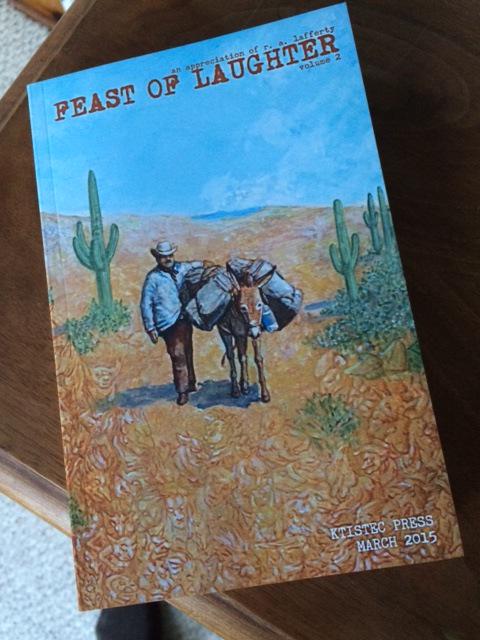
feast-frontFeast of Laughter 2 by Kevin Cheek

My rating: 4 of 5 stars

Fanzines are a new thing for me. But when I was approached about one of the reviews I published here about Lafferty’s collection Strange Doings appearing in the Lafferty fanzine Feast of Laughter, I was happy to oblige. And then when the editor asked whether I had any Laffertesque pieces of fiction that might fit its remit as well, I was even happier. Which is how a contributor’s copy of volume 2 of Feast, “An Appreciation of R. A. Lafferty,” appeared in my mailbox.

And what a fanzine! Feast, which I read from cover to cover is indeed just that: a veritable feast for anyone interested in Lafferty or his works. The table is set equisitely: the magazine is well put together, with a gorgeous cover (which I’ve admired but only just realized the creepy details from the story it illustrates depicted), perfect-bound, nearly 300 pages. As lovely as the front cover is, the back is even cooler: an office cameo of everyone’s hero himself. The only way this magazine could physically be better would be if it came with a tiny duplicate of the legendary Lafferty office door itself.

feast-backAnd then there’s the occasion for the meal itself. What other obscure Catholic science fiction writer could generate three hundred pages of prose (and a bit of poetry) simply because people like him so much? One who inspires a great deal of interest and loyalty among erudite fans and even a bit of emulation. A writer whose work is hard to find, difficult yet rewarding to digest, and almost entirely untouched by the popular press. (But you probably know all that already if you’re someone considered a work like this.)

So what are the courses of the feast? First we have essays. Besides Daniel Otto Jack Peterson, I wasn’t familiar with any of the authors. Some of the essays were compelling, especially those that dove into the allegory and Catholic context of Lafferty’s work. A few were as obscure as some of Lafferty’s own difficult work. In particular, I found Persaud’s “Question: Why? Excuse: Because Monsters” montage a bit inscrutable.

The second course consists of articles regarding Lafferty fandom around the world, particularly in Japan and Russia. The Japanese article was especially useful, as it opened a door into a world of Japanese science fiction with a list of recommended works by Japanese readers who love Lafferty. With Lafferty as a common denominator, this could be a powerful window into exploring the speculative literature of another culture, something that’s always daunting to know how to begin.

Then we get an interview with an early and important Lafferty fan, followed by a section of reprinted essays by greats such as Michael Swanwick. I was a bit lost in the contributions by Knight and Sirignano, which attempted to explain the labyrinth that is Lafferty’s Melchizedek saga, but this will likely be an important resource for someone who has read that work and is interested in deciphering its puzzles.Then come the reviews, and I was by this time so immersed in the meal that I had the simultaneously pleasant and disconcerting experience of turning a page and being surprised to see my own name, having forgotten for a moment that the whole reason I had been invited to this feast was because I had prepared a small dish.

The penultimate course is the Lafferty-inspired pieces, which consist primarily of poetry, though I have a story sandwiched pleasantly between a cozily-gruesome little piece by Daniel Peterson and a haunting story by Howard Waldrop and Steven Utley (yes, that Howard Waldrop, the one who wrote “The Ugly Chickens”). My piece is “What I Wrote for Andronicus,” which was originally published in Ideomancer in 2010. The meal ends with dessert: a reprinted interview with Lafferty himself and a reprint of one of his best known stories, “Sodom and Gomorrah, Texas,” which is illustrated by the fantastic artwork on the volume’s cover.

Then the plates are cleared away. The feast is over. But we’ll gather here again soon. Roll on, volume three.

The Man Who Made Models

The Man Who Made Models: The Collected Short FictionThe Man Who Made Models: The Collected Short Fiction by R.A. Lafferty

My rating: 4 of 5 stars

It’s kind of fun to be part of a renaissance, even if you were late to the party. It’s kind of fun to be part of something gathering steam, spilling open, being rediscovered. Right now, that’s more or less what’s happening to the writings of R. A. Lafferty.

If you don’t know Lafferty, you haven’t been reading my blog long, as I’ve reviewed at least two of his books here already. You also probably haven’t seen the lovely fanzine, Feast of Laughter, which celebrates the man and his work and in which in the latest issue I have a story and review. You haven’t heard there was this really odd guy in Oklahoma writing at the crest of the New Wave in science fiction who was– bizarrely– Catholic, conservative, and curmudgeonly. You’re one of the lucky ones, because you get to discover his work from the ground up.

The collection The Man Who Made Models is the best place to start. I’ve written about Lafferty’s novels before. They are, I would argue, an acquired taste (but one well worth acquiring). It is in his short stories though that his madness and exuberance come in more manageable bits. But these aren’t dainty snacks; even as short stories they’re bloody, quivering chunks of meat you have to unhinge your jaw to swallow.

Part of what makes a Lafferty renaissance fun to be a part of is that Lafferty’s writings are so immense and scattered. Only one of his books is still in print, and his short story collections are treasures for which used bookstores are to be scoured regularly. Many of his later works were never published on a large scale and only appeared in now-vanished small presses. His short stories are spread across decades and lost in a farrago of out-of-print collections, unpublished manuscripts, and copyright litigation. All of which makes this particular collection so exciting: it’s purported to be the first volume in Lafferty’s complete collected short fiction.

And it really is a great place to begin the strange odyssey that is Lafferty, assuming you can sweet-talk your local librarian in getting her hands on it. There’s a fantastic mix of Lafferties in here, though I don’t believe this volume was designed to be a “best of” collection. (My single complaint about this volume is that the editorial afterword doesn’t explain the selection process for this volume. It is not chronological, as the list of original sources at the volume’s conclusion shows these stories range from the 1960s to the 1980s and appeared in everything from big-name magazines to small-press chapbooks.)

Models a pleasant patchwork, but that makes it sound comfortable and cozy. It’s not. It’s a patchwork of monsters. You’ve got stories in here that are among Lafferty’s best and brightest: “The Six Fingers of Time,” “Frog on the Mountain,” and “Narrow Valley.” These are the ones you want someone to read for the first time when you’re trying to explain who Lafferty is any why people get so excited about him.

But when you want to go beyond that and highlight his exuberant monstrosity, you’ve also got plenty of choices here. You have “The Hole on the Corner,” for instance, which I think is one of the best examples of what makes Lafferty tick: the Chestertonian joy of the gruesome, bizarre, and hilarious. There are some that are genuinely frightening, whether that means chillingly subdued like “Parthen” or riotously macabre like “The Skinny People of Leptophlebo Street.” And you have the ones where Lafferty almost goes too far, leaving you with a simmering crackling in your mind, an effervescence that only hints at the things other writers feel they need to work into their stories such as plots or conclusions: “The Ungodly Mice of Doctor Drakos,” for instance, or the concluding work of the volume, “Rivers of Damascus.”

I’m not a literary analyst who can comment eruditely on the philosophical or theological things lurking below the surface of Lafferty’s prose, like some of the contributors to Feast of Laughter. But I want to comment briefly on two of the stories in this collection, because it’s not worth much to an outsider to simply say Lafferty is impossible to classify and leave it at that. Each one of his stories bears deeper analysis, and each one in some way forces eyes and minds toward a world where a multiplicity of options and universes await, something that is often off-putting for those coming to his stories hoping for tidy conclusions and explanations. Things are a bit larger than that here; it’s like waiting for a cloud-scape to fall into its final configuration.

But there are two stories in this volume I especially love. The first is “Days of Grass, Days of Straw,” which is absolutely strange. On first blush this story seems to be an alternate reality tale, in which a man comes to awareness in a “weird western” motif where Indians have a thriving civilization on the Great Plains. This, it is eventually explained, is a “day of grass,” an extra day in the calendar that doesn’t count, as opposed to the ordinary, mundane “days of straw.” Life in the day of grass doesn’t have much narrative structure: the characters eat and talk and make war with buffalo and dance beneath a floating mountain. Simultaneously, in our own reality the characters discuss the nature of these lost calendar days, and Lafferty lists several of them for us, days we’re led to believe he’s lifted from obscurity from half a dozen ethnic calendars. The story ends abruptly with no real conclusion: we’re left with only potentiality, a flicker of wonder around the edges of our own life, and some pseudo-philosophical discussion of time and potentiality. It’s gorgeous.

And then there’s “Thus We Frustrated Charlemagne,” which features– as much of Lafferty’s short fiction does– characters that form a recurring cast of sorts in many of his stories. A group of scientists has achieved the technological breakthrough of sending avatars back in time to alter the past. (One of the best things about reading Lafferty is the way he handles technology. His explanations, which border on the absurd, somehow have aged much better than some of the best “hard science” explanations for fictitious technology.) Each time they alter the past, the world around them is transformed. It’s a trope that’s been explored often in science fiction since, but here it’s as fresh and new and hilarious as an actual real world popping into existence.

That’s much of the deep magic here: new, real worlds. Lafferty’s science fiction is never about making fantasy worlds to replace this one. Rather, he writes to open our eyes to the weirdness and the wonder in this one. The world, Lafferty’s fiction seems to say, is stranger than you can imagine. This one. The one you’re sitting in. It’s going to eat you alive. All of the fantasy– all of the horror and monstrosity and laughter and joy– is just him shaking your shoulders. Shaking them hard. Wake up.

The Violent Bear it Away

The Violent Bear It AwayThe Violent Bear It Away by Flannery O’Connor

My rating: 3 of 5 stars

Why are Catholics so good at making monsters? Our friend Daniel Otto Jack Petersen might eventually have some good answers for us, but at this point– having concluded my audit of the twentieth-century Catholic novels course taught by my good friend Dave (okay, not quite concluded as I skipped Brideshead Revisited and fell off the boat before our final novel, Walker Percy’s Love in the Ruins)– I can venture something along the lines of G. K. Chesterton’s “all is grist.” For the Catholic novelist, it’s all real and it’s all fair game for creation. There aren’t “bad things” off limits. All is useful for building stories, because all– even the dark and twisted– can be redeemed.

But the real, unlike for perhaps an agnostic or atheistic writer, extends far beyond the sanctity of matter to include the reality of the spiritual. Throw all that in the mix, and you get monsters out the other end. For a writer with the bizarre, piercing humor and science fiction tendencies of Lafferty, these monsters become the fleshy, jovial horrors of “The Hole in the Corner.” For the steady eye of Flannery O’Conner in the stagnant heat of southern woods, the monsters take on a stranger and more human aspect.

Because it seems to me that at the core The Violent Bear it Away is a story about monsters.

There are four monsters (five if you count the agent of the sudden, lurching violence of the penultimate scene). The first is the boy protagonist’s great uncle, who considers himself a prophet called by the Lord and who raises the boy to know the Lord’s work in a splendidly wild and woody isolation. His death at the beginning of the novel initiates the book’s plot. The second monster is the boy’s uncle, who considers himself the rational antithesis to the old prophet’s madness and who, when the boy finds his way to his doorstep upon the prophet’s death, sees the possibility of freeing the boy from the prophet’s mad shadow.

The third monster is the boy himself, who drinks himself to a stupor upon his great uncle’s death, refuses to bury his body, and instead burns down the home in which they lived before wandering into the city to find his uncle. It is this monster’s stubborn battle to resist both the compulsion to carry on the Lord’s work placed upon him by his great uncle and his “rational” uncle’s frenzied effort to reform him that forms the primary tension of the novel. The boy is taciturn, isolated, arrogant, and desperate to live out his denial of his great uncle’s holy legacy.

All these characters are monstrous, twisted, and unpleasant to observe. And yet O’Conner pulls us along with them. We are captivated by their misery, by their mutual hostilities, by their failure to accept any sort of redemption from each other.

And then there is Bishop, the fourth monster, the son of the boy’s uncle. Bishop is a child, an idiot “waste,” who can do nothing but follow along innocently– uncomprehending and unconcerned– as the boy fights against his great uncle’s imperative to baptize Bishop and his uncle’s determination to break him of this compulsion. Bishop is the pathetic eye of the storm and the focus of the only genuine moments of pathos and tenderness in the novel.

This is an Old Testament story, and the god looming on the horizon of the boy’s mind is a god of blood and fire and fury, despite metaphors of the bread of life– that tired, stale bread the boy refuses to eat. As with Graham Greene’s Heart of the Matter, the conflict here is primarily in the mind of the boy, but this makes it in no way less real. It makes it instead more tight and tortured. And it makes it all the more terrifying for where it leads.

This is not a book to read for pleasure, unless of course for the simple pleasure of reading good writing. For the story itself, the only pleasure might come in assuring yourself how far your god is from the dark and stormy god of the warm, stagnant forest and how far you are from the pathways of the boy’s own mind– until, of course, you actually read the Old Testament and are forced to ask yourself how thin the line between madness and holiness might really be.

First Fleet #booktrailer

https://www.youtube.com/watch?v=HXS_WLYBm3M

So this is exciting. The folks over at Retrofit Publishing have rolled out the book trailer for my serialized novel, First Fleet. Give it a look! It’s cool enough it makes me want to re-read it.

Part 3, Descent, will be released April 1st and is available for pre-order on Amazon now!

First Fleet

FirstFleet1b

I’ve dropped some hints before, but here’s the official blog unveiling: the first two installments of my novel, First Fleet, are now available through Retrofit Publishing!

Go to there! See it! They’re doing some pretty exciting stuff over there, and I’m humbled and delighted to be a part of it.

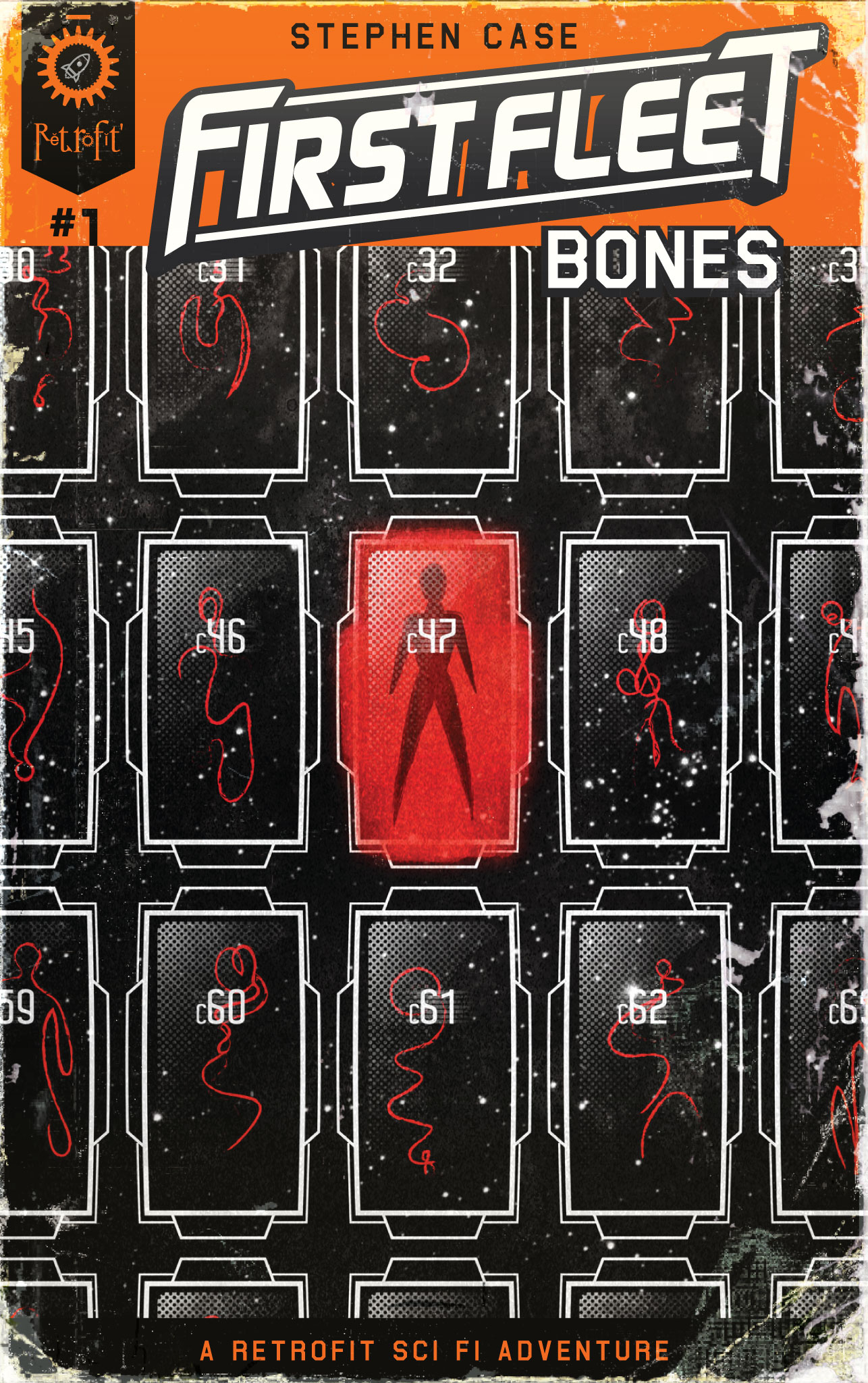
What business have I, you ask, who have never ventured beyond the short story or occasional novella, in writing a novel? I place the blame solely on the shoulders of my editor, who liked one of my published stories enough to contract for a novel based on the premises I started exploring in that first bit. And that first bit, retitled Bones (the awesome cover of which you see above), appears now as the teaser/intro to the novel proper, setting the stage and presenting the initial mystery of the First Fleet. The tone is Lovecraftian horror in space. The plot involves technology used to regenerate soldiers in a war going suddenly very badly.

You can (and should) download Bones. It’s free, and you can get it direct from the Retrofit website or from places like Amazon or Smashwords.

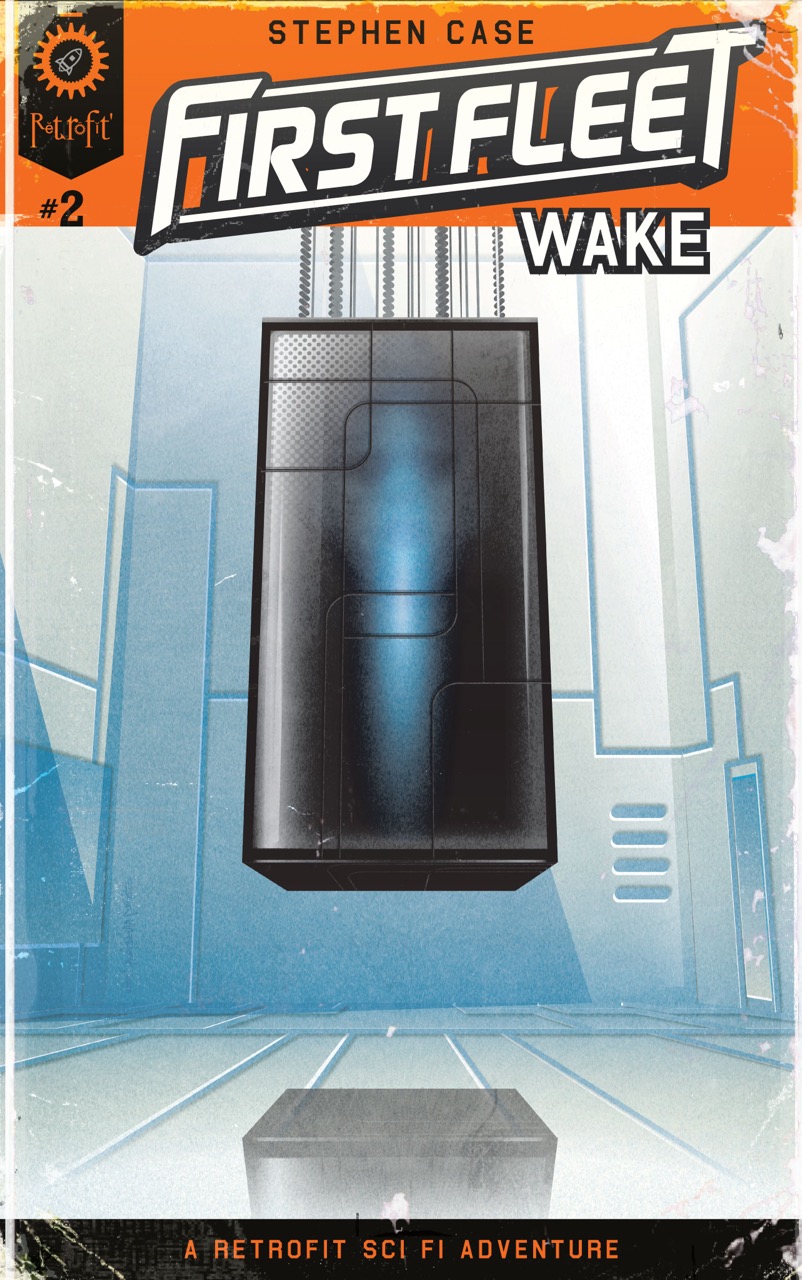
Wake (cover below) is the first installment of the novel proper, which follows the narratives of two women who get entangled in the mystery of the Fleet. I had a lot of fun building these characters and these worlds, as well as the technological systems that support them, and sending them off to solve the Fleet’s mystery. (I talk a bit more about the plot in a recent blog post at Retrofit.)

Besides the process of writing the novel itself, I’ve been blown away by how Retrofit has marketed and promoted this. The editing and formatting has been top-notch, and seeing the covers they designed (capturing perfectly the “old timey” pulp feel of the paperback novels I grew up reading) has been among the coolest parts of the process.

Take a look at the first two installments if you get a chance. If you’re a reviewer and you want a review copy of Wake, please let me know. It’s pulp scifi– with all the pulpy goodness of aliens, catastrophe, military espionage, and space ships you’d expect. If you’ve read my other pieces, you know short-form fiction, veering toward fantasy realism, has been my forte so far. This was an exciting and rewarding (and challenging) departure.

Descent, the second portion of the novel, is done and is due out in April. And I’m working on final edits to the third portion, tentatively titled Memory, as we speak.

Or I will be, as soon as I post this.

And maybe bathe the kids.

FirstFleet_Cvr2b

Drying Grass Moon

case2

Last week was a good one as far as publication go, as I had two stories go live in two different online magazines. The first appeared in AE: The Canadian Science Fiction Review, a quarterly magazine in which one of my previous stories, My Bicycle, 4500 A.D., appeared a few years ago. One of the cool things about having a story in AE is that each one is illustrated, so I get the treat of seeing how an artist interprets what I had to say. (The illustration above is by Al Sirois.)

I wrote “Drying Grass Moon” on a sleepy Sunday afternoon, which is when a lot of my writing seems to take place: sitting in bed with the kids playing upstairs and my wife napping beside me. Like many of my stories, it was based on a fragment I had sketched out in one of the voluminous free-write files that I try to keep regularly with varying degrees of success. The title itself, an old Native American (I think) designation of one of the full moons, had stuck in my mind. I wanted to play with that image, imagining settlement and abandonment on the lunar surface.

One of the challenges was trying to write about the passage of time on the Moon, about what that would actually look like. The Moon is tidally locked with the Earth, so the Earth remains motionless in the lunar sky. Your location on the Moon determines the Earth’s position in your sky, and that position does not vary over the course of the month-long lunar day. The Earth would, however, go through phases in its fixed spot in the sky. I wanted those realities to be the background of the story, as well as the developing reality of exoplanetary discovery and how that might transform the way we view human expansion into our own planetary system.

The twist in the story is about old age, youth, companionship, and– of course– sexbots. I’ll let you tell me whether or not you found it effective. Read “Drying Grass Moon” here.

Does Anyone Else Have Something Further to Add?

Does Anyone Else Have Something Further to Add?Does Anyone Else Have Something Further to Add? by R.A. Lafferty

My rating: 3 of 5 stars

Gene Wolfe has said of writing short stories that it is not enough to simply show people your ideas. He uses the analogy of a lion-tamer. A writer can’t just say to people, “Hey, look at this lion” and expect them to be impressed with her skills at showing them a lion. A writer has to do something with the lion, preferably something daring and unexpected. Wolfe says that the writer has to put her head in the idea’s mouth.

For me, that is the most difficult part of writing. Often I simply want to show people my ideas– an interesting imaginary place, for instance, or a character or device or image– but finding that narrative twist and plunge that makes the idea spark and come alive as a leaping, writhing story is something very different.

As important as Wolfe’s advice is though, I don’t feel like his requirement applies to R. A. Lafferty. There are in his stories– and specifically in the stories of this volume– rarely those unexpected twists that make you feel as though the bottom has fallen out of the narrative. In many of the stories that make up this collection, a reader can feel the end coming, can get a sense for the ultimate trajectory of the story, within the first few paragraphs. Part of this is because Lafferty does not craft those literary artifacts called short stories. Instead, he tells fables, and most fables have been told in some form before. But I think there’s also something deeper going on here with Lafferty and Wolfe’s lion-tamer analogy.

To return to Wolfe’s image, Lafferty does not need to stick his head in the idea’s mouth. Lafferty is the lion-tamer, but he’s a lion-tamer saying, “My God, it’s a lion. No, you haven’t ever really looked at a lion before. And you haven’t seen a lion like this. Look at it. This is the lionest lion that ever lived; this is the Ur-lion.” And then the lion– which, you realize, is indeed wilder and more savage and yet more merry than any lion you’ve seen before– rips out the lion-tamer’s throat and eats it with a wet chuckle, and both lion and lion-tamer have a good laugh together because that’s what lions are and that’s what lions do.

The story “Golden Trabant” in this volume is a good example of this approach. Narratively, the story is incredibly simple and has indeed been told many times before: a man discovers the El Dorado of asteroids, a rock not far from Earth formed completely of gold. What happens next? Exactly what you would expect. Pirates lay claim to it and become fabulously rich. Earth’s economy becomes unbalanced by the sudden influx of off-planet gold. The pirates build a kingdom with their new gold, sail the high skies hauling back their treasure in ship-loads, and ultimately turn each other. The asteroid becomes an irradiated waste haunted by a ghost. It’s every lost treasure story you’ve heard before with only the (now-blasé) element of being set in space. Maybe that was a new wrinkle when Lafferty wrote it, but beyond that there’s no unexpected twist that makes the story leap up out of the page like a living thing.

And yet it’s a fantastic story. Like so many of Lafferty’s, it simply works. The whole thing is alive. This is the case with many of the stories here. In some, it’s unclear what exactly is happening or has happened, plot-wise. “About a Secret Crocodile,” “Nor Limestone Islands,” and “Boomer Flats” are examples of this. “Boomer Flats” and “Maybe Jones in the City” in particular I found a bit frustrating, but the richness and jollity of Lafferty’s tone always wins me over eventually, even when they seem spun around nothing. If the bones of the story are a bit hollow, you still get Lafferty telling them. And that’s what you want. I’m convinced that had Lafferty taken it upon himself to re-write a phone book, it would be fun to read.

To be fair, there are stories with twists. There’s one at the end of “In the Garden” and “This Grand Carcass Yet” and “The Ultimate Creature.” “The Weirdest World” is all twist, and it may be one of the funniest Lafferty stories I’ve read yet. But the twist is secondary; the story is not built around it. And you probably saw it coming anyway. Moreover, the twist is usually twisted: this is a volume that highlights Lafferty’s brutal, grotesque humor, which is especially ripe in “This Grand Carcass Yet,” “Pig in a Pokey,” and “The Ultimate Creature.”

An annoying and puzzling (though easily ignored) feature of this volume is the needless division of the stories into those related to “Secret Places” and those about “Mean Men.” The stories in this work alternate back and forth between these two headings. In my edition of the book, this is even reflected by stories under each division having a differentiating font. Lafferty (not surprisingly) offers no explanation for this division, but it’s unlike Lafferty to offer much explanation for anything.

The reason the division doesn’t work though– or at least seems unnecessary and arbitrary– is that all of Lafferty’s stories are in some sense about secret places, and they’re all in some sense about mean men. They’re stories about the hidden, real world lurking just below the skin of this one and about the god or the devil lurking just below our own skins. That’s why their twists aren’t wholly unexpected: we feel them in our bones. We catch hints of them when we we’re not asleep.

If you’re new to Lafferty, this is as good a place to start with him as any. It’s hard to know what angle to approach his writings, but wading out into his short stories and learning how they rise and fall is easier than diving into one of his novels. Because, to be fair, you might not like his bright and bloody world. You might not want to get too close to that lionest of lions and hear its throaty chuckle. With his short stories, it’s easier to run away.