Tag Archives: science fiction

Strange Doings

Strange DoingsStrange Doings by R.A. Lafferty

My rating: 4 of 5 stars

According to certain interweb sources, R. A. Lafferty is making a comeback. There are several new (and very well done) websites dedicated to him and his work, a new journal just in time to celebrate his 100th birthday, and (finally) a series of his collected works that might make it incrementally easier to read some of his stuff that’s been out of print for years. Though not much easier. That first volume of his collected works, for instance, is published by a specialty press and is already out of print. It’s so difficult to get one’s hands on, in fact, that even my heroes– the interlibrary loan librarians at my university– couldn’t get me a copy. Instead, they found a few early Lafferty collections for me to read.

Lafferty shines brightest in his short stories. His romping, boisterous, almost drunken exuberance comes across better in these than extended across an entire novel. I’ve read plenty of Lafferty novels, but they’re more of an acquired taste. You have to go into them knowing what you’re going to get and prepared to weather the storm. Because Lafferty’s novels are like riding out the storms at the core of a gas giant: there’s a good chance diamonds are going to be falling, but there’s also a good chance you’re going to get turned inside out before it’s done.

His short stories are a bit easier, not because they’re more muted or less powerful but simply because they don’t last as long. What is it about this guy? He’s not simply a science fiction writer, though he has plenty of stories about humans on new worlds. He’s even less a fantasy author, though there are fantastic elements in almost all his stories. What he is, is a story-teller. He’s someone who tells tall, sweating, shambling, horrifying, and beautiful stories– who tells stories like they used to be told when the world was a lot younger– and at the time he was writing it was only in the fantasy and science fiction and horror pulps that stories like this still found a home.

The pieces in this particular volume seem to cluster around a theme. They are stories of breaking out, of some new, larger reality breaking into the world. They’re stories of superhuman genius (“Rainbird,” “The Man with the Speckled Eyes,” “The Transcendent Tigers,” and “Aloys”) and of making contact with transcendent creatures or transcendent places (“All but the Words,” “World Abounding,” “Entire and Perfect Chrysolite”). Lafferty writes stories of phase transitions, of tipping points, of new or unseen (and sometimes horrifying) worlds breaking in on this one (“Continued on Next Rock,” “Once on Aranea,” “Sodom and Gomorrah, Texas,” “Dream”). They aren’t always the most narratively dense or developed; they don’t necessarily have tight plots or stunning plot twists. What they all are, however, are huge, rollicking yarns told in Lafferty’s unmistakable voice.

And this is what makes them work. There is a grotesque jollity about Lafferty. For him, the world is a bloody, beautiful, terrifying place– but never simply grim or grey. He is more than a little drunk on the world. This is a huge, holy brutality similar to but rowdier than Chesterton and far less tidy than the subdued mysteries of Borges. Wolfe has this in flashes, like shots of light through his stories’ elaborate puzzles. But in Lafferty it’s all there on the surface, naked and undistilled.

If you want to hear Lafferty’s language, head over to Daniel Otto Jack Petersen’s blog, where he regularly lays out slabs of Lafferty prose in all their bloody, dripping glory for passers-by to admire. Besides his language, Lafferty has a strength in creating characters, but his characters are like his stories– super-humans, larger than life, more alive than alive. I’m reminded of the sort of things people say about van Gogh, that he saw colors more vibrantly than other people. When I read Lafferty’s stories, I can’t help but wonder: is this how he saw the world? Is this how he saw people? It’s as though someone was living as Chesterton wrote in Manalive, with a certainty that the world was more gruesome and deep and joyful than could be properly grasped. There’s nothing slow or sedate or studied in his character sketches.

The stories that are the most effective in this particular collection are the ones that attempt the least. “Rainbird,” which opens the volume, tells the story of an early American inventor and the way he did– or did not– shape the modern world. It has all the pieces of Laffertian excellence in an easy-to-swallow morsel: the language that takes an obvious delight in lists and the bright mundanity of the workshop in all its sawdusty glory, the hint of the fantastic and the ease of the impossible that makes the entire, simple time-loop drama shine. And then there’s “The Ugly Sea” near the volume’s end. Again, something as simple as a tale of how a man falls in love with a woman and with the sea– and yet nothing could be more significant. This is what Lafferty does. He tells stories, but they are the stories that live down deep in the bones of the earth. He’s a grave-robber, and he does it all with a deep-throated laughter and terrible bright eyes and words that are thick with soil.
Europa Report

EuropaI grew up in the generation after the golden age of manned space exploration. I never watched the Moon missions. I never held my breath as humanity first ventured into space. Was that terrifying to watch on television? Certainly the drama in events like the Apollo 13 mission must have been electrifying. But the explorers of my generation are primarily robots: intrepid Martian rovers and lonely orbiters. Landers on comets a hundred million miles away. We see new vistas, certainly, and dream big dreams, but the human element is often somewhat lacking.

It doesn’t necessarily have to be this way, Europa Report eloquently demonstrates. This low-budget, independent science fiction movie illustrates two things. The first is how close the high drama of true human discovery still waits beyond the horizon. The other is that it doesn’t take a studio powerhouse to bring this to life.

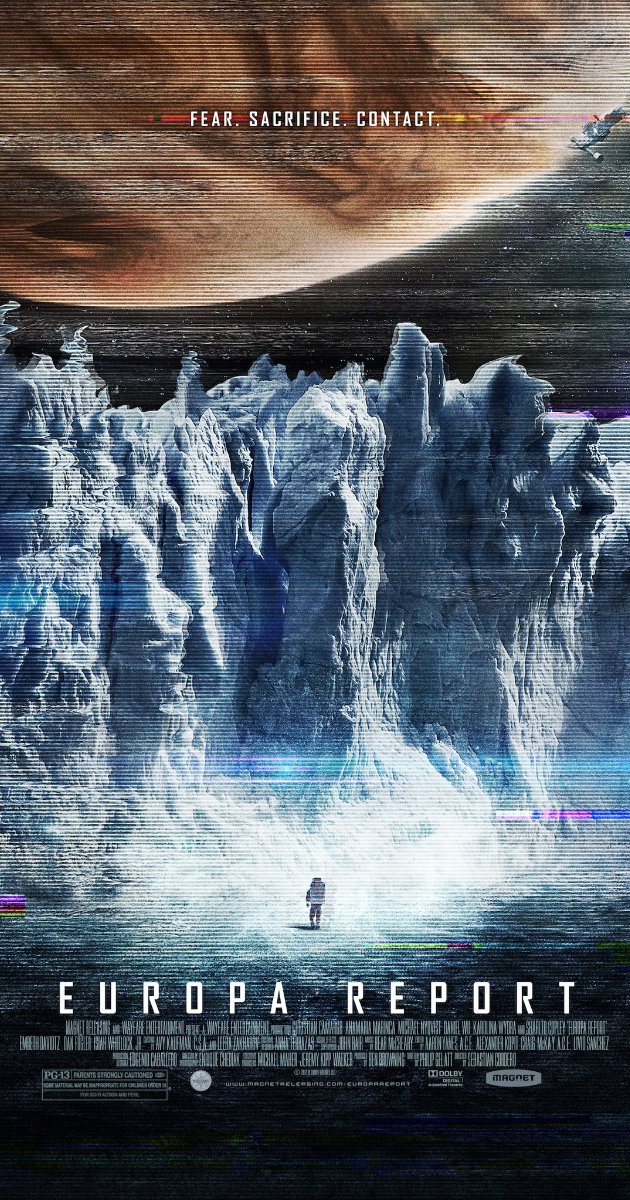
Europa Report is a story set in the near future chronicling the first manned mission to Europa, one of Jupiter’s large moons and today in truth assumed to be the most promising location for finding life in the solar system. The story is told in the form of found footage and interviews, a bricolage of believable glimpses into the life of the six astronauts living aboard their vessel on its twenty-two month voyage to Jupiter. They have been sent because scientists on Earth have (again, very believably) found strong evidence for the possibility of life on Europa. A private venture has funded the mission—humanity’s first voyage into deep space since Apollo—to ascertain whether or not there are microscopic organisms living beneath the moon’s icy surface.

The story is believable enough that at times I had a hard time separating the science from the fiction. It’s an image of a possible very near future, and there’s no wildly unbelievable piece of technology or contact with alien intelligence that pushes this movie firmly into the realm of the unbelievable. This could be us in a handful of years. There’s great effectiveness in this narrative humility. No epic story arch. No shaking camera angles. No impressive and overwhelming CGI explosions. This is a story about simple wonder and exploration—and that it’s never quite that simple.

Soon into the story it becomes apparent that something has gone wrong. One of the astronauts is killed, and the mission loses contact with Earth. The pieces are filled in as the story continues, but the survivors are faced with deciding whether to carry on and complete the mission. How far are they willing to go, they must ask themselves several times throughout the film, in answering the question of whether life exists elsewhere in our solar system?

You’re not going to find killer aliens or stark insanity or creeping terror here. This is not a psychological space-horror or Lovecraftian tale of unfathomable alien intelligences. There are certainly moments of terror, yes, and an effective story that keeps you guessing until the very end. (There’s a particularly effective twist that upends what you think you’re seeing and who you think survives near the end of the movie that’s expertly done.) The backdrops to the action are the ominous, gorgeous approach of Jupiter through the ship’s windows as the characters continue their voyage. It’s awe-inspiring in a slow, subtle way, a reminder of just how huge these objects are, how vast the distances, how audacious the hubris to venture out on that emptiness.

I loved Europa Report because it was simple. It was a terrifying and exciting drama of discovery against the immense and unforgiving background of space. The cramped confines of the ship were held in a steady, tight contrast with the emptiness through which they traveled, and these were both balanced against the bleak vista where one might find life sheltered against the void. The actors (no big names that I recognized) played the role not of heroes or villains but explorers, with all the shades of heroism and failings that this entailed.

The ending left the door wide open, not in the sense of dangling more mysteries to spin out a sequel (there was definitely resolution) but in the way that the sky remains open: there is more to discover. There is much more to know. In this respect, Europa Report felt like a throwback to the golden days of science fiction in the very best way possible.

My grade: A

Snowpiercer

SNOWPIERCER_LE-TRANSPERCENEIGE-Affiche-def

If Snowpiercer feels a bit one dimensional, that’s because it is. It’s linear, with a plot as streamlined and direct as a bullet train. But that’s exactly the point. The action is telescoped down to the length of a single train carrying the only survivors of the human species on an endless loop across a frozen landscape. Snowpiercer takes this claustrophobic setting and uses it to tell the story of revolution, a Great Train Robbery where the prize to be won is control of what’s left of the human species.

The background: in the very near future a failed experiment to reverse global warming has resulted in a deep freeze of the entire planet. The only survivors are the passengers of a luxury train with a perpetual engine that ceaselessly travels a worldwide circuit. The train is a closed, self-sufficient system. Seventeen years into the voyage a strict hierarchy between the cars has developed, with the first class passengers living in luxury and worshiping the benevolence of Wilfred, the designer and conductor of the train that sustains them, while the passengers in the rear cars live in squalor eating with children occasionally abducted by the crew of the front cars for unknown purposes. Conditions are, of course, ripe for revolution.

The effectiveness of the movie arises from its linearity. It’s set on a train. There’s nowhere else to go but back toward the rear or up toward the engine. The protagonist is Curtis, a man who leads a revolt to take control of the engine by pushing forward, car by car. This is a familiar motif if you’ve watched pretty much any western ever (or Back to the Future III), but here the difference is the surreal transformation, the slow blossoming of color, as the revolt surges up the train and moves from cars of industrial grime to bourgeoisie opulence. A heavy stamp of the movie’s origin in graphic novel format remains, especially in the elegantly brutal fight scenes when the rebellion reaches its first major obstacle (brutal because bullets are supposedly extinct on the train, so spears, bludgeons, and axes are the order of the day).

When I first heard the premise of this movie with its not-so-subtle commentary on social hierarchies, I assumed the movie would feature a somewhat more metaphysical (or at least futuristic) train that literally circled the entire world. I imagined the revolution was going to end with the realization that there was no front or rear to the train, that the characters would continue passing through a long series of cars only to eventually arrive back where they started from. There might even have been an analogy somewhere in that about the lowest classes themselves being the engine that drove society. Spoiler alert: that’s not what happens.

This is an actual finite train, with a front and a rear, but the revelations Curtis experiences when he reaches the engine are far from unexpected. In fact, the astute viewer has probably figured them out pretty soon into the movie, with the first clues that perhaps this rebellion is not as spontaneous as its participants would like to believe. For most of the movie it feels as though the questions Curtis wants answered are what’s driving the plot, but when those answers are finally given, you realize they’re not really what you wanted anyway.

In retrospect, the engine that actually drives the plot is justified outrage. Any subtly that could have been explored on the side of the train’s crew—embodied in Ed Harris’s portrayal of Wilfred and Tilda Swinton’s wonderful depiction of the minister (probably the best character portrayal in the movie, priceless in her initial speech to the inhabitants of the rear cars)—has to be overplayed with brutality to convince the viewer just how justified this revolution is. The plot skirts around legitimate discussion of how disciplined and carefully managed life on a self-sustained train would actually have to be to instead focus on how heavily-handed this discipline is carried out so sympathies stay firmly with the protagonists. There’s a lot of grey here that could have been explored. As it stands, the moral basically turns out to be something like: don’t be a dickish train manager.

The most powerful reveal, in my opinion, was the stuff that happened seventeen years before the story begins, as Curtis makes his confessions to his last surviving companion at the entrance to the engine car. There are themes of true self-sacrifice here amidst painful brutalities that offer some of the film’s most devastatingly effective lines. Yet all of that is in the past, and we get it here only to better understand why Curtis hates Wilfred so much—in a word, to keep fueling our justified outrage, which at this time might be dulled by seeing what life on the train actually involves.

For an excellent example of a movie that sets itself up perfectly for the sort of action it wants to depict—focused and linear along the length of a train—Snowpiercer is a success. The action is gritty and believable and beautifully orchestrated. The plot is fast with plenty of twists and bumps. As far as social commentary, an analysis of class relations, or apotheosis as god killing, it doesn’t do quite as well. The sermons are too predicable, the moral too pat.

My grade: C

Some spoiler thoughts regarding the end of the movie: Are we really to believe the train didn’t have any way of measuring external temperatures? And if it did, what do we make of Wilfred’s motives for keeping everyone trapped on the train?

And the final scene: I get the feeling, especially with the way the plot played with snow and Inuit heritage, that we’re supposed to find the shot of the polar bear hopeful and optimistic: life persists. But seriously? We have two kids standing in the wreckage of a train, face to face with one of Earth’s most effective predators. How are we not supposed to read this as hopeless?

Trees and Other Wonders

castle version

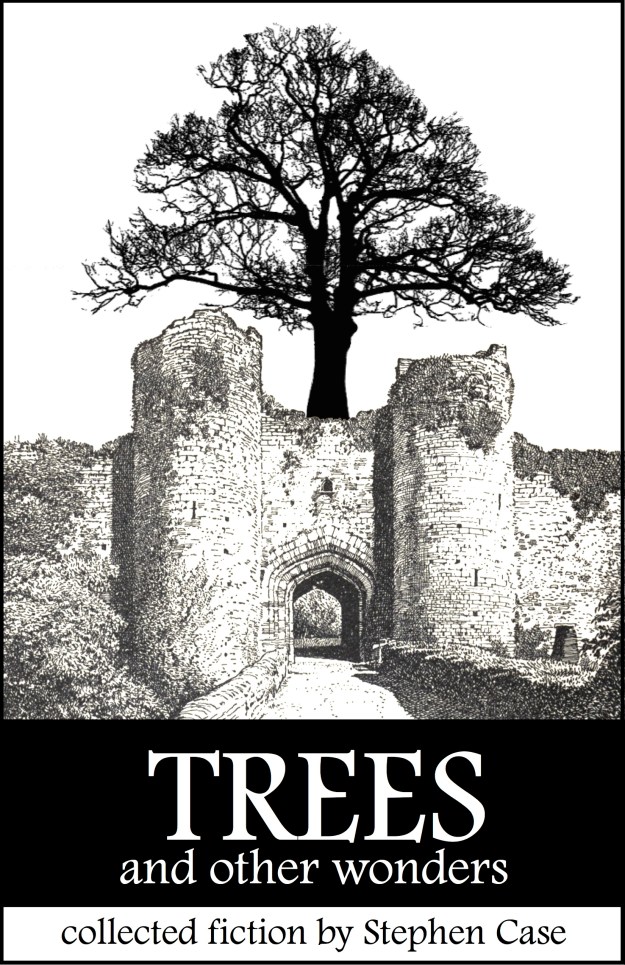
After I had published ten stories in various print and electronic magazines– at least one of which was published on another continent and many of which were quickly out of print– I figured I’d collect them all and try my hand at an anthology. Here they are. Ten of my published pieces from 2008 to 2013, along with two unpublished stories that I felt were worthy of inclusion. This was my experiment with electronic publishing. Currently the work is only available on Kindle, though Kindle as a platform can be downloaded for free on pretty much any operating system. A few people have asked me about getting a print copy. As of right now, I haven’t spent enough time on Createspace to get one worked up, and I haven’t been very pleased with the quality of the print-on-demand books I’ve seen. I did the cover myself and had fun creating an afterword explaining a bit about each piece. I haven’t gotten much feedback, though there are a few nice reviews on Amazon. The one print review I garnered was published in the Australian magazine Andromeda Spaceways Inflight Magazine. I thought it said some pretty nice things, which I’ve quoted below: “There’s a richness of the imagination here, a calmly-measured pace, a solidity. . . . There’s a vivid quality to his writing, and an underlying ability to evoke wonderment at the worlds or tableaux pictured within these pages. There are echoes, too, of a Golden-Age-anything-is-possible kind of sensibility to many of these stories. . . . Case has produced a collection in which almost every story reads like a fable, the moral of which is a secret the reader may hope to discover before the end. There’s an easy acceptance of the fantastical, a hint of the impossible.” I like that. If you’re interested, you can get a copy here.

Sword and Laser Anthology

Sword & Laser AnthologySword & Laser Anthology by Veronica Belmont

My rating: 4 of 5 stars

Please, judge this book by its cover. Because it is such a wicked cool one. And in this case, it’s a good indication of what you can find inside.

Sword and Laser is a “science fiction and fantasy-themed book club, video show, and podcast,” featuring Tom Merritt and Veronica Belmont, the editors of this anthology. The anthology itself consists of twenty stories split between “sword” (fantasy) and “laser” (science fiction). It is, as a good anthology should be, a hodgepodge, rough-and-tumble collection of stories with as many polished faces as jagged edges, sparking with ideas and a lot of raw enthusiasm. Its aim is showcasing new voices in the science fiction and fantasy community.

The enthusiasm is indeed palpable and refreshing. I suppose that’s what happens with a choir of fresh, new voices. Not every story is fantastic, but many are. And the beauty of an anthology is that each reader will likely differ about which stories to put within each category. If you’re a science fiction and fantasy fan, you’ll feel like you’re in a room with a bunch of friends. And they’re telling their best stories.

The ones that stood out to me were by writers who obviously know how the genre works and can have fun with it. In this vein “Partly Petrified” by Auston Habershaw, “The Same International Orange” by Luke R. Pebler, and “Honeybun” by Austin Malone were fine examples. “Honeybun” in particular I thought was a good representation of a lot of this anthology: potential. The bones of some excellent ideas that, perhaps catalyzed by inclusion in this anthology, could spiral out into something deeper and bigger. In this respect, the cover of this work is truer than perhaps anticipated: like the shelved world-bubbles in the image, there are a lot of seeds planted here.

There are glimmers of deeper waters as well. Perhaps because I’m in the midst of stitching together the bones of my own deep space endeavor, my sympathies in this anthology leaned toward the “laser” end of the book. The concepts in “Jonah’s Daughter” by Adam Callaway, “False Lights” by Victoria Hooper, and the very strong finish to the volume, David Emery’s “Only Darkness,” sounded the depths of the weirdness and the wonder that makes great science fiction shimmer.

Then there was my piece, “How Fox Fixed the Sky,” nestled in the final half of the “sword” section. It’s a fablesque epilogue to the story of Chicken Little. What if Chicken had been right and the sky was really falling? What if Fox made a knife from a fallen fragment of sky? What if he climbed through the hole to see what was beyond? I’m probably borrowing tone from Miyazaki, but Fox’s character was put to paper before I ever saw The Fantastic Mr. Fox (though if Miyazaki were to animate this story, Clooney would be a great voice for Fox). It’s surrealist and fun, maybe even a bit haunting, and if you pick up this book I hope you like the bit I contributed.

As far as I know, the anthology isn’t yet available for general purchase. I think it’s gone out to the contributors and the folks who backed Sword and Laser’s next season via Kickstarter. Check back here for updates though, because as soon as I know how you can get your hungry mitts on a copy (besides coming over here and borrowing mine), I’ll let you know.

UPDATE: Sword and Laser Anthology is available for purchase (electronic or traditional format) here. Buy a copy! Support fledgling writers and good science fiction! If you buy a paper copy I’ll promise not to drive its value down by trying to sign it.

The Land Across

The Land AcrossThe Land Across by Gene Wolfe

My rating: 3 of 5 stars

Gene Wolfe won my undying devotion by being the author of the books that pushed me across the borderland from science fiction and fantasy to literature. (There’s no hard and fast border between the two. It’s a spectrum, but when you start reading Wolfe you realized you’ve definitely wandered– or plunged– into the literary side of this spectrum.) The Fifth Head of Cerberus, Peace, and all of the Sun books are enough to cement his reputation, and they remain among my all-time favorite books. Yet the man is still writing, and I’m still obligingly reading everything that comes from his pen or whatever word-processing software he uses. The Land Across, a standardly (for Wolfe) unclassifiable novel that straddles the boundary between crime mystery, international espionage thriller, and supernatural fantasy, is his latest.

I’ll be honest, some of his most recent stand-alone novels seem like they could be a bit inaccessible to someone not familiar with Wolfe and his tricks. I come to them with a predisposition to love the writing and the writer. Even so, I left An Evil Guest with a confused frown and The Sorcerer’s House with a wry sigh. I closed The Land Across with a perplexed grin. It was nowhere near (to me) as impenetrable as Castleview (for which I lack the Arthurian key). Of all Wolfe’s novels, the one of which it reminded me the most was There Are Doors, but with the soft alienness of a foreign country instead of a parallel dimension. (I also recall Doors as having lots of conversations in cafes, as does Land.)

On the surface, the plot is not straightforward at all. In fact, it’s bewilderingly complex. The main character, Grafton, wants to write a travel book about an unnamed and difficult-to-reach Eastern European country. While traveling there by train he gets picked up by the border patrol and arrested as a possible spy. Under a loose sort of house arrest, he agrees to rent a (probably) haunted house in which there is reputed to be treasure. He gets kidnapped by an underground revolutionary movement and eventually arrested again by the country’s secret police. When his cell-mate escapes, the secret police enlist Grafton to help track the man down. The escapee seems to know some magic, and a secret society of Satanists gets involved. Mysteries are solved. Long conversations are held in cafes. Women (who, married or not, seem to throw themselves at the narrator) are obligingly slept with. Grafton gets awarded a medal by the country’s dictator. Then he goes back to see if he can find the treasure in the haunted house.

If all that seems rather random and scattered, it is. But the genius of Wolfe’s writing is the way he makes it all seem natural. There are aspects of the supernatural and the surreal, but as with most of Wolfe’s writing these aspects are subtle and the bones of the story are the people and the conversations they have. Wolfe is the only writer I know who can create what seems like an action-packed novel but where most of the action is actually taking place in conversations over cafe tables. He is a master of relaying dialogue the way it actually occurs in conversations. People talk like real people in Wolfe’s novels, with all the logical leaps and half-understood or misunderstood transfers of information that this normally entails. The challenge is that Wolfe doesn’t put you in the narrator’s head, so you’re required to make the leaps and conclusions on your own. The narrator might throw you a clue, but for the most part he assumes you can keep up.

I was left, as I so often am after reading Wolfe, with the feeling that there was a lot more going on in the novel than I figured out. Even though, as far as Wolfe novels go, there was a fair degree of closure. There are lingering puzzles: the jarring and dream-like way in which Grafton was first taken off the train at the beginning of the novel, the unnamed lady he meets a few times and then exits the narrative with, and finally the ghostly figure of the Leader himself (as well as Vlad the Impaler) that haunts Grafton throughout the story. But these aren’t large enough or central enough that their mystery detracts from feeling as though I’ve understood the story at all. (Though, with Wolfe, you can’t get away from the feeling that he’s laughing at you because the real story, the secret story taking place in the sewers beneath or the back alleys behind the narrative hinges on solving these lingering mysteries.)

Wolfe’s novels should be read multiple times, ideally immediately after having finished it for the first time. But I am still a bit of a lazy reader, so I was pleased The Land Across did not immediately draw me into a story of tangential pathways and dizzying divergences like Abel’s quest in the Wizard Knight books. Indeed, once Grafton fell in with the secret police, the “case” of solving where his escaped cellmate was and finding the identity of the head of the secret Satanist cult formed a more or less consistent thread on which the novel rested. And this thread was, at least superficially, resolved.

Starlight, Her Sepulchre

Light_and_Shadow_in_the_Carina_Nebula_-_GPN-2000-000880

I wrote a scary story once. I was trying to write a Lovecraftian science fiction piece for an anthology called (wait for it) FutureLovecraft. But it wasn’t a very good story. It was an interesting idea with a weak ending. It got a lot of deserved rejections. Then I sent it to TMPublishing, a Christian publisher that is now (judging by its dead website) unfortunately defunct, for consideration in their Emerald Sky magazine. The editor there liked it enough to ask me to make it better, which I think I did.

That’s what good editors do: they make you look hard at your story and dig out the twist that was lying in wait the whole time. “This technology you introduce,” the editor told me, “it needs to have a more pivotal role in the resolution of the plot.” So I threw out the ending and tried again, and then the story bucked and kicked in my hands and I saw the twist. It involves tissue regeneration and memory downloads and– because it is, after all, Lovecraftian– ancient and horrifying evils from the dawn of time.

I like it, and, from the comments I’ve gotten, many of my (albeit few) readers have liked it as well. Space is dark and scary, and I think I’ve captured a bit of that here. You can read “Starlight, Her Sepulchre” here.

My Bicycle, 4500 A.D.

Print

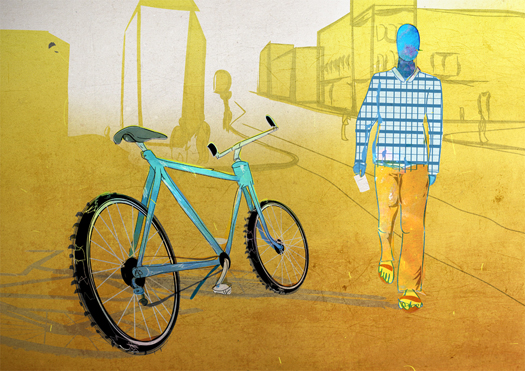
A couple summers ago my bicycle was stolen. It was my own fault. I left it unlocked outside my office. I had owned that bike since before I had a car, and I mourned its passing with this story, which involves time-travel and (a first for me) zombies. It appeared (with the lovely illustration above) in the Spring 2012 of AE: The Canadian Science Fiction Review.

You can read about my bicycle here.

The Story of the Ship that Brought Us Here

51cover_229_317

This was my second honest-to-goodness-physical-magazine sale, again semi-pro and this time in an overseas market. Andromeda Spaceways Inflight Magazine is (from what I understand) a leading science fiction magazine in Australia. It is certainly a quality rag that, like Shimmer, takes seriously putting together a professional publication with lovely covers and illustrations, thick and perfect-bound.

They’re also great because they published a review of my anthology, of which more anon. (I have a secret desire to become a huge hit in the Australian speculative fiction world so I have an excuse to travel there and sign books and explore. My Australian career hasn’t quite taken off yet.)

“The Story of the Ship that Brought Us Here” was published in issue 51 of Andromeda Spaceways, back in June of 2011. (You can still purchase the issue here.) It was my first story that featured an illustration, which meant that an artist actually had to read it and then depict what my brain was imaging when I wrote words. That is sort of fascinating for me. I think the artist did a pretty good job, even though I imagined the Princess with fewer tendrils.

Science fantasy is a sub genre in which technology is so far developed that it seems like magic and in which authors spend more time playing with the effects (often largely aesthetic) of such technologies than puzzling out how they might actually work or their implications. That’s what I do in “The Story of the Ship,” which is basically a fairy tale set in space. There’s a hero and a Princess and a planetary intelligence and a three-bodied prince and gem-encrusted ribbonships.

You should buy the magazine and read it.

The Fifth Head of Cerberus

The Fifth Head of CerberusThe Fifth Head of Cerberus by Gene Wolfe

My rating: 5 of 5 stars

I can’t keep beginning reviews of Gene Wolfe’s work with “one of the best books I’ve ever read” or “one of my favorite books of all time,” so I’ll begin instead with Ursula K. Le Guin’s blurb on the cover of my edition. She says that The Fifth Head of Cerberus is “a subtle, ingenious, poetic, and picturesque book; the uncertainty principle embodied in brilliant fiction.” I like that, especially the first part: this book is a subtle and ingenious puzzle, but it’s one clothed in poetic and picturesque language of the highest quality. So, yeah, I will go ahead and say it after all: one of my favorite books of all time.

The work is actually three separate novellas or novelettes. (I’m unsure of the word count, though the shortest, the middle one, is about sixty pages, while the final and longest is over one hundred.) I say separate, but they fit together like the pieces of a well-crafted and interlocking puzzle. Certain words or hints dropped in the first will only make sense after the final story is completed.

The stories take place on the twin worlds of St. Anne and St. Croix against a backdrop of colonialism, slavery, and (possible) genocide. The first story, set in a brothel in one of the cities of St. Anne, captures a rusticity and faded gentrification reminiscent of New Orleans. The first wave of settlers on St. Anne were French, but since then there’s been a war, and the setting (which spans much of the city) has a flavor of faded glory and isolation. The narrative centers around the narrator coming of age and his relationship with his brothel-master and geneticist father. Besides the science fiction elements, which remain subtle, the story is most striking in its tone– the mystery and mystique of an antique house filled with tall, silent women; the city and the slave market– all seen from the point of view of a child growing up and colored with by the dream-like perceptions of one who finds himself the subject of a years- (and perhaps generations-) long experiment.

There are deeper mysteries as well, perhaps only tangential to the first story but central to the second and third. The narrator of the first tale encounters one of these in the course of his childhood schooling, which is simply: what became of the aboriginal natives of St. Croix? There are theories that they did not die out but instead replaced the first wave of settlers and now masquerade as humans. Late in the story, the narrator encounters an anthropologist who has been on St. Croix and accuses him of being one of these native Annese. Yet this is not the riddle central to the first story, which reaches an oedipal conclusion involving cloning, entropy, and regeneration.

In the second story the scene shifts to St. Croix, ostensibly before the wave of French colonization. The narrative here straddles the boundary of history and legend in what seems a relatively straightforward account of the aboriginals on the eve of colonization. There’s a quality about it that makes me recall stories of the Dreamtime among Australian aboriginals, heightened by hints that the aboriginals can change form and the presence of the enigmatic Shadow Children– who may be the actual pre-French, original human settlers or perhaps the aboriginals who replaced them, depending on who is asking and when. This story concludes with the arrival of the new wave of colonists and the realization that a culture will be complete, inexorably lost.

Finally, the third story brings together the strands of the first two and picks up additional pieces in what I thought was the most effective of the trio (on this read). The narrative here is stitched together from interviews, journals, and interrogation recordings being sifted through by a bored official on St. Anne. You quickly come to learn that these are documents related to the case of the anthropologist we met in the first story. He traveled from Earth to St. Anne to attempt to document any surviving evidence regarding the fate of the aboriginal Annese, who have now all but disappeared. Here the aboriginals have the feel of the Fair Folk from European legend, and the blend of science fiction, folklore, and field research is rich, non-linear, and incredibly fun to read. The anthropologist heads into the wilderness in search of lingering aboriginals, certain events transpire, and he reemerges years later to travel to the university on St. Croix, where he is incarcerated as a spy.

Wolfe is doing multiple things with this particular story. There’s the unnamed official himself, flipping back and forth through the materials forming the narrative, slowly allowing us to re-create the events along with him. There’s the account of the anthropologist and his studies and his venture into the wilderness, which reads in places like a nineteenth-century travelogue, and then the 1984-esque accounts of him in interminable detention on St. Croix and subject to random and ominous interrogations. There’s commentary on colonialism and politics and slavery (which is ubiquitous on St. Croix), interviews with early colonists who may or may not have interacted with the aboriginals, and finally the puzzle itself of what happened to the Annese and what happened to the man who came to study them (which I think Wolfe gives us just enough in the second two stories to piece together).

It’s an incredibly gorgeous, subtle, brilliant, lovely book. This is the book that put Wolfe on the map, and if you like good storytelling and beautiful riddles, regardless of how you feel about science fiction, it should put him on yours.

Spoilers: Here’s my own answer to the riddle, in case you care. The first story is still largely inscrutable to me, but it’s pretty clear from the second and especially the third that by the time the anthropologist comes to St. Croix, he has been replaced by an aboriginal (specifically, the boy whom he hired as his guide into the wild). The Shadow Children are the original human colonists who came to the St. Anne, perhaps centuries before the French. They have dwindled until they’re almost a thing of legend to the aboriginals themselves, though their original coming influenced the Annese to take human form. When the French come, the first French colonists are indeed replaced by the Annese. (The narrator speaks of a war, which the French lost. Colonists of other nationalities come after this war, and the French survivors they encounter are actually the Annese.) Certain descriptions by early settlers of the “aboriginals” (who are seen as little better than animals and killed on sight) are prime example of Wolfe’s subtle treatment of horror and identity when you realize they are instead the remaining Shadow Children and indeed human.

View all my reviews