

 Boxers & Saints Boxed Set by Gene Luen Yang
My rating: 4 of 5 stars
I read Yang’s American Born Chinese years ago. I don’t remember everything about it, but I do recall that I enjoyed it quite a bit and was especially impressed with the way Yang treated both traditional Chinese mythology and Christianity, managing it in a way that neither belittled nor cheapened either. I hadn’t realized it was still possible to treat Christianity seriously in modern literature (and I definitely include many graphic novels in the category of modern literature) without making it the whipping boy for clashing cultures or post-colonial guilt.
Whereas Christianity and Chinese culture can coexist and and make American Born Chinese successful, no one can accuse Yang of ignoring when this has not been the case. Indeed, Yang takes one of the most famous and tragic confrontations between Western Christianity and Chinese culture as the focus of his latest two-volume work, Boxers & Saints. Here Yang combines history with magical realism, excellent artwork and storytelling, and cultural tact to present a retelling of this conflict from two complimenting viewpoints that is as poignant as it is tragic, as haunting as it is visually effective.
I call Boxers & Saints a two-volume work, but it is not a chronological division. Boxers, the longer of the two, tell the story of a Chinese peasant boy who becomes the leader of the Society of the Righteous and Harmonious Fist, known to Westerners as the Boxers, who rebelled against growing Western influence in China in the first years of the twentieth century. Saints tells the story of a Chinese peasant girl who becomes a Christian during this period and is a first-hand witness to the consequences of the Boxer Rebellion, particularly its targeting of Chinese Christians.
There are no good guys or bad guys in this book. Even the martyrs are simply people trying to do what they think is best. This is a huge strength of the work, something that Yang accomplishes by splitting the work into its two complementary pieces. We see the threat that Western influence represented to Chinese culture and the domineering presence of many Christian missionaries through the eyes of the hero of Boxers. And we see all the blood and death and ultimate personal tragedy that resulted because of it through the eyes of participants on both sides.
The shades of grey get even deeper in Saints, as we are given a glimpse of the mundanities that led many Chinese to embrace Christianity as well as the genuine piety that resulted. Even the saints are ambivalent though, and it’s a stroke of genius that it is Joan of Arc that appears to the heroine of this volume, making the parallels between her attempt to unify France and repel the English invaders and the Boxers’ attempts to do the same for China painfully obvious, even to the Christian protagonist. There are a lot of painful loyalties; there’s a lot of death and tragedy. That’s what makes it so real though: people living through things that really happened, making actual, complicated choices that are often wrong and never black and white.
What makes Yang’s work especially powerful though, like American Born Chinese, is that he never reduces these complicated choices to materialism alone. Magic and spirituality are real here. The heroine from Saints interacts with Joan of Arc throughout the narrative. The hero from Boxers is transformed into a Chinese god who turns out to be the first Emperor of China, returned to save his country through the peasant boy whatever the cost. The Chinese gods are as real– as they were undoubtedly– to the Boxers as the Christian saints (and Jesus, who makes an appearance) were to the Christians. Yang shows us that people don’t put themselves in danger or make sacrifices on behalf of others for physical reasons alone; they do so because of the spiritual realities– the magic– that underlies the world that Yang creates.
The story is told through Yang’s simple, straightforward artwork– pleasingly flat and colorful without ever being two-dimensional or distractingly cartoonish. It is a comic of simple lines and drawings, lacking the depth of shading or detail of something like Joe the Barbarian. In Yang’s work though, this is a strength. The effective simplicity frames the story quite well.
The two volumes are not clearly indicated vol. 1 or vol. 2, but I would suggest reading Boxers first. The stories of the two heroes intersect only twice in their narratives, once in passing at the beginning and again near the climax, but having read Boxers first you can understand the epilogue of Saints better.
Yang does an admirable job navigating what might for anyone else be a minefield of cultural and religious stereotypes to tell a compelling story that underlines the tragedy of religious war by making both sides understandably human. But the paradox, as I mentioned above, is that it does this by treating the spiritual aspects seriously without cheapening or patronizing either East or West. This doesn’t mean it’s all random shades of grey with no white: the true answer, the real heroism comes, Yang seems to be saying, where true compassion is present. There, whether embodied in the crucified Christ or the Chinese goddess of compassion, Yang says, there is hope.

My new year’s resolutions this year– which are off to a rather inauspicious start, what with illness and snow days– revolve around my writing. I’ve resolved to try to rise early each morning and spend time writing. And, at the close of the year, I culled several fragments from my mammoth free-write file that had been growing up like brambles for the couple years or so, put them all in a tidy file marked 2014, and resolved to finish them. I’m not sure what that means– delete them or submit them or maybe post some of them here. But finish them.
So here’s one that I’ve found and finished. It was written over a year ago, on an afternoon far removed from the wasteland of snow outside the window right now. I think it does a good job getting at what I sometimes try to touch in my writings as well as the chaos that is writing on summer afternoons that are never empty or silent.
Afternoon
It’s been a long time since I did any free-writing, a long time since I journaled anything that wasn’t an account of papers written or research questions posed. I’ve finished my comprehensive exams. The decompression now beginning is slow, letting the air back in through the pockets and windows of my mind.
It is the feeling of horizons opening up again, just a bit. The feeling of having pushed through a bottleneck.
It’s also the feeling of not knowing where was I with the stories I was trying to tell. I wrote a few ideas down somewhere, but how much time will it take before they begin crowding out again? Some are still knocking around in here waiting to get out, but others are lying just beneath the rocks and stones to stir to wakefulness.
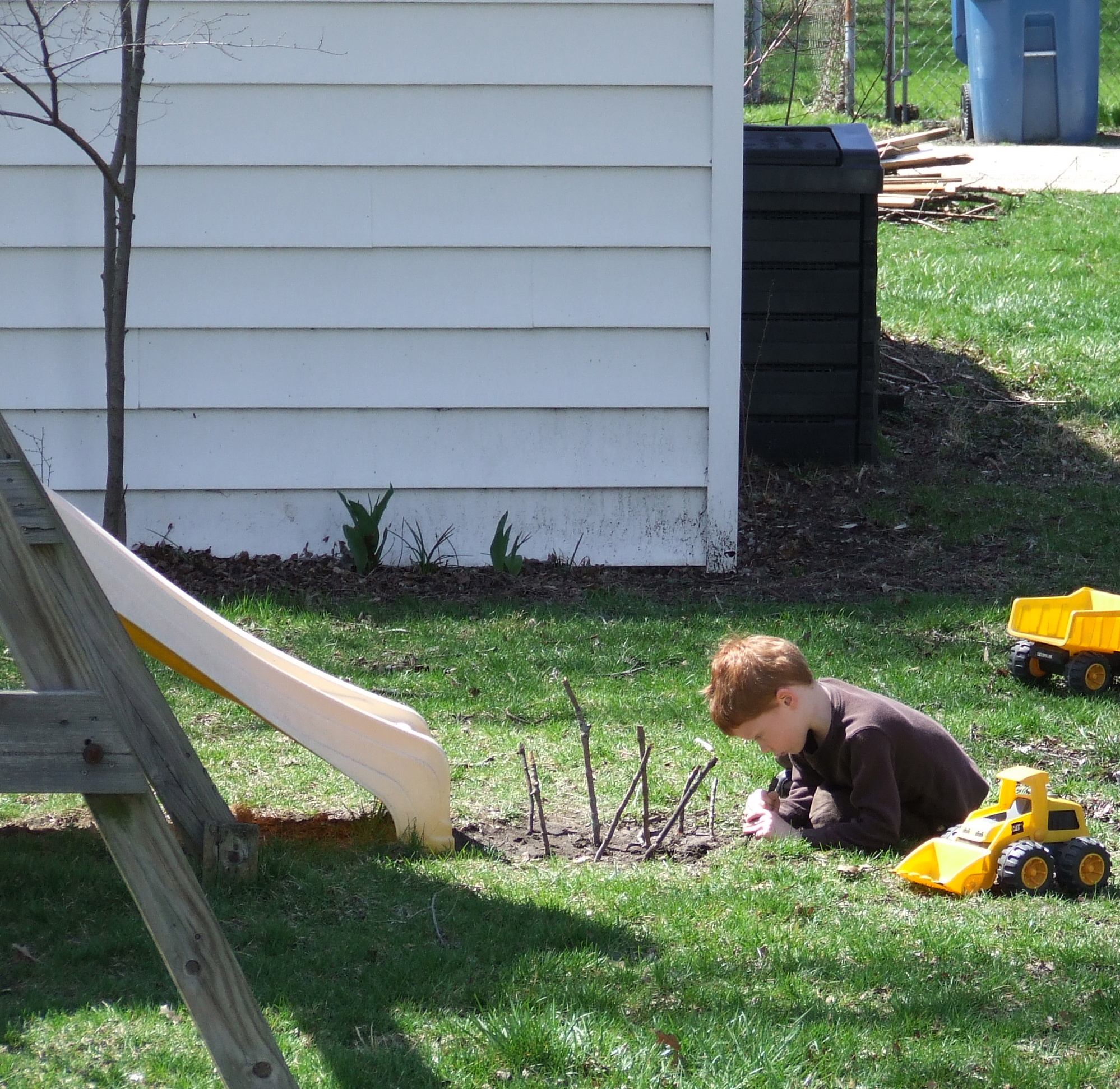
The kids are yelling outside the window. One of the twins, age six, stuck his head in and said this was the first day that felt like summer. They’re in the yard making up superheroes.
“My power, indestructible claws! Strength, two thousand five hundred . . .”
Their sister is yelling something over and over again that sounds like “Hydra.”
“Intelligence, ninety-four.”
Something waiting just beneath the grass and stones to stir.
“Acrobatics, one thousand billion million google . . .”
Their sister echoing, with slight variations. Her voice is harsher, sharper– cutting through the milky afternoon air above the low whine of a mower several lawns away.
Something waiting just beneath the grass and stones to stir. That’s spring, right? That’s the whole point. Lenten is come.
“Did you get hurt, B?”
Footsteps flapping on the pavement, the opening door.
“Can you put this pinecone I found on my shelf for my collection?”
That’s not a pinecone, bud. That’s an old corncob maybe a squirrel was working on.
“My name was Green Laser, because I shot out lasers from my fingers and they were green.”
In and out, in and out. Slamming doors. Flapping of rubber soles on cement. Voices in the backyard.
Questions. Cries. Requests.
The things an afternoon is made of.
Afternoons climbing up on the backs of other afternoons like the minerals left after the drop of water has fallen from the cave ceiling, the stack of years rising upward with a motionless slowness. A growing speleothem of daylights and moments and sharp words and quick smiles and broken glasses.
Something waiting beneath the grass and cement. Something sleeping shallow, something half-listening to the voices above. Something waiting to come back, to spring into wakefulness.
All my life, I realize, will be trying to recapture not the moments themselves but that quality of light and air and shade that hung over the fields and under the trees on the back roads between my hometown and the church campground in thick summer.
Something stirring to life around the corners, curling around the hedges of the fields, curling like fingers of ivy on the sill, like galaxies spiraling down from the edge of the priest’s slowly swung censor.
Something echoed.
Something recalled.

 The Remains of the Day by Kazuo Ishiguro
My rating: 4 of 5 stars
The back of my copy of Ishiguro’s The Remains of the Day uses phrases like “elegant,” “cruel,” and “quietly devastating” to describe this slender volume. This was another book read on the recommendation of my sister, and neither she nor the cover blurbs lied. I found the work to be a nearly flawless study of the life and reflections of a figure that has been often parodied but seldom understood– the English butler, living out a long and possibly futile career of service to a grand manor house in the first half of the twentieth century.
My readings lately have been orbiting around the First World War. I read Logicomix not long ago and was struck by the role that the War played and realized how little I knew of the history of the conflict. Logicomix led me to Wittgenstein’s biography, in which the War was the backdrop to the dissolution of the philosopher’s native culture and empire. Right now I’m about halfway through Keegan’s excellent one-volume treatment of the First World War, and I was not surprised to again find the War haunting the pages of Ishiguro’s work, its repercussions echoing down the halls of the house to which Ishiguro’s protagonist, Mr Stevens, devotes the prime years of his career.
The Remains of the Day is a novel about reflections, reminding me in many ways of Gene Wolfe’s Peace, one of my all-time favorite novels. As far as actual action and plot, not much happens on the surface: a butler, Mr Stevens, who has spend his career as the head butler of Darlington House in the service of Lord Darlington, finds himself in the evening of his life (this is where the title comes from) reflecting on his years of service as he takes a motoring trip across southwest England to renew an old acquaintance. The larger themes come out only slowly, as Stevens’ interior monologue takes him back and forth between reflections on the countryside and villages he is passing through and his own memories of past years at Darlington House.
You learn several things right away. The first is that Stevens defines himself in terms of “dignity”– a quiet, steady service to a worthy lord. We meet Stevens’ father in his recollections and see how this shaped his upbringing, and we get hints of the sort of international policies that were hammered out in unofficial meetings between great personages coming together at Darlington House. This is where the echoes of the Great War make themselves felt: Lord Darlington and his allies feel the terms of the Treaty of Versailles deals too harshly with the German people and want to preserve international peace by mitigating some of the more draconian strictures.
Stevens explains his view of the world at one point: To us the world was a wheel, revolving with these great houses at the hub, their mighty decisions emanating out to all else, rich and poor, who revolved around them.
As the novel progresses, Stevens is forced to acknowledge the ultimate failure– and indeed the sinister advantages made– of Lord Darlington’s naive idealism. What is more difficult though, is his slow realization of the costs his years of service have had on his own life. It is in this slow, subtle realization that Ishiguro’s writing truly excels. Stevens’ self-reflection, his recollected narratives, are couched entirely in painfully reserved– at times almost Asberger-like in its emotional detachment– preoccupations with proper decorum, dignity, and service. His attempts to reflect on his own feelings, such as those associated with his father’s death and his own unrequited love, are painfully stymied and round-about.
In many passages I found myself reminded of nothing more than Data from Star Trek: the Next Generation trying to understand certain difficult human emotions or expression. Stevens admits that a truly great butler– and for all his humility it is clear that he believes himself to be one by dint of doing good work at a great house– wears a persona he must never remove, and even in his own self-reflections, in the monologue within his mind, we see this persona so carefully constructed that he is unable to escape from it, even at the cost of his relationships with others.
This makes Stevens himself an unreliable narrator, something that again reminds me of Wolfe. It’s not that Stevens tells outright lies, but he either cannot reveal or cannot even perceive emotional nuances that would be obvious to anyone else. Because of this we don’t, for instance, ever learn the true extent of Stevens attachment to the acquaintance he is traveling to see or what their past relationship may have entailed– not because Stevens is covering it up, but because to speak of such things would be irrelevant or unseemly. He doesn’t give us his own emotional state; we’re left to learn of how he is feeling at particular times by the interactions he has with others and the questions they ask him. What we have, always, is the consummate butler.
I don’t know what Ishiguro knew of this world, nor do I know how much a story like this was a model for things like Downton Abbey today. But it seems to me he got a lot right about people who give themselves up entirely to a certain cause or perceived ideal and what happens when one is forced to live up to the fact that loyalty may have been misplaced or– even worse– ultimately futile.
If I have a single complaint about this novel, it’s because I’m partial to fantasies in which the house itself is part of the story. The quote by Stevens above puts me in mind of places like the Professor’s house in The Chronicles of Narnia or Evenmere of The High House. In this novel, Darlington House is never anything more than the background. We don’t see much of its character. We don’t really get any sense at all about what it looks like or its moods or atmosphere. Perhaps this is intentional: for Stevens, it is simply a workplace to be managed with a quiet and ceaseless efficiency. It also means that Darlington House has the strength of non-specificity; imagine any large, stately English manor house: that is Darlington House.
Like every story, The Remains of the Day is a love story at its core, but it is a buried love story. It is a love story of carefully spoken courtesies in which the shape of things unsaid only slowly become apparent. It is a romance of averted glances and missed opportunities, all the more tragic because the hero only slowly has any awareness that they have been missed. The ending, for all its soft cruelty, was satisfying, if not unexpected. This is not a book about storms or sudden, swift changes. It is a book about an evening– of an age as well as a life– about the slow fading of light and the reflections that long English evenings in the countryside entail.

 Magical Mushrooms, Mischievous Molds by George W. Hudler
My rating: 1 of 5 stars
This was without a doubt the worst book about mushrooms that I’ve ever read. Now, to be fair, I’m relatively certain it’s only the second book about mushrooms I’ve ever read, but it was still much less than satisfying. Writing a compelling science book, and one about a subject as far-ranging and yet obscure as fungus, has to be difficult. But as fascinating as the subject matter may be (and I’m not speaking ironically when I admit I find this particular topic incredibly interesting), unless the author can make that subject come to life, can show the information instead of simply telling it, the exploration will be tedium.
I am in the intended audience for this book: someone without a background in mycology but who is equal parts fascinated and horrified by the kingdom of organisms known as fungi. They’re such a twilight concept: plant-like, yet not plants, little understood or explored by biology at large, causing disease and rot yet also a pharmacopeia of beneficial medicines and psychotropic drugs. They’re as mysterious to most as their most familiar representation: the mushrooms that spring up on summer lawns almost overnight. And like mushrooms, most of what they are remains hidden beneath the soil.
In this book, the author is particularly interested in showing the relationship between the world of fungus and the human world. He wants to highlight species of fungus that have played a role or continue to play an important or potentially important role in human affairs. This includes disease-causing fungi, historically beneficial fungi (like the yeasts that make our bread rise, ferment our beer, and have, arguably, shaped the entire course of human civilization), fungi that cause disease in our crops and trees, and fungi that decay our homes and buildings.
And as you would expect for someone interested in fungi, there are a lot of truly interesting things in here. We get an introduction to the fungal kingdom in general, how they work and how they do the things they do from the point of view of a mycologist. The author then goes through each of his topics in turn with the rigor of an undergraduate survey course (as, incidentally, the book is based upon). I was especially fascinated at the role fungi plays in the fermentation of bread, beer, and wine (I’m currently cultivating in my “fermentation corner” in our kitchen a sourdough starter as well as a jar of kumbucha, a mildly fermented tea) as well as the ability for many to create the chemicals from which we derive many of our antibiotics that still resist laboratory synthesis.
The author is obviously passionate about his topic and eager to pass this along. If nothing else, he succeeds in illustrating the vast scope of influence that fungi have on human life. For all this intention though– and despite the rich content itself, many parts of which could have entailed entire books to themselves– the reading was a drag. In fact, the various chapters often felt like little more than a series of Wikipedia articles: well-written and informative but missing the elusive spark that turns organized knowledge into something more, that translates information into a cohesive and engaging dialogue with the reader.
The entire work is a series of interesting anecdotes. Take the author’s treatment of psychotropic mushrooms. He analyzes the chemical effects that such mushrooms have on the human brain, surveys how they are used in different cultures, and even goes into the history of the investigators in the West who studied the species and brought them to the attention of society at large. This is a fascinating tale, but it’s simply told as you would tell it in a lecture. It’s missing something. It does not reach out and pull the reader into what should be a compelling story that involves Central American tribes, LSD, and academic scandal.
It may not be fair to criticize a book– and one from what I can tell one that is free of errors and obviously written by an expert in the field– that nonetheless does an important job. It brings to light things that are little understood but that have a huge and often ignored effect on human life and flourishing. Still– as interesting as the content was, there’s no escaping the fact that something was lacking: the book was boring.
There are dozens of things to learn in this book to fascinate and horrify, but they’re all passed over from one to the other like you’re on a tour or– as I’ll say again, as it seems the most apt analogy– like you’re reading a series of Wikipedia articles. Perhaps that illustrates one of the challenges in tackling this field: the desire to provide an adequate survey of a huge topic.
One final example. I’ll never forget the one of the most poignant image I have in my memory related to fungi: the time-lapse photography in Discover Channel’s Planet Earth documentary showing mushrooms growing out the bodies of insects on a jungle floor. It was like something out of science fiction. Whether the insects were already dead or still living when infected, they were being consumed from within by something that seemed terrifying and alien and was going to spread spores so it could keep doing this. In this book you might learn a bit about those fungi, but you won’t get any of that wonder and horror: it will simply be another short stop on a tour.

I still place the blame (or credit) on Gene Wolfe’s fiction for setting me on the literary track that led to the all classical pieces of writing that I should have read in high school, if not before. Until reading Wolfe, it had been possible to enjoy science fiction and fantasy and bluff my way through an understanding of the classical allusions writers made at times. With Wolfe’s writings though, this was no longer possible. I realized I needed at least a rudimentary basis of culture to catch what he was often laying out in his stories– or at least, to try to catch more of it.
So I read, among other things, Dickinson’s translation of the Aeneid. What particularly struck me was the story of Palinurus, the faithful but hapless navigator who was sacrificed at the conclusion of Book V to appease Neptune and allow the surviving Trojans safe passage to Italy. I wrote a story based on this episode, but in the strange evolution of ideas the character of Palinurus was replaced by St. Polycarp.
There are metaphors here, to be sure, and maybe I was even trying to make them: Polycarp at the helm of the early Church, perhaps. His journey toward Rome and martyrdom. Maybe it also had something to do with what other books I was reading at the time and the idea (surely misplaced) that could write about an early church father more easily than an early Latin hero.
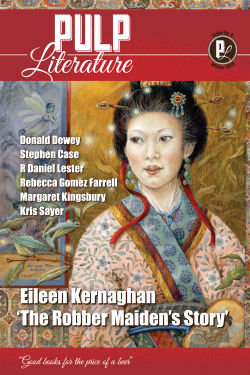
In any case, I wrote a surrealist retelling of this episode from the Aeneid with Polycarp standing in for Palinurus. It was short, haunting, and (I thought) poignant–but it was also rather eclectic. Indeed, it wasn’t until Pulp Literature’s call went out for especially unique stories– I think the editors said something about “those stories that you’ve been hiding under your bed”– that it found a home and has now seen print.
And what lovely print it is. The folks who put together the print magazine Pulp Literature make it look easy and elegant. Their latest issue– Winter 2015— is now out and on sale, and if you pick up your copy, you’ll find my Polycarp bit, complete with illustrations.
Doooooo it. Support writers (like me). But more importantly, support the lovely people who collect stories and publish them with such love and care.
 Stephen Reid Case