Eclipses

Sometimes I’m a lazy stargazer. The first lunar eclipse of the year was April 15th. I wrote a post about it on the Adler Planetarium blog. But when it came to setting the alarm to get up in the middle of the night to view it, I was secretly relieved to go to bed to an overcast sky. William Herschel used to fall asleep reading astronomy books in bed. He, of course, eventually got out under the night sky. I often don’t get beyond the books in bed.

Which is perhaps one reason why the history of astronomy appeals to me. I admit it: sometimes I like reading about the discoveries made by observers throughout history more than I like sitting under a cold observatory dome alone at night. Books don’t cloud over. Manuscript collections usually can only be visited by day. If I fall asleep over my work, there’s no real fear– as there was for the Herschels– of falling off a telescope platform.

I do wish though I had caught the most recent lunar eclipse. They’re slow events, more sublime than spectacular. Not like a solar eclipse (which I have never witnessed, though 2017 is fast approaching).

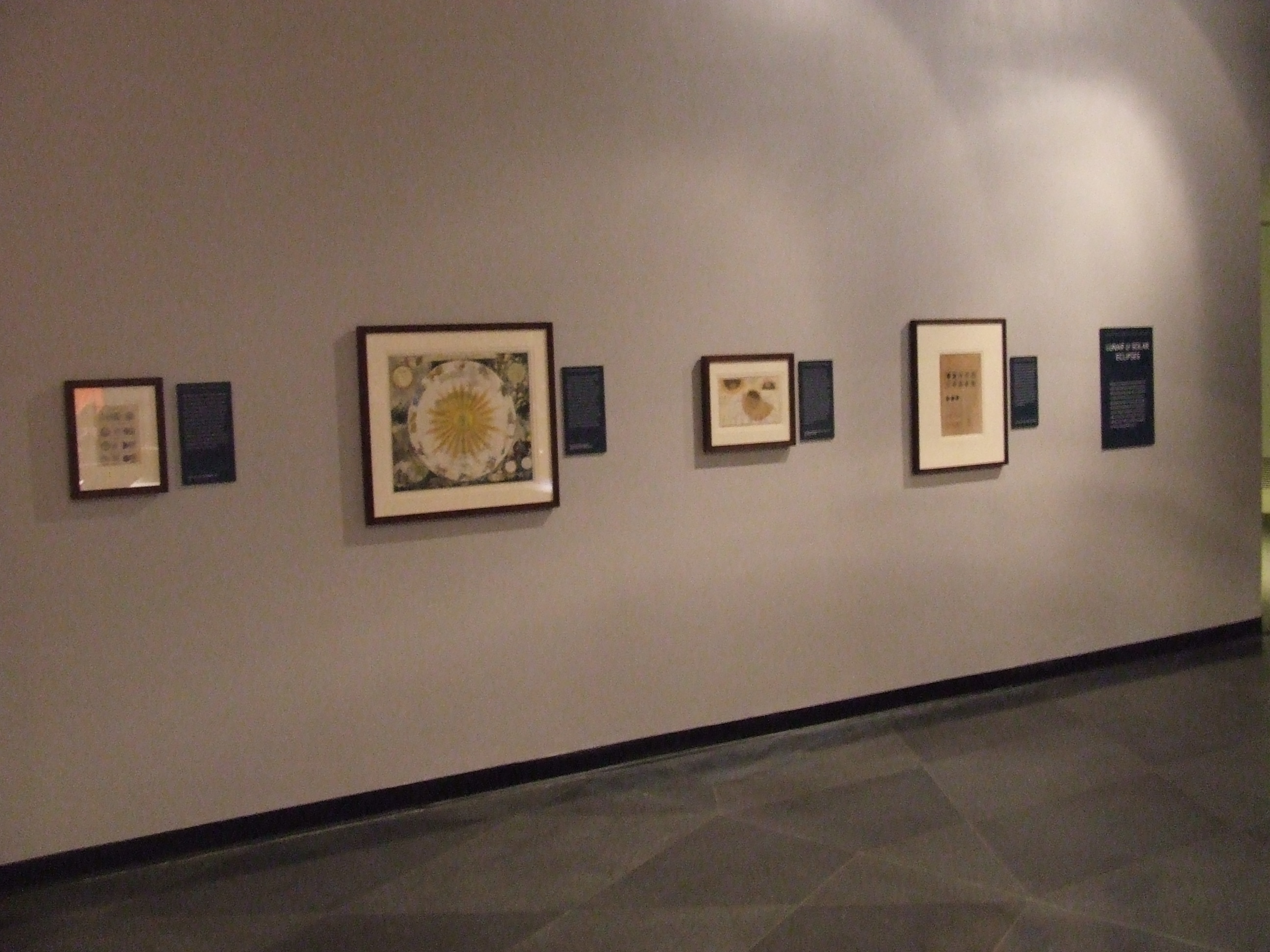
The most recent display I curated at the Adler was of eclipse depictions throughout history. These are all from the works on paper collection at the Adler (maps, diagrams, pictures, things that can be hung on a wall). The images really are quite nice, though the pictures I took don’t do them justice. (The gallery has subdued lighting, and a camera flash would have only created glare.) My favorite is of a broadside poster printed in the 1760s in England providing information on an upcoming solar eclipse. This would have been hung in a public place and is an early form of public science education, explaining what causes the eclipse and what the public could expect to see.

There’s a diagram from a medieval textbook as well, illustrating how the shape of the Earth can be deduced from the shape of the shadow during a lunar eclipse, and a few other images.

If you’re in Chicago, stop by the planetarium and take a look.

DSCF4411

The Stone Oaks

Beneath Ceaseless Skies, The Frost Valley

“The Stone Oaks” was my third publication in Beneath Ceaseless Skies (issue #112, in January of 2013). My wife is a huge Robin McKinley fan, and she (my wife) keeps pushing me to write stronger female characters into my stories (and, truth be told, if fiction is supposed to reflect life, and if my fiction is supposed to reflect my life, then– yes– my stories should be filled with very strong female characters).

So this story has one. I like Claire. I also like trees, nuns, and knights. I put them all together (with one additional element) in “The Stone Oaks.” The trees are exaggerated versions of actual trees that filled a park we used to go to in Mississippi. A friend recently asked me what the trees in this story symbolized. I had to think about that, but if forced I’d probably say something like, “They represent any time we’re given a job we don’t understand but try to do obediently and well. And they represent the unexpected fruit such labors may bring.”

I’m “working on” a follow-up to this piece, but I’m also working on a dissertation, so we’ll see.

You can read about Claire and her trees here.


Manalive

ManaliveManalive by G.K. Chesterton

My rating: 5 of 5 stars

What does optimism look like? What would be the result of a life lived in absolute goodness and innocence? Do you have to be blind and stupid (or intolerably dull) to imagine the world is an unspeakably good place and behave accordingly? This is the paradox of reading Chesterton. These are the questions that Chesterton, in all his blustering bigness, wrestles with in every one of his writings. And we shade our eyes, and we laugh or we sigh, and we ask ourselves: was he serious? And we hope desperately that he was.

I can’t do Chesterton justice. He’s a wonderful, frustrating, bigger-than-life character who himself belongs in a fairy tale (and, fittingly enough, Neil Gaiman puts him there in The Sandman). He has inspired and exasperated generations of Catholic apologists. He was a columnist, a journalist, a writer of pseudo-fantastic tales, a Christian apologist, and author of the greatest long-form modern poem in the English language. He is C.S. Lewis with a bit more swagger. He’s hard to swallow, wonderful to read, and always painfully refreshing.

Chesterton believes that the world is good. Unflinchingly, undeniably good. You can find his apologetics in Orthodoxy, but you can find his philosophy distilled to the best effect in his novel Manalive, one of my all-time favorite books. Manalive—for reasons I still don’t understand—is not as well known as The Man Who Was Thursday or even The Napoleon of Notting Hill. But if you want Chesterton at his brightest, if you want to know what all the fuss is about, start here. It’s not all smooth going, especially if you’re not up to speed on late-Victorian literary forms (because no one outside of Masterpiece Theatre really talks like this, do they?). Much of the story is told through letters and nested flashbacks, and the characters spend most of the duration of the novel in a single room. It’s short though, and it would make a fine play.

I maintain that it’s a great book. I’ve read most (all?) of Chesterton’s novels, and I think this is the best elucidation of what he was trying to convince people of regarding the nature of reality. Perhaps not the most compelling plot, but still fun to read and (once you get used to it) laugh out loud funny.

The plot is fairly straightforward. A group of world-weary adults are living together in a boarding house in London called Beacon Hill. An old acquaintance of one of them shows up and with his madcap antics convinces them that they’re not really living and that they should spend more time climbing trees, playing games, and having picnics on the roof. The boarding house is transformed into a place where anything is possible—where its inhabitants realize that anything always was possible—and, among other things, they pair off and start planning weddings. Innocent Smith, the newcomer, is the model of Chestertonian Christianity: very much alive and very much convinced of the goodness of the world. This is Chesterton at his best: making you stand on your head to see that the world was a magical place all along.

But what’s this? Smith attacks a visitor to the boarding house in the process of planning an elopement with one of the boarders. New information comes to the surface. It turns out Smith has attempted murder before. He’s a criminal. A thief. And, apparently, a polygamist, abducting unfortunate girls all over the country. An inquest is held. The boarders, so recently enchanted by Smith’s antics, decide to investigate the matter themselves, and through a series of eye-witness accounts and flashbacks that form the second half of the novel, each of the charges against Smith—attempted murder, robbery, marital abandonment, and polygamy—are examined in turn. Is Smith a villain, or is he simply the exemplar of true goodness and innocence that seems madness in the eyes of the world?

If you know Chesterton, you know the answer. All of Chesterton’s paradoxes are trotted out and displayed in the life of Innocent Smith. Smith shoots at people, but only because he’s sure he’ll miss and to show them the value of life. He breaks into houses, but only his own, because it’s by climbing through a window or down a chimney that you can see what is yours from a new perspective. He leaves home, but only to find it again for the first time. He courts his wife again and again under different guises, because only marriage is the true, unending romantic adventure. He refuses to settle into a life of dull contentedness; he continually shocks himself into true life, into true awareness and appreciation of his world, his home, and his family, by a sort of constant cartwheeling of innocent amazement.

Does it work, we ask along with the other characters in the novel. Is it possible that being so perfectly good and perfectly innocent will result in such exuberant happiness? Well, Chesterton asks us through the lips of one of his characters, how many of us have ever tried it? Smith in this novel is Chesterton’s challenge to world-weariness and ennui, which were always for him among the greatest sins. But does it work? I can suspend disbelieve in a novel. I can, as through the wide, bright windows of Beacon House, look out for a time on Chesterton’s world of sunlight and dizzying clouds. I can try to believe the world is as good as he says it is.

But I doubt. This is my Chestertonian paradox, and I don’t know enough about Chesterton’s biography to answer it. Manalive was written before the Great War, which killed the optimism of millions of lesser men than he. (For some reason I have it in my head that Chesterton was a war correspondent during the Boer War, but I can’t find a citation that establishes that right now. If so, it would mean he had experienced some fairly gruesome things firsthand.) Did it kill his? Probably not, but what about a kid dying of cancer? What about all the rotten, shitty realities of the world that make Chesterton’s radical optimism seem ludicrously naïve?

I love Chesterton. I think he’s right. I hope he’s right, and maybe that’s what it comes down to: hope and choice, choosing to believe the world is better at the core than we can sometimes perceive or conceive. And if you can take that from a dead, sometime overtly racist, Catholic white guy, read this book.

Our books become the windows through which we see our world. You might find Borges and Wolfe (who modeled my favorite character in literature, Patera Silk, after Chesterton’s famous priest-detective Father Brown) sitting on the sill of Chesterton’s stories. And the view through these windows is indeed bright. That’s certainly worth something, since so many of ours have become broken or are looking out onto grisly, post-apocalyptic scenes. Read Chesterton to try to believe the world is that good, and then go out into it to see for yourself. I can’t promise he’s right, but I hope to God he is.

Rice Boy

354

About a month ago, the website io9 ran a very dangerous story. It was a list along with short descriptions of 17 completed science fiction and fantasy web comics. I spent some time perusing it, knowing that they represented at least 17 potential worlds to fall into but that I couldn’t read them all. Their description of Evan Dahm’s Rice Boy as “fantasy word-building with a heavy dose of the surreal” caught me though, so I gave it a shot. I was not disappointed.

I have a few favorite web comics (Hark a Vagrant and David Troupe’s Buttercup Festival top my list), but reading a full-on graphic novel in a web medium was a new experience for me. I can see the appeal that such a form has for the creator and the freedom it affords. Ideally it allows an artist more creative freedom, without editors or publishers. It also seems a fairly smart business model: build a following by allowing people to read it for free, and then offer hard-copy version for sale. (This is the same model used by online services from WordPress to Spotify: those who pay the premium fees, along with advertisers, subsidize the cost that allows it to be free for everyone else.) As the io9 article indicates, there are a lot of talented individuals out there building graphical worlds along these lines.

Dahm’s Rice Boy is colorful and surreal. It follows the travels of the machine man The One Electronic (T-O-E), an agent of God looking to find the fulfiller of an ancient prophecy, and Rice Boy, a small, meek, polite, uh, thing, who may or may not be said fulfiller. Like any classical fantasy-quest story, there is lots of running around to lots of different ancient and magical realms. Interesting characters are met, words of magic are spoken, enemies gather, and the prophecy is fulfilled, though of course not in the way you expect. If that all sounds like fairly standard fantasy fare, it is. Indeed, the running hither and yon as Rice Boy slowly learns more about the history of Overside (the world in which the tale is set) and his own past gets a bit tedious, especially as Rice Boy himself seems to lack all agency until the very final chapter of the work.

What saves Dahm’s work though, indeed what makes it quite wonderful, is that this fairly standard fantasy trope is told through completely enchanting visuals. Imagine a fantasy epic set in the various vistas of Dr. Seuss’s Oh the Places You’ll Go or Oh the Thinks You Can Think and you have a starting point. Dahm’s world is vibrant, and it’s easy to set aside you frustration as Rice Boy is sent off to meet yet another mysterious figure in yet another distant land, because every place he visits is beautiful and singularly new. Really, Seuss’s worlds are the closest thing I can compare this to, though in Dahm’s work the whimsy of Seuss is supplemented by eerie loneliness and haunting vastness. This isn’t a place to rhyme about whether or not the sneetch has a star on its chest; this is a place to fight the Bleach Beast and venture into the foreboding desert of Skorch.

If the landscapes lack a Seussian whimsy, Dahm finds it again in his characters. Besides the innocence of Rice Boy himself (who reminds me randomly enough of the main character of Troupe’s Buttercup Festival), this land is filled with creatures who both in their friendliness and cuddliness might have tumbled off of an Ugly Dolls display. That’s not to say there are no villains. We have creepy black assassins and a frog army as well as some monsters, but Dahm’s bright colors and clear drawing style seem more suited for squishy friend than scaly foe.

Rice Boy is Dahm’s first complete tale set in his world of Overside, and on his website you can find another complete epic (this one in black and white) as well as his current, uncompleted project. And this is the real danger or gift of online web comics. Once you venture down that rabbit hole and realize how many talented folks there are out there continually creating worlds, where does it end?

It doesn’t, I suppose, and that’s kind of the point.

My photography

If you’ve been following this blog with any regularity, you’ll notice that there’s been a pattern to my posts. Tuesday and Thursdays I try to post a review of a book I’ve read. (I had a good backlog of these on Goodreads to draw from.) On Saturdays I try to post about something I’ve created (usually a published short story). And on Mondays, Wednesdays, and Fridays I post a photograph I’ve taken.

I had a pretty good backlog of these as well, and one of my motivations for this blog was that I simply didn’t know what to do with them. I wanted to share them. This seemed like a pretty low-stress way of doing it. So far I’ve been pleased.

I have very little photographical training (a single audited photojournalism course as an undergraduate). But I like to think I have an eye for detail. And I think I know where that came from.

Rails II copy

When I was young I used to pour over the photograph albums my parents kept in their bookcases. It was always surreal to see images of my parents and their friends as much younger people, but what held my attention– what captured my eye– were the photographs my father had made. A railway yard. A long row of straw bales in a meadow. A certain dead tree in different seasons against different skies. I grew up with a father who always had a camera strap across his shoulders. Wherever we went, it was normal to see him stop, lean up against a wall or hunker down on his heels, and take a shot at something. And it wasn’t the desire to document every single experience that has become so prevalent with our ubiquitous camera phones. It was simply seeing something from a different perspective.

scan0022_1 copy

When I started traveling, I found myself doing the same things in the cities I saw. What attracted me most though were the colors and textures of urban entropy. The tangle of electrical wires. The forgotten, peeling mural. Weathered wood. The things you walk by a hundred times and never really look at. (One day I’ll write a post about stencil graffiti, my favorite urban ghost.) I haven’t figured out how to capture large natural vistas, and I don’t like taking pictures of people. (I was scared to death in my photojournalism class that I’d have to take pictures of strangers.) But I think the camera is well suited for calling out the lovely, busy, complex details of the streets and alleys of a city, and so I go look for them.

This blog has been good motivation to continue. Now when I travel I try to give myself at least one morning wherever it is I’m going to get out and shoot. I try to leave early, just after sunrise, both for the quality of light and to avoid awkward questions.

“Why are you taking a picture of that fire escape?”

“Um. Color and texture?”

“It’s ugly and rusty. Go away.”

I always go by bike or by foot, because if you’re looking for details, there’s no way you’re going to catch them in a car. Plus, this is the way to really learn a city (or at least patches of cities).

I shoot with a Fujifilm FinePix S 5200 that my father got for me. I always use natural light, and I don’t do any more adjusting than can be done easily in iPhoto. I delete a lot. Then I post the ones I like.

Things change. Cities, streets, and buildings are born and die like people, only slower. Brick and mortar ephemera. There was a building across campus for a few months on which someone had spray-painted in huge letters YOU ARE BEAUTIFUL. I kept forgetting to bring my camera, and then it was gone.

scan0035_2 copy

Capturing things that will disappear. My dad taught me that too. All these images are his, but this last one is especially significant. That structure is the tower in the train yard in Flint, Michigan, where my grandfather spent most of his career as a yard master. It’s gone now. But one morning the light was perfect, and Dad took the shot.

More Than Meets the Eye: Volume 5

Transformers: More Than Meets The Eye Volume 5 (Transformers (Numbered))Transformers: More Than Meets The Eye Volume 5

My rating: 5 of 5 stars

How do you take an 80s toy franchise and make legitimate science fiction storytelling out of it? I’ll give you a hint: it has nothing to do with Michael Bay.

The Transformers are an interesting phenomenon. On the one hand, they represent the point in time when the boundary between making cartoons and selling toys finally broke down completely, and they were the opening salvo in what for many of us was a childhood filled with half-hour toy advertisements thinly disguised as entertainment. On the other hand, in the hands of the right writers they had the makings of truly epic science fiction: sentient robots who had been fighting a war for six million years and whose very bodies were shaped into vehicles and weapons. (The original animated movie was somewhere in the middle: a feature length toy advertisement with a plot only a seven-year-old could–and did–love, it was for many of us the first introduction to gorgeous Japanese animation and its potential for bringing giant robots to life.)

Perhaps unsurprisingly then, it is in the comic book medium– which seems especially suited for walking the line between outright commercialization and original storytelling– that the Transformers as credible science fiction have best found their niche. This happened originally in the final arch of the original Marvel run back in the 90s, written by Simon Furman and pencilled by Andy Wildman. Furman and Wildman together created an interpretation of the Autobots and Decepticons in which the corrosion of millennia of war was evident, and they gave an additional space operatic depth by a mythological explanation of the Transformers’ origins and position as guardians against the embodiment of Chaos. It worked (for too short a time), and I’ve dutifully passed on the Titan Book reprints of these runs on to my own kids.

Since then I’ve obligingly checked out the various reincarnations of the franchise, most often with the waste of time and money. (Come on, they’re giant transforming robots? How much depth do you really expect?) When I learned that IDW had split their Transformers run into two separate ongoing series a couple years ago, I figured the first collected volume of each might make appropriate Christmas gifts for my twin sons. I’d have to read them first, of course, so I flipped a coin and ordered volume one of More Than Meets the Eye. I quickly realized that a) this wasn’t a series for kids (or at least not for kids as young as my kids are), and b) this was what I had been waiting for since Furman and Wildman.

I’ve waxed eloquent on the merit of this series in my reviews of the previous four volumes, so I’ll try to keep my comments here constrained to the fifth and latest installment. All along, Roberts has been laying track to some epic conclusions but more importantly taking the time to build characters and backstory along the way. Milne’s artwork and eye for detail takes it up another notch. (Have you ever considered how difficult it must be to convey emotions on a robotic visage lacking nose, mouth, and other characteristic facial features?) My major (and really only) complaint with the series so far was the fact that Milne left the helm for the artwork of a few issues in volume four. It’s not that I don’t mind a different artist, but some of those who were drawing for issues in that volume simply weren’t up to the task of communicating the scenes and moods Roberts was creating.

I’ve tried to express the shear delight of this series before: imagine all your childhood friends getting together on a spaceship and going off to have adventures. In some sense, that’s all there is to it. On another level though, Roberts is writing science fiction in the best tradition, and doing it well. Remember, these are nearly-immortal robots who have known nothing but millennia of warfare. Exploring issues like what peace means to lifeforms whose very bodies are weapons, answering questions about mortality and origins, looking at what relationships might develop among a species that lacks gender– and doing it all with pathos and humor. This is what you can expect with this series.

Volume five in no way disappoints and even more encouragingly avoids two of the greatest dangers that often begin to afflict a series once it’s been going on for a while. The first danger with any continuing series is that subsequent issues will simply continue to string the reader along by adding mystery to mystery and refusing to provide any real resolutions. (Think the first few volumes of The Unwritten, or, from what I understand, the entire series of Lost.) Enough of this and you start to suspect that maybe the writer isn’t actually planning on resolving anything or maybe doesn’t have a plan at all. Maybe (horror!) they’re more interested in you purchasing the next issue than telling a great story. I started to get that dreaded feeling with the end of volume four, especially related to the fate of Ultra Magnus. An additional twist? And there was still so much that hadn’t yet been explained!

But in volume five there are answers, and we go places. The quest takes a major step forward. The fate of Ultra Magnus is explained, but more importantly the mystery of Skids’ immediate past, which had been lingering since the first volume, is resolved. New characters are introduced and some old ones are dispatched. The volume consists of a five-issue story arch in which our heroes discover a lost moon of Cybertron and defeat a character we’ve only heard alluded to in the past plus an additional one-shot character piece that gives nice breathing space before the series goes off to play in a big IDW crossover for a while. The writing and the art is as solid as I’ve come to expect.

The second danger of a continuing series is that certain (i.e. main) characters become more or less untouchable by default, so there’s eventually a lack of tension. You know the main characters are going to make it, no matter how grim things look. The redshirts are not. The best writers of course push this convention as far as the franchise (and it is, after all, a franchise) will allow, at times even turning it on its head. They make you care about redshirts, and then kill them (which happens in this volume). Or they “kill” a main character, but in a way you don’t expect (which is what happens to Ultra Magnus but doesn’t feel like a throwaway because it fundamentally alters the way you think about the character).

There’s a lot to love here (especially if you love giant transforming robots), but one of my favorite things about this series is the depth it brings to the character of Rodimus. I was never an Optimus Prime kid. Prime always seemed to me rather flat and over-idealized as a character. There’s not a lot to him besides 100% leadership and responsibility and seriousness all the time. Rodimus was different. If Optimus Prime was your dad, Rodimus was your cool older brother. He was the guy who stumbled into greatness and was never comfortable with the responsibility but craved the fame and glory. Roberts does great things with his character in this volume, balancing his headstrong immaturity with his responsibility to his crew. And all the while you know– or you know if your Tranformers mythos was highly influenced by the animated movie– that something is building. Rodimus is going to be central to something big, more than simply playing at being Captain Awesome (which he does quite well).

I’ve heard a rumor that this volume wraps up the first “season” of More than Meets the Eye and that Roberts has at total of five plotted out. I hope this is true, and I hope indeed that IDW knows what they have going on here and allow Roberts and Milne to keep up the good work. Because, come on? Making art and literature out of giant transforming space robots? That were originally toys cobbled together from two disparate Japanese toy lines and given a thin veneer of backstory to help them sell better? We need more of that kind of crazy.