Tag Archives: fiction

My Bicycle, 4500 A.D.

Print

A couple summers ago my bicycle was stolen. It was my own fault. I left it unlocked outside my office. I had owned that bike since before I had a car, and I mourned its passing with this story, which involves time-travel and (a first for me) zombies. It appeared (with the lovely illustration above) in the Spring 2012 of AE: The Canadian Science Fiction Review.

You can read about my bicycle here.

The Place of the Lion

The Place of the LionThe Place of the Lion by Charles Williams

My rating: 3 of 5 stars

Williams is an author in whose work the plot itself (at times obscure and even tedious) is second to the style in which it is written, which is in turn second to the ideas he wants to communicate. It’s the ideas that are rich. This is appropriate for a book about Platonic ideals breaking into the physical world. I read Williams for the first time years ago, after a return from Oxford and the realization that there was an Inkling of whom I had never heard. If you’ve read Lewis’s THAT HIDEOUS STRENGTH, you’ve some idea of what to expect. Philosophical fantasy in 1930s England. Returning to Williams now, after having some proper grounding in philosophical studies, I’m enjoying him much more. He is admittedly more dense and verbose than a Lewis or Tolkien. I still found myself rolling my eyes a bit as the novel reached its conclusion. But throughout there is also that bright strangeness one finds in the other Inklings, Gene Wolfe, sometimes in Borges, more boisterously in Chesterton, and more hilariously in Lafferty– the idea that the world is a terrifyingly good place. That is a world these writers live in, and they believe it to be the true world. I’d like to believe it too– or at least, act and write as though it were.

Read this quickly, for you will only have a moment . . .

Beneath Ceaseless Skies, Marching Off

I’m left-handed. My father was left-handed. I have four kids (two of whom are twins), and none of them are left-handed.

I’m a little disappointed.

Being left-handed, I am also slightly ambidextrous almost by default. I have on occasion kept myself occupied during particularly long presentations or lectures by attempting to take notes in my right hand. This often devolves into mirror-writing, where I write a word backward with my right hand while writing it forward with my left.

Then sometimes I just get distracted by how words look backward. There’s something fascinating about seeing a familiar word reversed.

This is what was happening when the germ for this story, “Read this quickly, for you will only have a moment . . .,” was planted. It was my second sale to Beneath Ceaseless Skies, back in November of 2011, and the first (and so far only) of my stories that has been made into a podcast.

It’s about words and names. It’s also about a woman who can kill with them, a castle drenched in rain and silence, crows, and a love letter.

You can read it (quickly) here.

Life of Pi

Life of PiLife of Pi by Yann Martel

My rating: 3 of 5 stars

Sometimes I think a good author simply comes up with an incredible situation and then writes to see how the characters respond to it, what they do, how they eventually get out of it. In this case the situation is a lifeboat in the middle of the Pacific with a tiger aboard. Pi is the only human survivor of a sunken ship, which was carrying his family and a small menagerie to a new life in Canada. After the accident he finds himself on the ship with the tiger, a hyena, a zebra, and an orangutan– and very soon with only a tiger.

So much you can learn from the back cover. What the back cover (at least the back cover of my edition) doesn’t mention is the twist at the end that casts the entire story into a new, more sinister light. It’s a twist worthy of a Gene Wolfe novel, the hook that makes you flip back through the pages, wondering how much of what you read you really understood, whether you are even now interpreting the signs correctly. Without that twist, it would have been an interesting and compelling novel. It would have been beautiful even. But it would not have been haunting. You would not wake up in the middle of the night thinking about the novel, uneasily considering the stories Pi told.

The novel is broken up into three main sections. The first talks about Pi’s life growing up in India. This portion of the story is told as though the author is interviewing Pi years after his ordeal, though at this point we’re still not sure what that ordeal is. Only that it is a story that will “make us believe in God.” Pi certainly believes in God. His enthusiasm for God leads him to actively pursue and practice three faiths, that of Christianity, Islam, and his native Hinduism, much to his parents’ perplexity. We also learn a lot about zoo-keeping here, as this is where Pi grows up, the son of a zookeeper in Pondicherry. Martel gives us lots to think about regarding our relationship with animals and the subtle, complex, and nuanced universe that is a zoo.

The second and longer portion of the work is Pi’s story about what happened in the lifeboat, how him and the tiger (named Richard Parker) survived their several-month ordeal. We already know the story is going to have a happy ending. (Remember, Martel is telling this as though getting it all from Pi himself, now married and with children and living in Toronto.) Our universe telescope’s down to Pi’s lifeboat, the day-to-day details of surviving at sea and living in close proximity to a Bengal tiger who is always hungry. This is where all the background regarding animals and zoo-keeping comes in handy. The book fits together well in that respect.

It doesn’t fit together as well regarding all the background we got about Pi’s religious faith in the first section of the story. The zoo-keeping stuff blended with survival at sea with the tiger. I kept waiting for Pi’s faith to likewise come into play in some deep existential way during his time on the ocean, but it never happened. Pi was simply there, with God, surviving. No epiphanies or visitations. No deep meaning welling up from his ecumenical perspectives on Vishnu, Jesus, and Muhammed. That’s fine, I just felt the first portion of the book was setting us up for something along those lines.

The third and by far shortest portion of the book was Pi’s interview with two Japanese officials who came to find out what he could tell them regarding the shipping accident. This is where the book twisted, where it showed a hidden depth I had not expected. Up until this point it was an enjoyable, imaginative novel with great description, a clever situation, and splashes of lovely surreality (because the Pacific, after all, is a huge and fairly unknown place to be drifting across). But the details of the story Pi tells are too fantastic, too unbelievable to these polite Japanese officials. Pi says some things about faith, about what we chose to believe.

And then he tells another story.

Perhaps this is the point of the book, the crux of the story that “will make us believe in God.” Because– and I don’t want to give too much away here– there are multiple ways to understand what actually happened to Pi while he was at sea. Pi asks the Japanese officials which story they think is better, which one they choose to believe. Pi knows what happened though, while his hearers have to make a decision. I’m not sure the analogy is perfect here, but in some sense this is us with life. We know what happened. We see (at least pieces of) the complex system of cause and effect we’re snarled within. Crazy, random, maddening, and sickening things happen. But we have to decide what story to believe– a story of chaos and meaninglessness or a story of significance.

This is a story that will make you believe in God, he said. I’m not sure it did. Maybe Martel is just telling us an excellent story about a boy and a tiger (and an ocean and a cannibalistic castaway and a carnivorous island and a tiny zoo in India). But maybe he’s also telling us a story about how life works and how we choose which stories to believe.


Barstone

Shimmer13Cover_small

“Barstone” was my first publication in an honest-to-goodness real print magazine, back in April 2011. The kind with actual physical paper that you can pick up and thumb through and then put on a shelf. And not a crappy cheapsie magazine either that looks like it was run off on a Xerox and stapled together in someone’s basement. No, a real high-quality perfect-bound magazine with a glossy cover and sharp, crisp pages.

At the time of publication Shimmer was a semi-pro magazine, but they’ve since begun paying professional rates. They’re a great market for urban fantasy or surrealist pieces with a melancholy tone and a literary flavor. Which is why “Barstone” fit nicely. It’s a surrealist piece about a giant or a hill or a giant who became a hill or something. A love story about conservation of momentum, loosely based on an actual three-legged dog and a park in Mississippi. The word “Barstone” popped into my head one night as I was falling asleep, and then I tried to build a story around him.

Unfortunately, this is the first story of mine that’s also behind a paywall. I guess it’s not perfectly inexpensive to publish nice, glossy magazines of good stories and pay authors for contributing. If you want to read “Barstone” (and some other fine stories) you can come over to my house and borrow my contributor’s copy. Or you can purchase Issue 13 of Shimmer here. You’ll be supporting good art, good people, and a good publication.

What I Wrote for Andronicus

eeaa06b4bca210b2c8235d754b2c8023

This may be my favorite story I’ve written so far. Much of my work is a love song to trees, and that’s evident in this piece. It’s about the afterlife too, a concept I like to play with in fiction. (I also like it because I was able to work in one of my favorite Chesterton quotes.)

If you only ever read one of my pieces, I think I would want it to be this one.

“What I Wrote for Andronicus” appeared in Ideomancer back in 2010. Ideomancer is a sharp, shiny online magazine that pays semipro rates, which according to Duotrope means between 1  and 4.9 cents per word. (Ideomancer currently pays 3 cents per word with a maximum payment of $40 per story.)

You can read “What I Wrote for Andronicus” here.

The Silver Khan

Beneath Ceaseless Skies, RuinsBeneath Ceaseless Skies is an elegant online magazine with gorgeous covers, award-winning stories, and a growing following. It publishes “literary adventure fantasy,” with an emphasis on “literary” in the best sense, and pays contributors professional rates. (In the speculative fiction world that means at least five cents per word.)

“The Silver Khan” was my first professional sale, and it appeared in Issue 29, back in November 2009. Like “The Glorious Revolution,” the story treats a revolution of sorts, though a much more abrupt and haphazard revolution. In a caliphate by the sea, a foreign visitor tries to uncover the secret of the Silver Khan’s floating palace (hint: it’s not magic) and decipher the meaning of the frozen statues scattered about its gardens.

Like much of my writing, this story was driven primarily by setting. I had an image of the palace and the gardens, and I wrote this story to explore them. The physical mechanics of the Khan’s palace was almost as much of a surprise to me as it was to the narrator when he suddenly pieced it together. Once I realized how it flew, I knew how it would fall. The epistolatory style I probably borrowed from Gene Wolfe, though to nothing like his effect.

You can read “The Silver Khan” here.

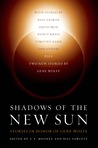
Shadows of the New Sun

Shadows of the New Sun: Stories in Honor of Gene WolfeShadows of the New Sun: Stories in Honor of Gene Wolfe by Bill Fawcett

My rating: 2 of 5 stars

If you love Gene Wolfe, read this book. If you don’t know who Gene Wolfe is, or if you haven’t yet gotten around to reading his stuff, don’t read this book. Read his stuff. Because, consider: for what other contemporary science fiction and fantasy author could you publish an anthology with original contributions by such well-known and respected names all somehow influenced by and tributing him? Even if you don’t believe all your nerdy and literary friends about how great Gene Wolfe is, you should believe Gaiman and Brin and Haldeman and Zahn.

That said, I only gave the anthology two stars. As much as I wanted to like every story in here, I was less than impressed by many of them. It’s probably not fair to compare them to Wolfe’s own stories (the anthology is Shadows of the New Sun, after all), but I couldn’t help it. A story written about Severian by someone other than Wolfe? Someone else trying to play with myth and allegory in a Latro tale? A view of Ushas through non-Wolfean eyes? They felt flat to me. Even Gaiman’s contribution was a bit of a disappointment. I would also have enjoyed hearing more about Wolfe’s life and influence; the introductory paragraphs before each story weren’t enough, especially when each story was followed by author bios two or three times as long.

There were bright spots. I especially enjoyed the contributions by Brin, Allston, Swanwick, and Zahn. Maybe because they were original pieces, and to me that seems the best tribute to Wolfe: be original. Do fine writing, but be original. Not that the others were totally derivative, they just weren’t Wolfe enough to play in Wolfe’s worlds or to play the kind of literary games that Wolfe does so well. Or I’m just picky when it comes to my favorite writer. If anything, this anthology (in particular Swanwick’s story) did inspire me to re-read The Fifth Head of Cerberus, and that may be the best gift of all.

View all my reviews

The Glorious Revolution

RayGun cover

This was the first short story I published, back in 2008 (though going by actual word count, I suppose it’s technically a novelette). It appeared in the now-defunct Ray Gun Revival, and I was paid $10 for it. An author whom I highly esteem told me that I should have held on to it and tried to sell it to a professional market, but at the time I think the boost of confidence I received seeing it actually in print was much more valuable than the money. (He may have been right though. Ray Gun Revival was the first market I sent it to, so I never had a chance for feedback from places like Asimov’s, Lightspeed, or Clarkesworld.)

From the editor’s description in the introduction to the issue in which it appeared, “The Glorious Revolution” almost didn’t make it: “The Slushmasters were divided on this story. It has a strange cadence, a unique voice, a construction that almost struck me as epistolary, a dialogue in written letters. Some will hate it. Some will love it. I thought it was worth the risk.” Ambiguous praise, at best, though much of Revival‘s remit seemed more geared toward the pulpy blasters-and-spaceships variety of fiction.

One reader had these thoughts: “It was really a beautiful story, dream-like and creative. Left me rather in awe! The author’s ability to describe wonder, and majesty, and evoke the indescribable — excellent. I think I will remember this story for awhile. It reached inside me and rattled around and really made me feel what was happening in the story.”

“The Glorious Revolution” is what I would call a science fantasy. It’s about a rebellion that turns out to be much larger than it seems. It plays with ideas of social mathematics akin to Asimov’s psychohistory, hierarchies of scale, the ideal of monarchy, and (of course) falling in love with a princess. Call it sentiment for that first publication, but I’m still rather fond of this one.

You can read “The Glorious Revolution” here. (It’s on pages 22 through 34).